You're in the gear aisle — or scrolling product pages at midnight — staring at a $75 fishing shirt next to the $40 athletic tee already in your closet. Both claim moisture-wicking fabric. Both promise breathability. And both look almost identical.
So what are you actually paying for?
I've chased redfish on the flats, thrown poppers from a kayak, and ground through tournament days under a brutal Gulf Coast sun. The difference isn't always obvious. But when it counts, it counts big.
This breakdown gives you a clear 8-dimension side-by-side comparison.The same comparison framework is also valuable for brands developing custom fishing shirts, helping them choose the right fabric and functional features before production begins. It also uncovers the fishing-specific design details most anglers miss — until they're standing in the sun wishing they hadn't. By the end, you'll have a dead-simple framework to answer one question: is a dedicated fishing shirt worth the money, or is your performance shirt already pulling its weight?
Core Functional Breakdown: 8-Dimension Side-by-Side Comparison
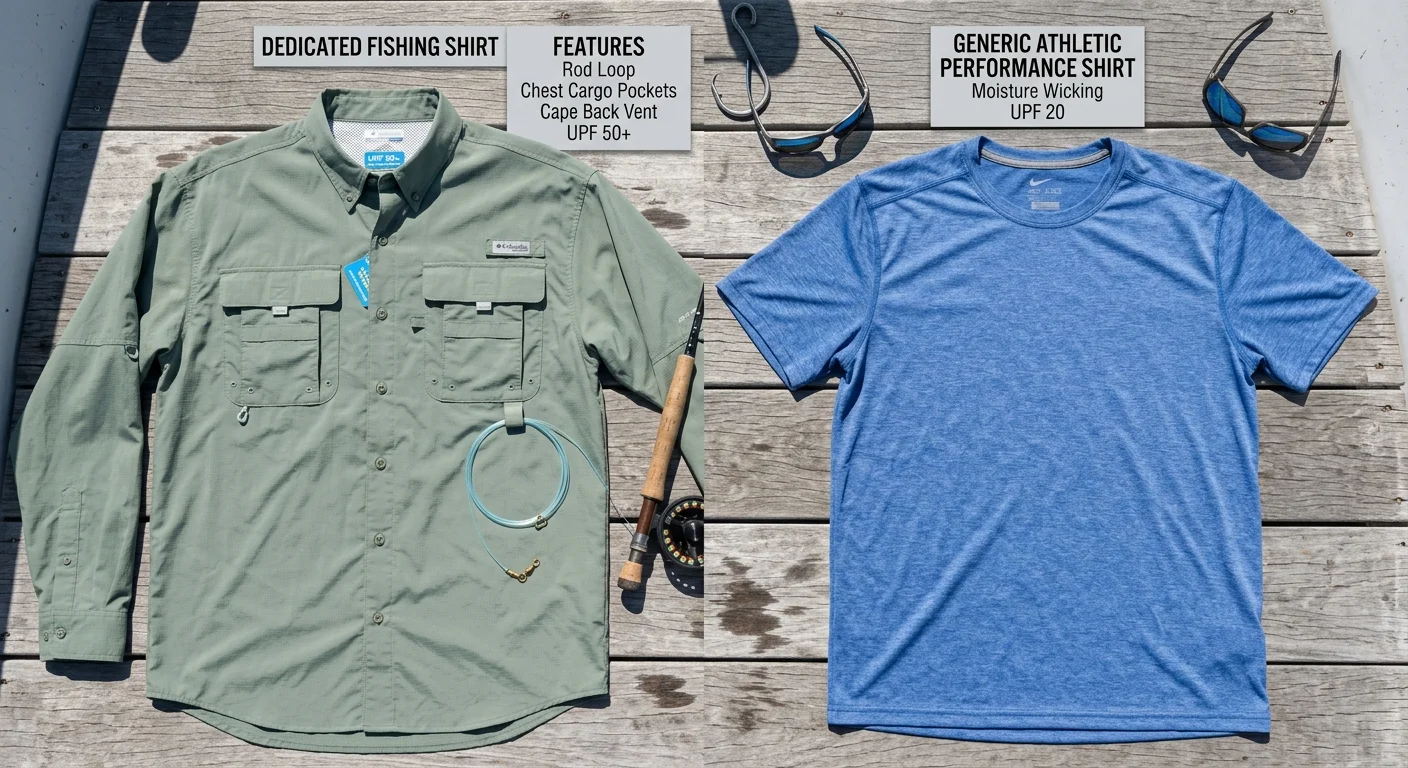
Eight dimensions. That's all it takes to separate a shirt built for the water from one built for the weight room.
The table below maps the real differences — not the marketing copy, but the actual engineering choices. These choices determine whether your shirt still performs at hour ten on a sun-blasted flat, or starts failing you in ways you won't catch until it's too late.
Dimension | Performance Shirt (Athletic) | Dedicated Fishing Shirt | What It Means on the Water |
|---|---|---|---|
UPF Certification | UPF 15–30 equivalent; often unstated, relying on fabric density and dark color rather than lab testing | UPF 30–50+; leading brands (Columbia PFG, Huk, Simms, Patagonia) tested to UPF 50 via AS/NZS 4399 | Certified UPF 50 blocks ≥98% of UV . An uncertified athletic top may let through 3–5× more radiation over a full day |
Fabric Composition | 85–95% polyester/nylon + 5–15% elastane; optimized for stretch and softness | 90–100% polyester microfibre, plain weave; minimal elastane for salt, DEET, and sunscreen resistance | Spandex breaks down fast in harsh conditions — bagging cuffs, collapsed collars. Fishing weaves hold structure through a full season |
Moisture Management | Branded wicking finish (Dri-FIT, Climalite); effective in gym settings, but saturates under PFDs and pack straps | Hydrophobic microdenier filaments, 90–140 g/m² areal weight; quick-dry in under 30 minutes from soaked state in direct sun | Between boat runs, fishing shirts shed water and stay light. Athletic tops cling to your lower back, causing chafing against wading belts and boat seats |
Ventilation Engineering | Mesh underarm panels or perforated zones — functional in the gym, but not designed around casting posture | Cape back vents, laser-cut armpit eyelets, double-layer back panels that bellows when running at speed | Each casting stroke pumps air up through front hem vents, across the spine, and out the cape vent — pushing out heat and humidity, not just wicking it |
Pattern Cut / Silhouette | Trim, body-skimming; short rear hem; standard T-shoulder; built for a treadmill, not a casting deck | Extended rear hem (+3–5 cm), articulated shoulders, action back pleats, relaxed torso for casting reach | Lean over a gunwale or double-haul from a poling platform — a gym shirt binds at the shoulder and exposes your lower back. A fishing shirt stays put |
Utility & Storage | One small zip pocket, maximum. No fishing-specific features | 1–4 bellows chest pockets, rod loop and tab , tool docks, interior sunglass wipe, tippet spool slots | The rod loop alone earns its keep. Pin your rod under your chest while re-tying a knot — both hands free, no rod on the deck getting stepped on |
Hardware Durability | Lightweight plastic zips, standard thread, knit cuffs; not rated for salt exposure | Corrosion-resistant snaps and zips , bartacked stress points at pocket corners, rod loop, and hem vents; rubberized buttons to protect boat gelcoat | After a season in brackish or offshore water, athletic hardware corrodes and seams pucker. Fishing shirt hardware closes clean, seams hold, logos stay intact |
Price Range (USD) | Mass-market: $20–$40 / Branded technical: $40–$70 | Entry-level: $25–$45 / Branded UPF 50: $50–$100 / Premium guide-grade: $90–$140 | The $30 gap between a gym shirt and an entry fishing shirt buys you certified sun protection, functional pockets, and salt-tolerant construction |
The Three Details Most Anglers Don't Notice Until They're Already On the Water
Plenty of fishing shirts look like glorified athletic tops at a glance. They're not. Here are three engineering differences that almost never make the product listing headline — but show up loud and clear over a twelve-hour trip.An experienced fishing apparel supplier will usually prioritize these functional details long before cosmetic design elements, because they're what truly affect on-water performance.
1. Fabric Memory Without Elastane
Athletic performance fabric leans on spandex for stretch and recovery. That works well in a climate-controlled gym. On the water, it's a liability. Salt, DEET-based insect repellents, chemical sunscreens, and chlorinated livewell water all attack elastane at the molecular level. After a summer of weekend salt trips, the cuffs go baggy, the collar droops, and the sleeves stop staying down.
Purpose-built polyester fishing shirts get their flexibility through mechanical means — generous pattern ease, articulated shoulder seams, and action back pleats. Zero elastane means zero breakdown. A quality fishing shirt bought in May should still look sharp and perform just as well come October.
2. Humidity Channeling, Not Just Wicking
Standard moisture-wicking fishing apparel moves sweat from skin to outer surface. That's stage one. Premium breathable outdoor shirts built for fishing go further with a three-part ventilation system: - Cape back vents at mid-scapula - Mesh inner panels that float off the spine - Underarm eyelets or side-seam perforations
The physics during a long casting session are straightforward. Each forward haul rotates your torso and acts like a bellows. Air enters through the lower front hem, travels up the shirt's interior, and exits through the cape vent — carrying evaporative moisture with it. The result isn't just a drier shirt. You get a drier lower back and fewer pressure sores under a PFD or wading harness by mid-afternoon.
3. Bartacks and Stress Architecture
This is the detail that separates a genuine fishing shirt from an athletic top with a chest pocket sewn on. Look at the corners of those pockets. Check the rod loop attachment point. Examine the side hem vents.
On a real fishing shirt, every high-stress junction gets a bartack — a dense cluster of reinforcing stitches. The rod loop anchors to the chest panel, not just the placket. Pocket corners get double-sewn. Side hem vents are reinforced at the point where they end. This matters because anglers clip hemostats, nippers, and forceps to their shirts — often under tension, over and over. Skip the bartacks for one season and those attachment points start giving out. First slowly. Then all at once, at the worst possible moment.
How Budget Maps to Function
The fishing shirts price spread across both categories tells its own story.
A $25–$35 athletic long-sleeve covers the basics for short freshwater sessions. You get limited UPF, no fishing-specific pockets, and elastane-based stretch that won't survive repeated salt exposure. Fine for a half-day on a bass pond. Not built for anything longer or harsher.
An entry fishing shirt at $30–$50 is often where the real value lives. You get UPF 30–50 certification, basic cape vents, and at least one functional chest pocket. The cut typically runs through a looser silhouette rather than advanced articulation. Even so, the jump in sun protection and storage alone over a gym top is solid for most freshwater anglers.
The $60–$120 certified UPF 50 sun protection shirt is where guide-grade construction begins. You get lab-tested UV blocking, salt-tolerant hardware, articulated casting geometry, and vent engineering built for standing on a bow or helm all day. You're not paying for the brand patch. You're paying for verified UV blocking on pale or sun-sensitive skin — and for a shirt that performs the same on day one as it does at the end of a hard season.
Exclusive Angler Design Details Generic Performance Shirts Don't Have
Four features separate a real fishing shirt from a gym top with a fish logo on the chest. Most anglers don't notice them until they're twelve hours into a trip and something goes wrong. Here's what to look for before you're standing on the bow wishing you had.
Rod Loops: The Feature You Didn't Know You Needed
Re-tying a knot in a 15-knot wind will teach you fast why rod loops exist.
A purpose-built fishing shirt stitches a bar-tacked loop into the front chest panel — not the placket, the panel. You park your rod against your torso and free both hands for the task. The rod stays vertical, off the deck, and out of the way. Your hands stay free to thread fluorocarbon through a hook eye without gripping graphite the whole time.
Generic athletic performance shirts don't have this. They're built around empty hands. A gym shirt assumes you set your equipment down between sets. On a casting deck, that's not always an option.
Construction matters too.For OEM fishing shirts, reinforced bartack construction and durable stitching specifications are often customized to meet different brand quality standards.
A rod loop sewn to the pocket seam and bartacked at both ends handles the repeated stress of parking a 7-weight or a medium-heavy spinning rod through a full day. A loop stitched to the pocket flap alone? It starts pulling free by mid-season.
Chest D-Rings and Tool Docks: Keeping Hardware Above the Waterline
Pliers on a hip holster bang into gunwales. Belt-mounted nippers dunk when you wade a flat. Fishing shirt designers figured this out decades ago.
Guide-grade angler shirts route hardware to the upper chest using sewn-in D-rings, utility loops, and tab attachments anchored behind the pocket seam. Tools hang above the belt line — away from the water, away from loose line, and within reach in half a second. A well-placed D-ring holds 150–250 grams of pliers plus a retractor without distorting the chest fabric or pulling the shirt off your shoulder.
No athletic performance shirt on the market addresses this. The designers may know anglers use tools. The shirts were just never built for that workflow.
The Integrated Microfiber Lens Wipe You'll Use Every Single Trip
Sounds trivial. Then you're sight-fishing a bonefish flat at 10 a.m. with polarized lenses coated in spray, sunscreen, and fish slime.
Several current fishing shirts stitch a small microfiber panel — about 2 × 4 inches of brushed polyester — into the inner front hem or a side seam. It's always there, always dry, and it won't scratch your lenses the way a wet shirttail will. On The Water flagged this as one of the standout features in their 2024 fishing shirt roundup. Easy to see why. Wet hands, fogged shades — you don't want to dig through a bag for a lens cloth.
No generic moisture-wicking athletic top includes this. It's a fishing-specific problem. The solution is a fishing-specific design.
Cape-Back Venting: Targeted Cooling Without Sacrificing Sun Coverage
Here's the core engineering problem for every sun protective clothing for fishing designer: you need UV coverage across the entire back, but a solid woven panel traps heat right where a PFD, pack, or wading harness presses and holds moisture.
The answer isn't mesh across the whole back — that kills UV protection. The answer is a cape-back yoke vent : a solid outer shell of woven UPF 50+ fabric with a hidden mesh underlay underneath. That gap creates a chimney effect. Heat and vapor push upward and out through the cape. UV coverage stays intact.
Brands like Pelagic call this "engineered venting" — built to push airflow while holding UPF 50+ ratings. Wrangler ATG's angler line uses the same principle. Mesh runs through the back to work with long sleeves, not against them.
Generic athletic shirts take a different approach: all-over thin knit, or laser-cut perforations placed nowhere near the real heat zones — mid-back, scapula, underarm. Those patterns look technical in a product photo. On the water, under a PFD, they perform the same as a blank panel.
Real Antimicrobial vs. "Freshness" Marketing
After a morning of handling live bait, working a livewell, and soaking in salt spray, odor stops being a cosmetic issue. It becomes a practical one.
Purpose-built anti-odor fishing gear uses one of two proven technologies: silver-ion (Ag+) treatments bonded at the yarn level, or branded finishes like Polygiene. Both hold effectiveness through 50+ wash cycles under normal conditions. These treatments survive repeated saltwater rinses, sun exposure, and contact with fish slime without breaking down.
Generic athletic shirts often use cationic "freshness" coatings — treatments similar to fabric softener that wash out in as few as 3–10 cycles. Use warm water or strong detergent and they go faster. After a few summer boat trips, those shirts become boat-only shirts. Not because the fabric failed — because the finish did.
How to check before you buy:
- Look for a named technology on the hang tag
- "Polygiene," "silver-ion," "Silvadur," or "antimicrobial yarn" are specific claims backed by third-party standards
- "Helps fight odor" with no further detail is not the same thing
The difference is small on the label. After ten trips, it's not small at all.
Spotting the Gimmicks
Not every feature in a "fishing shirt" earns its place. Two worth skipping:
Full-coverage sublimation graphics. A chest-to-hem print adds no storage, no hardware, no ventilation. In some cases it blocks fabric pores where the print sits thickest. That's branding. Not engineering.
Decorative laser-cut perforations. Holes placed in the center chest or along the front yoke — nowhere near your back, underarms, or scapula — are decorative, not functional. Real vent design targets where heat and moisture build up during a cast or a run. Front-yoke cutouts don't do that job.
No rod management. No tool attachment points. No engineered cape venting. No named antimicrobial technology. That's a gym shirt with a fish logo. The label doesn't change what's inside the seams.
Scenario Match: Freshwater Bank vs Inshore Saltwater vs Tournament
The shirt that keeps you comfortable on a Sunday bass pond will leave you wrecked by noon on a saltwater flat. Same principle: wrong tool, wrong job.
Three fishing environments. Three different answers.This type of scenario-based product segmentation is also widely adopted when developing private label fishing apparel collections for different customer groups. Here's how to match your shirt to the water you're fishing.
Freshwater Bank: Keep It Simple
Bank fishing for bass is a stop-and-go game. You're casting to docks, walking shorelines, kneeling behind laydowns. Sun exposure runs 1.5 to 3 hours on most sessions. There's no salt spray, no mangrove contact, no PFD pressing into your shoulders all day.
That makes this the one scenario where a well-chosen athletic performance shirt earns its place .
A 130–170 g/m² polyester long-sleeve — the kind built for trail running or gym work — moves sweat well during the constant motion of bank fishing. A heavier, expedition-grade fishing shirt adds heat load without adding real benefit. You're only outside for two hours.
What matters here:
- UPF 30–50 fabric (UPF 50 is ideal, but not critical under 3 hours with a hat)
- Raglan or articulated sleeves for casting mobility
- Mesh underarm panels for breathability during walking
- Quick-dry polyester — you want it dry in 15–30 minutes if you sweat through it
Budget reality: A $30–$50 quality UPF athletic shirt hits the sweet spot. Spending $90+ on guide-grade construction for a 2-hour bank session means buying performance you'll never use. Save that money for the next tier.
Inshore Saltwater: Where the Rules Change Hard
Step onto a grass flat or push through mangrove edges. The environment stops being forgiving fast.
UV load doubles. Water surface reflection stacks on top of direct sun across your entire face, neck, and forearms — for hours, not minutes. Salt spray breaks down coatings, weakens elastane-blended fabrics, and corrodes bare steel hardware faster than most anglers expect. Mangrove branches and oyster beds tear through thin athletic weaves built for climate-controlled gyms.
This is where the performance shirt hits its ceiling.
What inshore saltwater demands:
- True UPF 50+ , lab-certified — not estimated from fabric density
- High-denier nylon or polyester (150–200D) to resist snags from mangroves and boat hardware contact
- Corrosion-resistant plastic or coated snaps and zippers — bare steel turns brown and seizes after a summer of brackish exposure
- Cape-back or yoke vents for airflow during long wading sessions
- Extended rear hem to cover your lower back. You need it when crouching to unhook a redfish in ankle-deep water
Budget reality: A $30 athletic shirt on a full inshore day is a short-term call with long-term costs — pilling fabric, faded color, failed hardware, and degraded UV protection by mid-season. The solid baseline for anyone wading flats or working mangrove edges on the regular is a $60–$90 purpose-built saltwater shirt . Fishing inshore once or twice a month and rinsing gear after every trip? A $40–$50 entry-level fishing shirt gets you to the minimum viable spec. Go below that and you're relying on protection you don't have.
Tournament and All-Day Boat Days: The Case for Premium
A 10-hour tournament day is a different animal. You're not just fishing — you're managing decisions, managing energy, grinding through a full Gulf Coast summer day. By hour eight, a shirt that traps heat isn't just uncomfortable. It's costing you focus.
That's where the gap between a $40 athletic top and a $100 tournament-grade fishing shirt goes from theory to something you feel in your body.
What changes at 10+ hours:
- Multi-zone ventilation — strategic mesh at underarms and mid-back, tighter weave across shoulders to handle PFD and rain jacket layering without hot spots
- Articulated sleeves and gusseted underarms that cut shoulder fatigue across hundreds of casting motions. That matters in the final hour when decisions still count
- Built-in organization — zippered chest pockets sized for a tournament ID card, a small leader spool, or your phone; low-profile tool loops that won't snag your running line on a hookset
- UPF 50+ across every panel , including the back panels that sit under your PFD all morning
Budget reality:
Session Type | Recommended Spend | Minimum Viable |
|---|---|---|
Bank fishing, <3 hrs | $30–$50 athletic UPF shirt | $20–$30 generic sun shirt |
Inshore flats, 4–6 hrs | $60–$90 saltwater-spec shirt | $40–$50 entry fishing shirt |
Tournament / 10+ hr days | $90–$130 premium guide-grade | $60–$90 performance shirt |
For anglers running 10–15 full tournament days per season — or guiding — the $90–$130 tier pays back in durability alone. A guide-grade shirt that holds up through two full seasons costs less per trip than replacing a $50 shirt every eight months.
The short version: Match your shirt to your worst condition, not your average one. A $35 athletic top earns its keep on a weekday bass pond. Start wading open saltwater or grinding through a competitive event, and that shirt becomes your weakest piece of gear. You'll feel it around hour six.
Performance Shirt or Dedicated Fishing Gear — Which One Do You Need?
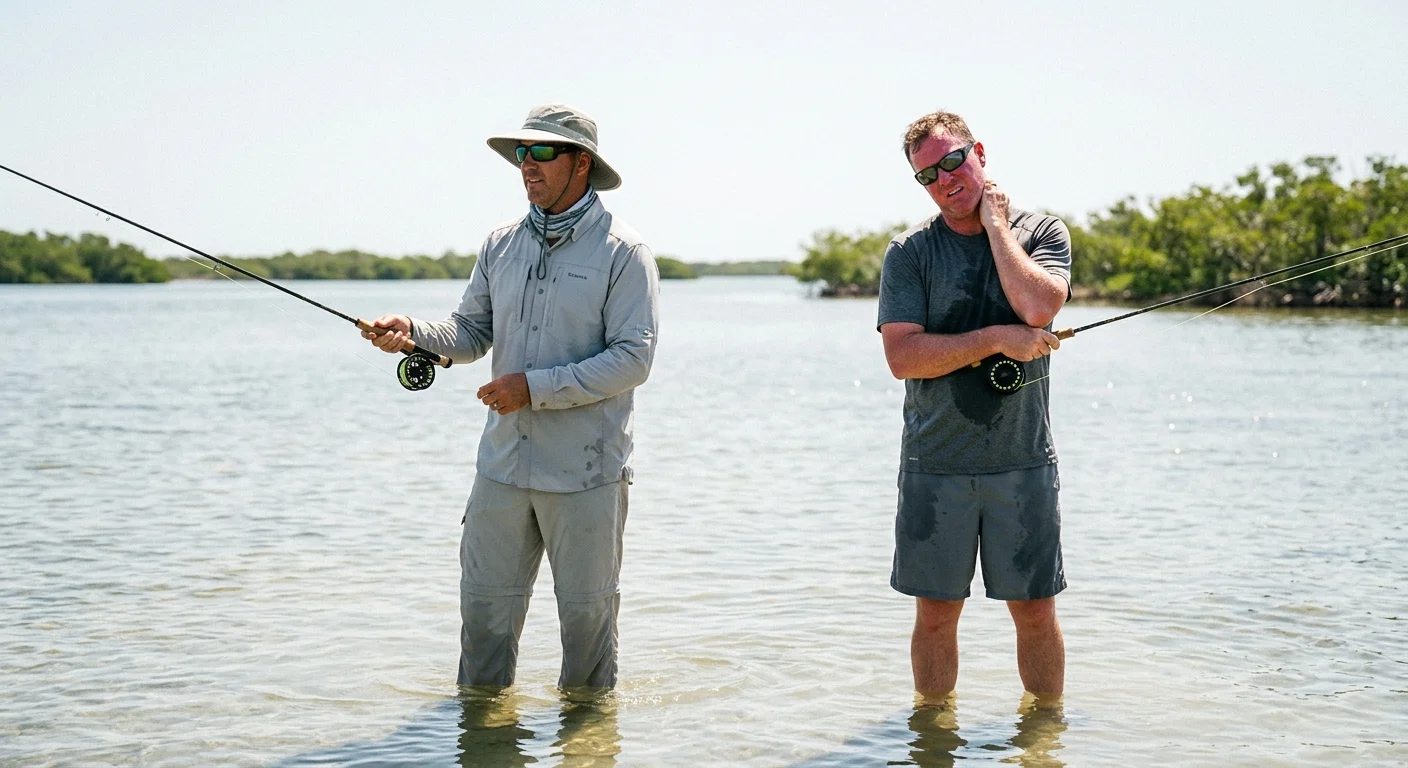
Two variables answer this faster than any product comparison: how long you're outside, and how much sun hits you.A professional fishing apparel wholesaler can also help retailers build product assortments around these usage scenarios instead of relying solely on price points.
Everything else — pockets, hardware, odor control — matters too. But session length and UV index are your first filter. Get those wrong and you'll overspend on features you never touch. Or you'll grind through a full day on the water regretting the call you made at checkout.
The Athletic Shirt Earns Its Keep Here
Short sessions in forgiving conditions. That's where a quality quick-dry athletic shirt holds its own.
Bank hopping for two hours in the morning? Fishing under tree cover? Running a half-day kayak float on a lake with most tools clipped to your bag? A solid synthetic long-sleeve gets the job done. UV index under 6. Shade available. One or two pieces of gear on your person, not six.
The performance shirt also works well with minimal tackle. You get clean casting freedom across the chest. No pockets to snag your line. No hardware bulk. Just a lightweight, breathable outdoor shirt that moves with you and dries fast.
Stay with standard performance gear when: - Sessions run 2 hours or less, morning or late afternoon - UV index stays at or below 5–6 - You're fishing shaded banks, creeks, or partial-canopy water - You carry two tools or fewer, clipped to a PFD or bag rather than your shirt - Temperature stays under 85° f with some breeze
A quick note on sunscreen: under three hours in moderate UV, a non-rated athletic polyester shirt plus sunscreen on your neck, ears, and hands is a solid setup. The shirt handles sweat. The sunscreen handles radiation. You're covered.
Where the Athletic Shirt Hits Its Ceiling
Around hour three in open sun, the math changes.
UV dose builds up. Sweat cycles repeat. Water reflection doubles the radiation your skin absorbs. Add a full day standing on a flat, running between spots on a console boat, or grinding through a competition day — and the gap between a generic quick-dry top and a certified UPF 50 sun protection shirt becomes very real.
Here's data worth knowing: UPF 50 fabric blocks up to 98% of UV radiation . An uncertified athletic shirt — depending on color, weave density, and fabric wear — can let through three to five times more. Over a six-hour inshore day, that gap adds up in a way sunscreen alone can't close, especially on your back and forearms.
On top of UV protection, performance fishing apparel built for full-day use dries 60% faster than standard athletic fabric. It can also cut core heat buildup by 2–4°F through strategic cape venting. That sounds like a small number. At hour eight in August, it doesn't feel small.
Move to a dedicated fishing shirt when two or more of these fit your situation:
You fish more than 3 hours per session , more than twice a month
Your local UV index hits 7 or above during your fishing window
You've had sunburn through fabric — or on your neck and lower back — even with sunscreen on
Your current shirt stays damp for 40 minutes or more and causes chafing under a PFD or wading harness
Your shirts show visible fading or pilling after a single season of salt exposure
Persistent fish and sweat odor survives the wash cycle
You carry three or more tools on your shirt and drop gear mid-fight
You fish from low kayak seats or crouch to land fish — and your lower back stays exposed every time
One of those triggers is enough reason to think about upgrading. Hit three or more, and the math is clear: a $60–$90 purpose-built fishing shirt will outperform and outlast two seasons of cycling through cheaper athletic gear.
The Practical Buy / Don't Buy Matrix
Your Situation | Right Call |
|---|---|
Casual angler, ≤2 hrs per outing, shaded freshwater | Keep the athletic shirt. Put that money toward sunscreen and a hat. |
Angler out 3–6 hrs, mixed sun and shade, inshore | Step up to a UPF 30–50 fishing shirt. UV dose and tool management make it worth it. |
Regular offshore or flats angler, 6–10 hrs, open water | Invest in premium UPF 50. Cape venting, anti-odor, extended rear hem — you'll use all of it. |
Multi-day trips or tournament schedule | A dedicated fishing shirt is non-negotiable. Durability, odor control, and certified sun protection pay for themselves over a season. |
The bottom line is straightforward. A $35 athletic performance shirt is a smart choice for a two-hour morning on a bass pond. On a six-hour saltwater flat under a July sun, it's a liability. Know which situation you're in — and buy for that.
Conclusion
Here's what most gear guides won't tell you: the right shirt isn't the most expensive one — it's the one you forget you're wearing while you fish.
Wading a quiet creek on a cloudy morning? Your current moisture-wicking shirt does the job fine. But grind through a full tournament day under open sky, or lean over the gunwale trying to land a redfish one-handed — those fishing-specific details start to matter fast. The rod keeper. The vented back panel. The UPF 50 rating built for hours of direct sun exposure. These stop being label talk and start being the difference between a good day and a rough one.
Use the comparison table. Match your scenario. Buy with purpose.
Don't upgrade your shirt because an article said to. Upgrade it because you've felt what's missing out on the water — and now you know what to look for.
That's how an angler shops.The same buying logic also helps brands evaluate white label fishing shirts, focusing on long-term performance instead of marketing claims when expanding their product lines.