Eight hours on the water. Sun hitting you from above and bouncing back off the surface. Anglers shopping for custom fishing sun hats often realize quickly that coverage and material quality matter more than branding alone.Your hat isn't just an accessory out there — it's your first line of defense against UV damage that builds up cast by cast.
Here's what most fishing gear guides won't tell you: not all UPF 50+ hats are created equal. The difference between a densely woven wide brim straw hat and a synthetic bucket hat could mean the difference between real protection and a false sense of security.
After enough long days on the bank and the boat, I can say this clearly: the "best" sun hat depends on where you fish and how you fish. Some of the most popular choices leave real gaps in coverage — gaps that show up directly on your skin.
So before you grab whatever looks good on the rack this season, let's look at the actual data, dimension by dimension.
UPF Sun Protection Mechanism & Material-Level Test Data Comparison
UPF isn't marketing language. It's a measurable, standardized rating system. Once you understand it, you'll never shop for sun protective headwear the same way again.
Here's the simple version: UPF (Ultraviolet Protection Factor) tells you what fraction of UV radiation passes through a fabric. A UPF 50+ hat blocks 98% of UV rays — about 1/50th gets through. Under international standards (including GB/T 18830-2009), a textile must reach UPF 40+ with UVA transmittance ≤5% before it can carry that "UV protective" label.
What controls that number? Four things:
Fiber type (synthetic vs. natural)
Weave structure and density (how tight, how many gaps)
Fabric thickness
Finishing treatments (resin coatings, UV-blocking chemical processes)
Notice what's not on that list: hat shape.A professional sun protective headwear manufacturer will normally focus on textile density and UV treatment performance long before changing brim geometry. A wide brim improves coverage area — but it doesn't upgrade the material's UPF rating. Most fishing hat guides skip over that detail. It's worth knowing.
Straw Hat UPF by Weave Type
This is where straw hat UV protection gets complicated — and where most buyers go wrong.
Straw Hat Type | Typical UPF Range | Key Characteristic |
|---|---|---|
Tight weave (gap ≤1mm) | UPF 40–50+ | Minimal light scatter, continuous weave |
Loose weave | UPF 15–30 | Visible light spots = UV spots on your skin |
Dyed / resin-treated | +15–20% improvement | Trade-off: reduced breathability |
A loose-weave wide brim straw hat can look solid and still deliver only UPF 15. Those gaps don't just let light in. They create scattered UV hotspots that hit your face and scalp in uneven patches. You could sunburn in a polka-dot pattern before you realize the hat isn't doing its job.
Tight-weave natural straw with a certified UPF finishing treatment? That's a real UV blocking hat material . Without that treatment, you're relying on visual density alone. That's not a solid measure of real protection.
Bucket Hat UPF by Fabric Type
Synthetic bucket hats have a structural edge: fiber density is engineered, not woven by hand. That consistency shows up in the numbers.
Bucket Hat Fabric | Typical UPF Range | Notes |
|---|---|---|
High-density polyester / nylon | UPF 50+ | Stable, consistent protection |
Cotton / cotton blend | UPF 10–30 | Drops 30–40% when wet |
UV-coating / micro-foam fabric | UPF 50+ | Lightweight, ideal for fishing |
For anglers, the cotton bucket hat data is critical. Sweat, spray, and humidity are part of any day on the water. A wet cotton hat can lose close to half its UV blocking power mid-session. A UPF 30 hat at the start of the day could drop to UPF 18 by hour four.
High-density nylon and polyester don't have this problem. Their protection is built into the fiber structure — not a surface coating. So it holds up even when soaked through.
What the Wash Test Data Shows
One research dataset on nylon four-way-stretch UV blocking hat material recorded pre-wash UPF values of 48.2, 63.7, 71.5, and 68.9 across fabric samples. After five wash cycles, those numbers dropped to 32.6, 57.4, 65.2, and 62.8 — a clear decline, though high-performance samples stayed above UPF 50+.
The more striking result came from polyester. Fabrics treated with nano-TiO₂ sol-gel processing saw UPF jump from 32 to 68. After 50 standard wash cycles , they still held UPF 52+. That's the top of what advanced UV blocking hat material technology can deliver right now.
Bottom line for decision-making:
A synthetic bucket hat UPF rating of 50+ is reliable and repeatable
A straw hat's UPF can range from 15 to 50+ within the same style — it depends on weave tightness and whether the hat carries a certified treatment
Check for the UPF 40+ or UPF 50+ certification label first. Then confirm whether that rating holds after washing and in wet conditions
UPF Protection Rating vs. Coverage Dimension: Which Hat Actually Shields More?
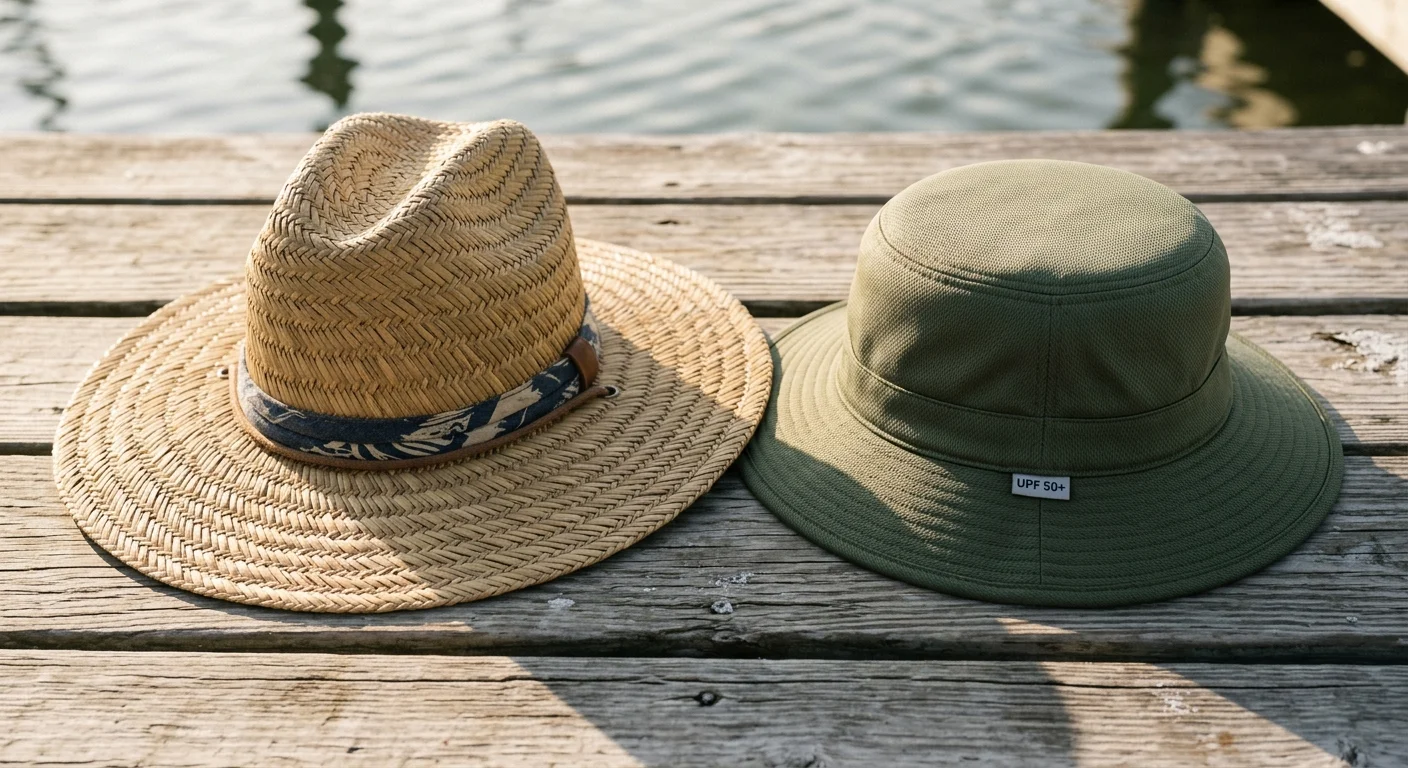
The rating stamped inside your hat tells only half the story.
Once a hat clears the UPF 50+ threshold — blocking 98%+ of UV radiation — pushing that number higher gives you diminishing returns. What matters more is geometry : how much of your face, ears, neck, and shoulders sit inside the hat's shadow throughout the day.
Think of it as two axes working together. The vertical axis is UPF intensity — how much UV the fabric blocks. The horizontal axis is coverage dimension — the physical area and angle of shade your hat casts onto your body. A wide brim straw hat rated UPF 50+ and a standard bucket hat rated UPF 50+ score the same on the vertical axis.Many premium brands now use ODM fishing hat development to balance certified UV performance with wider real-world coverage angles for long sessions on open water.
On the horizontal one, they are not even close.
Brim Width = Shadow Real Estate
Here's where the gap opens up fast.
Wide brim straw hats run 3.5–5 inches (9–12.7 cm) of brim. At midday, with the sun at a high angle, a 4.5–5 inch brim creates a cone-shaped shadow that covers:
Full face — forehead to chin, with near-zero direct exposure at noon
Both ears — fully shaded with your head level
Upper neck — strong coverage, more so with rear brim designs
Shoulder upper edges — 1/3 to 1/2 covered under the brim's shadow cone
Run the numbers. A wide brim sun hat with chin strap in the 4.5"+ range can cut UV dose to the head, face, ears, and upper neck by 60–75% compared to bare skin. Layer that over a UPF 50+ rated crown, and total UV reduction across covered areas can reach 70–90% — depending on sun angle and water reflectivity.
A standard bucket hat runs a 2–2.5 inch brim. At midday, that gives you maybe 20–35% more coverage over bare skin. Ears? Exposed. Neck? Bare, unless you add a separate gaiter.
Rigid Brim vs. Soft Brim: The Structure Factor
Brim width matters — but so does whether that brim stays where you put it .
A stiff-brimmed outdoor fishing hat holds a consistent shadow position. It doesn't fold in the wind. It doesn't droop as you tilt your head to watch a line. The circular shade stays circular.
A soft-brimmed bucket hat moves around. Look up to read the sky — the brim presses back. A gust hits — it folds. Those brief gaps in coverage are the moments your nose, ears, and jaw take direct UV hits. Short bursts, sure. But they add up fast across an eight-hour session on the water.
For anglers, this structural difference is real. Casting, reeling, scanning the water — none of these are static movements. A breathable fishing hat with a rigid wide brim holds its protective shape through all of them. The soft bucket hat brim needs constant adjusting to do the same job.
Section Verdict: Wide Brim Straw Hat Wins on Coverage
Metric | Wide Brim Straw Hat (4.5–5") | Standard Bucket Hat (2–2.5") |
|---|---|---|
Midday face coverage | ~75–100% | ~30–50% |
Ear protection | Full (when level) | Partial to none |
Upper neck coverage | Significant | Minimal |
Shadow stability | High (rigid brim) | Variable (soft brim) |
UV coverage dimension score | ★★★★★ | ★★★☆☆ |
Winner: Wide Brim Straw Hat — not because its UPF rating is higher, but because its coverage design protects the zones that matter most: ears, the sides of your face, and neck. These areas carry the highest risk for UV-related skin damage and early aging. A hat rated UPF 50+ that leaves your ears exposed has already lost the real protection battle.
Breathability, Heat Dissipation & All-Day Comfort: Which Hat Survives an Eight-Hour Session?
Shade is half the equation. The other half is what happens inside the hat once the sun gets serious.
The Airflow Architecture Difference
Natural straw has an open-weave structure. This lets air pass through the crown without any help from engineering. Synthetic fabrics have to work hard to match that. In calm conditions — early morning bank fishing, or waiting out a flat tide — that passive airflow keeps head temperature 1.5–2°C cooler than a standard synthetic shell.
A polyester or nylon bucket hat with no laser-perforated panels, mesh inserts, or moisture-wicking inner lining traps heat. It builds at the crown. At first, you barely notice. By hour five of a summer session, that trapped warmth is all you can think about.
A well-built breathable fishing hat in bucket style, with solid ventilation, closes most of that gap. Base-model synthetic bucket hats? They fight the physics every step of the way.An experienced fishing apparel supplier will usually separate entry-level synthetic hats from high-ventilation technical designs built specifically for humid summer environments.
Weight, Pressure & the Long Game
Here's where the lightweight fishing hat case for bucket hats gets real:
Factor | Wide Brim Straw Hat | Lightweight Bucket Hat |
|---|---|---|
Typical weight | 140–180g | 110–130g |
All-day pressure | Moderate — wider brim creates lateral torque in crosswind | Low — sits close to skull, weight well-distributed |
Dynamic stability | Shifts during casting, head tilts | Stays put through active movement |
Ventilation (base model) | Passive, structural | Depends on construction |
That 40–50g difference looks small on paper. After six hours of casting, scanning, and repositioning, you'll feel every gram. The straw hat's wider brim also creates side-wind pressure — it pushes against your forehead and temples and builds up over time. Fine at hour one. By hour seven, it wears on you.
Dimension-by-Dimension Rankings
Here's a quick breakdown:
Heat dissipation : Natural straw ≈ ventilated bucket hat > unperforated synthetic bucket hat
All-day comfort : Lightweight bucket hat > natural straw hat > standard heavy synthetic hat
Active fishing stability : Bucket hat > straw hat
Static high-shade performance : Straw hat > bucket hat
What to Look for When Buying
For a bucket hat that breathes:
- Weight: ≤130g
- Construction: laser-perforated panels, mesh side inserts, or moisture-wicking inner lining
- Inner band: sweat-wicking, quick-dry material
- Brim width: mid-range — going wide brings back wind resistance and torque
For a straw hat built for comfort:
- Weave density: open enough to let air flow through, not so tight it traps heat
- Inner band: padded or pressure-reducing sweatband
- Brim: skip the extra-wide rigid designs — they make side-wind pressure worse
Section Verdict: Bucket Hat Wins on All-Day Wearability
Active fishing — lots of casting, moving between spots, long hours in shifting wind — puts real demands on your hat. A well-built lightweight fishing hat in bucket style handles all of it better. It sits closer to your head, weighs less, and stays put without you touching it.
The natural straw hat has its place. Low-movement, high-UV days where passive airflow and wide-brim shade matter most — that's where straw earns its spot. But ask yourself which hat you'll still want on your head at hour eight. The answer leans bucket.
Winner: Bucket Hat — on weight, dynamic stability, and all-day pressure comfort. Add the right ventilation construction, and it matches straw's airflow performance as well.
Wind Resistance & Casting Visibility: Where the Bucket Hat Pulls Ahead
Wind doesn't care how good your hat looks.
At 15 knots (around 7.7 m/s) — a pretty ordinary day on open water — a wide brim straw hat becomes a liability. That large surface area catches wind like a sail. No chin strap or internal cinch cord? You'll spend as much time chasing your hat as watching your line.
The bucket hat works the opposite way.Some commercial buyers source these lower-profile designs through a dedicated fishing hat wholesaler because stable wind performance matters heavily for offshore operators and guide teams. A lower crown and short brim give the wind less surface to grab. On a pitching boat deck, scrambling between bank spots, or leaning into a headwind cast — it stays put. No hands needed.
The Casting Mechanics Problem
Here's something most hat reviews miss: your hat affects how you fish , not just how protected you are.
Tilt your head back to track a long cast with a wide brim straw hat. That extended brim cuts straight across your upper field of vision. Look left during a sidearm throw — the brim edge cuts into your lateral sightline. That visual lag leads to missed drops and sloppy line management.
A bucket hat's short brim keeps your visual field clean:
Upper vision — unobstructed as you look up to read your line arc
Lateral vision — full range during sidearm and overhead casting strokes
Polarized lens compatibility — no brim edge cutting into the top of your sunglasses frame
Head-turn tracking — clear sight line as you follow a moving target
Section Verdict: Bucket Hat Wins on Both Counts
Dimension | Wide Brim Straw Hat | Bucket Hat |
|---|---|---|
Wind resistance (15 kt+) | Needs chin strap to stabilize | Holds position without straps |
Upper field of vision | Blocked on head tilt | Clear and unobstructed |
Lateral casting vision | Brim edge interference | Minimal interference |
Dynamic movement stability | Needs frequent readjustment | Stays seated through active movement |
Winner: Bucket Hat — on both wind resistance and casting compatibility. The wide brim straw hat can compensate with a solid chin strap setup. But that's a fix for a problem the bucket hat never had. Your fishing involves frequent casting, tracking, and moving? The bucket hat stays out of your way and lets you focus on the fish.
Water Resistance & Quick-Dry Performance: Which Hat Holds Up When Things Get Wet
Rain, spray, sweat — on the water, your hat takes all three at once.
Material science is where these two hats truly split apart. Modern OEM performance fishing hats often use hydrophobic synthetic fabrics and quick-dry inner bands to prevent moisture buildup during long saltwater sessions.No other factor shows the gap more clearly.
The Fabric Structure Problem with Straw
Natural straw absorbs moisture. A wave hits the hull. A quick shower rolls through. That straw crown soaks it all in. The hat gets heavier. The shape softens. Drying takes real time — not the fifteen minutes you're hoping for between squalls.
The UV protection issue makes this worse. Wet natural fabric loses UPF performance. A straw hat that starts the morning at UPF 30 and soaks through by 10 AM isn't protecting you for the rest of the session.
How Synthetic Bucket Hats Handle Moisture
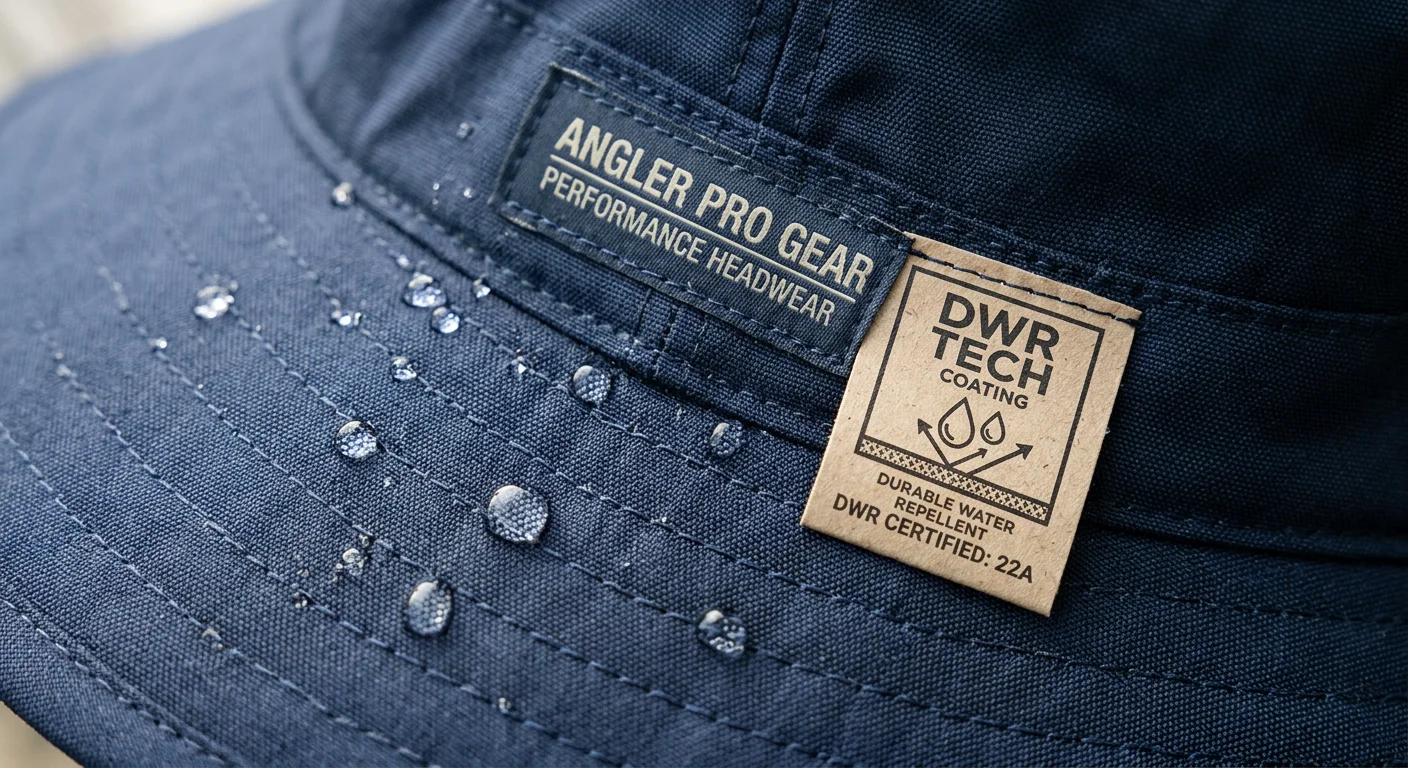
High-density polyester and nylon bucket hats built with DWR (Durable Water Repellent) or tri-proof fabric technology work at the structural level — not the surface level. Liquid beads up and rolls off. It never soaks into the fiber. This isn't a surface coating that fades after a few washes. It's a micro-nano hydrophobic structure built directly into the material.
Here's what that means on the water:
Splash hits → beads and rolls off within seconds
Sweat buildup → moisture-wicking inner band pulls it away from skin
Light rain → crown stays dry, weight stays consistent
Post-wet recovery → sun + airflow dries synthetic fabric far faster than natural straw
Quick-Dry Performance: The Numbers That Matter
Material | Wet Weight Increase | Dry Recovery Time | UPF Stability When Wet |
|---|---|---|---|
Natural straw | High — absorbs and holds | Slow (air dry required) | Drops 20–40% |
Cotton bucket hat | High — saturates fully | Slow to moderate | Drops 30–40% |
Polyester / nylon + DWR | Minimal — surface repels | Fast (sun + wind) | Stable — no significant drop |
Tri-proof nylon composite | Very low | Very fast | Stable |
Cotton bucket hats hit the same wall as straw. They absorb. They dry slow. Their UPF 50+ rating drops the moment they're soaked through. Synthetic fabrics with hydrophobic construction are the clear winner here — that's where the real advantage sits.
Section Verdict: Bucket Hat Wins — But Only the Right Kind
Factor | Wide Brim Straw Hat | Synthetic Bucket Hat (DWR/Tri-proof) |
|---|---|---|
Splash resistance | Poor | Strong |
Wet weight gain | High | Minimal |
Quick-dry speed | Slow | Fast |
UPF stability when wet | Degraded | Maintained |
Shape retention after soaking | Softens, may warp | Holds form |
Winner: Bucket Hat — polyester or nylon construction with DWR or tri-proof treatment. A plain cotton bucket hat doesn't make the cut here. A well-built UV blocking hat in synthetic form holds its shape, its weight, and its UPF 50+ rating — even after four hours of spray, sweat, and on-and-off rain.
What to look for on the label : DWR coating, tri-proof (防水防油防污), micro-nano hydrophobic structure, or original-yarn UV fiber construction. A tag that just says "quick-dry" without naming the mechanism gives you speed — not water resistance. That's half the solution for a full day on the water.
Fishing's Hidden Sun Traps — And How to Close Them
Most fishing hat reviews stop at UPF ratings. They never talk about the skin your hat covers — but doesn't protect.
Water changes everything. On open water, UV doesn't arrive from above alone. Static freshwater reflects 10–20% of UV radiation back upward. Choppy surf and wave faces push that to 25–30% . The result: your chin, jaw, and lower neck receive 1.3–1.6× the UV dose compared to standing on dry land. Any small gap in coverage — a loose weave, a short brim, a ventilation hole — stops being minor. It becomes a genuine burn zone.
Blind Spot #1: The Straw Hat's Polka-Dot Problem
Loose-weave straw hats — raffia, paper braid, decorative wide-brim styles — are the biggest offenders here. After 4–6 hours on the bank, anglers develop patterned, mottle-style redness on the cheekbones and sides of the neck. Not a uniform burn. A spotted one, shaped like the weave itself.
The math is straightforward. A loose-weave crown can transmit 15–30% of UV light through its gaps. Add upward water reflection as a second UV source, and those light-spot zones build up close to 1 MED within 2–3 hours — enough to trigger visible redness and mild swelling on average skin types.
The fix:
Hold your hat against a bright phone flashlight in a dark room. See scattered pinpoints of light on the inner surface? That's UV getting through during every hour on the water
Target UPF 40+ minimum, UPF 50+ preferred , with a tight-woven crown or an interior UV-blocking liner layer
Fishing with a straw hat? Layer a UPF 50+ face gaiter underneath. Put the gaiter on first, then place the hat over it so the brim edge overlaps the gaiter's upper border. This closes the gap-light problem for good
Blind Spot #2: The Bucket Hat's Neck and Ear Exposure Zone
A standard 2-inch bucket hat brim sounds like decent coverage. In practice, it falls short — once you factor in fishing posture, the gap becomes clear.
Anglers tilt their heads back all the time. Tracking a cast arc, reading the line, watching a float. That slight backward tilt reduces the forward brim angle. The rear brim lifts off the neck. The result: the ear canal, lower ear, and C1–C3 cervical region (the band of neck just below the skull) sit in direct sunlight for most of your session.
Dermatologists flag this exact zone — the ear ridge and posterior neck — as one of the highest-incidence sites for actinic keratosis and cumulative UV pigmentation in outdoor recreation populations. A 2-inch brim reduces UV dose to these areas by 30–50% at best. That's not a safe zone for anglers logging 40+ days on the water per year.
Upgrade options — in order of effectiveness:
Legionnaire-style rear neck flap — a removable soft panel extending ≥15–20 cm below the hat's back seam, wide enough to cover both sides of the neck down to the ear lobe. Detachable versions with snap or hidden-zip attachments work for both fishing and everyday use
Extended-side fishing-specific bucket hats — designs with a rear brim that angles down and side panels that shade the full ear, with side-flap coverage reaching at least 2–3 cm above the ear tip
Face gaiter + high-collar UV shirt combination — the gaiter's lower edge overlaps the shirt collar by at least 2–3 cm. This eliminates the neck gap that opens up mid-cast as you turn your head
Blind Spot #3: Crown Seams, Vent Holes & Thinning Hairlines
This one applies to both hat styles — and it's the blind spot most anglers never think about.
Decorative stitching at the crown, ventilation eyelets, mesh panels, and center button holes are built for breathability. They also act as direct UV channels straight to your scalp.
For anglers with a widening part, receding hairline, or thin hair, the hat's crown fabric alone doesn't give full coverage. Low-density hair can drop scalp UV blocking to as little as 20–50% effectiveness — even under a covered hat.
Practical defense:
Choose hats with solid, tightly woven crown panels — no mesh inserts above the scalp
Spray SPF 50+ scalp-formulated sunscreen along your part line and hairline edges before heading out. On full-day sessions, reapply at the 3–4 hour mark
Got a hat with ventilation eyelets? Place a UPF 50+ skull cap liner underneath. It adds almost no extra heat and closes every overhead gap at once
The Layering Principle That Ties It All Together
No single hat covers every blind spot. The anglers who come off the water without damage aren't wearing the most expensive hat — they're wearing a system .
Zone | Primary Defense | Backup Layer |
|---|---|---|
Face & cheeks | UPF 50+ hat brim | UPF 50+ face gaiter |
Ears & jaw | Extended side flap or wide brim | Gaiter coverage to cheekbone |
Rear neck (C1–C3) | Legionnaire neck flap ≥15 cm | High-collar UPF shirt overlapping |
Scalp / crown seams | Solid-crown hat panel | SPF 50+ scalp spray on part line |
The gaps don't announce themselves. They show up as a spotted tan line, a dark band across the back of the neck, a recurring burn on the ear ridge. Those are the marks of fishing seasons spent trusting coverage that looked complete but wasn't. Close the system before those patterns start.
Multi-Scenario Scoring Matrix & Quick-Decision Guide
Four fishing scenarios. Five performance dimensions. One table that cuts through the noise.
No more guessing which hat fits your fishing style. The matrix below scores both hat types across every dimension that matters on the water. Scores reflect real-world priority — not marketing copy.
Scenario Scoring Matrix (1–10 Scale)
Dimension | UPF Coverage | Breathability | Wind Stability | Water Resistance | All-Day Comfort | Top Pick |
|---|---|---|---|---|---|---|
Shore / Rock Fishing | 9 | 8 | 6 | 5 | 8 | Wide-brim straw hat + chin strap |
Boat / Saltwater | 7 | 7 | 9 | 10 | 9 | UPF 50+ bucket hat + neck flap |
Kayak / Raft Fishing | 6 | 9 | 9 | 9 | 10 | Lightweight bucket hat, rigid short brim |
Shoulder-Season / Early Spring | 8 | 6 | 8 | 8 | 7 | Fleece-lined windproof bucket hat |
Want to run your own numbers? Use this formula:
Overall Score = UPF×0.30 + Breathability×0.20 + Wind×0.20 + Water×0.15 + Comfort×0.15
Scenario Quick-Reference Cards
Shore / Rock Fishing
- Core demands: long hours of direct sun, side gusts, occasional splash
- Key specs: UPF 50+, brim ≥7–10 cm, removable chin strap, quick-dry fabric
- Best fit: tight-weave straw hat, polyester straw with a close weave, any UPF-certified wide-brim with a chin anchor
- Watch out for: skip the chin strap and one strong gust ends your session
Boat / Saltwater Fishing
- Core demands: heavy UV bouncing off the water, salt spray, regular soaking, non-stop wind
- Key specs: UPF 50+, rear neck flap, salt-resistant material, fast-dry construction
- Best fit: saltwater fishing caps, rear-flap bucket hats, packable water-repellent styles
- Watch out for: tall-crown wide-brim designs catch too much wind on an open deck
Kayak / Raft Fishing
- Core demands: low wind profile, a snug fit close to your head, hours of paddling sweat
- Key specs: short rigid brim (4–6 cm), mesh ventilation panels, ultralight, quick-dry
- Best fit: sport bucket hats, quick-dry angler caps, packable travel hats
- Watch out for: a wide brim gets in the way of your paddle stroke and blocks your forward view
Shoulder-Season / Early Spring Ice-Edge
- Core demands: cold morning wind, big temperature swings, a design that works with layers
- Key specs: windproof shell, fleece inner lining, optional ear coverage, quick-dry
- Best fit: windproof bucket hats, softshell sun caps, styles that pair with a neck gaiter
- Watch out for: cotton soaks up sweat and turns cold fast — a real problem once the temperature drops at sundown
The One-Line Decision Per Priority
Your Priority | Choose This |
|---|---|
Maximum UV protection | Wide-brim tight-weave straw hat or UPF 50+ sun hat |
Stability on open water | Bucket hat with chin strap + rear neck flap |
Active movement, casting freedom | Short-brim lightweight breathable fishing hat |
Spring/fall all-day wearability | Windproof shell + fleece liner, gaiter-compatible |
Scenario-Specific Recommendations: The Right Hat for Every Water
The scoring matrix gave you the overview. Now let's get specific — "best bucket hat" means something different depending on whether you're parked on a riverbank for six hours or bracing against chop on an open saltwater deck.
Here's the breakdown by scenario, with exact specs worth checking before you buy.
Shore Fishing / Still Water
Still water, long sessions, minimal wind. This is where the wide brim straw hat earns its place — but only if the specs back up the style.
What to look for:
Brim width: 3–3.5 inches (7.5–9 cm) , full 360° wrap — covers ears and upper neck. It won't block your sightline as you tilt up to watch a float
Weave density : tight-woven paper straw, wheat straw, or palm fiber with a polyester or nylon inner liner. Look for an AS/NZS 4399 or AATCC 183 certified UPF 50+ label, UV transmittance ≤2.5%
Gap size matters more than it looks. Weave openings should stay under 1mm . Hold the crown up to a bright phone flashlight in a dark room. Scattered pinpoints of light mean scattered UV hitting your face all day
Inner sweatband : polyester terry or quick-dry mesh, with at least 2cm of circumferential stretch (58–60cm range). Your head swells over six hours of summer heat — that stretch range covers it
Chin strap : use one the moment wind hits Force 2 or above (above 3.4 m/s — small ripples appear on flat water). Look for a 3–4mm elastic cord with a single-hand quick-lock buckle, plus an optional 40–60cm safety tether to clip to your chair or vest
Bonus detail : pick a light exterior color to reduce crown heat. Go dark on the inner brim though — a deep grey or black inner edge cuts the glare bouncing off the water surface. That makes a real difference with polarized lenses.
Boat / Saltwater Fishing
Salt air, spray, gusts that build all morning, and UV bouncing hard off open water. The wide brim straw hat loses this one. You need a UPF 50+ water-resistant synthetic bucket hat built for marine conditions.
What to look for:
Main fabric : 100% polyester or nylon micro-weave, 90–130 g/m² — dense enough to hold UPF 50+ (≥98% UV blocked) without feeling heavy
Surface treatment : DWR finish (C6 or fluorine-free), rated AATCC 22 ≥ 90 on spray testing. It should bead and shed saltwater, not absorb it
Hard pass on cotton : cotton absorbs water, drags weight, and collapses under sea wind. Its UPF rating drops 30–40% wet — right at the point you need protection most
Brim geometry : 2.5–3 inches (6.5–7.5 cm), shorter at the front and longer at the rear. This reduces interference on a hard rod strike
Neck flap : a fold-down rear panel of 15–20 cm covering the C1–C3 neck zone. The inner side needs its own UPF 50+ rating — check that label, not just the exterior
Chin strap design : non-elastic primary cord with a 3–5cm micro-elastic buffer zone at the front. This stops a sudden gust from snapping the cord tight under your jaw
Hardware : 316 stainless steel or nylon-only buckles — standard iron plating corrodes after one or two salt spray outings. Check the stitching too: polyester or nylon thread, Tex 40–70, double-locked seams
At wind Force 6–8 (11–21 m/s) — standard offshore conditions — look for side clip points that anchor to a life vest strap. That's the difference between a hat that stays on and one trailing somewhere behind the boat.
Kayak / Whitewater / Active Lure Fishing
Low profile, constant movement, and a casting arc that needs a clear visual field in every direction. The wide brim straw hat becomes an obstacle here — in both movement and visibility.
What to look for:
Brim width: 2–2.5 inches (5–6.5 cm) , uniform or a touch longer at the rear. Anything over 3.5 inches (9 cm) catches side gusts mid-stroke and blocks lateral vision on a sidearm cast
Weight target: 45–80g — this isn't about vanity. Overhead casting and paddle strokes pile up neck fatigue faster than most anglers expect. Every gram adds up by hour four
Fabric : 20D–40D nylon or polyester microfiber with Ripstop construction — tears less, packs smaller, dries fast
Crown ventilation : laser-perforated holes, 1–2mm diameter , positioned on the sides and rear of the crown, covering 10–20% of the crown's surface area . That's enough airflow without cutting into the hat's UPF protection overhead
Anti-slip inner band : a firm crown structure plus a 10–15mm silicone or rubber grip strip along the inner lower edge. Pivot fast on a kayak or snap your head mid-cast — this is what keeps the hat in place without you touching it
Float strip : some fishing-specific designs tuck a foam buoyancy strip into the brim channel. Hat goes overboard, it floats. Small feature. Pays off once — and that one time is the only time that matters
Polarized lens compatibility : a stiffened, curved front brim keeps the brim edge clear of your sunglasses frame. On fast-moving water where you're reading current and structure non-stop, that clearance matters
Crown height should stay at or under 9 cm. Taller crowns catch more wind and create clearance problems with helmet-mounted cameras or headlamps on early dawn sessions.
Shoulder Season / Early Spring Ice-Edge Fishing
Most fishing hat guides skip this scenario. Cold air, hard UV, snow-reflected radiation, and body temperature that swings ten degrees between sunrise and midday. One hat doesn't cover all of that. A layered system does.
The two-piece setup:
Inner layer — UPF fleece cap:
- Polyester fleece at 150–200 g/m² , fine-pile inner surface, full UPF 50+ rating
- Must cover ears and forehead fully, with thickness 1.5–2.5 mm max . Go thicker and the outer hat won't sit right
- Function: thermal base + UV block on the head's upper surface
Outer layer — windproof bucket hat:
- Softshell or high-density nylon/polyester with a wind-barrier membrane, or woven tight enough to do the same job
- Add DWR for meltwater resistance — snow hits the brim, melts on contact, and runs off the front edge rather than soaking through
- Brim: 2.5–3 inches (6.5–7.5 cm) — wide enough to cut reflection off bright snow and ice, short enough to keep sight lines clear down to an ice hole
- The inner circumference should seat firm over the fleece layer with no gaps. Wind finds every opening, especially crouching to pull fish through a hole
Color matters more here than any other scenario:
Snow reflects up to 80–90% of UV radiation — far higher than open water. Deep colors (charcoal, navy, forest green) absorb that reflected UV rather than passing it through. A black or dark-grey polyester hat at 150 g/m² can test at UPF 50+ . The same weave weight in white or cream may test at UPF 15–20 . That's not a styling preference. It's a protection gap you can measure.
Chin strap spec for cold conditions : non-elastic primary cord with a fleece or fabric-wrapped contact section. Bare elastic against cold skin pulls tight and numbs the chin over hours. Ice fishing wind at Force 4–7 is standard — the hat must stay secured through a bent-over rod-check and a fast stand-up strike.
Scenario Quick-Selection Summary
Fishing Scenario | Hat Type | Non-Negotiable Specs |
|---|---|---|
Shore / Still Water | Wide-brim tight-weave straw hat | UPF 50+ certified, brim 3–3.5", elastic chin cord at wind Force 2+ |
Boat / Saltwater | Synthetic bucket hat | DWR polyester/nylon, rear neck flap 15–20cm, corrosion-resistant hardware |
Kayak / Active Lure | Short-brim lightweight bucket | 45–80g, brim 2–2.5", silicone inner grip, optional float strip |
Shoulder Season / Ice-Edge | Fleece cap + windproof bucket | Fleece UPF 50+ inner, DWR outer, deep color, fabric-wrapped chin cord |
Find your row. Match the specs. The right hat for your water is in that table — not whatever's hanging on the closest rack.
Conclusion
Countless hours on the water teach you one thing. There is no universal winner — only the right hat for your water .
Wide brim straw hats with tight weaves give you UPF 50+ protection and top-tier breathability. That makes them a strong pick for long shoreline sessions where heat is your biggest problem. Out on open water, gusts are a different story. A UPF 50+ bucket hat with a chin strap stays on your head. A hat that flies into the lake protects no one.
The real takeaway? Don't just buy a hat. For outfitters, fishing teams, and retail programs, comparing durability alongside wholesale price fishing hat options can make a major difference over a full season of heavy use.Buy a system :
Pair your hat with a neck gaiter for extra coverage
Add polarized lenses to cut glare
Choose the right material for your specific fishing spot
Your skin remembers every trip you take. Make sure your headwear works as hard as you do.