That "UPF 50+" label on your sun shirt? It either means something — or it means nothing.For brands building compliant performance gear, custom OEM/ODM sun protection fishing apparel is where real UPF 50+ verification actually starts.
The difference comes down to one question: did a spectrophotometer ever touch that fabric inside a certified lab? Or did a marketing team pick a number that sounded good?
I've walked countless fabric samples through the AATCC 183 ultraviolet protection factor testing process. The gap between a verified rating and a printed claim is wider than most shoppers expect.
Here's what this guide covers: a complete breakdown of how UPF 50+ sun shirt certification works. We start from the moment a fabric sample hits the lab bench. We end at the moment a test report gets signed.
Shopper trying to cut through the noise? This gives you the facts.
Brand preparing your first compliance submission? This shows you exactly what to expect.
No vague claims. Just a clear look at how the process works, step by step.
The Complete Lab Journey: Step-by-Step AATCC 183 Testing Protocol
Five distinct stages separate a raw fabric swatch from a signed UPF 50+ test report. Each stage has its own equipment requirements, tolerance thresholds, and failure points. Miss any one of them, and the number on the label means nothing.
Here's what happens inside a certified lab.
Stage 1: Instrument Calibration — The Foundation Everything Else Depends On
Before anyone touches a fabric sample, the spectrophotometer needs to be dialed in.
The instrument scans a wavelength range of 280–400 nm — the full UV-R spectrum — using an integrating sphere. Calibration covers three separate verification steps:
Wavelength scale : Verified using a mercury vapor lamp or holmium oxide glass filter, cross-referenced to ASTM E275
Transmittance scale : Set to 100% with an empty port (air reference), then confirmed at 0% using an opaque block
Linearity check : Neutral filters or multi-cell plates confirm the instrument reads at the correct level across the full range
For wet testing, a plastic film covers the observation port — and calibration runs again from scratch. This step is not optional. Skipping recalibration for wet samples is one of the most common reasons UPF readings come out inflated in non-accredited testing.
Stage 2: Sample Preparation — Why Your Fabric Needs Conditioning First
Sample size starts at a minimum of 50 mm × 50 mm . At least two samples per fabric are required.
Size isn't the critical variable here, though. Conditioning is.
Per ASTM D1776, every sample must sit at 21°C ±1°C and 65% ±2% relative humidity for at least four hours on a perforated rack before testing starts. Swatches are cut without stretching. Pre-washing follows ASTM D6544 protocols — either one wash cycle or no washing at all, depending on whether the test checks initial UPF or durability after laundering.
One key flag for brands: optical brighteners and fluorescent dyes can push UPF results higher than they should be . Your fabric contains either? Disclose it in the test submission.
Stage 3: Spectrophotometer Measurement — The Three-Angle Rule
The fabric sample sits flat on the transmission port of the integrating sphere. Then the measurement sequence starts:
Measure at 0°
Rotate the sample 45° — measure again
Rotate another 45° — record the third measurement
That gives three values per location. For multi-color or patterned fabrics, the lab targets the area with the highest UV transmittance — the weakest point, not the best-performing one. This detail has a big impact on the final rating.
Stage 4: The UPF Calculation — What the Numbers Mean
This is where raw transmittance data becomes a UPF rating.
The formula uses erythemally weighted UV-R irradiance — a weighting system built on real-world solar spectral data from Albuquerque, NM:
UPF = UV-R (no specimen) ÷ UV-R (with specimen)
The solar irradiance values (S_λ) are weighted against erythemal effectiveness (E_λ) at each wavelength interval. The result shows how much UV radiation the fabric blocks at a skin-relevant level — not just total UV energy.
The final UPF value is the mean of three readings per sample, averaged across a minimum of five locations . Here's what those numbers mean in practice:
UV Transmittance | UPF Rating | UV Blocked |
|---|---|---|
20% | UPF 5 | 80% |
10% | UPF 10 | 90% |
5% | UPF 20 | 95% |
~2% | UPF 50+ | ≥98% |
UPF 50+ means the fabric transmits 2% or less of UV radiation. That's the 98% blocking threshold that earns the classification. The standard also requires a critical wavelength of ≥375 nm (per ASTM D6603) to confirm broad-spectrum UVA coverage — not just UVB performance.
Stage 5: What the Final Test Report Contains
The signed test report is more than a UPF number. A compliant AATCC 183 report covers all of the following:
Mean UPF value with individual location readings
UVA and UVB transmittance percentages (UVA: 315–400 nm; UVB: 280–315 nm)
UVA/UVB blocking percentages — calculated as (1 − T) × 100
Conditioning state — whether samples were tested dry, wet, or post-launder
Actual moisture content if wet testing exceeded 150% moisture regain
Full spectral transmittance curve from 290–400 nm
Dry vs. wet UPF comparison if both test conditions were run
That last line is where most reports get interesting: the wet UPF value. Wet fabric almost always lets through more UV than dry fabric. A shirt rated UPF 50+ dry might drop to UPF 30 once soaked in sweat or water. A brand's report leaves out wet-state data — and the garment targets water sports or high-intensity outdoor use? That's a gap worth raising directly with the lab or UPF 50+ Sun Protection Fishing Shirts Supplier.
Decoding the UPF 50+ Rating: Transmission Data and Protection Metrics
Most people see a UPF 50+ label and assume it means "maximum protection." That assumption is correct — but the number tells a more precise story than the marketing copy ever will.
UPF works on an inverse transmission scale. The higher the UPF, the less UV radiation passes through the fabric. The relationship is direct:
UPF Rating | UV Blocked | UV Transmitted | Protection Category |
|---|---|---|---|
15–24 | 93–96% | 4–7% | Good |
25–39 | 96–97% | 3–4% | Very Good |
40–50 | 97–98% | 2–2.5% | Excellent |
50+ | ≥98% | ≤2% | Maximum |
That bottom row is what UPF 50+ means in real, measurable terms: 2% or less of UV radiation reaches your skin . Not close to 2%. Not "around 2%." The standard requires a mean UPF of ≥50. Sub-2% transmission must be confirmed after simulated wear conditions — including washing and stretch testing.
Here's a number that puts it in real-world context: a plain white cotton T-shirt sits at UPF 5. That's 20% UV transmission. The gap between UPF 5 and UPF 50+ is not a modest improvement — it's a 10× reduction in UV exposure .
Why the "50+" Cap Exists
You won't see garments labeled UPF 75 or UPF 100 in legitimate certification systems. That's by design.
AATCC TM 183 caps the rating at 50+. So does AS/NZS 4399 and the Chinese standard GB/T 18830-2009 . The ceiling isn't a technical limitation. It's a guardrail against over-marketing. Once a fabric transmits ≤2% UV, reducing that number further adds no meaningful skin protection for everyday outdoor use.
The one exception: UV STANDARD 801 , used in European performance markets, extends the scale to UPF 80 (≤1.25% transmission). For U.S. market compliance under AATCC 183, though, UPF 50+ is the top classification.
What Gets Labeled — and What Doesn't
Compliance standards are specific about which UPF value appears on the label. Under AATCC TM 183, the lowest UPF value recorded across all panels and colorways sets the labeled rating — rounded down to the nearest 5. Take a garment with a dark navy panel testing at UPF 55 and a light mesh panel testing at UPF 38. That garment gets labeled UPF 35. The weakest point sets the claim.
The Skin Cancer Foundation's Seal of Recommendation sets its own floor. A garment needs a minimum of UPF 30 to earn the seal — no matter how high other panels test. That benchmark works as an independent industry signal. It sits separate from AATCC compliance but gets cited alongside it often.
One more threshold worth knowing: UPF 15 is the regulatory minimum for a garment to carry any "sun-protective" labeling at all. Anything below that? No claim permitted — regardless of fabric color or weave density.
Global Standards Comparison: AATCC TM183 vs AS/NZS 4399 and EN 13758
Three different standards. Three different solar baselines. Sell sun-protective clothing across multiple markets and the wrong assumption here costs you real money.
These standards don't disagree on testing equipment or fabric prep. The real split is which sun you're designing against.
Standard | Solar Reference Location | Peak Date | Primary Market |
|---|---|---|---|
AATCC TM 183 | Albuquerque, New Mexico, USA | July 31 | North America |
AS/NZS 4399 | Melbourne, Australia | January 1 | Australia / New Zealand |
EN 13758-1 | Albuquerque, New Mexico, USA | July 31 | European Union |
Melbourne's January sun hits harder than New Mexico's July sun. That one fact makes AS/NZS 4399 the strictest standard of the three . Fabrics tested under it face a harsher UV baseline. So a fabric that earns UPF 50+ under AATCC TM 183 might score 5–10 UPF points lower under AS/NZS 4399. Same fabric. Different number.
How the Three Standards Differ in Practice
AATCC TM 183 is the U.S. market default. It reports a mean UPF value, plus separate UVA (315–400 nm) and UVB (280–315 nm) transmission percentages. Wet-state testing is a firm requirement under ASTM D6544 for full compliance claims. Stretch testing is optional. Skip it and your base UPF rating stays untouched.
AS/NZS 4399 starts from a worst-case position: the most intense solar spectrum on earth, paired with the most UV-sensitive skin type. The original 1996 version left out stretching, wetting, abrasion, and washing entirely. A 2020 update filled part of that gap by adding protocols for those conditions. Note the word optional — those protocols are still not required for base labeling. Two things are required: a transmission graph with every report, and a labeled UPF that shows the lowest measured value, not the mean.
EN 13758-1 uses the same Albuquerque solar reference as AATCC TM 183 and applies the CIE erythemal action spectrum weighting. The two standards land within ±5% UPF variance of each other. That makes EN 13758-1 the simplest bridge standard for brands already testing for the U.S. market. One real difference: EN 13758-1 lets you report exact UPF values — UPF 47, UPF 52 — instead of banding. Retail labels can still round to UPF 50+ for values ≥50.
The Fourth Standard Brands Often Overlook
UV Standard 801 stands apart from the rest. The International Association of Applied UV Protection created it in 1998. It's the only standard that treats realistic wear conditions as mandatory , not optional.
Under UV Standard 801, every garment goes through stretching, wetting, abrasion, and care treatments before it gets a UPF value. The final rating reflects the lowest UPF recorded after all those stresses , based on Melbourne's solar spectrum and the most sensitive skin type. The labeling scale also goes further: UPF 10, 15, 20, 30, 40, 60, and 80. The other standards stop at UPF 50+.
Brands that hold UV Standard 801 certification alongside AATCC TM 183 are making a clear statement: this garment performs under real-world conditions, not just controlled lab conditions.
What This Means for Brands Targeting Multiple Markets
Here's what global distribution actually requires:
U.S. market : AATCC TM 183 + ASTM D6603 substantiation — both are required for FTC-compliant sun protection claims
Australia / New Zealand : AS/NZS 4399 testing through a NATA-accredited lab is mandatory — AATCC results alone don't meet AU/NZ retail compliance
EU market : EN 13758-1 is the required standard; results are accepted across UK, Switzerland, and Norway
Running all three protocols as separate tests costs $800–$1,500 per fabric per standard at labs like Hohenstein. The most efficient path for multi-market brands: test to EN 13758-1 first and use it as your baseline. Then run AS/NZS 4399 as your additional check. AATCC TM 183 and EN 13758-1 results track closely enough that one set informs the other.
Bottom line: AATCC TM 183 and EN 13758-1 together cover around 80% of major global markets. Add AS/NZS 4399 and you have full coverage. Add UV Standard 801 and you have a premium story that no brand relying on base compliance can match.
Verifying Authentic Third-Party Certification: Red Flags and Lab Report Checks
Counterfeit lab reports exist. And they're more common in the sun-protective clothing market than most brands or shoppers want to admit.
Here's the hard truth: printing "AATCC 183 Tested" on a hangtag costs nothing. Submitting a fabric sample to an accredited lab and paying for real ultraviolet protection factor testing costs several hundred dollars per fabric per standard. That price gap creates a clear incentive to fake it — and some UPF 50+ sun protection fishing apparel manufacturers do just that.
Industry estimates put 90% of fraudulent UPF test reports as missing a complete spectral transmittance graph . That one missing piece is your fastest warning sign. No 290–400 nm transmittance curve attached to a "UPF 50+ certification"? Stop right there.
Here's how to check the rest.
What an Authentic AATCC 183 Report Contains
A legitimate sun protective clothing standard report is a specific document. Every real one contains all of the following elements — not just some:
Report Element | What to Look For | Red Flag if Missing |
|---|---|---|
Specimen ID | Unique lot or batch code matching your garment label | No traceable batch reference |
Conditioning State | Stated clearly: dry, wet, or post-launder | No degradation or wet-state data |
Spectral Transmittance Graph | Full curve from 290–400 nm | Graph absent or cropped |
UPF Metrics | Mean UPF ≥50 across all panels; separate %UVA and %UVB block values | Peak UPF shown alone, not the lowest panel rating per ASTM D6603 |
Lab Authorization | Signature, official stamp, accreditation scope number | No accreditation proof, or generic logo alone |
The UPF metrics row needs extra attention. ASTM D6603 requires the labeled UPF to reflect the lowest panel rating — not the mean, not the best swatch. A report showing only a peak value is either incomplete or manipulated.
How to Confirm the Lab Is Real
Accreditation claims are easy to print. Checking them takes two minutes.
Start with the lab's accreditation scope:
A2LA and NVLAP both maintain searchable online directories. Look up the lab name and confirm their scope covers AATCC TM 183 or UV transmittance fabric testing . General textile accreditation does not cover UPF measurement by default.
ILAC and IAF directories list accredited labs from around the world operating under ISO/IEC 17025 — the global standard for testing laboratory competence.
Three labs that show up often in UPF fabric certification work: Hohenstein (Germany, ISO 17025 accredited for textile UV testing), TFV Inc. (U.S., NVLAP-scoped for UV), and Solar Light Co. (spectral testing). These aren't your only options — but they're a solid reference point for comparison.
A sun protection fishing shirts supplier's report lists a lab that doesn't appear in any of those directories for the relevant test scope? Contact the lab directly. Ask for the report issuance record tied to your specific specimen lot ID. A real lab confirms this in minutes. One that can't — or won't — tells you everything you need to know.
Five Practical Checks Before You Trust a UPF Claim
Match the batch code. The lot or specimen ID on the test report must match the batch code on the garment or hangtag. No match means the report was not written for that product.
Check the rating method. The labeled UPF should reflect the lowest panel value , rounded down to the nearest 5 — not the highest. A multi-panel garment with one light mesh section can pull the whole rating down. The label says UPF 50+ but no mesh panel appears in the report data? Something was left out.
Look for wet-state data. Full compliance under ASTM D6544 requires wet testing. A report showing only dry-state results — on a product sold for swimming, surfing, or high-sweat activity — does not cover its actual use case.
Verify the accreditation scope yourself. A lab logo on a report is not proof. Spend 90 seconds in the A2LA or ILAC directory and confirm the specific scope covers spectrophotometer UPF measurement under AATCC TM 183.
Request the spectral graph. This one is non-negotiable. A real AATCC test method 183 report includes a full spectral transmittance curve from 290–400 nm. A fiishing apparel wholesalers who can't produce it either never ran the test or fabricated the report.
One more red flag worth noting: unusual payment requests or offshore payment routing for lab services are warning signs that show up across fraud cases. Accredited labs charge standard rates — $400–$800 per fabric for AATCC TM 183 is the normal range. A quote that comes in far lower, combined with pressure to skip accreditation checks, deserves immediate scrutiny.
The full verification process takes under 10 minutes. For a purchasing decision that protects your customers' skin — or your brand's compliance standing — that's time well spent.
Durability Under Stress: How Laundering and Wear Impact Long-Term UPF Ratings
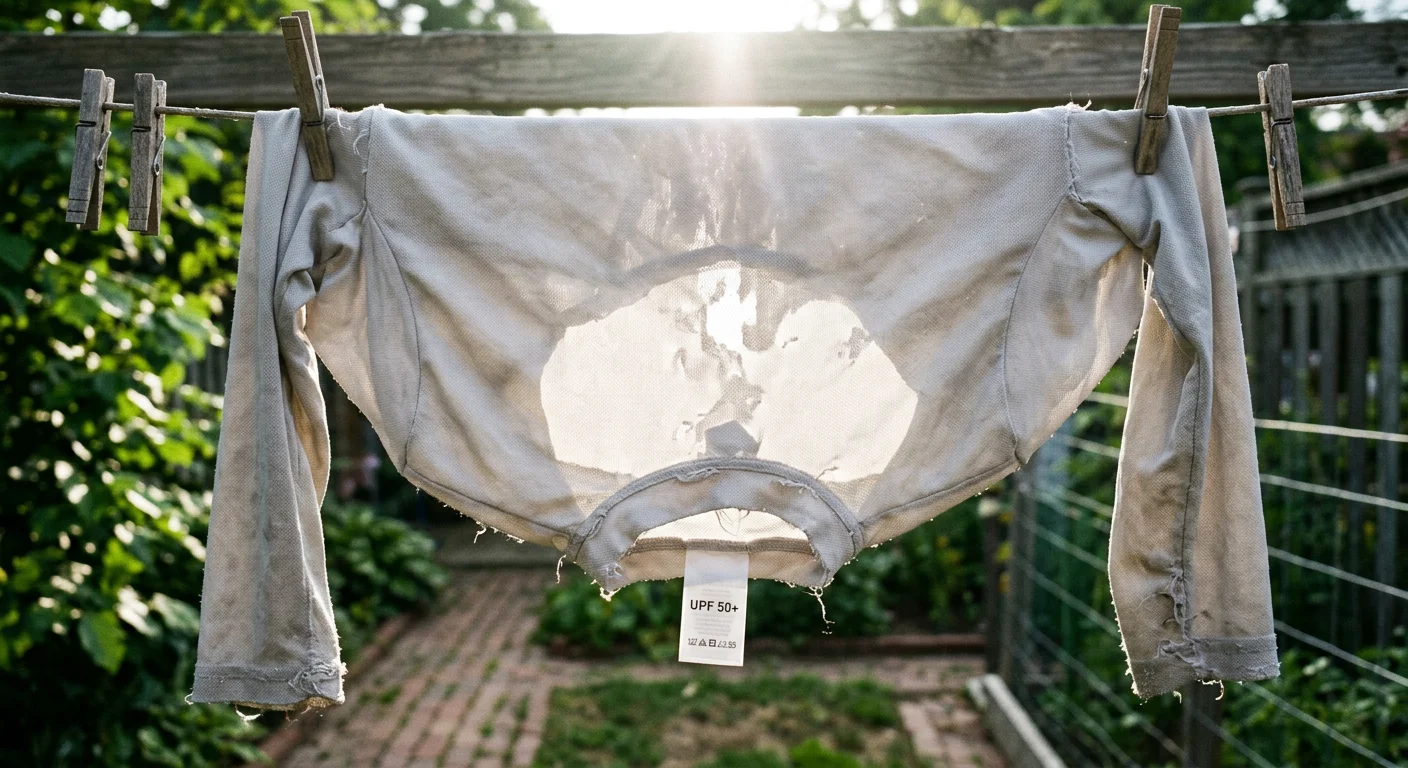
That UPF 50+ rating was accurate the day the fabric left the lab. What happens after 40 wash cycles is a different story.
Most sun shirt buyers never think about this. You get the certified garment, wash it, wear it hard — and assume the protection stays the same. It doesn't. UPF values decay over time. The rate depends on fabric construction, dye type, and how hard you treat the garment. Knowing that decay curve separates smart buyers from those wearing a false sense of security.
How Washing Degrades UV Protection
Every wash cycle puts mechanical stress on the fabric. That stress breaks down UV-blocking treatments at the fiber level — not all at once after cycle one, but building up across many cycles.
The chemistry matters here. UV absorbers and specialized dyes are sensitive to three things: detergent chemistry, UV exposure itself, and chlorine. Harsh detergents and fabric softeners speed up that breakdown. Enzymatic detergents — the kind sold as "powerful stain removers" — cause 8–12% UPF degradation in untreated light and white fabrics after repeated cycles. That's not a worst-case number. That's the industry benchmark.
Brands running compliance programs should know this: ASTM D6544 standardizes this aging simulation at 5 home laundering cycles before post-wash AATCC 183 testing. That protocol exists because the certification community saw early on that initial UPF ratings mean little without validated durability.
Fabric composition controls how fast that decay happens:
Tightly woven polyester and nylon carry UV blocking built into the fiber structure itself — washing breaks them down at a slow rate
Cotton and linen fabrics depend almost entirely on applied chemical treatments — those treatments fade faster and at a more predictable rate
Dark pigments (navy, black, charcoal) hold ≥98% UV blocking across 20+ wash cycles
Light-colored fabrics show measurable UPF decline much sooner
Physical Wear: Stretching and Wet Conditions
Washing isn't the only stress source. Physical wear creates its own path to degradation.
Friction and repeated stretching thin the fabric weave — creating gaps between yarns that weren't there on day one. The data is specific: stretched garments transmit 5–15% more UV due to less yarn coverage. That's a real difference. A garment rated UPF 50+ at rest can drop below UPF 40 when pulled tight across your shoulders during a paddling stroke.
Wet conditions make it worse. Water saturation drops UPF 10–30% in lightweight weaves without chemical UV absorbers by changing how the fiber bends light. A garment tested in dry conditions only — then marketed for swimming or water sports — doesn't give you the full picture.
Practical Lifespan: When to Replace
Plan to replace sun shirts worn on a regular basis every 2–3 years . Swim often or train outdoors every day? Move that timeline up.
The fastest field check needs no equipment: hold the garment up to a bright light source . See light coming through the fabric? The protection is gone — no matter what the original test report said.
To get the most life out of your sun shirt:
Wash in cold water with mild detergent — skip fabric softeners
Air dry instead of using a tumble dryer; heat breaks down UV treatments faster
Rotate between multiple garments to cut down wear on any single piece
Brands managing wholesale inventory or "UPF 50+ verified" warranty claims should follow the industry benchmark: re-test at 6-month intervals with documented UPF retention curves. That data backs up both your compliance standing and your customer promise.
The protection is real as long as the certification is real — but only if the garment still holds the condition that earned it.
Conclusion
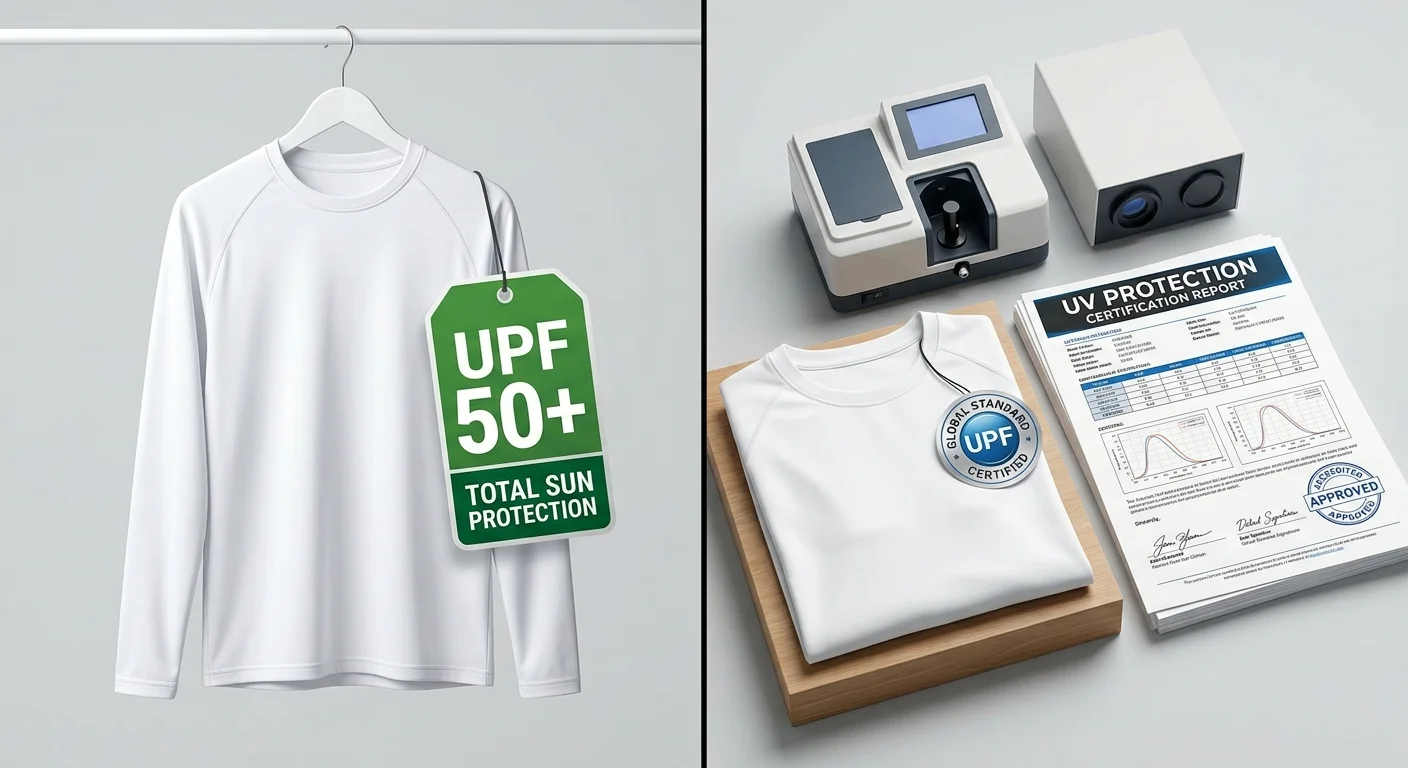
Here's the truth most sun shirt brands don't want you to know: printing a UPF 50+ label costs nothing. What does cost something — time, equipment, and third-party testing — is earning that label through real AATCC 183 testing .
Now you know the difference.
The standard is the same for everyone. Protecting your skin as a consumer or protecting your reputation as a brand — it doesn't matter. You need real spectrophotometer measurements. You need documented UVA/UVB transmittance data. You need a certified lab report you can trace and verify. Not a marketing claim. Not a self-assessment. A number backed by science.
So here's your next move. A sun shirt that can't show a traceable UPF fabric certification from an accredited third-party lab? Treat that UPF claim like an unverified review. Don't trust it.
Your skin blocks nothing. Make sure your shirt does.At the production level, working with experienced OEM/ODM custom apparel partners is what ensures UPF claims are backed by real, repeatable lab validation — not marketing shortcuts.