Every fishing apparel brand hits the same wall. China fishing clothing manufacturer quotes climb. Your accountant flags the Section 301 tariff exposure. Then someone in a Facebook sourcing group swears Vietnam changed their business.
But those conversations leave out the fishing-specific details that determine whether a factory switch saves you money — or costs you six months of quality nightmares. Things like sublimation print consistency on 100% polyester UPF fabrics. Moisture-wicking performance after 50 washes. Whether a Vietnamese cut-and-sew operation can hit your color-blocking specs on the first bulk run.
This guide breaks down China vs Vietnam fishing apparel manufacturing across three dimensions that matter:
Landed cost
Technical capability
Real-world lead time
You get real numbers here, not rough estimates.
Landed Cost Breakdown: FOB Unit Pricing & US Tariff Simulation
The number your China fishing apparel supplier quotes you is not the number that hits your P&L. That gap — between the FOB price on your purchase order and the actual landed cost in your US warehouse — is where sourcing decisions win or lose.
Here's the math most brands ignore: landed cost runs 20–40% above FOB . That's what happens once you stack international freight, customs duties, port handling, brokerage fees, inland trucking, and insurance on top of the supplier's unit price. For fishing apparel sourced from China, that gap has grown much wider thanks to Section 301 tariffs .
The True Cost Formula
Before we run the numbers, here's what you're paying for:
Landed Cost = FOB Price + International Freight + Insurance/QC Risk + Customs Duties + Broker & Documentation Fees + Port/Terminal Handling + Domestic Drayage + Overhead
Every one of those line items differs between China and Vietnam. The tariff line alone reshapes the entire sourcing decision for US-bound fishing apparel.
Side-by-Side Simulation: $6.18 FOB Performance Fishing Shirt
Take a sublimation-printed UPF fishing jersey at $6.18 ex-factory. Run that price through both origins and here's what you get:
Cost Component | China Origin | Vietnam Origin |
|---|---|---|
FOB Unit Price | $6.18 | $6.50–$6.80* |
Ocean Freight (per unit, LCL est.) | $0.35 | $0.40 |
Cargo Insurance | $0.08 | $0.08 |
MFN Duty (HS 6105, ~32% knit shirts) | $1.98 | $2.18 |
Section 301 Tariff (China only, 25%) | $1.55 | $0 |
Customs Brokerage & Fees | $0.18 | $0.18 |
Port/Terminal Handling | $0.12 | $0.12 |
Inland Drayage + Overhead | $0.20 | $0.20 |
Estimated Landed Cost | ≈ $10.64 | ≈ $9.56 |
*Vietnam FOB runs a bit higher due to fabric sourcing overhead and smaller-scale production efficiency — covered in the Cost section below.
The tariff gap alone is $1.55 per unit on a $6.18 FOB shirt. That's a 25% punitive add-on Vietnam fishing apparel suppliers don't carry. Scale that across a 5,000-unit run and you're looking at $7,750 in avoidable tariff exposure per order.
What the 1,000-Unit Scenario Looks Like
Running modest fishing apparel volumes? Here's a concrete allocation model:
FOB value : $10.00/unit × 1,000 units = $10,000
Freight : $2,800 (allocated by weight)
Customs duty : $800 (by declared value)
Insurance : $150
That adds $3.75/unit — pushing per-unit landed cost to $13.75 , or 37.5% above FOB . Add China's Section 301 surcharge, and that number climbs further. Vietnam's cleaner duty structure holds that allocation tighter.
The Gross Margin Reality
This matters beyond unit economics. Your gross margin formula is:
Gross Profit Margin = (Revenue – Landed Cost) / Revenue
Retail a moisture-wicking fishing shirt at $49.99 with a China-sourced landed cost of $10.64. Your gross margin sits at 78.7% . Switch to Vietnam at $9.56 landed, and it moves to 80.9% . That's a 2.2 percentage point margin gain per SKU — before any volume discount negotiation.
On a single shirt, that's not a big deal. Across a full fishing apparel line — jerseys, hoodies, sun shirts, performance pants — those points add up fast.
One Practical Audit Move
Before finalizing any sourcing decision, request both EXW and FOB quotes from the same factory for the same fishing apparel SKU. The gap between those two figures should equal inland trucking + export customs clearance + local port charges for that origin. A Vietnamese fishing apparel factory's FOB uplift over EXW looks inflated? You've spotted a cost padding problem before it ever reaches your landed-cost model.
Run your numbers through tools like the FedEx Duty & Tax Calculator or Tactical Logistic's landed cost calculator. Stress-test your HS code assumptions — especially for knit performance fishing shirts (HS 6105) versus woven UPF sun shirts (HS 6210). These two carry different MFN base rates and each reacts differently to Section 301 exposure.
The FOB price is just the opening bid. The landed cost is where you compete.
Technical Maturity Gap: Dye Sublimation Printing & UPF Fabric Processing
Most sourcing guides won't tell you this: the country you manufacture in matters less than whether that country's factories understand your fabric.
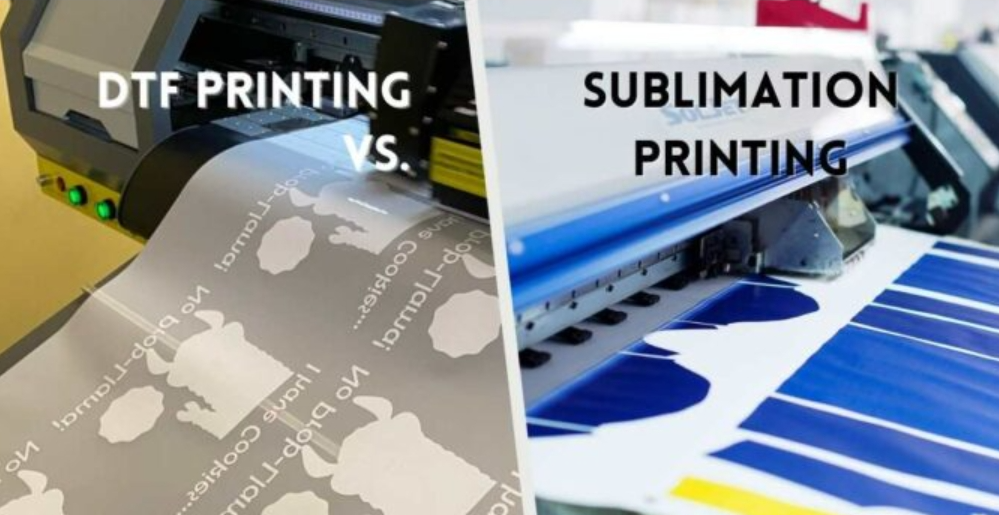
For fishing apparel, that distinction is everything. Sublimation printing on UPF polyester knits is not standard sportswear production. It's a demanding process. Calender temperature, ink laydown, transfer paper GSM, and fabric construction all interact at once. Get any one of those variables wrong — on a 130 gsm warp-knit UPF jersey — and you're looking at ghosting, color shift, or reduced UV protection. You won't catch it until your customer complains.
This is the gap between China and Vietnam right now. And it's wider than most buyers expect.
China's Sublimation Infrastructure: Deep and Integrated
The Guangdong clusters — Dongguan, Zhongshan, Foshan — and Zhejiang hubs in Shaoxing and Ningbo have built something that takes years to replicate. These regions run sublimation ecosystems inside or right next to cut-and-sew operations.
That means in-house roll-to-roll and flatbed dye-sub equipment — Mimaki JV300/JV330, Atexco Vega X, Homer HM series, Epson f -series — running fabric-specific ICC profiles tuned to each polyester knit construction: interlock, birdseye, piqué, warp knit. Not generic "130–150 gsm polyester" settings. Per-construction profiles.
Those profiles control everything:
Ink laydown limits : 220–260% total ink coverage for polyester knits — well below the 300%+ used on paper
Transfer paper GSM selection : 60–100 gsm, chosen based on fabric porosity
Calender temperature : 190–210°C, with dwell time at 30–60 seconds, dialed per fabric
Climate-controlled print rooms : maintained at 20–24°C and 45–55% RH to stop moisture-induced bleed
Chinese print operations run what's called a "scorch test" to set calender limits. They raise temperature and dwell time until the knit starts to yellow. Then they back off in 10-second steps to find the safe window for that specific fabric. This isn't a one-time setup. It repeats for every new fabric construction.
The result? Strike-off turnaround of 24–48 hours for new artwork. Same-day for repeat customers. That speed reflects infrastructure depth — not just effort.
Vietnam's Sublimation Capability: Real, But Built Differently
Vietnam is not incapable of sublimation printing. The real picture is more layered. Capability exists — but the supply chain structure creates friction. That friction shows up in your production timeline and print consistency.
Most Vietnamese garment factories — particularly in Binh Duong, Dong Nai, and Hai Phong — outsource sublimation to dedicated transfer houses . Many of those transfer houses are FDI Korean or Taiwanese-owned. That separation adds a full color-matching cycle:
File → test print → lab color check → revised ICC profile → second test print
That loop runs 3–5 days for outsourced sublimation in Vietnam versus 1–2 days for in-house operations in China. On a sampling round with five colorways, you've added a full week before a single stitch is cut.
The deeper issue is profiling discipline. Vietnamese factories with newer sublimation setups tend to run fewer, broader profiles — "medium-weight knit" rather than per-construction settings. Most rely on OEM RIP software presets. The practical results for fishing apparel:
Color shifts between production lots — fabric batches that vary even slightly in finish add-on percentage will produce inconsistent color
Ghosting on lightweight 120–140 gsm UPF jerseys — transfer temperature or dwell time isn't tuned per fabric
Lower chroma output on UPF-finished whites — UV-absorbing surface chemistry (benzotriazole derivatives, TiO₂ dispersions) affects ink diffusion, and a single generic profile won't account for that shift
Mature Chinese print rooms maintain separate profiles for "UPF-finished white" versus "standard optical white" polyester . That distinction matters. The UV-absorber finish reduces ink penetration depth. Without a profile adjustment, prints come out duller. Most Vietnamese operations haven't built that level of detail yet.
The UPF Fabric Supply Chain Gap
The printing gap comes with a second gap underneath it: fabric sourcing.
China's UPF polyester knit supply chain is local and dense. Shaoxing, Cixi, Haining, and Dongguan mills stock ready UPF-certified whites — tested to AS/NZS 4399 UPF 50+ or EN 13758-1 — as standard inventory. For common fishing shirt constructions (120–140 gsm 100% micro-polyester, 150–180 gsm poly/spandex blends), mid-tier mills cut to 50–100 meters per color for repeat customers. Solution-dyed and dope-dyed colors need higher MOQs (300–500 m/color), but smaller fishing apparel brands can still access the supply chain without a custom mill program.
Vietnam's UV knit supply picture is thinner by structure. Local mills that can produce consistent UPF 50+ warp knits are mostly FDI Korean or Taiwanese-owned . Their pricing reflects that:
800–1,500 meters per color for solution-dyed performance constructions
1,000 kg per PO minimums for high-performance knits
High yarn and lab setup costs that make small color runs cost-prohibitive
Smaller Vietnamese garment factories fill the gap by importing pre-finished UPF fabric — often from Korea, Taiwan, or China — on a per-container or multi-brand consolidation basis. That import cycle adds 2–5 weeks to fabric lead time compared to domestic Chinese sourcing. You're rebuilding part of China's supply chain inside Vietnam, at lower efficiency and higher cost per unit.
Performance Chemistry: What "Moisture-Wicking" Means at the Factory Level
For fishing apparel, moisture-wicking isn't a marketing phrase. It's a functional claim. Your customers are standing on a boat in 90°F heat. The finish needs to perform.
Chinese dye-houses serving fishing and sports labels in Guangdong and Zhejiang run structured performance finish portfolios:
Moisture-wicking : polyether-modified silicones or PEG-based finishes targeting >5–8 cm vertical wicking in 30 minutes
Quick-dry : aligned to <20–30 minute drying time per AATCC 201-2016 on lightweight UPF knits
Anti-microbial / anti-odor : silver, zinc, or quat-based, with growing OEKO-TEX Standard 100 Class II or Bluesign approval
Dope-dyed cationic polyester : available for deep shades — cuts post-dyeing water use and improves colorfastness under UV
Vietnam can access the same chemistry through multinational fishing apparel suppliers — Huntsman, Archroma, Rudolf, Nicca. The gap isn't chemical availability. It's application depth . Most Vietnamese dye-houses run 1–2 standard "quick-dry" or "wicking" formulas across their sportswear programs. Fewer operations run UPF optimization across different GSMs or multi-step performance recipes that combine wicking, UV absorption, and anti-odor in a single finish sequence.
Durability Reality: Lightfastness in Marine Environments
Here's a technical point most sourcing comparisons skip.
Dye-sublimated polyester holds up well for wash, sweat, and abrasion. Industry colorfastness targets for export fishing jerseys run AATCC 61 at Grade 4–5 for color change and staining. Both countries can hit that target with proper process control.
The weak point is lightfastness in full-sun marine environments . Industry data shows pigment and acid dye printing can deliver up to 5× better lightfastness than sublimation under high UV exposure. That's not a China vs. Vietnam issue. It's a technology limitation that applies to both.
Where the two countries split is in how they compensate for it. Experienced Chinese fishing apparel suppliers often use a dope-dyed base shade — medium grey, light blue — combined with sublimation graphics. The base fabric color carries UV stability. Sublimation adds the design detail on top. This hybrid approach cuts visible fading sharply over 6–12 months of heavy use.
Vietnamese fishing clothing suppliers more often default to full-panel sublimation on optical-white base fabric — the simpler setup, but with higher visible fade risk over a real fishing season.
QC Benchmarks: What Mature Sublimation Programs Test
Evaluating a Vietnamese factory's sublimation capability? Ask for documentation against these benchmarks — the same ones established Chinese fishing apparel supply chains treat as baseline:
QC Parameter | Industry Benchmark | China (Mature Operations) | Vietnam (Emerging) |
|---|---|---|---|
Wash Colorfastness (AATCC 61) | Grade 4–5 | Documented consistently | Variable; less regularly audited |
Lightfastness (AATCC 16 xenon-arc) | Grade 4 after 20 hours | Applied for major brand programs | Less commonly specified |
UPF Verification (AS/NZS 4399) | UPF ≥ 40 (mean ≥ 50) | Routine; re-tested post 40–50 washes | Inconsistent post-wash verification |
Seam Stretch Recovery | >90% recovery at 50–80% extension | Standard flatlock QC protocol | Depends on factory tier |
Calender Temp Uniformity | ±2–3°C across width | Monitored with per-printer setting charts | Often operator-dependent |
The pattern holds across every technical dimension: China's fishing apparel sublimation ecosystem is deeper, more profiled, and more consistently audited. Vietnam's capability is real — but narrower. It's concentrated in higher-tier FDI factories, and still building the fabric-specific process discipline needed to prevent lot-to-lot variation.
That doesn't make Vietnam the wrong choice. It means your quality outcomes in Vietnam depend on which factory tier you access — a decision that takes more due diligence than finding the lowest FOB price.
Full Production Lead Time: Sampling, Bulk Manufacturing & Logistics Timeline
Lead time kills more fishing apparel launches than bad design ever will.
You can have the perfect UPF jersey spec, a clean tech pack, and a competitive FOB price — and still miss your Q2 drop window. The reason is simple: the full production cycle takes longer than most brands expect. Here's the framework you need before you commit to either origin.
The Formula Nobody Posts in Facebook Groups
Total Lead Time = Sampling + Bulk Production + Shipping & Customs + Warehouse Receiving
That's it. Each block carries a different risk profile, though. It depends on whether your order moves through a mature Chinese supply chain or an emerging Vietnamese one.
Here's the full timeline broken down by stage:
Phase | China | Vietnam |
|---|---|---|
Sampling (simple styles) | 2–3 weeks | 3–5 weeks |
Sampling (complex sublimation fishing jerseys) | 3–5 weeks | 5–8 weeks |
Bulk manufacturing | 4–6 weeks | 5–8 weeks |
Ocean freight to US port | 3–4 weeks | 3–5 weeks |
Port handling + drayage + receiving | 1–2 weeks | 1–2 weeks |
Realistic full cycle | 11–17 weeks | 14–23 weeks |
Vietnam's sampling window runs longer for one structural reason: outsourced sublimation adds a full color-matching loop. That loop adds 3–5 extra days per colorway before a single panel gets cut. Run a fishing jersey line with five colorways and two size runs, and that gap compounds fast.
Where Chinese Factories Compress the Timeline
China's advantage isn't just speed. It's integrated compression across multiple phases at once.
Stock UPF fabric availability : Shaoxing and Dongguan mills carry ready-to-cut UPF 50+ polyester knit inventory. Fabric lead time for standard fishing shirt constructions runs 1–2 weeks from local mills. Vietnam's imported fabric pipeline adds 2–5 weeks before cutting even starts.
Strike-off turnaround : In-house sublimation operations in Guangdong return print strike-offs in 24–48 hours . Vietnamese outsourced transfer houses need 3–5 days — and that's per revision cycle, not per colorway.
Trim and packaging sourcing : Zippers, reflective piping, moisture-wicking hang tags, performance label stock — Chinese fishing apparel clusters have all of it within a 30-minute truck radius. Vietnamese factories often source these on consolidated import runs. Specialty trims add 3–6 weeks if you don't pre-plan.
The Bulk Production Reality
Sampling clears, and bulk manufacturing kicks off. Both countries run on a similar base timeline: 4–8 weeks for cut-and-sew performance fishing apparel . The gap narrows here, but it doesn't disappear.
Chinese factories handling fishing apparel sublimation at scale follow structured production blocks:
Fabric inspection and spreading: Day 1–2
Print run (roll-to-roll sublimation): Day 2–4
Cutting: Day 3–5
Sewing and assembly: Day 5–18
Finishing, QC, and packing: Day 18–25
A well-run Vietnamese Tier 1 FDI factory can hit similar milestones — but only with fabric and trims already in-house at order confirmation. Any procurement gap pushes that block out further. Your tech pack must be fully locked at PO placement. Miss that, and add 2–4 weeks to your Vietnam estimate right away.
Logistics: Where Vietnam Can Surprise You
This is one area where Vietnam closes the gap. Transit times from Ho Chi Minh City and Hai Phong to US West Coast ports run 18–22 days on direct services. Shanghai comes in at 16–20 days . The port efficiency gap that existed five years ago has closed for major container routes.
Logistics breakdown for both origins, US-bound:
Factory to origin port : 1–3 days
Port handling and loading : 2–5 days
Ocean transit : 16–22 days (both origins, USWC)
US customs clearance : 2–5 days
Inland drayage + warehouse receiving : 3–7 days
Total logistics time: 3–5 weeks , regardless of origin. This phase is a wash either way.
The Planning Trigger You're Missing
Most fishing apparel brands back-calculate from their launch date. That's the wrong starting point.
The correct trigger is fabric confirmation — the date your supplier confirms UPF fabric stock availability or custom fabric delivery. Everything downstream — sampling, bulk, logistics — runs from that anchor point, not from your PO date.
China sourcing with stock fabric: your realistic full-cycle planning window is 12–16 weeks from first inquiry to US warehouse receipt. Vietnam with imported UPF fabric and outsourced sublimation: plan 16–22 weeks for the same product complexity. Miss that buffer, and you're air-freighting at 4–5× the ocean freight cost — or launching late.
Run your timeline with confirmed fishing wear supplier dates, not estimates . A supplier saying "around 6 weeks" is not the same as a written production schedule with fabric delivery confirmation. One gets you to your drop date. The other gets you explaining a stockout to retail buyers.
MOQ Flexibility & Trim Sourcing: Scaling Customization for Emerging Brands
Minimum order quantities are the silent killer of emerging fishing apparel brands. And the number your supplier quotes isn't the only MOQ that matters.
Most buyers fixate on the garment MOQ. The real constraint is the stack of MOQs sitting underneath it: fabric minimums, trim minimums, and print minimums — all running on separate tracks. Miss any one of them and you're stuck choosing between paying surcharges, simplifying your design, or dropping the colorway altogether.
Here's how China and Vietnam compare on this — with real numbers.
The MOQ Landscape by Country
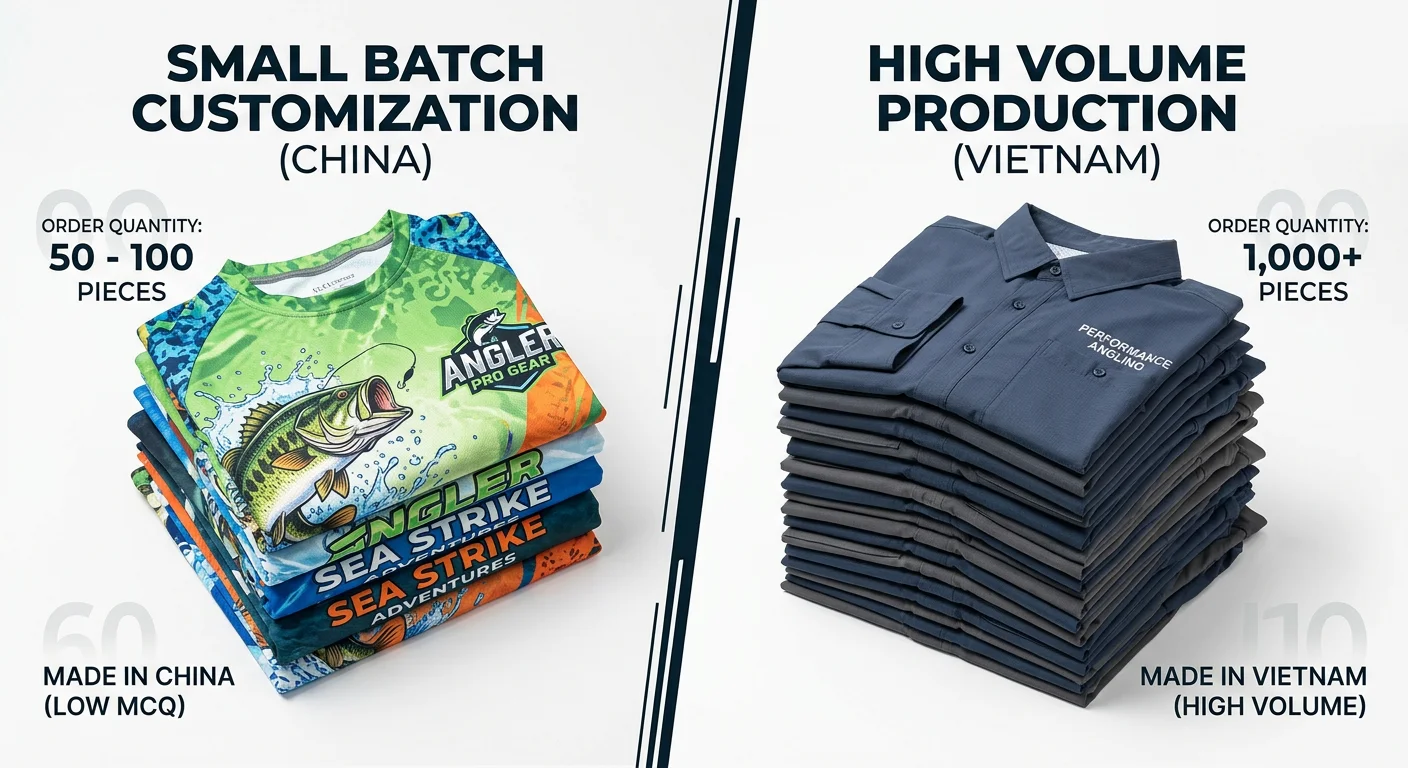
For sublimation-printed performance fishing jerseys , China's smaller custom teamwear and fishing apparel factories advertise starting MOQs of 100–300 pcs per design . Size and name customization can run within the same print block. Mid-to-large Chinese export factories raise that floor to 500–1,000 pcs per style/color — but the trim ecosystem picks up the slack. Woven labels, YKK zippers, silicone patches, and reflective piping are all within a 30-minute truck radius. So factories can flex down to 50–300 pcs per style as long as you consolidate trim specs across your range.
Vietnam's export factories work in a different range: 500–3,000 pcs per style/color is the realistic band. Drop below 500 pcs and most Vietnamese operations add a +15–25% FOB surcharge to cover line inefficiency. That surcharge wipes out Vietnam's tariff advantage before you've shipped a single unit.
The Trim Sourcing Gap Nobody Talks About
Standard trims — generic zippers, basic elastic, woven labels in stock colors — are easy to source in Vietnam, with lead times close to China. That works fine for a basic performance top.
Fishing apparel is not a basic performance top.
The category-specific trims that define a premium fishing jersey — magnetic net releases, co-molded rubber patches, specialty cord locks, complex waterproof zipper variants — almost always get cross-shipped from China to Vietnamese factories. That cross-border move adds 1–2 weeks per trim category. It also creates import admin overhead that makes small, SKU-diverse orders a logistical headache. Vietnamese factories push back by steering brands toward fewer colorways and simpler trim menus — the exact opposite of what a standout fishing apparel line needs.
The Sub-1,000-Piece Math
For orders under 1,000 pcs per style, China's integrated ecosystem beats Vietnam on net unit economics — even with Section 301 tariffs factored in. The logic is simple:
Fabric, printing, and trims all come from the same regional cluster
No cross-border logistics cost per component
Stock materials available for 50–100 pcs test runs
Small-lot sublimation batches at 100–300 pcs/design are standard practice, not a special request
Vietnam's tariff advantage starts to outweigh these friction costs once you hit 3,000+ pcs per style with stable, repeat colorways . Below that threshold, surcharges, import delays, and trim consolidation complexity eat through the duty savings.
The Hybrid Model Worth Considering
Some experienced sourcing teams use a smarter structure: keep sublimation printing and specialty trim sourcing in Guangdong, then ship pre-printed panels or semi-finished pieces to Vietnam for cut-and-sew and final assembly .
The practical result:
Technical risk stays in China — sublimation ICC profiling and UPF fabric handling are both mature there
Tariff savings happen in Vietnam — value-added assembly can qualify for favorable duty treatment at scale
MOQ math works on both ends — run 100–300 pcs per design through China's print houses, then pool assembly in Vietnam across a few designs that share the same base body and trim set to hit the sewing line minimum
Practical Checklist: MOQ Strategy for Emerging Fishing Apparel Brands
Before placing your first order from either country, run your design through these four checks:
Consolidate trims : use the same zipper type, color, and slider across 3–5 styles; pick one woven label and one heat-transfer artwork for your full first collection
Share print bases : one white polyester base fabric across multiple sublimation graphic runs keeps your fabric MOQ fixed while artwork changes freely
Use stock trims for early runs : standard YKK black or navy, generic silver reflective tape, open-stock cord locks — don't commit to 1,000+ pcs of a custom trim before your design is locked
Plan 2–3 sampling rounds : prototype with open-stock library trims first; move to custom components after bulk specs are confirmed
The bottom line: China is the clear choice for sub-1,000-piece fishing apparel customization . Vietnam earns its spot in your supply chain once volumes hold above 3,000 pcs per style — or the hybrid print-in-China, sew-in-Vietnam model fits your range.
Sourcing Decision Matrix & Vetting Checklist for Production Allocation
You already have the cost data, the technical gap analysis, and the lead time numbers. Now you need a system that turns all of that into an actual decision.
Below is the weighted model sourcing teams use to split production — plus the vetting checklist that stops you from handing volume to the wrong fishing apparel factory.
The Decision Matrix: Five Criteria, Weighted by Impact
Score each factor 1–5. Multiply by the weight. The total tells you where your order belongs.
Criteria | Weight | Vietnam Fits When... | China Fits When... |
|---|---|---|---|
Quality / Compliance | 30% | Factory holds AATCC, UPF, OEKO-TEX docs | Complex sublimation, gradient prints, tight spec tolerance |
Landed Cost | 25% | 30k+ pcs/year, Section 301 tariff exposure | Sub-3k pcs; surcharges erase duty savings |
Lead Time / Flexibility | 20% | >70-day timeline; stable, repeat styles | <45-day window; rapid restock or market test |
Communication & Responsiveness | 10% | Tier 1 FDI factory with English merchandisers | Integrated account management; faster revision cycles |
MOQ / Scalability | 10% | High-volume basics; color-block, low-SKU runs | Sub-1,000 pcs custom; multi-colorway fishing jerseys |
Packaging / Integration | 5% | Regional inspection partners established | Hangtags, labels, barcodes, cartons — one ecosystem |
The short version: Pick Vietnam for high volume, repeatable styles, real US tariff exposure, and timelines over 70 days. Pick China for under 3,000 pcs per style, high print complexity, or restock speed under 45 days.
The Vetting Checklist: Five Non-Negotiables Before You Award Volume
1. Confirm sublimation is in-house — not outsourced.
Ask the fishing clothing factory straight: "Is printing done on your floor or through a subcontractor?" In-house sublimation gives you faster strike-offs, tighter color repeatability, and one fewer handoff point for lot-to-lot variation. Outsourced printing in Vietnam adds 3–5 days per color cycle.
2. Request actual test reports — not generic certifications.
You need AATCC wash fastness, crocking, and perspiration results. Make sure they tie to a specific fabric lot and batch code. UPF test reports need post-wash verification covering 40–50 wash cycles — not just base fabric testing. Ask for the lab name, test date, and article number.
3. Audit responsiveness before you send a tech pack.
Set a clear target: under 48 hours for quote response, tech pack clarification, and sample feedback. A factory that takes five days to answer a measurement question will take three weeks to fix a bulk defect. That pattern shows up early — pay attention to it.
4. Lock AQL 2.5 inspection rights in writing.
For performance fishing apparel, AQL 2.5 is the standard baseline for major defects. Make sure the factory accepts your nominated third-party inspector. They must also hold shipment until test results come back. Push back from the factory on this point? That's your answer right there.
5. Verify MOQ at every level.
The garment MOQ is just the number on the surface. Check minimums by color, size run, fabric order, and print method — each one. Get the sample fee policy, bulk price breaks, and packaging surcharges in writing before you commit to anything.
How to Pilot Without Blowing Your Budget
Don't shift your entire production allocation based on one sourcing decision. Run a 70/30 pilot split first. Put 70% of one style group in your established hub and 30% in the new one. Sample at least three colorways in parallel. Lock fabric contracts 120 days out for dyed polyester and UPF knits.
Move to a primary hub after three back-to-back on-time deliveries. Stable inspection pass rates and confirmed landed cost need to back that up. That's the data that actually matters — not a fishing apparel supplier's pitch deck or a sourcing group recommendation.
Conclusion
The numbers don't lie. After breaking down landed costs, sublimation printing, lead times, and MOQ realities, the answer isn't "China or Vietnam." It's which one, and for what job.
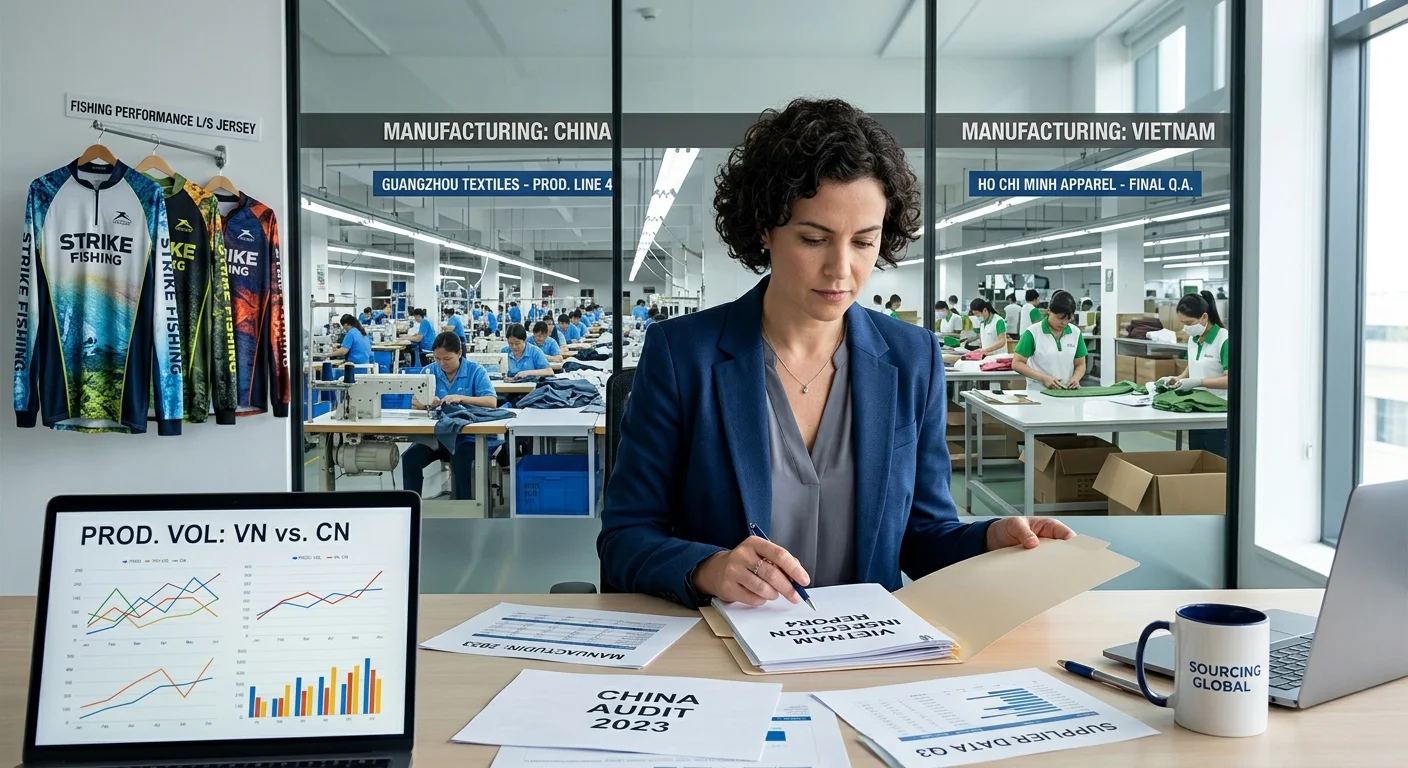
China holds the technical edge on complex UPF fishing shirt production. It also handles tight deadlines better. Vietnam beats China on tariff-adjusted landed cost for U.S.-bound orders. Section 301 pressure isn't fading anytime soon — that gap will stay.
Smart sourcing managers aren't picking one country and walking away. They're allocating . Here's how that breaks down:
High-complexity SKUs with tight deadlines → Stay in China
Proven, repeatable styles → Move to Vietnam once the fishing apparel factory relationship is solid
Brands that treat this as a binary choice are the ones getting burned.
So here's what to do next:
Use the decision matrix
Run your own landed cost simulation
Visit both factories before you spend a dollar on tooling
Your supply chain is your competitive moat. Treat it that way. Build it with intention, and it becomes one of the hardest things your competitors can copy.