You've Googled "factory direct fishing apparel " before. You landed on a dozen supplier pages, all claiming the lowest prices and highest quality. That part is easy. The harder question is whether the channel you choose will eat your margins before you catch the damage.
Take this example: a trading company quotes $8.50 per UPF 50+ performance shirt. A factory quotes $6.20 FOB. The factory looks cheaper — but add in failed fabric tests, communication delays, and a 300-piece defect write-off. That $6.20 price can end up costing you more.
This guide breaks it down with a clear cost model. We compare three real order volumes — 500, 2,000, and 10,000 units. You'll see the exact break-even point where direct factory sourcing for fishing apparel shifts from a risky bet to a real profit margin advantage.
FOB Price & Production Cost Breakdown by Order Volume
Most sourcing guides skip this part: the FOB price on a fishing apparel supplier's quote sheet is just the starting point. The number that drives your margin is what that price becomes after you spread fixed costs across your order volume.
That spread is where everything shifts.
Why Fixed Costs Are the Hidden Variable
Every fishing apparel order carries two layers of fixed costs. These have nothing to do with how many pieces you buy:
Factory setup costs per style:
- Cutting dies, sublimation plate setup, pre-production samples: $100–300 per style
Export/FOB leg costs per shipment:
- Export customs declaration: ~$50
- Documentation, terminal handling, THC: ~$175
- Total: ≈$225 per order
Add those together and you're looking at $325–525 in fixed costs per style, per shipment — before a single shirt is cut.
Here's what happens when you spread that number across different order quantities:
Order Volume | Fixed Cost Per Unit | Impact on FOB Price |
|---|---|---|
100 pcs | $3.25–5.25 | Devastating |
500 pcs | $0.65–1.05 | Significant |
2,000 pcs | $0.16–0.26 | Manageable |
10,000 pcs | $0.03–0.05 | Negligible |
This explains why a 500-piece trial order feels expensive even with a low base manufacturing cost. You're carrying the full fixed-cost burden on a small quantity.
FOB Price Bands by Product Type and Order Volume
These benchmarks come from Asian sportswear supplier quotes (2023–2025). They're adjusted for fishing apparel's specific needs: UPF performance fabrics, sublimation printing, and technical construction.
1. Basic Quick-Dry Fishing Shirt
100% polyester, full sublimation, UPF 30+, 130–150 gsm, long-sleeve
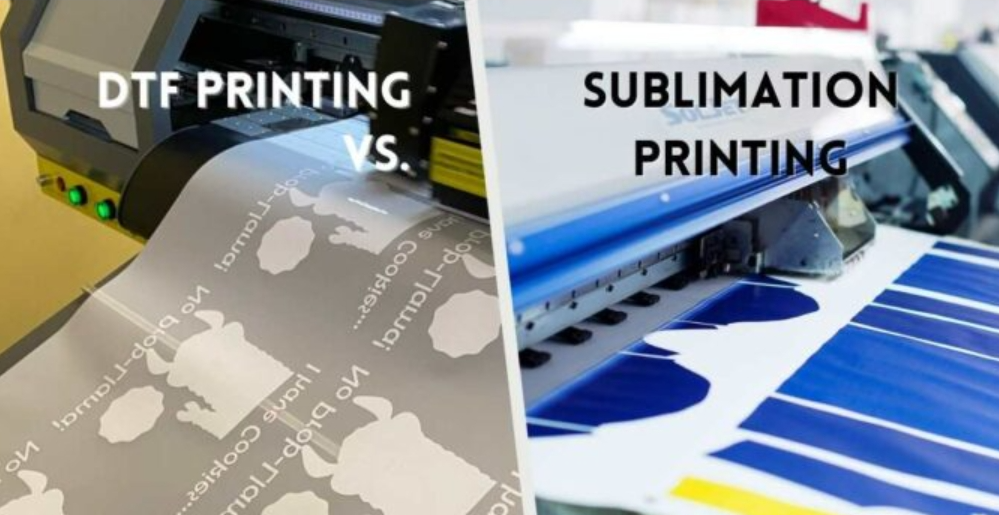
The cost structure here is straightforward. Fabric runs $1.20–1.60/pc . Cut-and-sew labor adds $1.20–1.80/pc . Sublimation printing — inks, setup, spread across units — runs $0.60–1.20/pc depending on volume. Packing, labels, and polybag add $0.20–0.30/pc .
Order Volume | Direct Factory FOB | Trading Company FOB | Trading Markup |
|---|---|---|---|
500 pcs | $5.00–7.00 | $5.50–9.00 | 10–30% |
2,000 pcs | $4.80–6.20 | $5.30–7.50 | 10–15% |
10,000 pcs | $4.20–5.50 | $4.60–6.00 | 5–10% |
Look at what happens between 500 and 2,000 pieces on the factory side: the per-unit price drops about $0.80 on the low end. That drop comes from setup and FOB fixed cost amortization — not from the factory giving you a better deal out of goodwill.
2. Technical Fishing Hoodie
Poly-spandex blend, UPF 50+, thumb holes, flatlock stitching
Move up to a technical hoodie and the cost structure changes fast. Spandex-blend fabric, heavier GSM, and flatlock seam construction add $1.30–2.60/pc in materials and labor compared to a basic shirt. The hood pattern alone brings extra fabric waste and cutting complexity.
Order Volume | Direct Factory FOB | Trading Company FOB | Trading Markup |
|---|---|---|---|
500 pcs | $8.00–12.00 | $9.00–15.00 | ~15–25% |
2,000 pcs | $7.00–10.00 | $8.00–12.00 | ~15–20% |
10,000 pcs | $6.00–9.00 | $6.50–10.00 | ~5–15% |
At large volumes, some trading companies price close to factory level to protect long-term relationships. That 5–15% margin at 10,000 pieces is real, but it's thin.
3. Breathable Fishing Bibs / Rain Jacket
2.5L PU/TPU membrane, taped seams
This is where sourcing complexity spikes. Membrane fabric alone runs $3.00–5.50 per meter , and each garment uses 1.7–2.5 meters. Seam taping — labor, tape material, plus QC verification — adds another $3–7/pc . Third-party waterproof and breathability testing (water column 10k–20k mm) costs $150–400 per style . Trading companies often bury this cost inside their quotes without breaking it out.
Order Volume | Direct Factory FOB | Trading Company FOB |
|---|---|---|
300–600 pcs | $20–45 | $23–55 |
The 15–25% trading markup on technical outerwear isn't random price-gouging. It covers real risk: taping verification failures, membrane delamination, lab test resubmissions. Whether that protection is worth it depends on your team's technical experience with this category.
4. Neck Gaiters / Buffs
140–160 gsm sublimation polyester
Low material cost, low labor — but fixed costs hit hard on small runs.
Order Volume | Direct Factory FOB | Trading Company FOB |
|---|---|---|
1,000+ pcs (mixed prints) | $0.40–0.70 | $0.55–1.00 |
5,000+ pcs (single print) | $0.30–0.45 (EXW) | Market rate |
Trading margins of 20–40% on commodity items like gaiters are common. At scale, they're hard to justify. At 5,000+ pieces, the math for going direct is obvious.
The Break-Even Calculation: Direct Sourcing — Does It Win?
Let's run a clean numeric model using a basic fishing shirt.
Assumptions:
- Fixed per-style costs (setup, sampling, tech pack): $400
- Fixed export/FOB leg per shipment: $225
- Variable manufacturing + packing (EXW): $3.60/pc
- Factory margin target: 15%
Effective cost per unit at 500 pieces:
- Variable cost: $3.60
- Setup amortization: $400 ÷ 500 = $0.80
- FOB leg amortization: $225 ÷ 500 = $0.45
- Pre-margin cost: $4.85/pc
- With factory margin: ≈$5.58 FOB
At that price, a trading company quoting $6.50–7.00 adds $0.90–1.40 per unit. On 500 pieces, that's $450–700 in total markup . It's real money — but it can also be real value. If they're handling QC, testing coordination, and communication you'd otherwise manage yourself, that cost has a return.
The real cost inflection point for most sourcing programs sits between 1,000 and 3,000 pieces per style per color. Below that, trading company margins often match or fall below the hidden costs of direct factory management: communication friction, sample revision rounds, QC trips, and defect absorption. Above 3,000 pieces, direct factory economics become hard to argue against — as long as you have the systems to manage production on your own.
That's the threshold this entire sourcing decision comes down to.
Hidden Costs & Operational Risks: Time, Defects, and Inventory
The FOB price gap between a factory and a trading company looks clean on a spreadsheet. What that spreadsheet won't show you is the operational drag that eats your margin after the order is placed.
This is where most first-time importers get hurt — not on the quote, but on everything that comes after it.
The Time Tax Nobody Quotes You
Source fishing apparel direct from a factory, and you absorb all the communication overhead yourself. Chasing pre-production samples. Resolving UPF fabric substitutions mid-production. Coordinating third-party lab tests for performance claims. Each of these touchpoints costs real hours.
A rough estimate: 15–25 hours of management time per style per season for buyers without established factory relationships. At $50/hour opportunity cost, that's $750–1,250 in hidden labor cost per style before a single unit ships.
Trading companies take on most of that friction. Their margin isn't just markup — it's also a service fee for keeping that workload off your plate.
Defect Risk Is Not Spread Evenly
Here's the part that stings: defect exposure is far higher in direct factory sourcing. This is especially true for technical fishing apparel categories.
Take sublimation fishing shirts with UPF 50+ claims. Factories may swap fabric lots mid-run without telling you. A different GSM or polyester blend can cause color shift, UPF degradation, or hand-feel inconsistency across a 2,000-piece run. No on-site QC or third-party inspection means you won't catch it until the goods arrive .
The numbers hit hard at small volumes:
Defect Rate | Order Size | Defective Units | Write-Off Cost (@ $6 FOB) |
|---|---|---|---|
3% | 500 pcs | 15 units | $90 |
3% | 2,000 pcs | 60 units | $360 |
5% | 2,000 pcs | 100 units | $600 |
That write-off cost doesn't include return shipping, re-inspection fees, or replacement lead time. All of those pile up fast when you're managing the factory relationship on your own.
Inventory Overcommitment: The Slow Bleed
High MOQ thresholds at direct factories push buyers into overbuying. A factory requiring 1,000 pieces minimum per colorway forces you to either consolidate SKUs or sit on inventory you can't move.
Excess fishing apparel inventory carries a clear set of risks:
- Seasonal obsolescence — fishing apparel designs tied to annual releases lose value fast
- Storage costs — $0.50–1.50/unit/month depending on 3PL arrangement
- Capital lockup — funds stuck in slow-moving SKUs can't fund next season's bestsellers
Trading companies often accommodate 300–500 piece minimums with mixed colorways . That's a real structural edge. You can test SKUs before locking in capital at scale.
The real hidden cost isn't any single line item. It's time, defects, and overstock hitting at the same time — on a margin structure that was already thin.
Profit Margin Impact & Exact Break-Even Threshold Calculation
The margin difference between direct factory and trading company sourcing is real — but it's smaller than most buyers expect. Below a certain order volume, that difference disappears. Here's the exact math.
The Per-Unit Margin Gap (Direct vs. Trading)
Start with a simple retail example. Your UPF 50+ fishing shirt sells at $49 .
Direct factory route : landed cost ≈ $8 (FOB + ocean freight + 15% import duty + inland) → gross profit $41, margin ~84%
Trading company route : landed cost ≈ $10 → gross profit $39, margin ~80%
That's a $2 difference per unit . Doesn't sound like much. Run the numbers at volume, though:
Order Size | Extra Gross Profit (Direct vs. Trading) |
|---|---|
500 pcs | ~$1,000 |
1,000 pcs | ~$2,000 |
2,000 pcs | ~$4,000 |
At wholesale ($24/unit), the gap holds: direct sourcing nets ~$16/unit (66% margin) vs. ~$14/unit (58% margin) through a trader. Same $2 gap — just at a lower dollar level.
Per-unit math always favors going direct. The real question is whether the fixed overhead of managing your own factory relationship cancels that advantage out.
The Real Fixed Costs of Going Direct
Most sourcing articles skip this number. Source direct, and you absorb costs that a trading company quietly bundles into their markup:
Pre-shipment inspection (AQL 2.5): $150–$300/order
Tech pack development for a new style: ~ $250 (5 hrs × $50/hr opportunity cost)
Defect risk provision (2% defect rate × $3 rework/emergency cost): ~ $60 per 1,000 pcs
Communication and coordination overhead: $150–$300/order
Total: $500–$700 in fixed direct-sourcing overhead per order — and that's a conservative figure. A trading company absorbs most of this into their markup. Their added fixed cost to you is closer to $0–$100 .
The Break-Even Formula (Exact)
Here's the model:
Q* (Break-Even Units) = f ÷ ΔC
Where:
- F = fixed overhead cost of direct sourcing per order ($500–$700 base; up to $1,500 once sampling rounds and time costs are included)
- ΔC = per-unit cost saving vs. trading company ($2–$3 typical)
Running the numbers:
Scenario | F (Fixed Overhead) | ΔC (Per-Unit Saving) | Break-Even Q* |
|---|---|---|---|
Conservative | $600 | $2 | 300 pcs |
Midpoint | $700 | $3 | ~233 pcs |
Full cost (incl. time, sampling risk) | $1,500 | $1.50–$2.00 | 750–1,000 pcs |
The basic math puts your break-even at 300 pieces. But the full-cost scenario tells a different story. Factor in communication friction, sample revisions, and quality risk — costs that are harder to pin down — and the real operational threshold lands closer to 1,000 pieces per style per color .
Practical rule : Below 1,000 pcs/order, a trading company's total landed cost often matches or beats direct sourcing once hidden costs are counted. Above 1,000 pcs, direct starts pulling ahead. Above 2,000–2,500 pcs, the case for direct sourcing is hard to argue against.
Where Scale Breaks the Equation Wide Open
At 2,000+ pieces, factory volume discounts kick in — a 10–15% drop in FOB price versus small-run rates. On a $10 landed cost, that's $1.00–$1.50 per unit in extra savings that a trading company won't pass through to you.
2,000 pcs × $1.00 saved = $2,000
2,500 pcs × $1.50 saved = $3,750
Both figures clear the $500–$1,500 fixed overhead of direct sourcing — by a wide margin. At that point, the break-even stops being a question. Staying with a trading company is leaving measurable profit behind.
At 10,000+ units per year , the math becomes hard to ignore:
10,000 pcs × $2–$4 margin gap = $20,000–$40,000 in additional annual gross profit
That covers a dedicated QC representative in China ($12k–$24k/year) or a retained third-party inspection firm (~$7,500/year for 30 inspections)
At that volume, direct factory sourcing isn't just an option — it's the only rational margin decision
The One Number to Keep in Mind
Take one figure away from this section:
~1,000 pieces per style per color is your directional break-even threshold for fishing apparel direct sourcing.
Below that number, a trading company's built-in support — QC management, communication handling, flexible MOQs — often delivers more value than their markup costs. Above it, every piece you buy through a middleman is a direct, measurable transfer of your margin to theirs.
Decision Matrix: 6 Core Sourcing Dimensions Compared
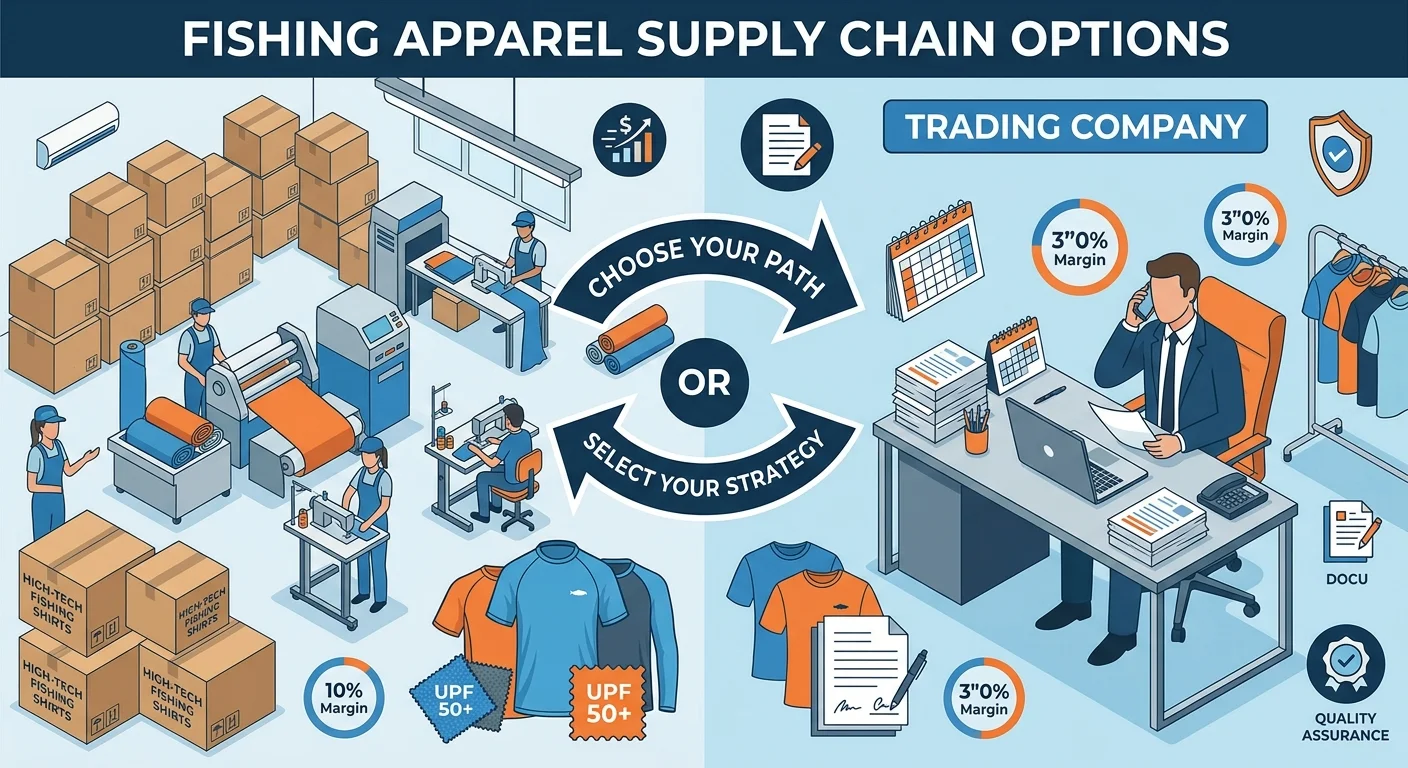
Six dimensions. Two fishing apparel and accessories supplier types. One decision that shapes your entire fishing apparel margin structure.
The break-even math from the previous section shows when direct factory sourcing makes financial sense. This matrix shows whether you're ready to run it — and where each channel wins over the other.
Each dimension is scored 1–5 and weighted by real-world impact for a mid-size fishing apparel brand. Use it as a scoring sheet against your current fishing wear supplier.
The Weighted Scoring Model
Dimension | Weight | Direct Factory | Trading Company |
|---|---|---|---|
Price Competitiveness | 30 | ⭐⭐⭐⭐⭐ (5) | ⭐⭐⭐ (3) |
MOQ & SKU Flexibility | 15 | ⭐⭐ (2) | ⭐⭐⭐⭐⭐ (5) |
Quality Control | 20 | ⭐⭐⭐–⭐⭐⭐⭐ (3–4) | ⭐⭐⭐⭐–⭐⭐⭐⭐⭐ (4–5) |
Communication Efficiency | 15 | ⭐⭐ (2) | ⭐⭐⭐⭐⭐ (5) |
Lead Time Stability | 10 | ⭐⭐⭐ (3) | ⭐⭐⭐⭐ (4) |
After-Sales Response | 10 | ⭐⭐ (2) | ⭐⭐⭐⭐ (4) |
Weighted Total (max 500):
- Direct Factory: ~295–320
- Trading Company: ~390–415
At moderate order volumes, trading companies score higher on a weighted basis. Direct factories close that gap fast once volume crosses 2,000 pieces. But that requires you to have systems in place to cover their weak spots in the bottom four dimensions.
Here's what each score means in the fishing apparel context.
Dimension 1: Price Competitiveness (Weight: 30)
Direct Factory: 5 / Trading Company: 3
Direct factories win on price — but scale is the condition. For UPF 50+ performance fishing shirts from China or Vietnam, these are the benchmark FOB price bands:
Order Volume | Direct Factory FOB | Trading Company FOB |
|---|---|---|
300–500 pcs/style | $7.50–$9.50 | $8.50–$11.00 |
1,000–1,999 pcs/style | $6.50–$8.00 | $7.50–$9.50 |
≥2,000 pcs/style | $5.80–$7.20 | $6.50–$8.50 |
That 10–25% FOB drop between a 500-piece run and a 2,000-piece run isn't generosity. It's fabric bulk purchasing at work. Knit fabric dye lots run 800–1,200 meters per color. Hit that threshold and you unlock real material cost reductions. Longer production runs also improve marker efficiency by 2–5%, which adds to the savings.
Trading companies add a 10–15% markup on factory FOB for technical garments. At annual volumes above 50,000–80,000 pieces per factory, direct sourcing runs 5–15% cheaper overall — even after you count your internal sourcing overhead.
Score 5 for direct. But only if your volume justifies the investment.
Dimension 2: MOQ & SKU Flexibility (Weight: 15)
Direct Factory: 2 / Trading Company: 5
Early-stage fishing apparel brands hit a hard wall with direct factories here.
A standard knit performance fabric dye lot needs 800–1,200 meters per color . At 160–180 gsm, that means 250–400 pieces per colorway just to meet fabric MOQ. Drop below that threshold and you'll pay a small-order surcharge of $0.30–0.80 per piece — or get locked into stock colors like white, black, and navy with no custom fishing apparel's colorway option.
Want to launch with 10 SKUs across 3 colorways? Direct factory math forces you into one of two choices: overcommit capital or cut your line. Going from 2 to 6 colors can push your total buy up by 30–60% just to satisfy dye-lot economics.
Trading companies handle this differently. They pool orders across multiple brands using stock greige fabric — pre-positioned performance knits ready for sublimation. Typical minimums look like this:
50–100 pcs per color/print
150–200 pcs per style across the full size run
As low as 30 pcs per SKU if the total mixed order crosses 500–800 pieces
For a fishing apparel startup testing 10–30 shirt SKUs before scaling, that flexibility isn't a minor perk. It's the difference between a controlled market test and an overstock problem.
Dimension 3: Quality Control Capability (Weight: 20)
Direct Factory: 3–4 / Trading Company: 4–5
The scoring gap here is conditional — and that condition is you.
A direct factory with ISO 9001 and BSCI certification can deliver solid quality. But the factory's QC system works correctly only if you set the parameters up front. That means defining AQL levels (AQL 1.5 Major / 2.5 Minor at Level II), seam strength thresholds, colorfastness standards, and UPF test protocols. For technical fishing apparel claims — UPF 50+, moisture wicking, DWR — plan on third-party lab testing through SGS, Intertek, or Bureau Veritas. That runs $80–200 per test per style .
Skip that technical setup and inline QC becomes inconsistent. Factories fall back on final-only inspections. They won't flag fabric lot substitutions mid-run on their own.
Trading companies include most of this infrastructure by default:
Pre-production sample sign-off before bulk
1–2 inline visits at cutting, mid-sew, and finishing stages
Final random inspection against agreed AQL
Pre-approved mill lists with existing UPF and microfiber performance data — no need to qualify fabric from scratch
For fishing apparel with performance claims on the label, that pre-approved mill list alone cuts 2–4 weeks of qualification time per new fabric introduction.
Dimension 4: Communication Efficiency (Weight: 15)
Direct Factory: 2 / Trading Company: 5
Factory production teams — pattern rooms, QC staff, fabric sourcing — work in Mandarin or local languages. Sales contacts may have workable English. That gap creates friction at the worst possible moments: mid-production spec changes, UPF fabric substitutions, print color adjustments.
Add a 6–15 hour time zone difference , and a standard factory response cycle runs 1–2 business days . One misread seam diagram or an incomplete BOM can trigger a full revision round — that's 10–20 days lost before the error even surfaces.
To manage this well, you need to provide complete, versioned tech packs: graded specs, stitching details, print position diagrams, color-coded measurement tolerances, and standardized change request formats. That's fair to ask — but it requires internal capability that most small fishing apparel brands are still building.
Trading companies cut through this entirely. Many run native or near-native English account managers out of Hong Kong, Singapore, or North America. They follow Western project management norms: Gantt-style timelines, weekly WIP reports, and a single point of contact from design through logistics. For a fishing apparel brand without a dedicated sourcing hire, that structure has real, measurable value.
Dimension 5: Lead Time Stability (Weight: 10)
Direct Factory: 3 / Trading Company: 4
Direct factory benchmarks for performance fishing shirts:
Proto sample : 7–20 days after receiving tech pack (20–30 days with sublimation graphics or special trims)
Bulk production : 30–60 days from PP sample approval
Peak seasons — pre-summer and pre-Christmas — push those timelines out by 10–30 days . Single-plant factories also carry a specific risk: one production disruption hits your entire order.
Trading companies reduce this risk through structural backup. They split POs across 2–3 approved factories for similar styles, pre-book fabric capacity with core fishing fabric mills, and maintain backup forwarder relationships during port congestion. Standard practice is to build a 10–20% lead time buffer into commitments. So if a factory quotes 45 days, the trading company commits to 50 and tries to ship ahead of that.
For reorders on core never-out-of-stock fishing apparel, pre-positioned fabric lets some trading operations ship repeats in 25–35 days versus 35–50 days from a new direct factory PO.
Dimension 6: After-Sales Response & Remedy (Weight: 10)
Direct Factory: 2 / Trading Company: 4
Defects arrive in your warehouse. The resolution path through a direct factory is slow and combative by default. Standard contracts give you a 7–30 day claims window after arrival. Remedies are limited to rework credits on the next order or partial price reductions of 2–10% — and only if you can prove factory fault without question. Return freight falls on the buyer in most cases unless the defect rate tops 5–10%.
Factories push back hard on full returns for seasonal fishing apparel. The negotiation takes real time and effort.
Trading companies act as a buffer at this stage. Credit notes, next-PO discounts, and localized rework through in-market 3PL partners are all standard remedies. Their multi-factory volume also gives them real leverage — they can push factories to share claim costs in ways a single small buyer simply cannot.
For a brand in its first two seasons, that leverage gap is worth something concrete.
Reading the Matrix: What the Scores Tell You
Run the weighted totals straight. Trading companies score ~390–415 out of 500 . Direct factories score ~295–320 — and that's assuming you're already managing QC, tech packs, and communication yourself.
The gap is real. But it closes in one direction: as order volume per style passes 2,000 pieces, and as your internal sourcing setup matures , the five dimensions where trading companies lead you become manageable. Price competitiveness — the single heaviest-weighted dimension — starts to drive the model.
The matrix isn't a final verdict. It's a diagnostic tool. Score yourself against it every 6 months.
Channel Selection Guide by Business Stage & Scenario
The channel that works at 300 units will destroy your margins at 3,000. Stage matters more than any other variable.
This framework covers three business phases. Each phase has a sourcing path, a channel recommendation, and a clear signal for when to switch.
Stage 1: Pre-Launch (Under 500 pcs per style)
Use a trading company. Full stop.
At this volume, you're not chasing cost savings — you're buying information. What sells? What fits? What do your customers think about your UPF fabric hand-feel? Those answers are worth more than the 10–20% trading markup you're paying.
The mechanics work in your favor here too. Trading companies fold your order into existing 1,000-meter polyester sublimation fabric runs at the mill level. Your 60-piece jersey order and 80-piece gaiter order get absorbed into a larger run. You skip the mill MOQ wall.
What your trading company handles:
- Tech pack translation and print file prep
- Fabric sourcing from pre-approved performance knit mills
- QC and pre-shipment inspection
- CIF or DDP logistics coordination
Your commercial focus at this stage: 2 channels maximum . A Shopify storefront plus paid social ($20–50/day on Meta) is enough. Add a handful of local tackle shops at 12–24 pieces per style. Keep it reversible. Keep it fast.
Stage 2: Growth Phase (500–2,500 pcs per style)
This is where the hybrid model starts earning its keep.
By now you have 3–6 months of order data. Two or three SKUs are pulling ahead. Your UPF 50+ long-sleeve jersey and standard neck gaiter are likely on that list. Those hero SKUs become your direct-factory candidates.
The math is simple: on an $18 FOB sublimated fishing shirt, cutting a 20% trading markup saves $3.60 per piece . At a 2,000-piece run, that's $7,200 in recovered gross margin — enough to cover a full season of third-party lab testing and still come out ahead.
How to split the line:
Product Type | Sourcing Channel | Why |
|---|---|---|
Top 2 repeat SKUs (jersey, gaiter) | Direct factory, 1,000–2,000 pcs MOQ | Lock in spec, capture margin, build relationship |
Seasonal / technical items (bibs, rain jackets) | Keep through trading company | Multi-material builds, seam taping, membrane sourcing — too risky to manage direct at this volume |
On the commercial side, double down on your 2–3 best-performing channels. Scale paid social into proven ROAS territory. Layer in email and SMS retention. Pre-booked seasonal wholesale orders from regional retailers start making sense here. They also justify the 1,000–2,000 piece production run math.
Stage 3: Mature Operations (10,000+ pcs Annually)
At this scale, sticking with a trading company means giving margin away on purpose.
Switch to annual blanket orders with quarterly call-offs on your core styles. Build direct mill relationships for custom fishing apparel's fabric specs. Your 140–160 GSM 4-way stretch performance knit gets developed to your exact requirements once you hit 3,000–5,000 meters per spec .
The negotiation move that changes everything at this stage: the annual volume rebate . Clear 10,000–20,000 pieces per year with a factory, and an 8% annual rebate on invoiced FOB is a fair ask — paid as a quarterly credit note or wire transfer. This structure is standard in mature apparel vendor relationships. Most small buyers never think to ask.
Quality control at this stage needs a clear split. Run your engineering and pattern development through factory technicians. Route all QC and compliance work through an independent third-party inspection firm. AQL 2.5 for major defects, AQL 4.0 for minor. Budget $150–300 per man-day . The gap between a factory's internal QC team and an independent auditor is significant — don't treat them as equal.
The One-Page Stage Selector
Your Situation | Sourcing Channel | Priority |
|---|---|---|
Under 500 pcs, still testing SKUs | Trading company (50–150 pcs/style MOQ) | Speed of learning over cost |
500–2,500 pcs, 2+ proven SKUs | Hybrid: direct for heroes, trading for technical | Margin recovery on repeat lines |
10,000+ pcs/year, stable line | Full direct + blanket orders + rebate negotiation | Operational efficiency and margin defense |
The channel you're using right now isn't permanent. It's the right one for where your volume sits today.
Supplier Verification Checklist: 8 Key Evaluation Metrics
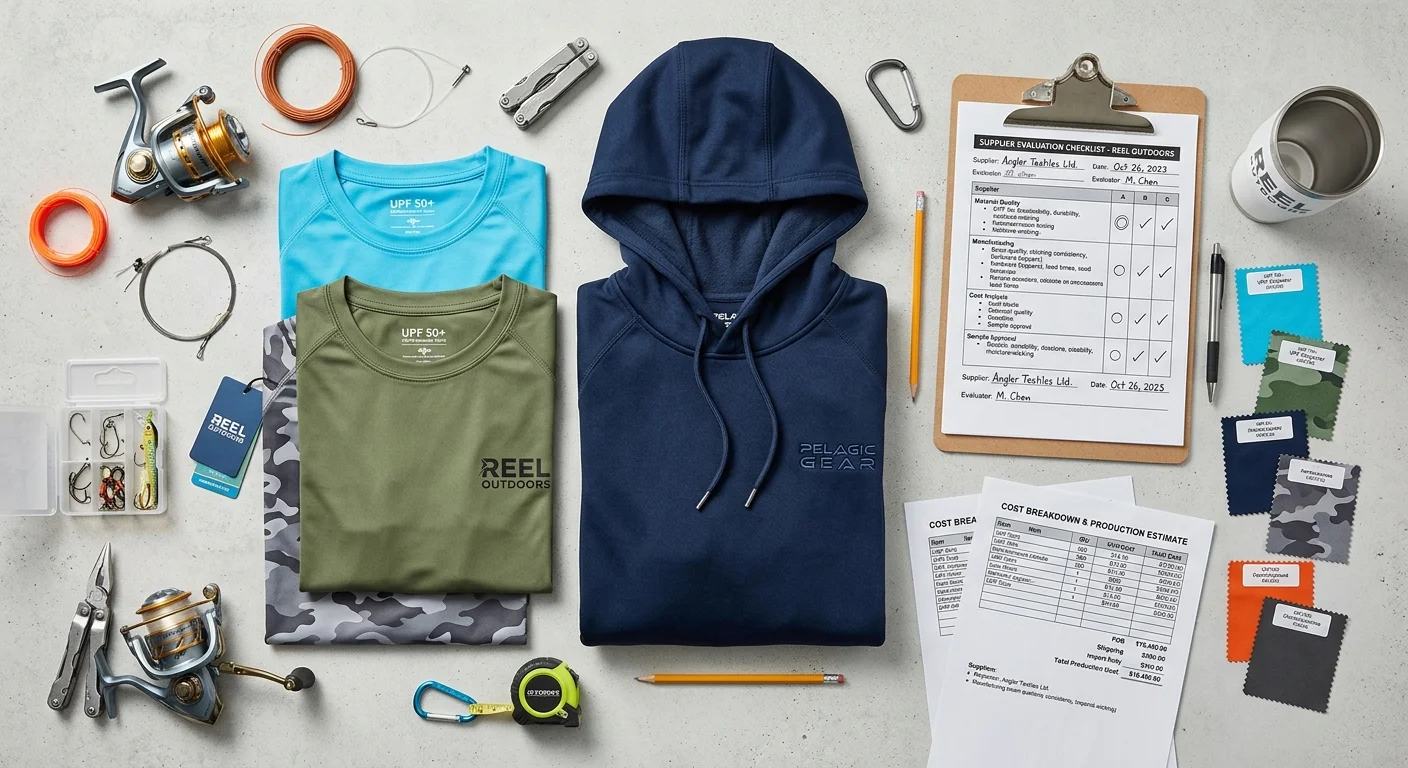
Eight questions. That's all it takes to separate a reliable fishing apparel supplier from one that drains a season's worth of margin.
Most buyers skip this step. They get a price quote, like the number, and wire the deposit. Six weeks later, a container of mis-printed UPF shirts arrives — wrong GSM, faded sublimation, and a lab report tied to a different fabric. Run through this checklist before you commit to any fishing apparel supplier, whether they're a direct factory or trading company.
Score each metric as Pass / Partial / Fail. Any "Fail" on metrics 1–4 is a hard disqualifier.
Metric 1: UPF Performance Documentation
Don't accept a "UPF 50+" claim on a website. Ask for the actual third-party lab report. It should be issued under ISO 24444, AATCC 183, AS/NZS 4399:2017, or ASTM D6603 — and tied to the exact fabric code and color you're buying. The report must show UVR transmittance below 2%, test conditions with wash cycles (minimum 40), and an accreditation number confirming ISO/IEC 17025 certification.
Hard red flags: No batch-specific report. No test method referenced. Same PDF reused across fabrics with different GSM or fiber blends.
Metric 2: Sublimation Print Quality & Colorfastness Standards
Ask for the printer model, resolution (minimum 720×720 dpi), and press temperature profile — standard range is 190–205°C for 45–60 seconds. Then check Pantone matching capability. You want a Delta E tolerance of ≤3 against your target TCX/TPX reference. Anything above ΔE 5 on a branded fishing apparel colorway is visible to the naked eye.
For colorfastness, your benchmark minimums are:
- Dry crocking (AATCC 8): Grade ≥ 4.0
- Wet crocking: Grade ≥ 3.5–4.0 for performance sportswear
- Wash fastness (AATCC 61): Grade ≥ 4.0 after 5 cycles at 40°C
Also set a print placement tolerance of ±3mm at critical points — chest logo, sleeve hit, center front. Ask to see measurement photos from past customer orders. Those photos confirm they hit the spec, not just claimed it.
Metric 3: Fabric Sourcing Depth & MOQ Transparency
Ask for a fabric matrix. This is a simple document listing every fabric code they run: composition, GSM, width, UPF rating, stock vs. dye-to-order status, and lead time per option.
Benchmarks to compare against:
- Stock colorways: 200–300 pcs per color per style
- Dye-to-order runs: 800–1,000 yards per color at mill minimum
- Sub-MOQ surcharge: +10–20% for runs below threshold
Ask whether they pool leftover rolls from other clients for small-quantity colors. Ask if they'll hold reserved yardage under your company code across multiple POs. Those two questions show you how much real flexibility they have — versus what they're saying to close the deal.
Metric 4: AQL Protocol & Inline QC Checkpoints
Put your inspection levels in writing before the PO is placed — not after. Industry standard for fishing apparel: AQL 2.5 for major defects, AQL 4.0 for minor , using ANSI/ASQ Z1.4 sampling tables. For a 1,200-piece lot, that's a 200-piece sample with an accept threshold of 10 major defects.
A credible fishing apparel supplier walks you through their inline checkpoint structure without prompting: 4-point fabric inspection at receiving, 100% panel inspection at cutting, patrol audits during sewing, and final random inspection at 80–100% packed. A supplier who can't describe this process has final-only QC — problems ship with your goods.
For your first 1–3 shipments with any new fishing apparel supplier, route the final inspection through an independent firm: SGS, Bureau Veritas, Intertek, or QIMA.
Metric 5: Sampling Speed & Technical Comprehension
Prototype lead time for a complete tech pack with existing patterns: 7–14 calendar days . New pattern plus custom fabric or trims: up to 20 days. A supplier who keeps missing the 20-day mark on simple styles has a capacity or engineering bottleneck — not a one-time delay.
Before you approve a proto, run a comprehension check. Ask them to repeat your key specs back to you: fabric code, GSM, shrinkage allowance, colorway list, print placements, critical measurements, grading rules. A supplier who gets this wrong at the proto stage will get it wrong in bulk.
The full cycle — first proto through PP sample approval — should close within 30–45 days for a stable style. No bulk cutting before the PP sample is sealed and the measurement report signed.
Metric 6: Communication Structure & Response SLAs
A supplier running on a single "[email protected]" inbox is a risk. Make sure you have a dedicated merchandiser, a named backup contact, and a direct QC contact for claims — three separate people, each reachable on their own.
Test response times during vetting, not after you've placed money down:
- Technical queries: first reply within 24 hours, full resolution within 48
- Quote revisions on existing fabrics: 24–48 hours
- Sample and lab test status: written updates every week, without you asking
Their English needs to cover the real operational conversations: pattern adjustments, tolerance disputes, print placement corrections. Relying on a translator app with a 48-hour lag adds real cost to your production management.
Metric 7: Logistics Capability & Export Documentation
Confirm they can quote and execute the Incoterm you need — FOB, CIF, or EXW — with that term spelled out on both the proforma invoice and the final commercial invoice.
Required export documents for fishing apparel imports:
- Commercial invoice with HS codes and declared Incoterm
- Packing list with carton dimensions and gross/net weights
- Certificate of origin in the right format for your trade agreement (Form A, RCEP, EUR.1 as applicable)
- Accurate fiber content declarations for customs clearance
Ask for a container loading plan showing carton count and cube utilization per 20'/40' HQ. Also require written WIP reports every week during production — fabric arrival percentage, cutting percentage, sewing percentage, planned ex-factory date. Suppliers who won't send these are managing your shipment by guesswork.
Metric 8: Payment Terms & Financial Risk Structure
Standard terms for a new fishing apparel supplier : 30% T/T deposit on order confirmation, 70% balance against copy of bill of lading and passed third-party inspection report. For first orders over $30,000–50,000, ask for Alibaba Trade Assurance or an irrevocable LC at sight.
Walk away from any of these:
- 100% T/T in advance on bulk orders
- Payment requests to personal accounts or via Western Union
- Tooling or print setup fees with no written confirmation that plates, molds, and dies transfer to buyer ownership after payment
Using This as a Scorecard
Convert these eight metrics into a weighted scoring sheet. A workable weighting model:
Metric | Weight |
|---|---|
UPF documentation | 20% |
AQL & QC process | 20% |
Sampling & technical comprehension | 15% |
Communication structure | 15% |
Logistics capability | 15% |
Payment & risk controls | 15% |
Any supplier scoring below 70% overall — or failing metrics 1 through 4 outright — doesn't get a purchase order. FOB price doesn't change that. A low quote from an unverified supplier isn't a deal. It's a delayed write-off.
Conclusion
The factory-vs-trading-company debate isn't about who charges less. It's about which model your business can afford to get wrong right now .
Here's the straight answer: below 2,000 units, a trading company's markup often costs less than the hidden expenses of direct factory sourcing. Think sample revisions, UPF certification confusion, 3am WeChat negotiations, and defect batches you absorb with no QC leverage. Cross that 2,000-unit threshold, and direct sourcing shifts from a gamble into a solid margin strategy.
Your fishing apparel profit margin doesn't get decided at checkout. It gets decided today — in how you structure your supply chain.
So pull out the verification checklist from this guide before you contact another fishing apparel supplier. Score your current or prospective vendors across all eight metrics. The numbers show what your gut misses.
The best sourcing decision isn't the boldest one. It's the one that matches where your business stands right now — not where you expect it to be six months from now.