Choosing the wrong manufacturing model for your fishing apparel brand costs you more than money — it kills your momentum. In a market where performance fishing shirts stand or fall on technical credibility, stalled launches and product-market mismatches can destroy a brand before it gains traction.
The OEM vs ODM fishing apparel question looks simple on the surface. Then reality hits. You're sitting across from a custom fishing jersey supplier quoting 500-piece minimums on a design you haven't locked down. Or you find out your "exclusive" ODM style is already selling on three competitor storefronts.
This isn't a glossary lesson.
What follows is a decision framework built around the variables that actually matter:
Your budget runway
Your design capabilities
Your MOQ tolerance
How fast you need to move
These get mapped against the real manufacturing demands of private label fishing shirts — UPF fabrics, sublimation printing, moisture-wicking construction, and the factories that know how to deliver all of it.
Cost Structure & Budget Realities
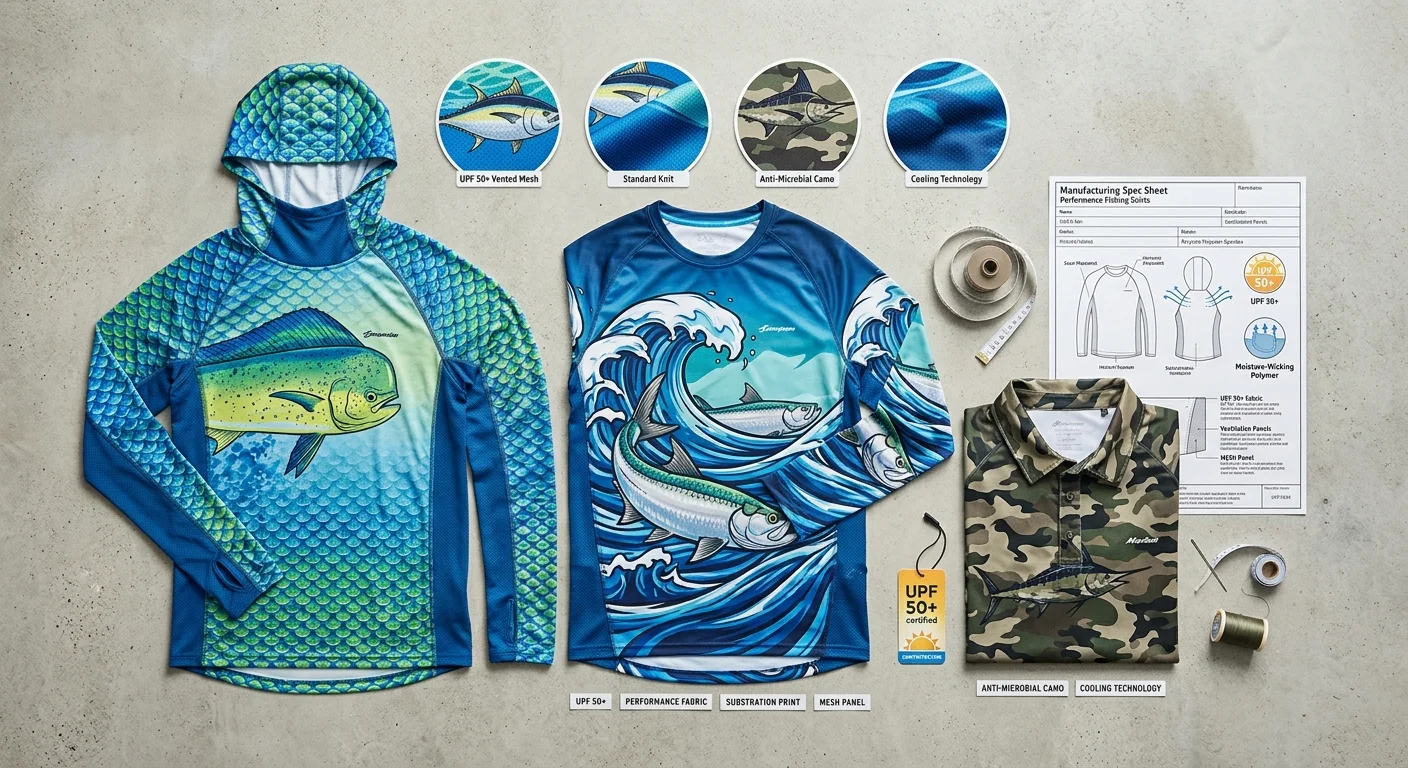
Budget isn't just a number. In fishing apparel production , your budget determines which manufacturing model is available to you — before you make a single phone call.
The cost gap between OEM and ODM is wider than most first-time buyers expect. And it goes beyond unit price.
What You're Paying For
With UPF fishing shirts OEM , the upfront spend starts before a single stitch is sewn. Tech pack preparation alone runs $150–$400 per style . Pattern and grading adds $200–$600 . Then come two to four prototyping rounds at $50–$150 per sample run . Add performance fabric testing for UPF compliance at $100–$300 per test package . Your pre-production bill hits $3,500–$7,500+ before bulk fabric is cut. That's on a 500-piece run.
ODM rewrites that math. A white label fishing apparel launch at 300 pieces costs $1,250–$2,650 before freight. Sample setup fees run $0–$150 . The factory's existing block patterns cover the development cost you'd otherwise carry yourself.
Launch Scenario | Upfront Cash (Pre-Shipment) |
|---|---|
OEM — 500 pcs | ~$3,500–$7,500+ |
ODM — 300 pcs | ~$1,250–$2,650+ |
Unit Economics by Model
Bulk fishing shirts wholesale pricing follows the same pattern:
OEM unit cost : $6–$12 FOB at standard MOQs of 500–1,000 pieces per color, using 100–200 gsm UPF 50+ polyester. Volume discounts of 10–25% kick in past 1,000 pieces per colorway.
ODM unit cost : $4–$8 FOB at 200–500 pieces per color. The factory absorbs tooling, design amortization, and trim costs — so your per-unit price stays lower.
The Hidden Costs Nobody Quotes You
Both models carry costs that don't show up on the initial price sheet.
OEM hidden costs to budget for:
- Lab dips and color approvals: $20–$80 per color
- Spec sheet corrections billed at $25–$80/hour by factory tech teams
- Size grading adjustments: $200–$600 per style
ODM hidden costs to budget for:
- Logo heat transfer or embroidery setup: $0.20–$2.50 per piece
- Neck label and hangtag customization: $0.05–$0.40 per piece
- Small-run freight premiums adding 5–15% to your landed cost
The Budget Threshold That Matters
OEM delivers better returns — but only after your capital base can support the full development cycle. $15,000+ in startup capital is the real floor for a serious OEM entry into performance fishing shirts manufacturing .
Below that number, ODM is the smarter move. A $3,000–$15,000 initial budget can fund real market validation through a sublimation fishing shirts factory . You test your product without locking capital into an unproven design.
The right model for your brand isn't the one with better margins on paper. It's the one your current cash position can execute.
MOQ Thresholds & Inventory Risk Management
Every unsold fishing shirt in your warehouse is a dollar that stopped working for you.
That's the inventory reality neither model will tell you upfront. MOQ isn't just a factory policy — it's a lever. It controls how much capital you lock into unproven demand. A missed forecast hurts more at higher MOQ levels.
The Numbers, Straight
ODM catalog fishing shirts start at 100–300 pieces per style/color . Repeat buyers with solid factory relationships can negotiate down to 50 pieces per color . That's possible when the factory already holds matching fabric and pattern blocks.
OEM custom fishing shirts work on a different scale. The floor sits at 300–500 pieces per style — spread across two to four colorways to hit the factory's production economics. Technical builds push that number higher. Seam-taped panels, multi-fabric UPF constructions, and complex sublimation programs can demand 500+ pieces per style. Cutting, sewing, QC, and material sourcing don't get cheaper at low volumes.
Manufacturing Path | Entry MOQ | Technical Builds |
|---|---|---|
ODM / white label fishing apparel | 50–300 pcs | 100–300 pcs |
OEM / fully custom fishing shirts | 300–500 pcs | 500+ pcs |
What Higher MOQ Costs You
More units ordered means more capital frozen per SKU. You get greater exposure to slow-moving sizes and colorways. Deadstock risk grows fast in a seasonal category like fishing apparel production — forecasts miss more often than most buyers expect.
Lower MOQ flips that equation. Smaller runs protect your cash position. You can rotate seasonal assortments faster and cut markdown exposure if a color or silhouette underperforms. For DTC brands and marketplace sellers still mapping their size curves, ODM's lower commitment threshold is a structural advantage — not just a convenience.
Inventory Risk Controls Worth Applying
For OEM fishing shirt programs:
- Launch with 2–3 core colorways only — save variants for proven demand
- Negotiate split deliveries : 40% initial shipment, 60% after the first sell-through signal comes in
- Forecast by size curve and color sell-through , not raw unit totals
- Save OEM commitments for repeat B2B accounts and team uniform programs where demand is predictable
For ODM fishing shirt programs:
- Order small test lots across multiple colors before scaling any single SKU
- Prioritize styles built on existing factory pattern and fabric libraries — shorter lead time, lower risk
- Refresh assortments based on weekly sell-through data , not pre-season guesswork
- Keep your SKU matrix tight to avoid fragmented, unmanageable inventory
The Decision Threshold
One simple rule cuts through most of the noise:
Below 70–80% forecast confidence — stay at ODM levels ( 50–300 pcs ). The inventory risk doesn't justify an OEM commitment.
Above 80–90% forecast confidence with documented repeat demand — OEM levels ( 300–500+ pcs ) start delivering the unit economics that justify the capital exposure.
For performance fishing shirts with technical features — UPF fabrics, moisture-wicking panels, sublimation print registration — build in a higher MOQ buffer no matter which model you choose. Defect rates, fabric waste, and rework are real factors in technical construction. Cut your order too close to minimum and you have no room to absorb them.
Most established fishing clothing factory relationships land on a hybrid path. Validate with ODM at 50–300 pieces first. Then move proven styles into OEM at 300–500+ pieces once the sell-through data backs it up. Start lean. Scale what works.
Product Differentiation & Brand Barrier Risks
Here's the trap nobody warns you about: you can do everything right — right factory, right MOQ, right price point — and still build a brand with no walls around it.
That's the differentiation problem. In fishing apparel production , it cuts deeper than most categories.
The ODM Homogeneity Trap
Walk through any major fishing apparel storefront on Amazon. Count how many brands are selling the same shirt — identical vented back panel, same collar cut, same placket geometry — dressed up in different sublimation prints. That's not a coincidence. That's the white label fishing apparel supply chain doing what it's built to do.
ODM factories sell the same base silhouettes to dozens of brands at the same time. Your competitors aren't just competing with you on price — they're wearing your shirt. The product is identical. So differentiation collapses to graphics, discount depth, and ad spend. Margin follows it down.
The result: low switching costs, low loyalty, no defensible position. Any new entrant can source the same ODM base body within 60 days and undercut you.
What OEM Protects
A custom fishing jersey supplier relationship built on proprietary OEM patterns creates something ODM can't replicate: a product moat grounded in function.
The specifics matter. A longer back hem that prevents ride-up during a cast. Raglan sleeves and gusseted underarms built for overhead throwing motion. Thumbhole cuffs that keep UPF fishing shirts coverage intact while you reach for a rod. Magnetic plier docks integrated at the seam. These aren't aesthetic choices — they're engineering decisions. Competitors can't copy them if you've protected the patterns.
That's what turns a performance fishing shirts line into a brand barrier. Not the logo. The construction logic underneath it.
Differentiation Dimension | ODM Path | OEM Path |
|---|---|---|
Pattern exclusivity | Shared across brands | Proprietary to you |
Functional feature ownership | Generic catalog | Engineered + protectable |
Competitor replication speed | 30–60 days | Protected by IP |
Premium pricing support | Weak | Strong — tied to verified performance |
Brand moat strength | Horizontal (print only) | Vertical (function + quality) |
The Brand Extension Consequence
This gap grows as your brand scales. Under ODM, stretching into adjacent categories — jackets, shorts, neck gaiters — means sourcing more catalog patterns from the same factory network. The homogeneity problem repeats across your entire line. Your brand story becomes generic fishing lifestyle content. There's no coherent technical identity holding it together.
Under OEM, you get the opposite dynamic. A proprietary shoulder mobility system built for your private label fishing shirts carries into a jacket. A ventilation structure built for your shirt becomes a recognizable design language across your full product range. Each new category reinforces the same core position: this brand moves and protects better on the water.
Before extending into any new product type , run three checks:
- Does the category have real white space at the technical or mid-premium tier?
- Can your core ergonomic or functional IP carry into this category with a straight face?
- Is there a distinct proposition versus existing competitors — or are you launching an ego-trip extension?
Differentiation isn't what you print on the shirt. It's what the shirt does that no other shirt can claim to do. OEM is the path that builds that kind of wall.
Time-to-Market & Production Cycles
Speed isn't a luxury in fishing apparel — it's inventory strategy.
The gap between OEM and ODM launch timelines is wide. That gap decides whether you catch a seasonal window or miss it.
ODM moves in 6–12 weeks. Patterns are pre-engineered. UPF fabrics are pre-stocked. Sewing lines are pre-balanced. Your job is logo placement, colorway selection, and trim approval. That's it. Some sublimation fishing shirts factory partners turn repeat orders in 15–20 days once your pattern block is locked.
OEM runs 3–5 months minimum. Here's what that includes:
- Tech pack creation
- Pattern drafting
- Two to four fit sample rounds
- Bulk material booking
- Lab dips
Each stage stacks onto the next. You can cut time by running material orders at the same time as your PP sample approval. But feature creep burns through any buffer you built. Each design change after pre-production approval adds weeks to your timeline.
Path | Concept to Warehouse |
|---|---|
ODM fishing shirts | 6–12 weeks |
OEM custom fishing shirts | 3–5 months |
ODM reorder (proven style) | 2–4 weeks |
Your brand is chasing a spring tournament season? Responding to a viral moment? ODM is the model that gets you there. OEM works for planned calendars. It's not built for reactive moves.
Intellectual Property & Design Ownership
Most fishing apparel brands don't find out they have an IP problem until a competitor shows up selling the same shirt.
By then, it's too late to negotiate.
Who Owns What
IP ownership in apparel manufacturing is not automatic. It follows contracts. No contract? It defaults to whoever created the work.
Under OEM , your brand commissions the design. With the right contract language, you own everything that comes out of that process: tech packs, graded CAD patterns, print files, construction specs, trim designs. The factory is a manufacturing partner — not a co-owner. A solid OEM agreement includes a "work-made-for-hire and assignment" clause. That clause transfers all patterns, prototypes, and files to your brand once the work is done. The factory cannot reuse your pocket configurations, vent geometry, or color blocking for any competing buyer.
Under ODM , the factory owns the base. That's not a fine-print detail — it's the standard commercial arrangement. The factory built the pattern block, the collar shape, the sleeve construction. You picked it from their catalog. What you own is your logo, your labels, and any custom print artwork. The underlying shirt is licensed to you on a non-exclusive basis. That same pattern is most likely already sold to three other brands in your category.
Ownership Element | OEM | ODM |
|---|---|---|
Tech packs & CAD files | Brand owns | Factory owns |
Pattern blocks & grading | Brand owns | Factory owns |
Custom print artwork | Brand owns | Brand owns |
Logos & trademarks | Brand owns | Brand owns |
Base construction & silhouette | Brand owns | Factory retains |
Unique functional features | Protectable by brand | Not claimable |
What OEM IP Protection Covers
A strong OEM agreement for custom fishing jersey supplier relationships goes beyond protecting your logo. It covers the specific functional engineering that makes a performance fishing shirts line defensible:
Tech packs : All schematics, measurement charts, material specs, BOM, care label layouts
Patterns and grading : Base and graded size patterns, all CAD files in editable format (.dxf, .ai, Gerber)
Functional features : Integrated rod-butt anchors, magnetic plier docks, gusseted underarm panels built for casting range, convertible cuff systems — any angler-specific feature built to your brief
Trim tooling : Commissioned proprietary zipper pulls, cord locks, or rubber patches? The molds belong to you. You can move them to a new factory.
Pattern block buyouts work like this: your brand pays a one-time fee to gain full ownership of a factory-developed block. In fishing and outerwear production, that fee runs $500–$3,000 per style . That's the cost to turn a shared ODM asset into IP your brand controls.
Legal Protection Options for Fishing Apparel Brands
Not everything is protectable. But more is than most brand owners think.
Copyright covers original graphic prints, camo patterns, label artwork, and logo shapes. It does not cover a standard shirt cut or generic garment construction.
Design patents protect the visual appearance of functional products. Distinctive vent panel geometry, unique pocket shapes, and seam layout can qualify — as long as they're visually non-generic. This is an underused tool in fishing apparel production .
Utility patents cover genuine functional innovation. A specific vent-plus-mesh-plus-flap setup built for casting movement is a real candidate. So is an integrated rod-holder system with a new mechanical structure.
Trade dress builds over time. Use a distinctive combination consistently — specific panel arrangement, color blocking, trim positioning — and it can become protectable once buyers connect it to your brand alone.
The ODM Upgrade Path
Starting with ODM doesn't lock you into permanent IP exposure. It means your IP-building plan needs to be intentional, step by step.
Here's the sequence that works:
Start with an ODM base — confirm demand before committing to full pattern development
Commission structural modifications — novel rod-holder loop layout, integrated fly-patch, convertible cuff — and make sure the contract assigns all modifications and derivative works to your brand
Negotiate a pattern buyout on proven styles: $1,000–$5,000 per fully graded style is the standard negotiation range for complex fishing outerwear
Secure an exclusivity clause tied to volume — ODM factories often grant regional exclusivity (North America, for example) for 1–3 seasons in exchange for minimum annual commitments
File before you publish — keep NDAs in place with factory and testing partners until design patents and utility filings are filed
One contract clause that most buyers overlook: the file delivery clause . Your agreement needs to require the factory to hand over all production-ready CAD and pattern files in editable format on request. Skip this, and your tech pack sits on the factory's server. Switching manufacturers then becomes a costly rebuild from scratch.
The Risk That Kills Brand Equity
The "same shirt, different logo" scenario is real. It's the direct result of white label fishing apparel supply chains running without contract restrictions.
Address it head-on in your contract. Your ODM or OEM agreement should block the factory from producing any style that combines similar panel shapes, seam lines, pocket configurations, vent placement, and color blocking for any competing buyer in your category. The phrase "substantially similar" carries real legal weight here. "Identical" is too narrow — factories can work around it easily.
For UPF fishing shirts OEM programs aiming at premium positioning — where the product story depends on real technical differences — IP ownership is not a legal box to check. It's the foundation that makes the brand story hold up.
Quality Benchmarks & Performance Validation
Performance claims on a fishing shirt aren't marketing copy. They're contractual commitments. The difference between OEM and ODM is simple: do you own the validation process, or are you inheriting someone else's?
The UPF Standard That Matters
UPF 50+ is the floor, not the goal. It means ≤2% UV transmittance under AATCC TM 183 — the U.S. benchmark — or AS/NZS 4399:2020, required for Australian market labeling. Some European buyers go further. Hohenstein UPF 80 certification signals up to 80× protection compared to unprotected skin.
Building a UPF fishing shirts OEM program for premium retail? Write that number into your tech pack. Test it on the finished garment through SGS, Intertek, or Bureau Veritas — not just the greige fabric roll.
OEM: You Define the Spec, You Own the Risk
Under OEM, every performance target lives in your tech pack. That detail protects you. It also makes you liable. A solid OEM PO for performance fishing shirts manufacturing locks in:
UPF 50+ on finished garment (AATCC 183 & AS/NZS 4399:2020), with a contract floor of UPF 45 at any tested point
Colorfastness to light : ISO 105-B02 ≥ Grade 4
Colorfastness to perspiration : ISO 105-E04 ≥ Grade 4 (color change), Grade 3–4 (staining)
Pilling resistance : ISO 12945-2 ≥ Grade 4 after 5,000 cycles
Shrinkage : AATCC 135 ≤ 3% in warp and weft after three washes
Antimicrobial durability : AATCC 100 ≥ 90% bacterial reduction retained after 20 home launderings — required if you're making odor-control claims
Vague tech packs shift risk back to you. Factories default to "best effort" without explicit tolerances. Add penalty clauses for any spec failure confirmed by independent re-test.
The QC sequence for a serious custom fishing shirts supplier relationship runs four stages:
Lab-dip approval — initial UPF and colorfastness check
PP sample — full third-party report included
In-line inspection — using an in-house UPF analyzer
Final random inspection — AQL 2.5, with UPF verification across at least three to five garments per colorway
ODM: Pre-Validated, but Fixed
ODM white label fishing apparel programs give you speed in exchange for flexibility. Reputable factories come with existing lab reports — UPF 50+ certificates, pilling Grade 4–5, shrinkage under 3% — all covering their standard fabric constructions. Your QC role narrows to print accuracy, measurements, and visual checks. Add periodic lab verification once per season.
The limitation is real. That standard polyester bird's-eye knit at 150 g/m² is validated. Swap it for premium microfiber nylon, seamless construction, or a proprietary anti-odor finish, and you've triggered a full OEM-style test suite. Any fabric or finish change is a new development — not a simple upgrade.
The Practical Checklist
For ODM orders , get these in writing:
- Current UPF, pilling, shrinkage, and colorfastness reports for the exact fabric and weight
- Written confirmation that yarn, knitting machine, and finish chemistry are unchanged since the last report
For OEM orders , embed every benchmark above in the PO. Require all third-party test reports before shipment authorization. That single clause cuts out the most common quality dispute in fishing apparel production .
Decision Matrix by Brand Development Stage
Three different brands walk into the same fishing apparel trade show. One is burning through its first $10k trying to figure out which shirt sells. One is doing $400k a year and starting to feel the ceiling on its ODM margins. One is sponsoring tournament pros and developing proprietary fabric blends in Taiwan. Same category. Very different manufacturing realities.
Your brand's current stage determines which model you can execute — not which one sounds better on paper.
Stage 1: Early-Stage Brand (Revenue: $25k–$150k)
80–90% of new fishing apparel brands at this stage run ODM. That's not a compromise — it's the correct call.
Your job right now isn't product perfection. It's demand validation. Find out whether US anglers will pay $45–$75 for your collared vented shirt. Do that before you spend $7,500 developing a proprietary pattern they may not even want.
Start with two SKUs:
- 1 hooded sun shirt — lightweight, UPF 50+, optional thumbholes
- 1 collared vented shirt — long sleeve, mesh back vent, roll-up sleeve tabs
Run 2–3 colorways per style . Total first run: 200–500 units spread across both styles . ODM sublimated shirts land at $6–$12 FOB . MOQs can drop to 50–150 pcs per color — use "size mix test" framing with the factory to get there.
The numbers that tell you it's working:
- 1–2 styles moving 200–400 pcs/year at >70% sell-through within 6 months
- 100+ customer orders with size/fit reviews and NPS ≥ 40–50
Until those numbers are in, ODM protects your cash. Once you hit them, you have the sell-through data to justify moving up.
Vendor evaluation priorities at this stage:
Criteria | Minimum Threshold |
|---|---|
MOQ flexibility | 50–150 pcs/color for first 2–3 runs |
Fabric spec | UPF ≥ 30 (target 50+), 120–160 gsm, wicking report |
Lead time | ≤ 45 days post-sample approval |
Decoration capability | In-house sublimation + embroidery |
Payment terms | 30% deposit / 70% before shipment |
Stage 2: Growth-Stage Brand (Revenue: $150k–$750k)
This is the stage where ODM starts to show its seams — and not just a figure of speech.
You've got repeat buyers above 25–35% of orders. You're in 5–30 wholesale accounts. Customers are sending feedback about sleeve length, torso fit, pocket placement. The catalog base that got you here is now the ceiling you're hitting.
The move: hybrid OEM. Keep ODM base patterns, but start modifying the block.
Bring in a technical designer or pattern consultant — $40–$80/hour or $500–$1,500 per style for full spec and fit rounds. Focus modifications on what anglers are complaining about most:
Extended back drop : +3–6 cm stops ride-up during casting and seated boating
Articulated elbows : double-layer abrasion panels at +$0.30–$0.80/garment
Vent optimization : mesh panels positioned to clear PFD shoulder straps
The ROI test for any new feature:
- Adds ≤ 10–15% to unit cost
- Supports ≥ 15–30% retail price lift
- Requested by ≥ 15–20% of surveyed customers or pro staff
A modification that fails any one of those three tests is an ego feature — not a brand feature. Cut it.
Once you hit 500–1,000+ pcs per style per year , negotiate line-level MOQs: 500–800 pcs spread across 2–3 colors , rather than per-color minimums. Repeat order history earns you 5–15% cost reductions . Use that leverage — but lock down graded spec sheet ownership and pattern modification clauses in writing first. Do that before you sink development money into a block the factory still owns.
Transition trigger to full OEM: 3–5 styles clearing 1,000–3,000 pcs/year each , with documented fit and feature gaps that no ODM catalog can close.
Stage 3: Established Brand (Revenue: $750k–$5M+)
At this stage, ODM is a liability, not an asset. You're sponsoring tournament pros. You have 50–200 retail accounts. Customers are loyal because of what the product does — and that product identity has to hold up across 15–50 SKUs.
Full OEM fishing apparel services is the only model that scales without collapsing your differentiation.
Every style needs a complete tech pack: full spec, graded measurements, stitching callouts, BOM, and layered artwork files. Outsourcing tech pack creation costs $250–$800 per style — budget for it. Proprietary fabric development means working direct with mills in China, Taiwan, or Italy. Minimum greige orders run 1,000–3,000 meters per color — enough for 800–2,400 shirts depending on GSM and style.
Multi-factory structure is non-negotiable:
- Minimum 2–3 core factories
- Each with capacity of 5,000–20,000 pcs/month
- Exclusivity clauses on proprietary fabrics or constructions in key markets (US/Canada) for 2–3 years
Category expansion decision matrix:
Evaluation Factor | Threshold to Proceed |
|---|---|
Google/Amazon search volume | >5,000–10,000/month on core terms |
Cross-sell attach rate potential | ≥ 20–30% of existing shirt buyers |
Development capex | Acceptable (bibs: $5k–$20k in patterns/testing) |
Fit complexity risk | Start with accessories before complex bottoms |
Put 5–10% of apparel revenue into R&D every year. Run a rolling 2–3 year product roadmap with at least 1–2 patentable or trademarkable innovations per cycle. At this stage, IP isn't paperwork — it's the compound interest on every design decision you made back in Stage 1.
The Through-Line
Stage 1 is about survival and signal. Stage 2 is about translation — turning customer signals into proprietary construction. Stage 3 is about moat-building at scale.
Brands that stall out are the ones that stay in Stage 1 mode long after their data says to move. ODM fishing apparel at $500k revenue isn't lean — it's leaving differentiation on the table. OEM at $30k revenue isn't ambitious — it's a capital allocation mistake.
Know your stage. Match your model to it.
Supplier Evaluation: 10-Point Checklist
The factory pitch deck looks clean. Samples arrive on time. Then six months later, your UPF certification fails a retailer audit. Your pattern shows up on a competitor's Amazon listing. Your "dedicated account manager" hasn't replied in eleven days.
That's how fishing apparel brands get burned. Not by obvious bad actors — by suppliers who looked solid until they didn't.
Score each point below on a 0–5 scale. Total possible: 50 points. Set your threshold before you start — ≥38/50 moves to a trial order . Below that, you're either developing them or moving on.
1. Vertical Specialization (Competence)
The question isn't "do they make shirts." It's do they make your shirt. Ask for proof: tech packs from similar SKUs, percentage of revenue from performance or UV apparel, years in the category. A factory where fishing and outdoor makes up less than 30% of their business is a fashion operation dabbling in your space.
Score 5: ≥3 major clients in fishing/outdoor; ≥5 years in performance apparel; documented problem-solving on technical builds
Score 1–2: generic CMT operation; no UPF or sublimation fishing shirt track record
2. Capacity & Delivery Consistency
Ask for their OTIF rate — On-Time In-Full — over the last 12 months. ≥95% is the baseline , not the gold standard. Get peak-season blackout dates in writing. A factory running at 100% capacity in February is no use to a brand chasing a spring tournament window.
Written lead-time guarantees with escalation path
Documented contingency for delays: overtime lines, backup contractors
Real proto-to-bulk timeline: prototype (days), fit sample (days), bulk from PO (weeks)
3. Cost & MOQ Transparency
A solid fishing clothing factory gives you a tiered price table without being asked. It breaks down by style, decoration method, and volume band. Setup fees — sublimation paper, pattern development, print screens — should appear as separate line items. They shouldn't be buried in unit cost. Payment terms should be stated upfront: 30% deposit / 70% before shipment is standard, with L/C thresholds for orders above $50k.
Transparent cost breakdown: fabric, trims, labor, overhead, margin
MOQ flexibility on multi-style bundled orders (e.g., 50 pcs/style when total order hits 300+ across 4–6 styles)
4. Communication Infrastructure
How fast they respond during sampling tells you how fast they'll respond during a production crisis. Set a clear benchmark up front: 24-hour reply window on working days , a dedicated English-speaking account manager, and status updates every week during active orders. They can't meet this during the sales phase? They won't meet it when your shipment is on the line.
Escalation hierarchy with named backup contacts
Shared project tracking tool (not just WeChat threads)
Documented approval turnaround on lab dips and PP samples, in days
5. Quality System Rigor
Ask for their QMS documentation — ISO 9001 alignment is a good sign. Check that they run AQL 2.5 for major defects at final inspection, not just internal self-checks. Incoming fabric records should cover shrinkage, GSM variance, colorfastness, and shade band sign-off. Ask for real inspection reports from past production runs — with photos.
Written defect handling and claim compensation procedure
Agreement for final random inspection with photo/video documentation at factory
6. Compliance & Test Documentation
For UPF fishing shirts OEM , this is non-negotiable. You need current lab reports — dated within 12 months — covering UPF (AATCC 183 or AS/NZS 4399:2020), OEKO-TEX STANDARD 100 for skin-contact fabrics, colorfastness to light (ISO 105-B02), and perspiration (ISO 105-E04). No lot number and lab name on every report? The report doesn't count.
Third-party testing coordination willingness (SGS, Intertek, Bureau Veritas) at your cost
REACH and RSL compliance documentation for chemical restrictions
7. In-House Technical Depth
Factories that send out pattern development and sublimation printing add two failure points you can't check. Confirm they have in-house CAD capability (Gerber, Lectra), a dedicated sample room with a 7–10 day proto turnaround for new styles, and their own printing equipment. A subcontracted print shop down the road doesn't count.
Documented sample revision rounds included before fit lock
Equipment list: printing capacity (m²/day), sewing machine types, bonding/taping capability
8. Financial Stability
A factory that depends on one client for more than 30% of annual revenue is a supply chain risk you take on. Ask for volume band data from the last two to three years — not full financials. Look for a growth trend and a spread of clients across different buyers.
No single-client dependency above 30% revenue
Dual-sourcing or safety stock options available on request
9. IP Protection & Cultural Fit
Most buyers skip this conversation. Don't. Before sharing a single tech pack, get a signed NDA. Then get contract language that blocks the factory from producing designs with similar panel configurations, vent placement, or print layouts for competing buyers in your market. "Identical" is too narrow a bar. Experienced factories know how far they can shift a seam before it technically clears that threshold.
Signed NDA before design disclosure
Contract clause with defined penalties for IP breach
Social audit documentation (SMETA or BSCI) for labor and environmental compliance
10. Verified Track Record
References exist to be called — so call them. Ask for 2–3 current customers in fishing or outdoor apparel. Not fashion, not uniform programs. Make the calls. Key questions: Did they grow from small test orders to full production runs without issues? Did they flag fabric or construction problems before shipment, or only after? What was their claim rate on quality disputes?
Historical OTIF ≥95%, verifiable with shipping documentation
Evidence of technical upgrades based on client feedback
Case study showing progression from small MOQ entry to scaled seasonal volume
Put every prospective custom fishing jersey supplier through this scoring framework before placing your first purchase order. A score below the threshold doesn't rule a factory out — some gaps can be worked on. But go in knowing which gaps you're accepting and why. Finding out mid-production, after your spring catalog is already committed, is a much harder place to be.
ODM-to-OEM Transition Roadmap
Most brands don't pick a manufacturing model once and stick with it. They move through different models over time — and the ones that scale well are the ones that planned their next move before they had to make it.
The roadmap has four phases. Each one builds on the last.
Phase 1: Validate With ODM Catalog (0–6 Months)
Pick two silhouettes from an ODM fishing shirt catalog. A long-sleeve hooded sun hoodie and a non-hooded crew both work well here. Both should be UPF 50+ polyester in the 130–180 gsm range. Run 2–3 colorways per style at 100–200 pcs per color . Full-sublimation adds $0.50–$1.50/pc over solid colors. Total first shipment: 400–1,200 units. FOB cost at this volume: $5–$8/pc from China.
Phase 1 has one job — collect data. Track returns by reason code. Target a <5% return rate . Log feature requests by how often they come up: hood bulk complaints, sleeve ride-up, missing plier loops, pocket interference. Don't change anything yet. Hold off until you have 300–1,000 customers per style and at least 50–100 structured feedback points — reviews, surveys, and ambassador notes combined.
Phase 2: Build Your Delta Spec (Months 3–9)
Once the data levels out, patterns show up fast. More than 15% of customers saying "runs small"? Increase chest grading by 2–4 cm across M–XL. More than 10% reporting sleeve ride-up during casting? Add 1.5–2.5 cm sleeve length plus thumbholes or elasticized cuffs.
Pull it all together into a Delta Spec Sheet . List the original factory POMs next to your target adjustments in millimeters. Focus on changes that show up across both test silhouettes — not a single complaint tied to one SKU.
Fabric issues get their own list:
- "Too hot" : drop to 130–150 gsm with warp-knit mesh vent panels at underarm and side body
- "Snags/pills" : shift to higher denier, tighter knit construction; add Martindale pilling resistance to the spec
- "Odor retention" : add an antimicrobial finish (silver-ion or Polygiene-type); test durability across 20–30 wash cycles
Score every proposed change on two axes: complaint frequency × casting-use severity, and pattern-only cost (low) versus new fabric or hardware tooling (high). Your Gen 1.5 target: 3–5 fit changes, 1–2 ventilation upgrades, 1–3 gear features — all changes that won't trigger new lab testing.
Phase 3: Semi-Custom Co-Development (Months 6–18)
This is the phase where a technical designer comes in. Go independent at $40–$100/hour , or use a factory's built-in patternmaking service at $500–$2,000 per style . A full tech pack revision for a fishing shirt takes 10–25 designer hours .
Your Gen 1.5 tech pack needs to cover:
- Revised POM table with all delta adjustments graded across sizes
- Raglan or articulated sleeves for overhead casting range
- Extended ventilation : mesh underarm-to-hem panels, back yoke vents, laser-perforation under the hood
- Bartack placement map : plier loop, pocket corners, side seam at hem, hood connection
- Cuff spec : thumb hole placement and elasticized binding dimensions
MOQ at this stage: 300 pcs per color/style at mid-tier performance factories. That rises to 500+ for a custom fabric introduction. Cost adds vs ODM baseline: pattern amortization runs $0.20–$0.50/pc over the first 500–1,000 units; mesh vent panels add $0.50–$1.00/pc ; bartacks and reinforcements add $0.05–$0.15/pc .
Before locking the pattern, field-test with 5–20 brand ambassadors across 3–5 full-day fishing trips each . Score casting shoulder restriction, heat buildup, sun coverage, and feature utility on a 1–5 scale. Pattern freeze threshold: average ≥4/5 on all critical criteria, no structural failures through 20+ wash cycles.
Phase 4: Full OEM — Own the Pattern, Own the Margin
One milestone triggers Phase 4: ≥1,000 units sold via ODM test, a stable size curve, and a clear pain-point map resolved in Gen 1.5 sampling.
At this point, you stop modifying factory blocks and start owning them. Store master patterns in your own CAD system — Gerber, Lectra, or Optitex. Write up grade rules per size. File design patents or utility models on any features worth protecting: unique ventilation systems, integrated plier harness setups, convertible cuff mechanisms.
At the same time, move fabric sourcing straight to the mill. Two or three core constructions cover most of your line:
- Sun hoodie : 130–150 gsm, 90–95% polyester / 5–10% spandex, UPF 50+, wicking
- Utility shirt : 160–180 gsm, higher denier, snag-resistant
Mill MOQs run 1,000–3,000 meters per color — enough for 800–2,400 shirts depending on yield. The cost benefit is clear: going direct to the mill cuts fabric cost 10–20% versus buying through the factory's markup.
At 1,000–2,000 pcs per color with mill-direct fabric and an optimized sewing line, your FOB drops to $4.50–$6/pc — a 15–25% reduction from the $6–$8/pc you paid in Phase 1. That margin difference funds your next design cycle.
Transition Phase | Timeline | Key Output |
|---|---|---|
Phase 1: ODM catalog validation | 0–6 months | Sell-through data, size curve, feature feedback map |
Phase 2: Delta spec build | 3–9 months | Prioritized adjustment list, Gen 1.5 spec sheet |
Phase 3: Semi-custom co-development | 6–18 months | Field-tested Gen 1.5 pattern, frozen tech pack |
Phase 4: Full OEM + mill-direct | 18 months+ | Proprietary pattern blocks, IP-protected, scaled margin |
This transition isn't one big decision. It's a series of checkpoints — each one needing solid evidence before you move forward. Rush Phase 1 and you'll build a Gen 1.5 product no one wanted. Skip Phase 3 and you're locked into full OEM tooling with no field data behind your spec choices. Follow the sequence, and by the time you're producing private label fishing shirts at 1,000+ units per color under a full performance fishing shirts manufacturing program, every design decision ties back to real feedback from real anglers on the water.
Conclusion
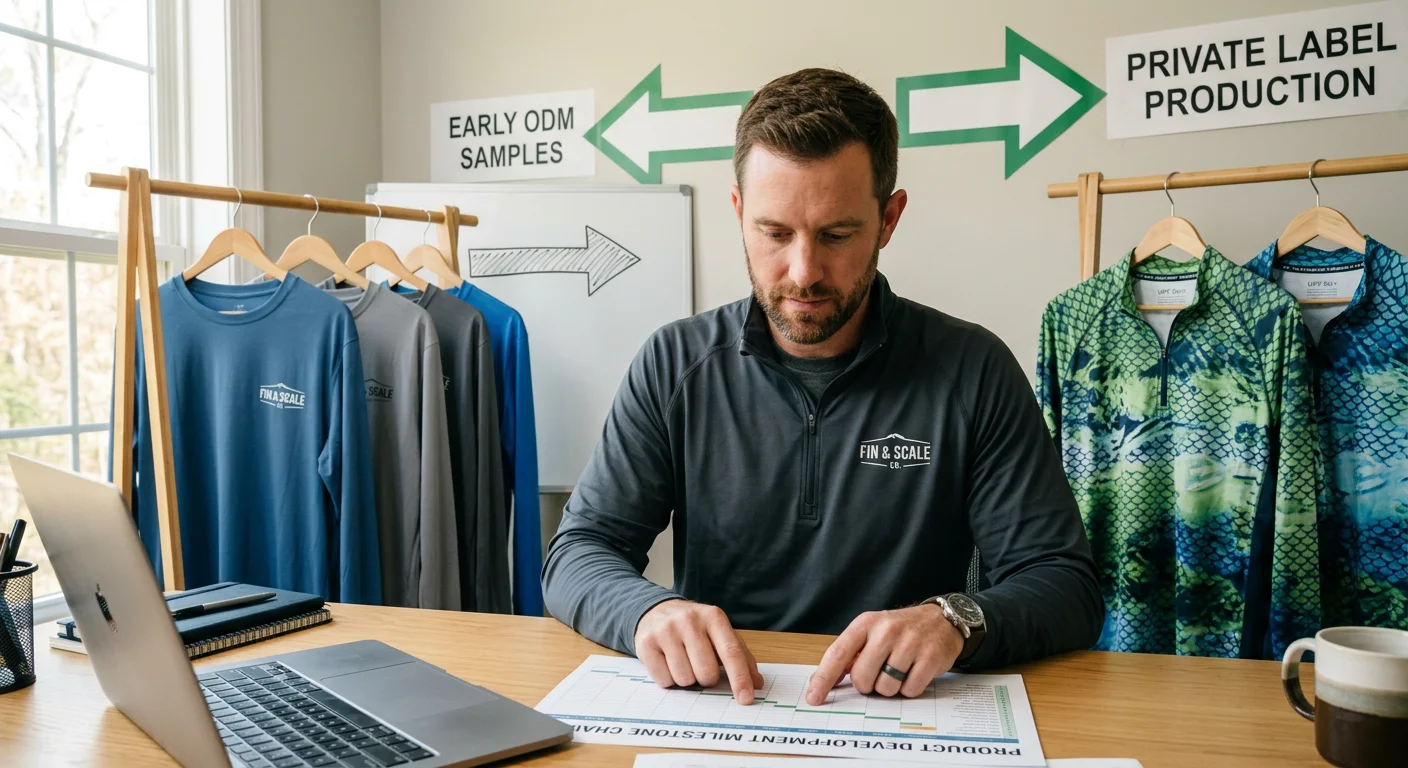
OEM vs. ODM — this isn't a permanent choice. It's a strategic position based on where your brand stands right now .
Limited capital? No in-house design team? ODM gets you to market fast. You get manageable MOQs and proven performance fabrics without the heavy upfront investment. Ready to own your patterns, UPF specs, and sublimation colorways from scratch? OEM is where real brand equity gets built.
Most successful private label fishing shirts brands don't lock into one path. They start with ODM, validate demand, then shift into OEM manufacturing as volume grows and vision gets clearer.
You've got the decision matrix. You've got the supplier checklist. You've got the roadmap.
One thing remains — the conversation with the right custom fishing jersey supplier .
Start there. Ask hard questions. Build something anglers want to wear — season after season.