Your fishing club voted on new team shirts. Thirty members, one budget, and a deadline before the next tournament weigh-in. Now you're staring at two quotes: one for screen printing, one for heat transfer vinyl, and they couldn't look more different in custom fishing club clothing price, promises, or fine print.
The "cheaper" option today might crack, fade, or peel after three saltwater trips and a dozen washes. The "premium" choice might be total overkill for a 20-shirt club order.
This comparison is built for your situation: sun-baked docks, moisture-wicking jerseys, and orders too small for big-batch pricing. You'll know which method survives your conditions, fits your headcount, and doesn't blow your gear fund.
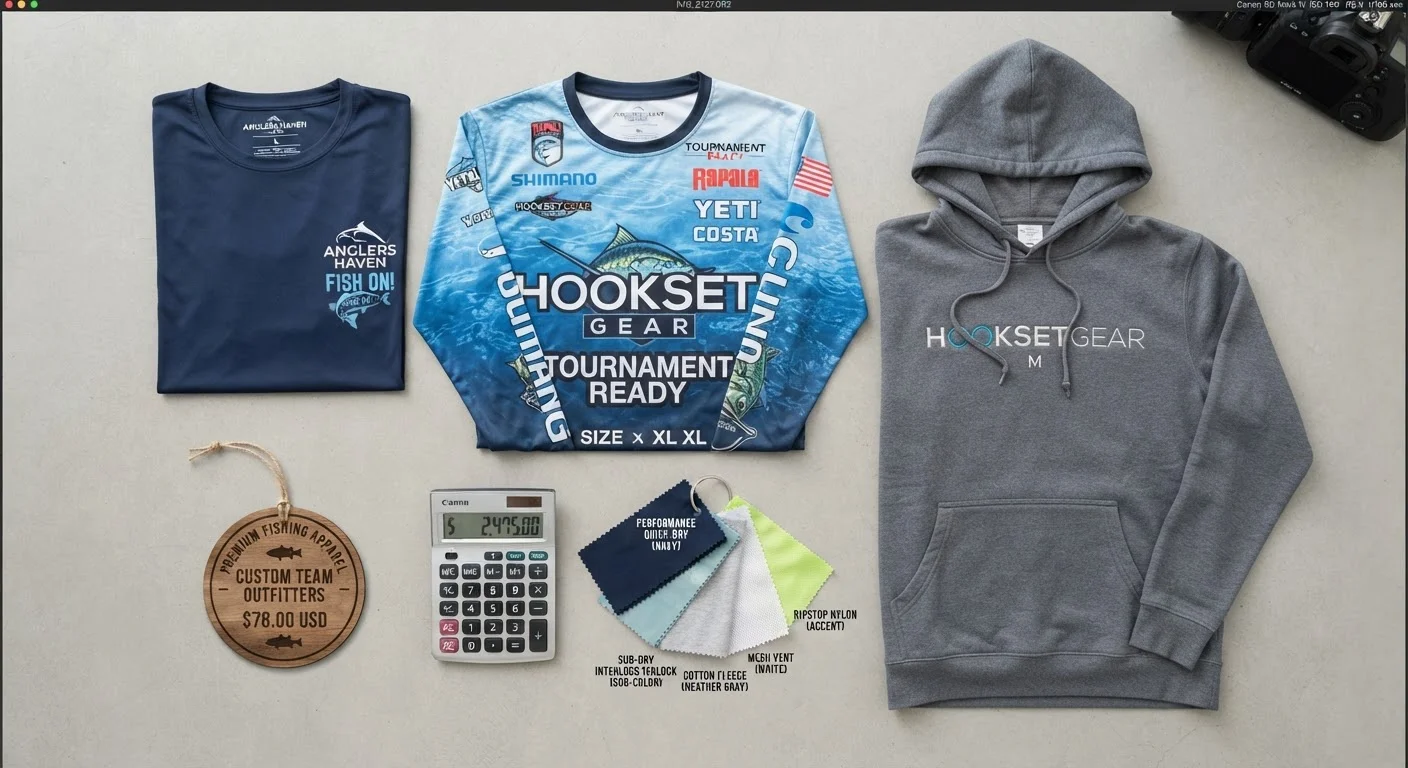
Cost Showdown: What Your Fishing Club Actually Pays at 10, 50, and 200 Shirts
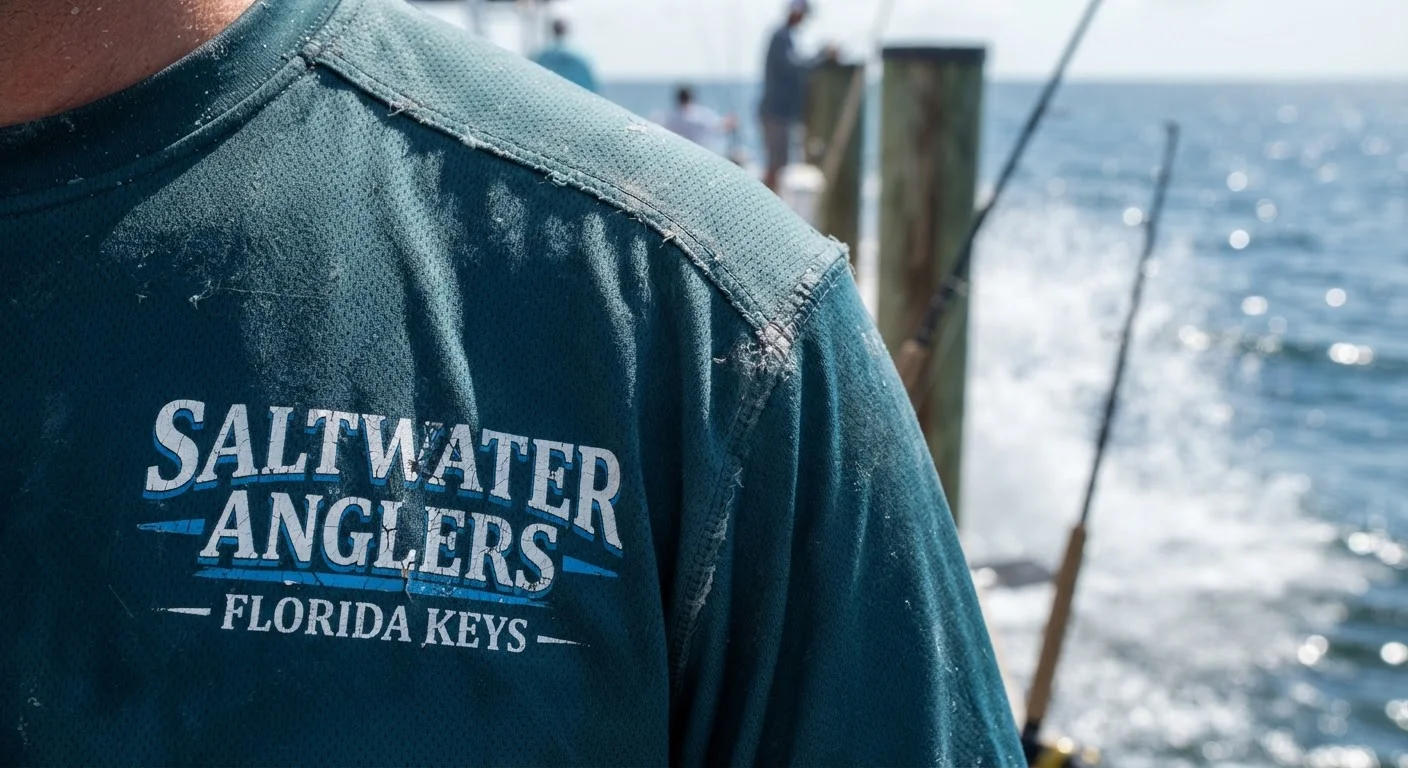
Numbers don't lie, but quotes sure can confuse. Here's what shows up on your invoice at three order sizes every fishing club hits eventually: the small tournament run, the mid-season restock, and the "we're finally big enough for wholesale fishing club apparel" order.
10 Shirts: The Small-Batch Reality
At this size, you're paying for setup, not volume. Screen printing setup cost gets baked into a tiny run, so expect $14–$16 per shirt , putting your total around $140–$160 . That's the price of not having enough shirts to spread the fixed costs around. If you're leaning toward embroidery instead, budget $18–$24 per fishing club shirt , noticeably steeper and usually not worth it for a plain logo tee.
Clubs under 20 members take the biggest hit here. They're paying the "small order tax" with no volume discount to soften it.
50 Shirts: Where Bulk Pricing Kicks In
Fifty shirts is the first real breakpoint. Screen printing here drops to roughly $5–$7 per shirt , sometimes quoted at $6 each for a $300 total . Another pricing model lands closer to $10.50 per shirt , pushing totals between $525–$1,039 depending on decoration complexity and shirt blend.
Budget $250–$350 total and use $6/shirt as your working number when you talk to vendors.
200 Shirts: Near-Large-Batch Territory
At 200 shirts, screen printing settles into $3.50–$4.50 per shirt . Heat transfer vinyl and DTF methods often undercut that, landing at $2.50–$4 per shirt in true bulk runs. One benchmark puts 200 shirts inside the 100–249 unit band at $9.00 per shirt , which would total roughly $1,800 . That's a big spread, and it comes down to blank quality and decoration choice.
For a leaner bulk order, expect somewhere between $500–$900 total , with $4/shirt as your realistic planning anchor.
Quick Reference: Club Treasurer's Cheat Sheet
Order Size | Per-Shirt Cost | Total Budget |
|---|---|---|
10 shirts | $14–$16 | $140–$160 |
50 shirts | $5–$7 | $250–$350 |
200 shirts | $2.50–$4.50 | $500–$900 |
If You're Selling Shirts for Club Fundraising
Selling performance tees to members or the public changes the math. Base cost for moisture-wicking, fishing-grade fabric runs $24–$29 per shirt . Retail sweet spot lands at $38–$45 , giving you a margin of $10–$18 per shirt . Most clubs running fundraisers target $10–$15 profit per tee , enough to cover next season's gear without gouging your own members.
At 10 shirts, price differences between methods barely matter because you're paying setup costs either way. At 200 shirts, the printing method you choose can swing your total budget by hundreds of dollars. Know your headcount before you call a vendor.
Durability Under Fishing Conditions: Saltwater, Sun, and Constant Washes
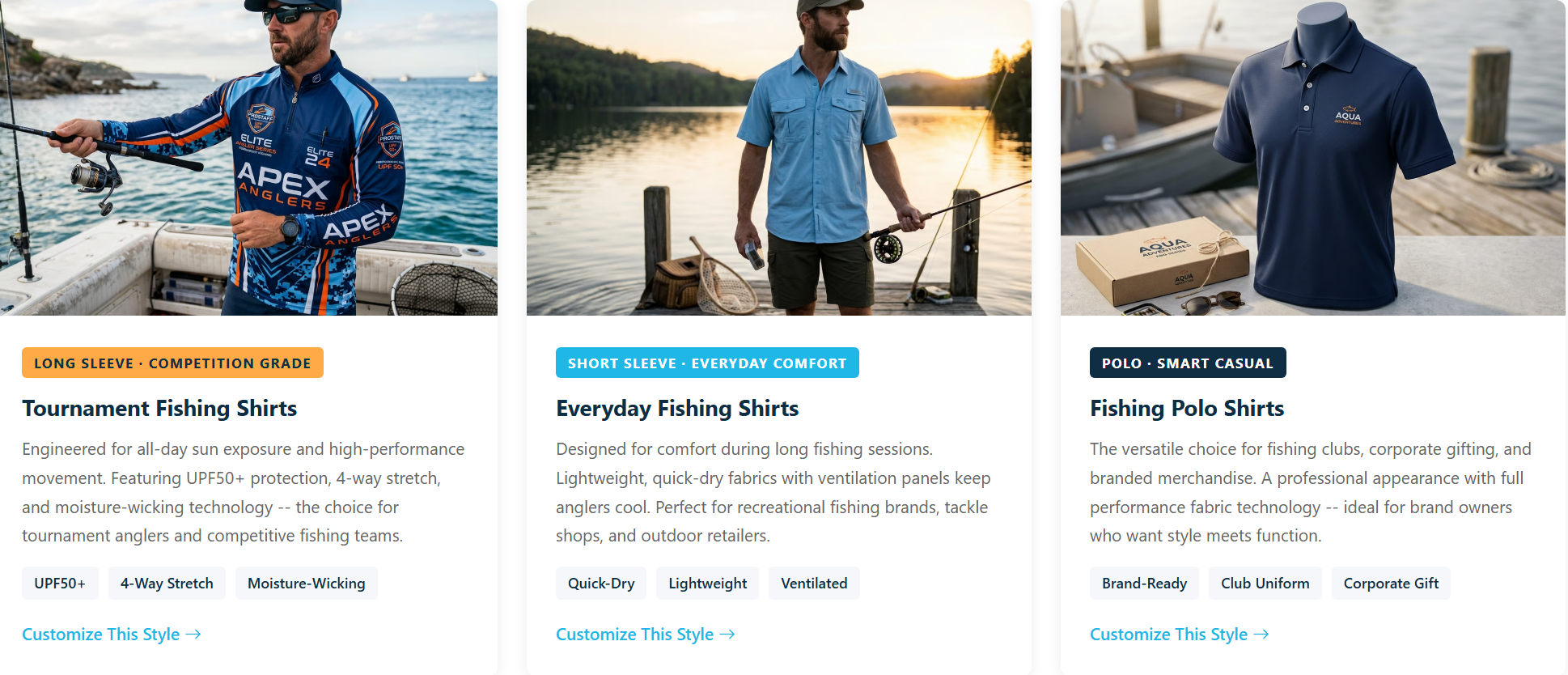
Salt doesn't discriminate. It goes after the weakest point. On printed fishing shirts, that's the print.
Screen Printing on Moisture-Wicking Fabric
Screen printing durability on outdoor apparel depends on what's underneath the ink. Cotton and cotton-blend tees take screen printing well. The ink bonds into the weave and stays put. Moisture-wicking fabrics are trickier. The slick, stretchy polyester that fishing shirts are made from doesn't hold ink the way cotton does. After 50+ saltwater exposures and repeated stretching, thinner ink layers crack along stress points: shoulders, underarms, wherever the shirt flexes most during a cast.
Genuinely durable printed apparel retains ≥90% of its original tear strength after 50 saltwater exposures and ≥85% of its color after 75 combined saltwater and UV exposures. Screen printing on the right fabric blend hits those numbers. On the wrong blend, it doesn't.
Heat Transfer Vinyl in the Same Conditions
Vinyl heat press fishing shirts fail at the edges. Heat transfer vinyl holds up fine indoors or in dry climates. Add saltwater, constant flexing, and sun exposure, and the vinyl's edges start lifting first, a slow curl that turns into full peel after enough wash cycles. You'll notice corners catching on your fingernail, then eventually catching on a fish or a rod guide and tearing loose.
Why Washing Protocol Matters More Than Method
Regardless of which printing method you choose, care routine changes the math. A quick freshwater rinse right after a saltwater trip removes 80–90% of salt before it crystallizes into the print. Skip that, wash in hot water with bleach or fabric softener, and you can cut the lifespan of either print method roughly in half. Cold wash, gentle cycle, no softener, air dry. That single habit can double how long your logo survives.
Where Sublimation Fits In
Sublimation printing for fishing gear sidesteps the cracking-and-peeling problem by dyeing the fiber itself. It's the most saltwater-and-sun-resistant option of the three. But it only works on light-colored, high-poly-content fabric, which limits your color and blank choices for team shirts.
Moisture-Wicking Fabric Compatibility (The Fishing Club's #1 Fabric)
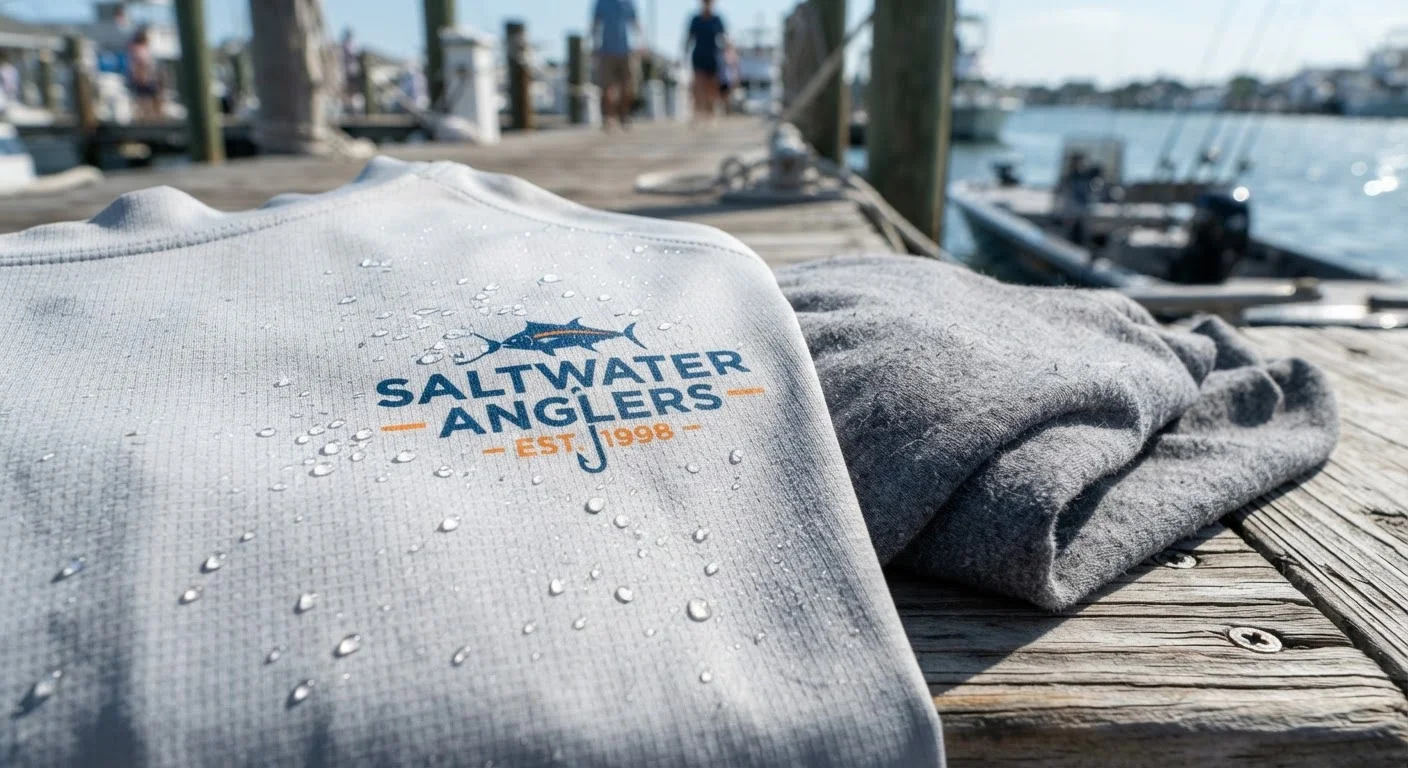
Polyester microfiber isn't just popular in fishing apparel. It's the standard. And that standard fabric behaves very differently under ink and vinyl than the cotton tees most printing quotes are written for.
Why This Fabric Wins the Fishing Club Vote
Polyester holds just 0.4% moisture regain , compared to cotton's 8.5% . That's the science behind why your fishing shirt dries while your cotton one's still soaked. Fishing-grade blends wick moisture 3× faster than cotton , and premium versions with hexagonal micro-channel fibers (think Helios-style construction) wick 40% faster than basic polyester. Top-tier shirts move sweat from your skin in 10–15 minutes flat .
Drying time backs it up. A soaked cotton shirt takes 4+ hours to dry. High-performance polyester? 15–20 minutes . That speed comes from fabric weight too. The sweet spot for all-day fishing sits between 4.0–5.0 oz/yd² , lighter than most cotton blends, which is exactly why print jobs behave differently on it.
What That Means for Your Print Job
Lighter, slicker fabric means less surface for ink or vinyl to grip. The same wicking structure that keeps sweat off your back also resists adhesion, whether you're screen printing or heat pressing vinyl. It's physics.
Care Rules That Protect Both Fabric and Print
Skip the fabric softener. It clogs synthetic fibers and can cut wicking performance by 40–60% . Same rule that protects your print protects your fabric's core function.
Cold or warm wash only. No bleach.
Air dry when you can. High heat degrades both the fiber geometry and whatever's printed on top of it.
Wash inside-out to shield graphics and preserve the fabric's UPF 50+ coating, which blocks roughly 98% of UV rays .
The Bottom Line for Club Buyers
If your club's shirt order uses this engineered polyester, both screen printing and heat transfer vinyl have to fight the fabric's own low-friction, quick-dry design. That fight determines which method survives your season, and it's the reason a "cheap" print job on the wrong blank can fail faster than the shirt itself.
Decision Triangle: Cost vs. Durability vs. Use Case for Fishing Clubs
Three variables fight for control of your printing decision, and cost alone never wins the argument. The triangle pits cost (upfront price plus lifetime cost per wear) against durability (how the print survives your actual fishing conditions) and use case (club size, event frequency, environment). Get the ratio wrong and you either overpay for durability nobody needed or underpay for a print that quits by August.
Cost Per Wear Beats Cost Per Shirt
Treasurers who compare shirts by sticker price miss the real number: cost per wear. A $300 batch of 50 screen-printed shirts worn 20 times a season for two seasons delivers roughly 1,000 total wears, landing at $0.30 per wear . That figure should drive your decision, not the invoice total.
The rule of thumb: if a shirt sees more than 30 wears a year , a durability premium of 20–30% — think sublimation or a heavier vinyl grade — pays for itself within two to three seasons. Below that frequency, the premium rarely earns its keep.
Three Club Templates
Template A – Growth-Stage Club (30–60 members, monthly events)
Favor screen printing on standard blends. Low frequency means low wear-and-tear, so entry-level cost wins. Accept a shorter print lifespan since usage doesn't stress it hard enough to matter.
Template B – Established Active Club (weekly outings, mixed fresh/salt water)
Split the order. Main roster gets mid-range screen printing on moisture-wicking fabric. A smaller "legacy" batch for officers or sponsors — the shirts photographed at weigh-ins — justifies vinyl or sublimation's higher per-unit cost.
Template C – Youth or Tournament-Heavy Program
High abuse, frequent laundering, constant sun exposure. Skip the cheapest print option entirely. Target a print method proven to survive 200+ wear-and-wash cycles , even at 20–30% higher cost, because replacement rates on the cheap option run close to double.
The Bottom Line
Match your club's actual wear frequency to the triangle before requesting quotes. A 20-shirt casual club and a 40-shirt weekly tournament team shouldn't be buying the same print method, even if they're ordering the same shirt.
Runfish Apparel – Custom Fishing Gear OEM Manufacturer
Blanks matter as much as printing method. Runfish Apparel is a Guangzhou-based OEM/ODM fishing apparel factory that has focused solely on fishing apparel since 2009. They sell directly to clubs that source UPF50+ moisture-wicking shirts before any ink or vinyl touches the fabric.
Why It Fits Small-Batch Club Orders
MOQ from 50 pcs/style — well below the 300–500 pcs most custom fishing club apparel factories demand
7–10 day sampling so your treasurer sees a physical shirt fast
Third-party certified UPF50+, anti-salt, quick-dry fabrics built for saltwater and sun
AQL inline + wash-test QC, catching weak print adhesion before shipment
For clubs ordering blanks separately from their print vendor, that certified performance fabric directly affects which printing method survives the season.
Conclusion
There is no universal winner in the heat transfer vs screen printing debate — only the right call for your order size, your fabric, and your fishing conditions.
If your 30-person club is running moisture-wicking jerseys for tournament day, screen printing earns its setup fee through sun and saltwater. If you're printing 15 sponsor tees for a weekend derby, heat transfer vinyl gets you sharp logos without the minimum-order headache.
You now have a decision triangle. Pick two priorities from cost, durability, and use case, and the printing method chooses itself.
Take your headcount and your fabric type to a custom fishing club apparel manufacturer who actually understands bulk order fishing club shirts. RunFish Apparel builds gear for exactly this scenario. Get a quote before your next tournament deadline sneaks up on you.