A custom Offshore Fishing Bibs supplier quotes you $4.50 per meter for "waterproof" fabric. Another wants $11. Both claim their material will handle offshore conditions. Without knowing what separates a legitimate PU coating waterproofing system from a coating that'll delaminate after twenty wash cycles, you're just guessing—and guessing wrong means a container of fishing bibs coming back with customer complaints about leaks at the seams.
When you're sourcing fabric for custom offshore fishing bibs, this guide covers the difference between PVC-coated and TPU-laminated options, what hydrostatic head ratings mean for your use case, and why the cheapest fabric on the quote sheet often becomes the most expensive decision six months later. You'll know exactly what to ask your supplier before you approve a single sample.
Main Fabric Types: PVC Coated, TPU Laminated, and Breathable Membrane Systems
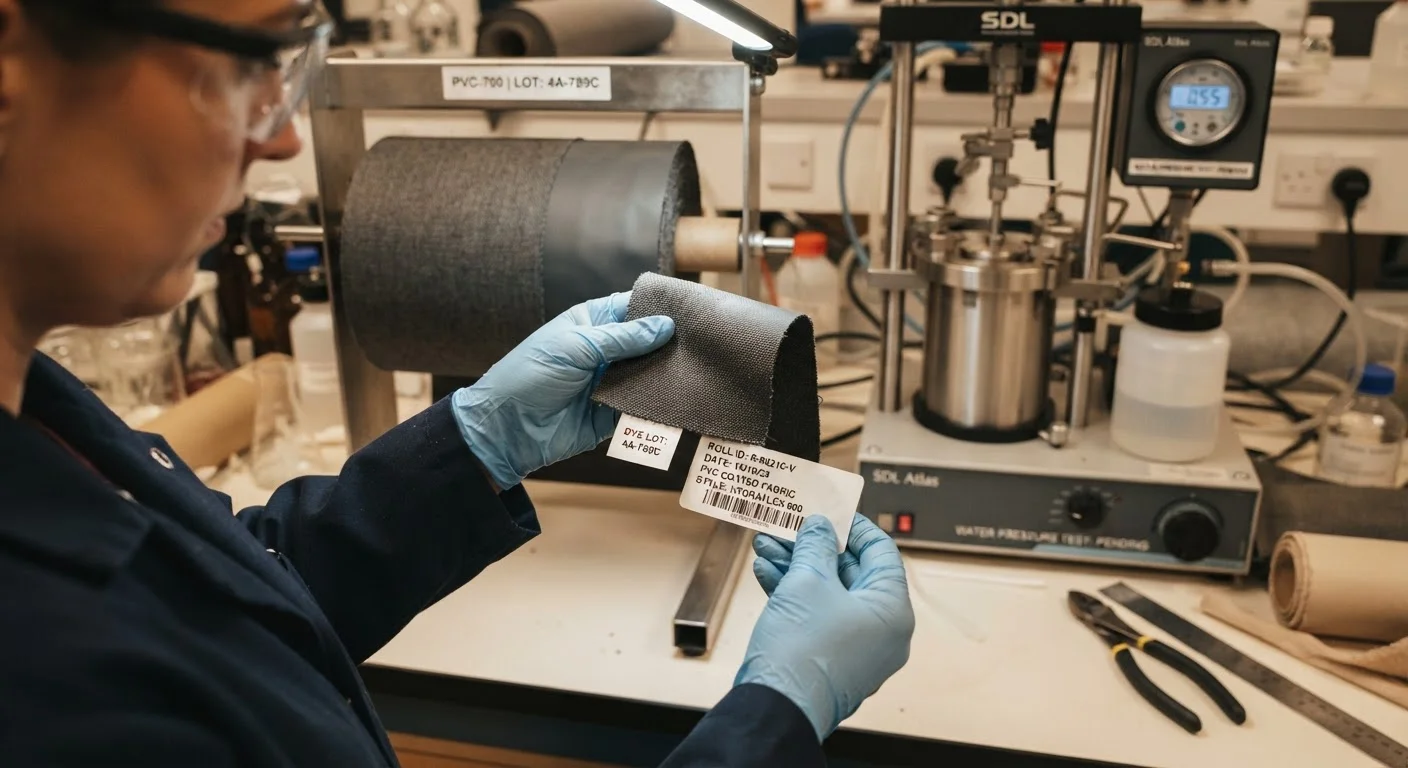
Three fabric families dominate offshore fishing bib production, and each one solves waterproofing with a different physics approach. Knowing which is which keeps you from comparing apples to oranges when quotes come in.
PVC coated fabric starts with a high-tenacity polyester base — usually 110–1100 dtex — coated single or double-sided with PVC, then finished with an acrylic or PVDF topcoat for UV and mildew resistance. Minimum hydrostatic head is 2,000mm, and high-end architectural-grade PVC pushes past 10,000mm. Air permeability drops to nearly zero (0.5 cfm), so it's fully waterproof but you'll sweat inside it. Abrasion resistance is solid at 20,000–50,000+ Martindale cycles, which matters when you're leaning against a boat rail all day. Service life runs 3–7 years for lighter grades, 10–20+ years for heavy structural PVC. The catch: it's the heaviest option of the three, and plasticizers degrade under UV exposure over time.
TPU laminated fabric uses a nylon or polyester base (20D–420D denier range) with a thin TPU film, typically 0.02–0.20mm. Hydrostatic head commonly exceeds 10,000–20,000mm and sometimes tops 50,000mm in heavy-duty inflatable-grade films. TPU stays flexible in cold water, cracking around -40°C versus standard PVC's -15 to -25°C. Abrasion and puncture resistance beat PVC at equivalent thickness. The trade-off is cost — TPU laminates run higher per meter, and aliphatic (UV-stable) grades cost more than aromatic ones.
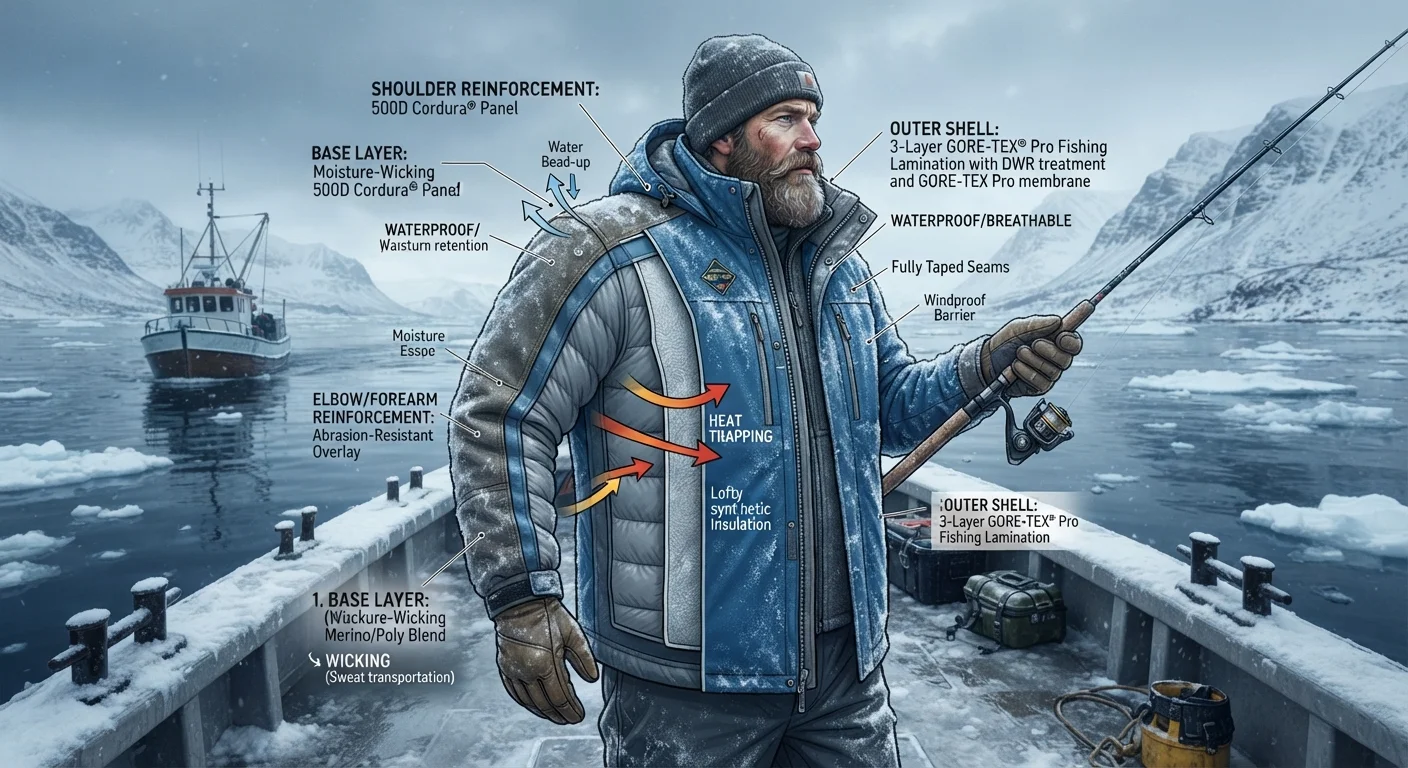
Breathable membrane systems — including Gore-Tex fishing gear and comparable ePTFE or PU membranes — aim for comfort alongside waterproofing. Premium shells hit 20,000–30,000mm+ hydrostatic head with MVTR ratings of 20,000–40,000 g/m²/24h. Construction comes in 2-layer, 2.5-layer, or 3-layer builds; 3-layer gives the best durability-to-breathability ratio for offshore use.
Property | PVC Coated | TPU Laminated | Breathable Membrane |
|---|---|---|---|
Hydrostatic head | 2,000-10,000+mm | 10,000-50,000+mm | 10,000-30,000+mm |
Breathability | None | Variable | High |
Weight | Heaviest | Medium | Lightest |
Cost tier | Lowest | Mid | Highest |
For custom bib orders, this table is your starting negotiation point. Ask suppliers exactly where their fabric lands on each row.
Waterproof Rating Standards: Hydrostatic Head Requirements for Offshore Use
Most fishing clothing waterproof fabric suppliers toss around the word "waterproof" without ever giving you a number. That's your first red flag. In textile terms, a fabric doesn't earn the waterproof label until it hits 1,500mm hydrostatic head—the industry benchmark tested under ISO 811 or AATCC 127. Below that, you're looking at water-resistant, not waterproof. Big difference when your customer is standing in three-foot chop.
Offshore use diverges sharply from general outdoor gear:
1,500–5,000mm – Light rain, minimal contact. Fine for a windbreaker, useless on a boat.
5,000–10,000mm – Heavy rain, land-based wear. Still not built for sustained spray.
10,000–20,000mm – Coastal and inshore fishing. Handles regular splash but not constant pressure.
20,000mm+ – The real offshore threshold. Henry Lloyd and Gill Marine both specify this for continuous rain, wave impact, and salt exposure.
25,000–30,000mm – Professional-grade. Race boats and commercial crews spec this for long passages where crew can't just head to shore when conditions turn.
Windrider backs this up for offshore anglers: 10,000mm is the floor for "serious anglers," but 20,000mm+ is the real recommendation for tournament days or any scenario where escaping the water isn't an option.
To put those numbers in physical terms: 10,000mm equals roughly 98 kPa of static pressure, 20,000mm doubles that to 196 kPa. That's the force your PU coating waterproofing or TPU laminate has to withstand every time an angler leans against the rail or kneels on a wet deck.
Bottom line for custom orders : if your supplier's spec sheet lists anything under 20,000mm for offshore bibs, you're buying coastal-grade fabric at offshore prices. Ask for the ISO 811 or AATCC 127 test report before approving samples—not just a verbal claim.
Durability Metrics: Denier, Fabric Weight, and Reinforcement Zones
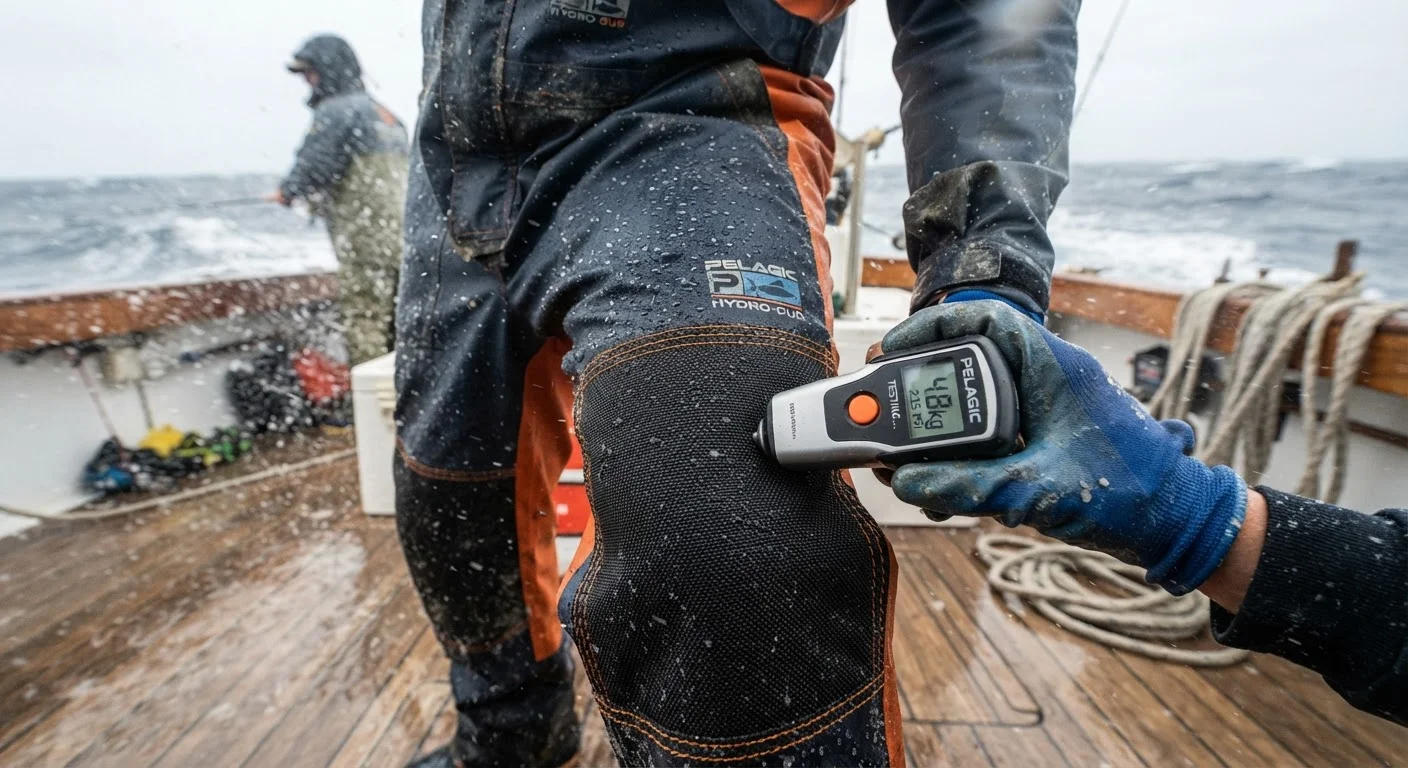
A fishing bib doesn’t fail evenly. It fails where the angler kneels on the deck, where the pack straps rub against a gunwale, where the seat drags across a cooler lid a hundred times a trip. That’s why denier alone won’t tell you if a fabric survives offshore use. You need denier, fabric weight, and reinforcement placement.
Denier measures yarn thickness — grams per 9,000 meters of yarn. Higher denier means thicker yarn and better abrasion resistance within the same fiber type. For fishing bib denier rating, here’s where the ranges land:
210D–420D : Standard for main body panels. Light enough to move in, tough enough for general splash and contact.
420D–600D : The real workhorse range for offshore gear. This is what shows up in most quality nylon vs polyester fishing gear comparisons at the mid-tier.
500D–1000D : Reserved for high-wear zones. Seat, knees, bib bottom.
1680D ballistic nylon : Overkill for full garments, but shows up as reinforcement patches at drag points on premium builds.
Fabric weight (GSM) tells you the finished density, not just yarn thickness. A 300D fabric at 250 GSM is denser and more durable than the same denier at 180 GSM. For offshore bibs, look for 200–300 GSM in the main body and 250–350+ GSM at reinforced zones.
Reinforcement zones matter as much as base fabric. Ask your supplier about:
Double-layer panels at knees and seat: 400D–600D overlay on a lighter body fabric.
Ripstop fabric durability grids, where thicker yarns woven at intervals stop small tears from spreading across the whole panel.
Bartacking at strap attachments and pocket corners: a visible cluster of stitches, not a single seam pass.
Seam strength ratings: under European textile standards, fabric below 220 GSM needs seams rated to 150N minimum; above 220 GSM, that jumps to 200N.
If a quote sheet lists one denier number for the entire garment with no mention of reinforcement zones, that’s a spec built for a spreadsheet, not a boat deck.
Cost-Benefit Analysis: Why the Cheapest Fabric Quote Usually Costs More
Run the real numbers, and a $2.00/yard fabric can end up costing more than a $2.40/yard one. That's the math suppliers hope you don't do.
Total fabric cost = raw material + dyeing/finishing + freight/duties + waste buffer. That waste buffer isn't optional. Professional costers add 10-15% extra yardage on top of calculated need. Marker efficiency—how tightly patterns lay on fabric—should hit 85-95%. Below 85%, you're burning fabric on bad layout.
Rejection rates change everything. Ask suppliers their typical defect rate. Stable mills run 2-5%. Aggressive low-price Offshore Fishing Bibs suppliers often hit 8-15% and won't volunteer that number unless you ask directly.
Compare a 10,000-yard order:
Supplier A ($2.00/yard, 10% rejection): Base cost $20,000. Rush-reorder 1,000 yards with air freight and rush fees adds $2,700. Rework on defects adds about $1,000. Effective cost: $2.37/usable yard.
Supplier B ($2.40/yard, 2% rejection): Base cost $24,000, minimal rework, no rush shipping. Effective cost: $2.45/usable yard.
If Supplier A's defects climb to 15%, or delays idle your sewing line—often $500-$1,000/day for small custom waterproof fishing Bibs factories—Supplier A's real cost overtakes Supplier B entirely.
Before approving any quote, demand an itemized breakdown: fabric width, MOQ, shrinkage allowance, freight terms (FOB vs. DDP), and every surcharge—cut fees, small-lot fees, rush charges. A verbal "all-in, don't worry" answer means those costs show up on your PO later, not before.
Decision Tree: Matching Fabric Tier to Your Order Volume and Target Market
Forget guessing. Match your fabric choice to two hard numbers: how many units per color you're ordering, and what price point your bibs sell at. Everything else follows from those two variables.
Node 1: Under 300 units per color — You're testing a new line or running a boutique offshore brand. MOQ constraints push you toward PVC coated fabric at 2,000-10,000mm hydrostatic head, sourced from stock rolls rather than custom dye lots. Fabric cost target: $3-5/meter. Don't fight the mill for custom waterproof fishing bibs' colorways at this volume—you'll pay a premium and wait longer for nothing.
Node 2: 300-1,000 units per color — This is where TPU laminated fabric earns its price tag. You've got enough volume to justify $6-9/meter for 10,000-20,000mm hydrostatic head material, and enough margin room if your bibs retail above $80. Mid-tier tournament brands and regional tackle shop private labels sit here.
Node 3: 1,000+ units per color — Mass OEM territory. Now you're negotiating custom TPU formulations or even breathable membrane systems if your retail price supports $150+. Fabric cost drops per-unit through volume leverage, but defect tolerance tightens—demand under 2% rejection rates at this scale, because a 10% defect rate on 5,000 units is a real financial hit, not a rounding error.
Match market type to tier : promo and rental fleets stay in PVC territory regardless of volume—durability over comfort. DTC performance brands need TPU minimum. Anything claiming "premium" or "tournament-grade" without hitting 20,000mm+ is marketing language, not a spec.
Supplier Verification: 5 Critical Tests to Demand Before Approving a Fabric Sample
Every fabric sample that lands on your desk should come with paperwork, not just a swatch. Here's the checklist that separates suppliers who'll stand behind their claims from ones who won't.
1. Fiber composition & weight verification. Demand a third-party FTIR report confirming the actual blend, with ±2% tolerance from what's declared. Cut a 10cm × 10cm swatch, weigh it, multiply by 100 for GSM. Reject anything with more than 3-5% deviation from spec.
2. Shrinkage & dimensional stability. Mark a 20×20cm square, wash per AATCC 135, remeasure. For technical outerwear, shrinkage should stay under 3%. Anything higher means sizing complaints on your first reorder.
3. Colorfastness. Test washing (AATCC 61), rubbing (10 rubs with a damp white cloth), and light exposure. Minimum acceptable grade: 4 on the gray scale. Compare against your approved swatch in natural daylight. Artificial light hides shade variation.
4. Surface performance. Rub two swatches together 50 times to check pilling. Request Martindale abrasion data (ASTM D4966) alongside tensile and tear strength (ASTM D5034). Non-negotiable for abrasion resistant fabric claims on offshore gear.
5. Functional performance vs. claims. Sprinkle water on the surface; it should bead, not soak through. Stretch fabric in four directions and check recovery. For any waterproof breathable fabric or PU coating waterproofing claim, require lab-verified hydrostatic head and MVTR numbers. Not a verbal promise.
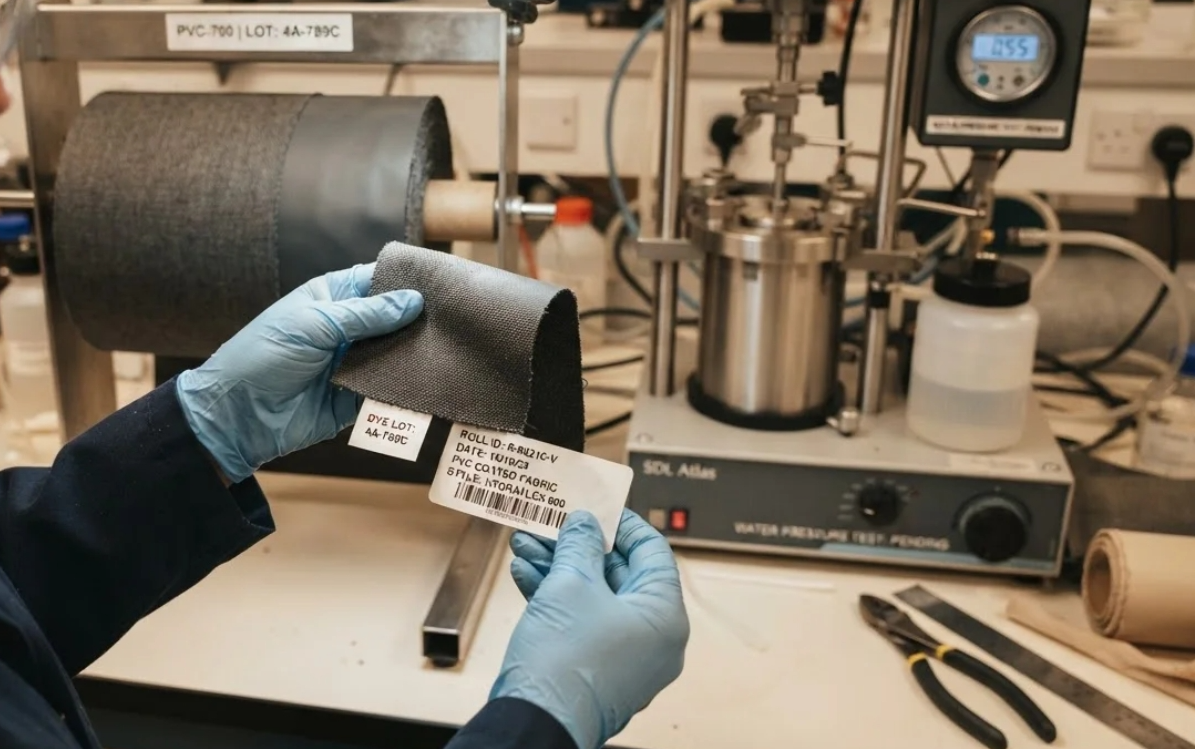
Cut at least one meter from the actual roll, tagged with dye lot and roll ID. Run independent lab tests within 8-12 days. Flag anything over 5% off-spec before you commit to a trial order.
Conclusion
Choosing fabric for custom offshore fishing bibs comes down to math, not marketing copy. A PVC coated fabric might win on price per yard, but if your hydrostatic head rating can't handle a real offshore soak, you're just outsourcing the cost to your return department. The suppliers worth working with will hand you a PU coating waterproofing spec sheet without you asking twice, and they won't flinch when you request abrasion test results on seat and knee zones.
Before you sign off on any bulk order, request three samples across price tiers, run them through the water pressure test yourself, and calculate your true cost-per-unit including projected defect rate. That number, not the quote, tells you who deserves your production run. Do that this week, and you'll walk into your next customizable fishing Bibs waterproof fabric supplier call knowing exactly what you're paying for.