A client orders 1,000 fishing jackets rated "waterproof," and three months later, half of them come back with complaints about internal condensation and seams leaking after twenty wash cycles. The problem isn't bad manufacturing. Someone chose a fabric based on a single spec sheet number instead of matching material performance to actual fishing conditions.
This is not a technical detail you can leave to your custom Fishing Jackets supplier. The choice between PU coated fabric, PVC, membrane laminates, or TPU composites determines whether your product line scales profitably or bleeds margin through returns. Below, you'll find hydrostatic head ratings, breathability figures, abrasion counts, and per-unit costs broken out by order volume, plus the exact traps that trip up buyers who only compare waterproof rating (mm) without checking what happens when a jacket gets wet from the inside.
Fabric Choices for Nearshore and Recreational Fishing Jackets
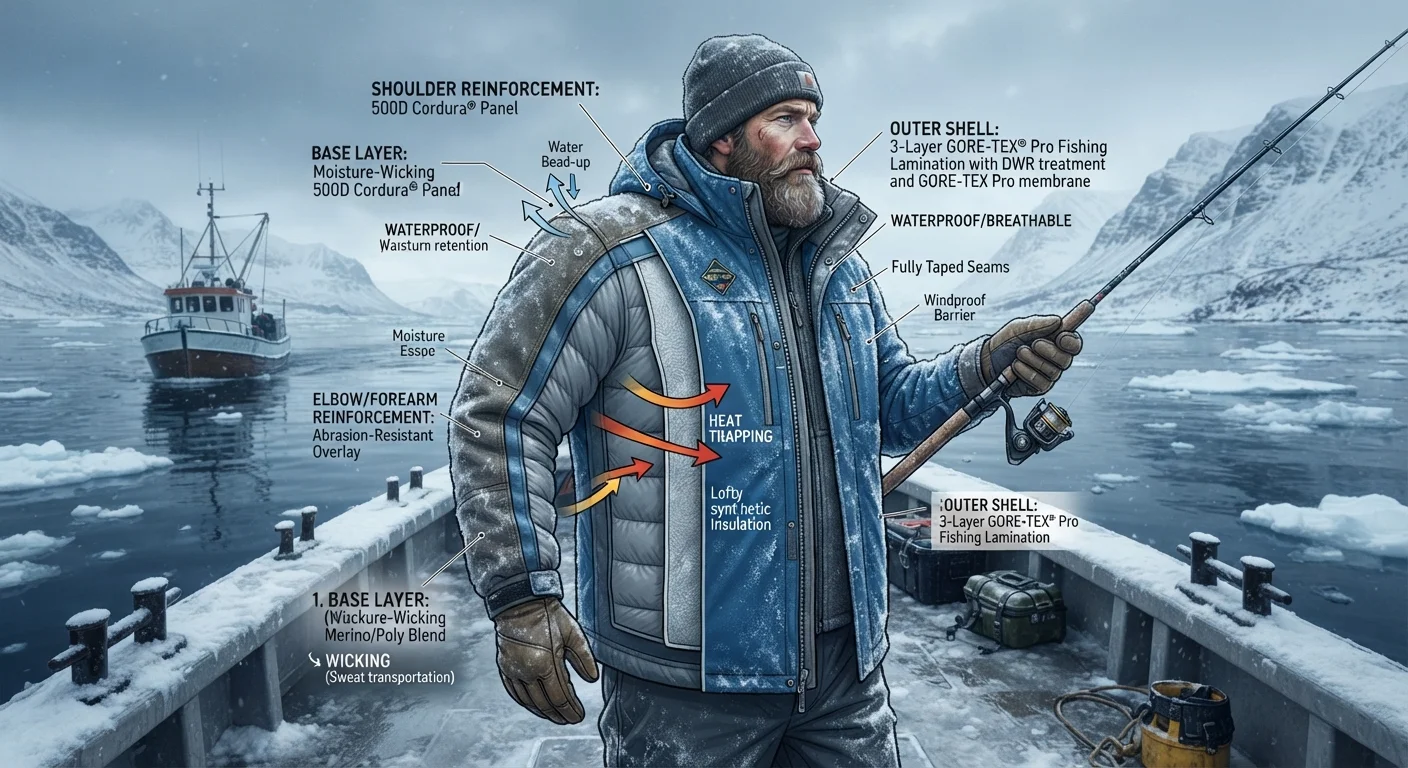
Nearshore anglers aren't fighting deep-sea swells or sub-zero spray. That changes everything about which fabric makes sense.
Face fabric: nylon vs polyester fishing jacket decision
The trade-off is straightforward:
Polyester ripstop (30–40D) : dries faster, holds UV stability better, and works well for stream wading and packable recreational shells. You sacrifice some abrasion resistance compared to equivalent-weight nylon.
Nylon ripstop (40–70D) : tougher against dock hardware, reef contact, and hull chafe. Slower to dry, less UV-stable, but this is your abrasion-resistant fabric pick for rocky shorelines.
Rule of thumb : general coastal jackets use 30–40D polyester. Rugged nearshore with frequent hardware contact calls for 40–70D nylon with reinforced shoulder and elbow panels.
Waterproof Rating and Breathable Waterproof Membrane Specs
Nearshore boat fishing needs a minimum HH of 20,000mm with fully taped seams. General recreational use can work with 15,000mm, but anything under 10,000mm only survives brief showers — not sustained spray.
Breathability matters just as much. Target an MVTR of at least 10,000 g/m²/24h as baseline, and push to 15,000 g/m²/24h if your customer is actively casting or moving around the boat. Keep RET at 10 or lower.
Common membrane options at this tier: 2 to 2.5-layer PU laminates, or proprietary systems similar to Musto BR2 (30,000mm) or Helly Hansen HELLYTECH — both land in the 15,000–30,000mm HH range with solid MVTR performance.
Construction Details That Prevent Complaints
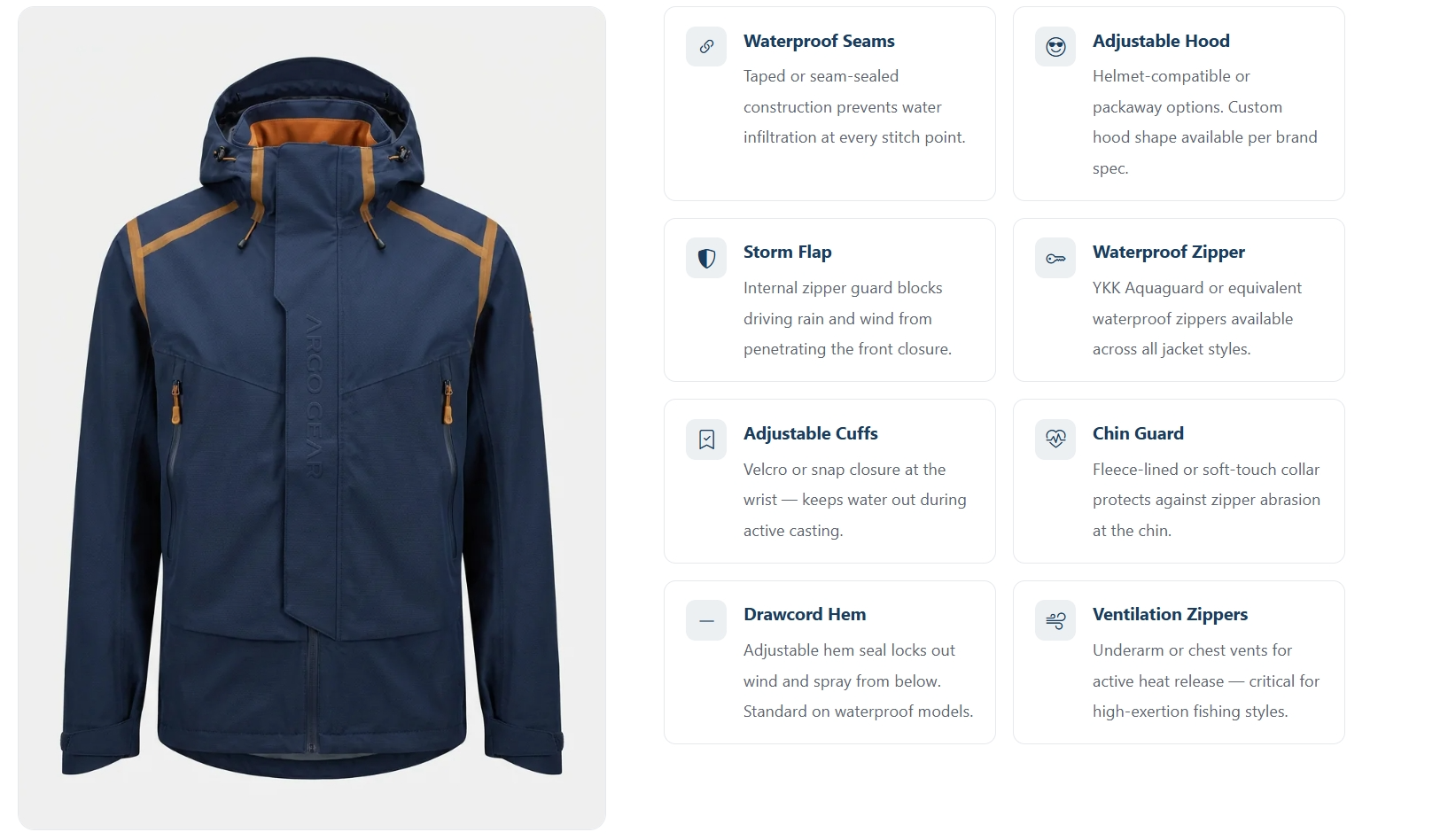
Seams : fully taped, not just critical zones.
Ventilation : pit zips at least 25cm plus back yoke vents.
Hardware : corrosion-resistant zippers, snap storm flaps.
UV : UPF 30–50+ fabric or coating — polyester blends block up to 98% of UV.
Skip PVC here entirely. It delivers maximum waterproofing, but zero breathability makes it miserable for recreational use.
Fabric Specifications for Deep-Sea and Offshore Fishing Operations
Deep-sea gear lives in a different world than coastal recreation shells. Continuous salt spray, sustained high winds, and hours of wave impact mean fabric failure isn't a minor annoyance — it's a safety and liability issue. Waterproof rating, tensile strength, abrasion resistance, and fabric weight all move into a higher tier than nearshore builds.
Waterproof rating and construction
Offshore work jackets need a hydrostatic head test result of at least 15,000–20,000mm, with 25,000–30,000mm preferred for continuous spray exposure. Fully taped seams are mandatory. TPU laminates and heavier PU coated fabric constructions both perform well here; TPU composites often edge out standard PU coatings on abrasion resistance while holding comparable waterproofing, making them a reasonable Gore-Tex alternative for teams managing tighter budgets.
Salt spray resistance — the spec buyers forget to ask for
Standard fishing fabric degrades fast under sustained salt exposure. Anti-salt treated fabric changes the equation:
Metric | Anti-Salt Fabric | Standard Fabric |
|---|---|---|
Salt spray duration (ISO 4611) | 500 h | 72–100 h |
Color retention | Grade 4–5 | Grade 2–3 |
Tensile strength retention | ≥85% | ~60% |
Wash durability | 100+ washes | 30–50 washes |
If your Custom Fishing Jackets supplier can't quote salt spray hours, assume you're getting the standard fabric — and a return rate to match.
Fabric weight and abrasion zones
Shell weight typically runs 130–160 gsm for 100% polyester with anti-salt treatment. That's the baseline for the body panel. Knees, seat, and shoulder contact points need heavier woven inserts in the 300–500D range, or wear-resistant panel materials borrowed from marine gear engineering, since standard deck contact will chew through lightweight shells within a season.
Windproof performance and deck traction
Wind at sea carries moisture and drives cold straight through weak seams. A windproof waterproof fabric with a tight weave count matters more here than breathability numbers. Some Custom Fishing Jackets manufacturers apply "grip print" treatments to seat and knee zones, pushing wet-surface friction coefficients to 0.65–0.72, which meaningfully reduces slip incidents on a pitching, spray-soaked deck.
For deep-sea specs, lock these numbers before quoting a client: HH ≥15,000mm, salt spray ≥500h, shell weight 130–160 gsm, reinforced abrasion zones at 300D+.
Fabric Requirements for Cold-Weather and Arctic Fishing Conditions
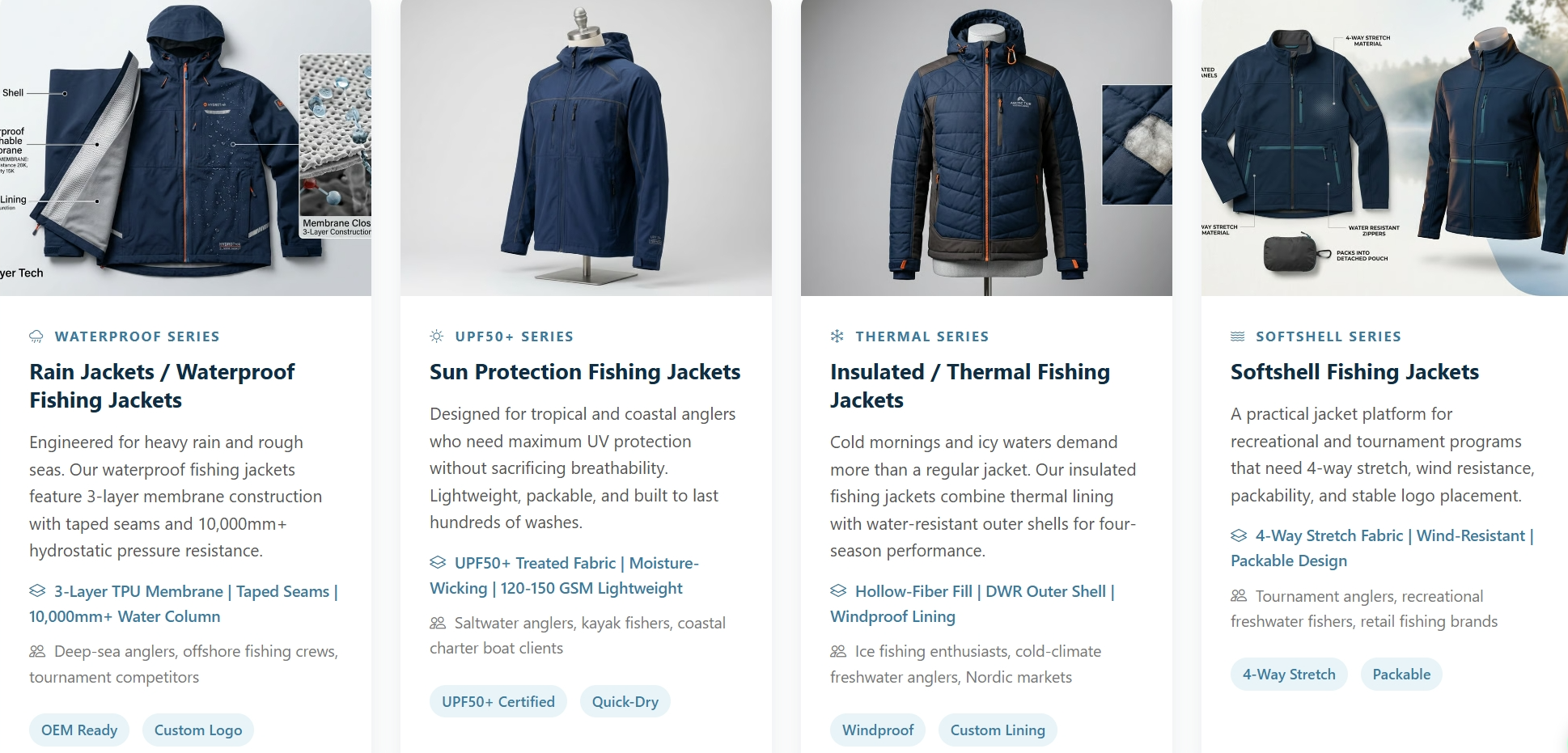
Sub-zero fishing breaks the single-fabric model. You're building a three-layer system where each piece has a different job, and getting any layer wrong sends heat straight out the door or traps sweat that turns to ice against skin.
Base Layer: Where Cotton Becomes a Liability
Cotton is banned from this conversation. It absorbs moisture and stops insulating the moment it gets damp, a known failure mode in cold-weather gear design.
Merino wool: 200–260 gsm for active use (jigging, walking to spots), 260–320 gsm for static ice fishing.
Synthetic polyester blends use hydrophobic fibers with a wicking knit and offer MVTR performance around 8,000–15,000 g/m²/24h.
Fit needs to stay snug and non-compressive. Loose base layers lose capillary wicking and create cold spots fast.
Mid Layer: Insulation Numbers That Match Temperature Range
Match gsm to the actual temperature window your customer fishes in:
Condition | Insulation (gsm) | Target CLO |
|---|---|---|
0°C to +5°C | 100 gsm | 0.8–1.2 |
Around –10°C | 200 gsm | 1.2–1.8 |
Static ice fishing, sub-freezing | 200–400 g (mid), 600g+ (heavy) | ≥2.0 |
Polar fleece, wool, and synthetic loft fills (PrimaLoft, Thinsulate, Climashield) all work here. Synthetic fills hold over 90% of insulating value when wet. This is why they beat down in Arctic conditions.
Outer Shell: Waterproof Rating and Windproof Fabric Specs
Open-water winter fishing: HH 15,000–25,000mm, MVTR ≥10,000 g/m²/24h, fully taped seams.
Static ice fishing: HH 25,000–30,000mm, heavy knee reinforcement for kneeling on slush, MVTR 8,000–12,000 g/m²/24h.
Arctic multi-day expeditions: CLO 1.5–2.5+ across the full system, windproof block at 90–100%.
Shell weight runs 300–800 gsm. Gore-Tex alternative fabrics, like laminate nylon or polyester composites, perform close to name-brand membranes at lower cost, while PVC-coated builds add chemical resistance for commercial cold-water operations.
Technical Comparison of Mainstream Waterproof Fabrics: PU Nylon, PVC, ePTFE Laminate, and TPU Laminate
Four materials dominate the fishing jacket supply chain. Each one wins on a different axis, and none of them win on all of them. Here's the side-by-side breakdown you need before you call a supplier.
The Core Numbers, Side by Side
Spec | PU Nylon | PVC | TPU Laminate | ePTFE Laminate |
|---|---|---|---|---|
Waterproof rating (HH) | 3,000–8,000mm | >10,000mm | 10,000–20,000mm | 20,000–30,000+mm |
Breathability (MVTR) | 3,000–10,000 g/m²/24h | None | 8,000–15,000 g/m²/24h | 15,000–30,000+ g/m²/24h |
Cold performance | Down to -40°C | Down to -30°C (some -10°C) | -35°C to -40°C | -40°C to 130°C |
Warp tear strength | ~350 lb (1000D) | ~220 lb | ~280 lb | Higher than both |
Fabric weight | ~545 g/m² | ~1,680 g/m² | ~1,000 g/m² | ~700 g/m² |
Relative cost | Low-medium | Lowest | Medium-high | Highest |
A jacket rated at 3,000mm and one at 8,000mm both carry the same fabric name on the spec sheet but perform nothing alike in sustained rain.
What the Weight and Cost Numbers Mean
PVC has the highest waterproof rating floor, zero breathability, and is the heaviest fabric at nearly triple the gsm of PU nylon. That weight drives up shipping cost across a 1,000-unit order in ways buyers forget to model.
TPU-laminated nylon runs $1.6–5.5/m and PVC tarpaulin runs $1.2–6.0/m, depending on spec and Custom Fishing Jackets factory. The overlap surprises most buyers — PVC isn't automatically cheaper once you factor in coating grade and weight class.
Chemical and Durability Differences That Don't Show Up on a Spec Sheet
TPU : recyclable, phthalate-free, odorless. Better abrasion resistance than PVC in academic testing.
PVC : harder to recycle, often phthalate-treated, comes with a pungent odor buyers notice at unboxing.
PU : lighter and cheaper, but carries hydrolysis and VOC concerns over the product lifecycle.
ePTFE : stiffer hand-feel, premium price, selected for performance ceilings rather than cost efficiency.
How to Choose
Need breathability and top-tier waterproofing → ePTFE laminate .
Need weldability, flexibility, and cold resistance beyond PU → TPU laminate .
Need lightweight, sewable, cost-sensitive builds → PU nylon .
Need maximum barrier, easy welding, lowest cost, no breathability requirement → PVC .
Match this to your target scenario before quoting a client.
Procurement Cost Analysis Across 500, 1000, and 5000 Unit Order Quantities
Fabric price per meter tells you almost nothing until you run it through a full cost model. The number that matters is landed cost per finished jacket, and that changes dramatically depending on whether you're ordering 500, 1000, or 5000 units.
The formula:
Total Procurement Cost = (Material Unit Price × Order Quantity) + Ordering Cost + (Holding Cost Per Unit × Order Quantity) + Transportation Cost + Receiving Cost
Run this at each quantity tier, then compare per-unit totals, not just the headline material price.
Quantity | Cost Advantage | Cost Risk | Best Fit |
|---|---|---|---|
500 | Low inventory exposure | Fixed costs (freight, receiving, POs) spread over fewer units → highest per-unit cost | Testing a new fabric or new market |
1000 | Balanced price vs. holding cost | Moderate freight and working-capital load | Standard baseline sourcing scenario |
5000 | Strongest unit-price leverage from the mill | Highest carrying cost, obsolescence risk if a fabric spec changes mid-season | Stable, repeat-demand product lines |
Unit Cost = Total Cost ÷ Quantity Purchased. Calculate this at all three tiers before comparing Custom Fishing Jackets wholesaler quotes side by side. A lower per-meter price at 5000 units can still lose to 1000 units when you factor in holding cost and slow-moving inventory risk.
Two more numbers worth pulling from Waterproof Fabrics for Custom Fishing Jackets supplier before you commit:
Break-even quantity: the order size where the volume discount finally outweighs added holding cost. Ask for tiered pricing at 500/1000/5000 and plug it into your own carrying-cost rate.
Should-cost target: build this from raw material cost + labor + overhead + margin, then use it as your negotiation floor instead of accepting the first quote at face value.
Benchmark every quote against market pricing history. If 1000 units of TPU laminate suddenly costs more per unit than your last order, push back before signing.
Conclusion
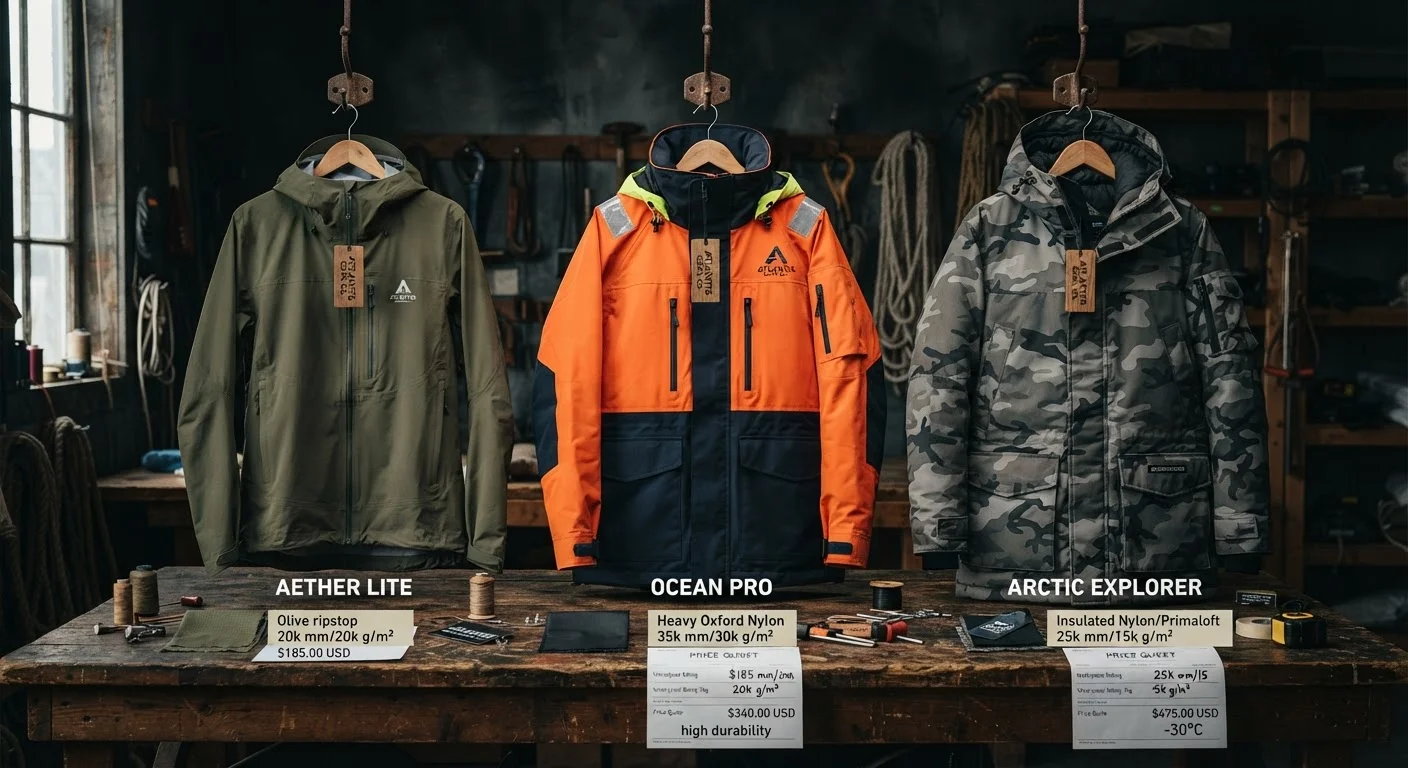
The right waterproof fabric depends on your customer's fishing environment. Nearshore jackets need moderate breathability and cost efficiency, deep-sea gear demands 10,000mm+ waterproof ratings with reinforced abrasion resistance, and cold-weather applications require insulation-compatible laminates that won't crack in freezing temps.
Stop choosing fabric based on price alone. A cheaper PVC roll that saves $2/meter can cost you thousands in returns when customers complain about condensation or seam failure after one deep-sea trip.
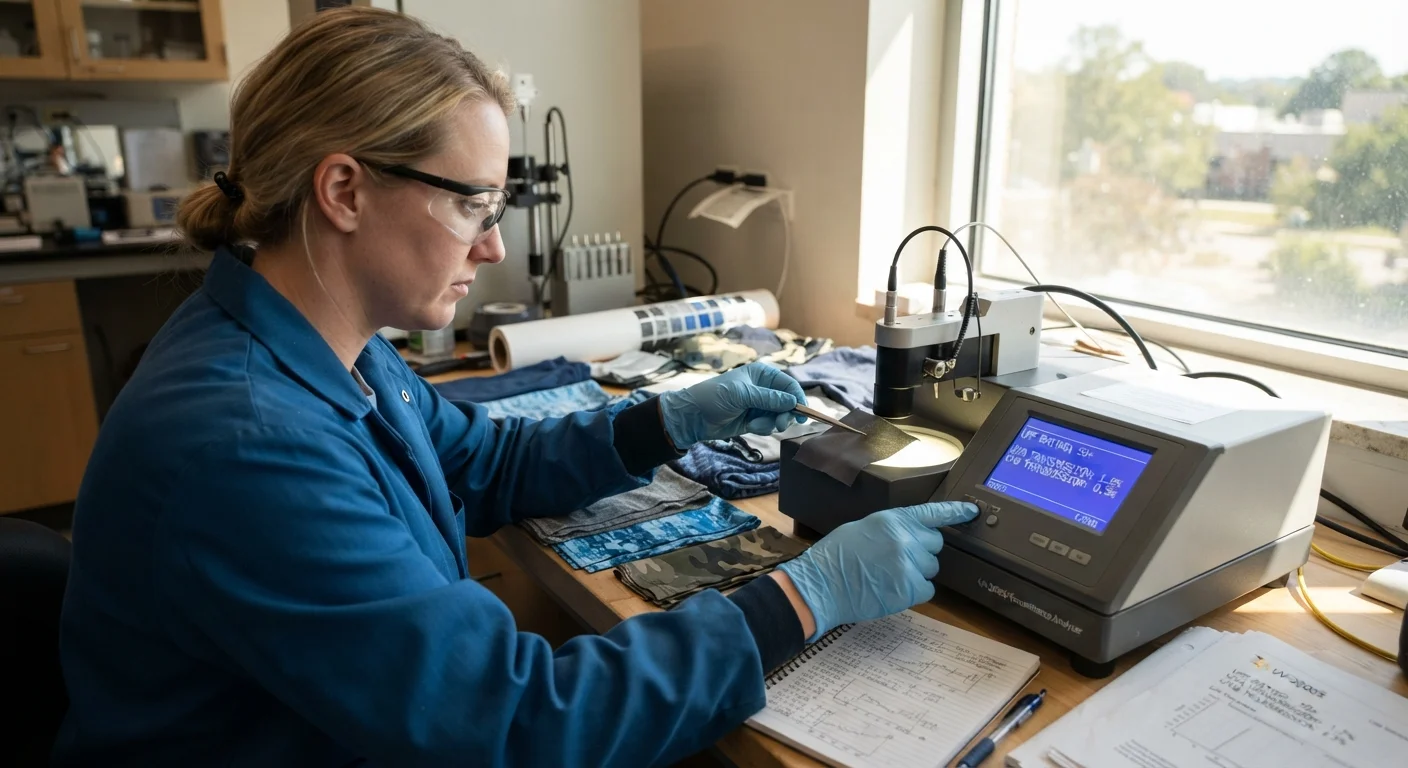
Use the comparison table and cost breakdowns above as a specification sheet your Performance Custom Fishing Jackets supplier has to match. Before your next order, run the numbers at 500, 1,000, and 5,000 units, then request lab-tested hydrostatic head reports, not marketing claims.
Get the fabric spec right, and everything downstream gets easier: pricing, customer retention, repeat orders.