Three saltwater seasons ago, I watched a fishing buddy peel off his brand-new "fishing shirt" after a full day offshore. The fabric had already started pilling along the collar seams. The chest pocket zipper had turned a grim shade of rust orange. He'd spent $45 on what looked like a solid buy. The salt had other opinions.
That moment made one thing clear — most gear guides won't tell you this straight: not all fishing shirts are built for saltwater. The difference between a shirt that lasts one season and one that lasts five comes down to a few specific details. Most buyers never think to check them.
So here's a practical field-screening system. It covers four key areas:
Fabric composition
UPF authentication
Hardware integrity
Ventilation design
Use it to check any custom mens fishing shirts saltwater option, on any platform, in under five minutes. You'll know fast whether you're looking at a keeper — or buying rust and regret.
Decode Fabric Composition for Salt Corrosion Resistance
Fabric composition is where saltwater separates real gear from retail theater.
Most anglers shop by feel — they grab something that looks technical, has a few fishing-branded logos, and moves well in the store. That works fine for freshwater. In saltwater, it's how you end up with a stiff, chalky, foul-smelling shirt by trip three.
Here's what actually happens. A saltwater-soaked shirt dries and leaves sodium chloride crystals behind inside the fiber structure. Those crystals don't just sit there — they grind against fibers during movement, speed up UV-driven color fading, and if there's any cotton in the weave, they pull moisture into the cellulose structure and invite mold. The shirt doesn't fail all at once. It breaks down trip by trip, until one morning you're pulling on something that smells like a bait bucket and feels like sandpaper.
The fix isn't spending more. It's buying the right thing.
The Three-Fiber Reality Check
100% Polyester — Your Default Starting Point
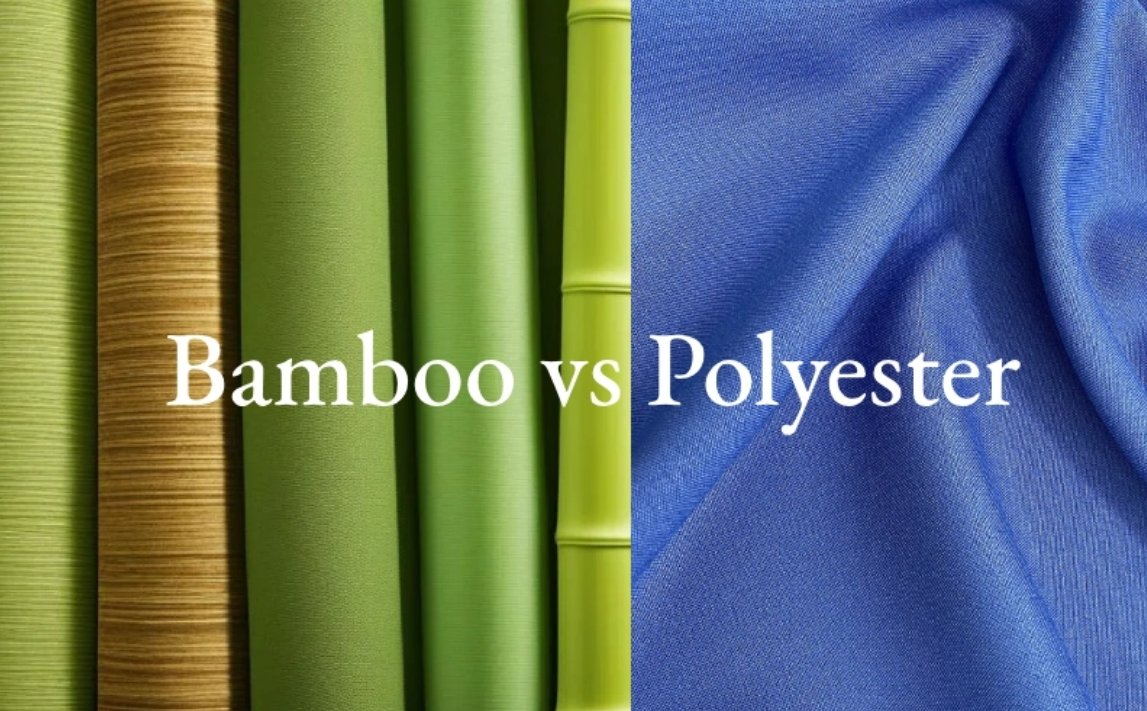
Pure polyester is the sensible baseline for most saltwater fishing. The numbers back this up: smooth continuous-filament polyester knits hold less than 2% salt by weight after a rinse-and-dry cycle. They lose about 1–2% tensile strength after 72 hours of simulated seawater exposure. Moisture regain sits around 0.2–0.4%. That means it absorbs almost nothing, dries fast, and gives salt crystals very little to grip.
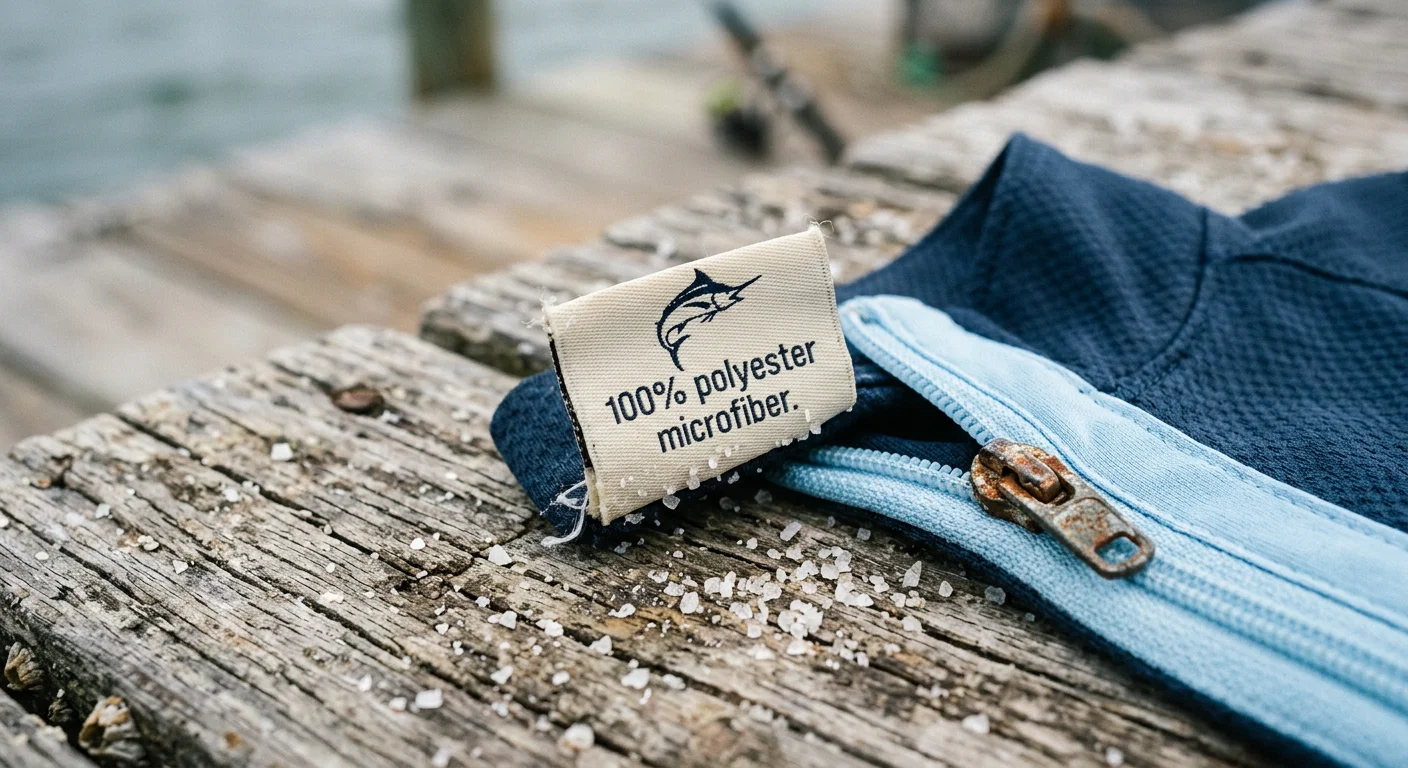
Construction details matter here. Microfiber or warp-knit polyester beats coarse, heavy-denier versions because tighter, smoother surfaces trap less salt in surface gaps. Look for "100% polyester microfiber" on the tag of any moisture-wicking fishing shirt you plan to take offshore on a regular basis.
Nylon — Useful in the Right Zones, Problematic Everywhere Else
Nylon (polyamide) offers strong abrasion resistance — about 15–25% better than comparable polyester by standard testing. That's why you'll find it on reinforced panels: shoulders, pocket edges, collar undersides. Smart design.
The problem is nylon's chemistry. Its moisture regain runs around 4% — about ten times that of polyester. Its amide groups interact with salt ions and hold them close to the polymer chain. Leave a nylon-heavy shirt in salt without rinsing and you're running a slow breakdown experiment on your own gear. The verdict: nylon reinforcement panels, yes. Full nylon construction for heavy offshore use — commit to a freshwater rinse within 24 hours every single time, no exceptions.
Cotton Blends — The Disqualifying Factor
There's no polite way to say this. Any shirt with more than 15% cotton content is not a saltwater performance shirt. It's a comfort shirt wearing fishing branding.
Cotton's moisture regain is 7–8%. Its pore structure holds salt solution deep inside the fiber. Salt dries and sodium chloride crystals form bridges across individual fibers and cell wall microfibrils — that's where the scratchy, brittle feel comes from, and it gets worse every trip. In a marine climate with humidity above 75%, cotton content above 15% raises mold and mildew rates by 300–500% compared to a fully synthetic build. What feels soft on the rack becomes a biology problem by mid-season.
The Print Method You're Probably Ignoring
There's one detail almost nobody checks — and it drives a large share of premature shirt failures in saltwater.
The way graphics are applied determines whether the shirt survives salt.
Standard screen-printing lays pigment and a binder film on top of the fabric surface. Salt crystals act as micro-abrasives against that film. UV makes the binder brittle. Flex cycles crack it. After a handful of offshore trips, you get chalking, flaking, and color loss — not because the shirt wore out, but because screen-printing was never built for this environment.
Dye-sublimation works at a different chemical level. The ink transfers as vapor directly into the polyester polymer matrix at temperatures around 180–210°C. Color becomes part of the fiber itself — not a layer sitting on top. Salt crystals have no film to cut. They sit on the surface and rinse off clean. Look for "dye-sublimated graphics" on the tag or product description, or phrasing like "colorfast to saltwater/chlorine."
For solid-color shirts, solution-dyed (dope-dyed) polyester is the top tier. Pigment goes directly into the polymer melt before the fiber forms — color runs through the full thickness of every filament. Marine canvas and boat covers use this same technology, built for years of salt exposure.
A product page that says "stain-resistant" without mentioning sublimation or solution-dyeing? Treat that as marketing noise.
The Budget-to-Performance Translation
Price Range | Typical Fabric | Salt Reality | Best Use |
|---|---|---|---|
Under $25 | Poly/cotton blends (often 20–40% cotton), screen-printed graphics | High stiffness and fading risk within 2–3 trips | Occasional beach days |
$25–$50 | 100% polyester microfiber, dye-sublimated prints, UPF 30–50 | Low salt retention, color-stable, reliable over many trips | Reliable daily-use saltwater fishing shirts for most anglers |
$50+ | Engineered nylon–poly hybrids, permanent DWR, mechanical stretch | Built for 20–30+ salt immersion cycles; holds hand feel and abrasion resistance | Guides, tournament anglers, heavy offshore use |
The $25–$50 tier is where real value lives for most anglers. A well-built 100% polyester microfiber shirt with sublimated graphics will beat a $70 cotton-rich "performance" shirt in saltwater every time. Men's saltwater fishing shirts' price doesn't fix wrong fiber chemistry.
The Fabric Checklist — Five Seconds at the Hang Tag
Standing in Bass Pro or scrolling Amazon? Run through this list in order:
Fiber content : 100% polyester for the core build. Nylon in reinforcement panels only. Cotton above 15% — put it back.
Print method : Look for "dye-sublimated" or "solution-dyed polyester." No sublimation mention? Treat the graphics as a weak point.
Finish claims : "Colorfast to saltwater," "marine-grade UV fastness," and "permanent DWR" are worth something. "Quick-dry" alone means nothing without fiber specifics.
Construction weight : Target 120–170 g/m² lightweight knits with smooth microfiber surfaces. Skip brushed, heavy, or terry-loop builds.
Care instructions : The tag should allow — and ideally recommend — a freshwater rinse after salt exposure plus line drying. Dry-clean or high-heat tumble dry instructions mean the men's saltwater fishing shirts manufacturer never designed this shirt for the water.
This is the foundation of any solid saltwater resistant clothing decision. Get the fiber wrong and nothing else saves the shirt — not the UPF rating, not the venting, not the brand name.
Authenticate UPF Ratings and UV Shield Standards
The sun doesn't care what the hangtag says.
Spend a full August day running offshore in the Gulf — water like hammered glass, sun bouncing off every surface — and the truth hits fast. UV protection on a fishing shirt isn't a nice-to-have feature. It's the whole point. The problem is that "UPF 50" has become the kind of phrase marketers stamp on packaging, knowing most buyers won't dig deeper. Some of those claims are real. A lot of them aren't. Sorting the difference takes about ninety seconds if you know where to look.
The Certification Marks That Mean Something
A legitimate UPF rating isn't a number a brand made up. An independent textile lab produces it by running your shirt through a set protocol. Three test standards dominate credible sun-protection apparel:
AATCC TM 183 — the primary U.S. standard for UV transmittance through fabric
AS/NZS 4399 — the Australian/New Zealand standard, referenced by quality offshore apparel brands
EN 13758-1 / EN 13758-2 — the European framework; garments sold as sun-protective PPE in the EU must carry CE marking, UPF 40+ minimum, and UVA transmission below 5%
One of these standard codes on the hangtag or product documentation — paired with a specific UPF number — gives you real evidence. A product page that just says "UV blocking fabric" or "sun protective shirt," with no standard named and no lab reference, gives you marketing copy. Treat those two things as completely different.
What the Numbers Block
The math is simple but worth knowing:
UPF 30 blocks 96.7% of UV — 3.3% gets through
UPF 50 blocks 98% — 2% gets through
UPF 50+ is the top category, reserved for fabrics that transmit less than 2% UV
That gap between 3.3% and 2% sounds small on paper. Stack it across six hours of direct sun amplified by water reflection, and it adds up fast. Water surfaces push effective UV exposure up by 25–50% compared to land conditions. Your shirt's rating is being stress-tested the entire time you're out there. For any serious offshore fishing apparel use, UPF 50+ is the only rational target — not UPF 30, no matter how well-branded the shirt looks.
The Wet-Shirt Problem Nobody Mentions
Most buying guides skip this part.
Standards-based EU labeling for sun-protective clothing includes a clear warning: protection may be reduced when the fabric is stretched or wet. That's a certification body telling you, in the fine print, that labs measure the UPF number on dry, unstretched fabric. Not on a soaked shirt pulled tight over a life vest while you're fighting a kingfish in July.
For saltwater anglers, this matters on two levels. First, a shirt that gets wet from spray, sweat, or a wave over the gunwale loses some UV blocking right away. Second, a shirt stretched across your shoulders over bulky gear loses more. So look for products that mention wet-UPF retention by name, or that document test conditions including immersion or splash exposure. That kind of language shows the men's fihing shirts manufacturer thought about how the shirt performs on the water — not just how it performs in a lab.
The Fast Screening Method
Standing in Bass Pro Shops or scrolling sun protection fishing gear on Amazon? Run this three-point check first:
Standard reference present? Look for AATCC 183, AS/NZS 4399, or EN 13758 on the hangtag or product description. No standard named = no verified claim.
Specific UPF number? "UPF 50+" with a lab reference beats "excellent UV protection" by a wide margin. Vague language is a red flag.
Wet/stretch performance addressed? Any statement about protection under real conditions — wet, stretched, high-reflectivity environments — is worth noting. Silence on this point is a real concern for offshore use.
Budget context: Under $25, marketing-only UPF claims are common — verify before trusting. The $25–$50 range is where legitimate UPF 50+ garments with named standards start showing up. Above $50, you're more likely to find added design features — hoods, extended neck coverage, longer sleeve cuts — that close the coverage gaps no fabric rating can fix on its own.
A certified number tells you what the fabric does. Coverage, fit, and wet performance determine what protects your skin on the water.
Audit Corrosion-Prone Hardware and Seam Construction
Pull a shirt out of your gear bag after three offshore trips and look at the zipper pull. That orange tinge isn't a trick of the light. That's galvanic corrosion — and it means the shirt was never built for salt.
Most anglers never think to check hardware. They inspect the fabric, maybe scan the UPF label, and call it done. But saltwater doesn't stop at the weave. It finds every piece of bare metal, every cotton thread, every tight seam fold where moisture pools and dries and concentrates. Then it starts working. The shirt you thought was fine starts failing at the edges. Pocket seams split. Collar stitching goes brittle. The zipper freezes halfway up. None of this happens because the fabric was bad. The hardware and construction were never designed for what you put them through.
Here's what to check before you buy anything.
The Zipper Test: One Question That Filters Out Half the Field
Not all zippers hold up the same in a saltwater environment.
Standard metal zippers — the kind you'll find on most sub-$25 "fishing shirts" — use mixed-metal construction. Brass slider, steel pull tab, zinc stops. Drop that combination into saltwater on a regular basis and you're running a basic chemistry experiment on your own gear. Different metals touching a conductive liquid create galvanic couples. The weaker metal corrodes first, and fast. In real coastal spray conditions, painted or plated metal zippers can show visible rust or white oxidation within two to three weeks of daily salt exposure .
The fix is specific:
Plastic or resin coil teeth — inert in salt, no galvanic reaction possible
YKK AquaGuard® or equivalent marine-grade line — PU-coated coil construction with documented salt spray test results
Polymer-coated or all-polymer slider and pull — cuts out mixed-metal contact at the most stressed point of the zipper
Polyester tape backing — no cotton underneath, which soaks up salt and speeds up corrosion at the tape-to-fabric joint
Fabric garages at zipper stops — the top and bottom stops are classic salt trap sites; a simple fabric cover over each stop removes that problem
No zipper brand on the product page? No mention of plastic teeth? Treat the zipper as unverified. That's not a small detail — that's how shirts die in the first season.
Thread Material: The Hidden Structural Failure
Most gear guides skip this one entirely.
Every seam in your shirt is stitched with thread. Thread has a fiber content, just like fabric. In saltwater, that fiber content decides whether your seams hold or open.
Cotton thread — or cotton-wrapped thread with a synthetic core — absorbs salt water by design. Salt crystals form inside the fiber as it dries. After repeated wetting and drying cycles, the thread swells, weakens, and rots at the needle holes. That's why you sometimes find a shirt where the fabric still looks fine, but the shoulder seam or chest pocket has split open. The fabric didn't fail. The thread gave out.
What to look for:
- 100% polyester or polyester core-spun thread throughout all exposed seams
- A specific call-out for UV-stabilized sewing thread on shoulders and collar — these areas take the hardest combined hit of UV radiation plus salt spray
- Skip any shirt with care instructions that suggest hand-washing with no mention of saltwater rinsing — that signals cotton-based construction underneath
Seam Architecture: Where Salt Sets Up Camp
Seam shape matters more than most buyers realize.
Bulky overlock seams on shoulders create raised ridges. Those ridges trap salt crystals, hold them against your skin, and grind them into the fabric surface every time you move. Over a full season of offshore trips, that's not just discomfort. That's concentrated abrasion right along the line where your shoulder carries a bag strap or vest harness.
What good construction looks like:
Flatlock or flat-seamed coverstitch on shoulders and underarms — sits flat against the skin, no ridge to collect salt
Double-needle topstitching around chest pockets , plus bar-tacks at all four pocket corners and at flap ends — these are high-stress points where salt-weakened seams blow out first
Seam allowances of at least 10–12mm with clean-finished edges — raw edges fray and pull salt into the seam interior; a folded, finished edge closes that off
Lockstitch with back-tack at every stress point — bottom zipper stop, collar insertion, pocket top corners
The collar deserves its own mention. The neck area stays wet all day — sweat, salt spray, UV, and wind hit it in cycles. Look for a stand collar with an inner sweat-wicking guard — a microfiber or mesh liner that keeps salt-soaked sweat away from the structural collar fabric and its stitching. Add an extended rear neck drape that covers the upper spine. That's where "neckline fade" hits hardest. It's also where you'll find the thinnest, most exposed stitching on budget shirts.
Hardware Beyond the Zipper
Every piece of metal on the shirt is a potential failure point in salt spray.
Buttons, snaps, D-rings, tool loops, adjusters, eyelets — check each one with the same logic you used for the zipper.
Hardware Type | What to Avoid | What to Require |
|---|---|---|
Buttons & snaps | Bare steel or brass anywhere on collar or placket | Nylon, acetal, or polymer-capped snaps with stainless substrates |
D-rings & loops | Exposed metal D-rings on chest or waist | Molded polymer loops — for plier clips, tool hang points, adjusters |
Eyelets & vents | Bare metal eyelets near sweat zones | Laser-cut fabric vents or plastic eyelets; stainless only where metal is load-bearing |
The core principle here mirrors what coastal structural engineers follow: reduce the number of metal types, avoid mixed alloys, and keep hardware as uniform as possible. Each additional metal type adds another potential galvanic couple. The simpler the solution, the better — replace metal with polymer wherever the load allows it.
The Hardware and Seam Checklist — Two Minutes at Any Price Point
Run this before you buy, on any platform:
Zipper teeth : Plastic/resin or coated marine-grade? Metal teeth with no coating — flag it.
Zipper brand/spec : YKK marine line or equivalent documented? Generic or unlabeled — assume standard-grade.
Thread content : Polyester confirmed? Any mention of cotton thread, or no thread spec at all — that's a risk.
Shoulder construction : Flatlock or flat seam noted? Bulky overlock on shoulders — expect salt buildup.
Pocket reinforcement : Bar-tacks and double-needle topstitching visible or specified? Single-stitch pockets on a shirt marketed for offshore use — common at the sub-$25 tier, and they show it.
Collar design : Inner wicking guard and rear drape coverage? A flat collar with single-row stitching at the neck edge is a durability liability offshore.
Budget reality : Under $25, plated metal zippers and single-stitched cotton-blend seams are the norm. Expect zipper corrosion by week two of regular use. The $25–$50 range is where YKK coil zippers and polyester lockstitch construction start showing up — but check the zipper line directly, because not every YKK product is marine-grade. Above $50, you're paying for sealed zipper construction, UV-rated thread, flatlock shoulder architecture, and full polymer hardware. Those features hold up across a full season of weekly offshore trips without any extra babying.
The fabric sets the foundation. Hardware and seam construction decide whether the shirt survives to the end of the season — or comes apart at every point salt found a way in.
Match Ventilation Architecture to Inshore vs Offshore Scenarios
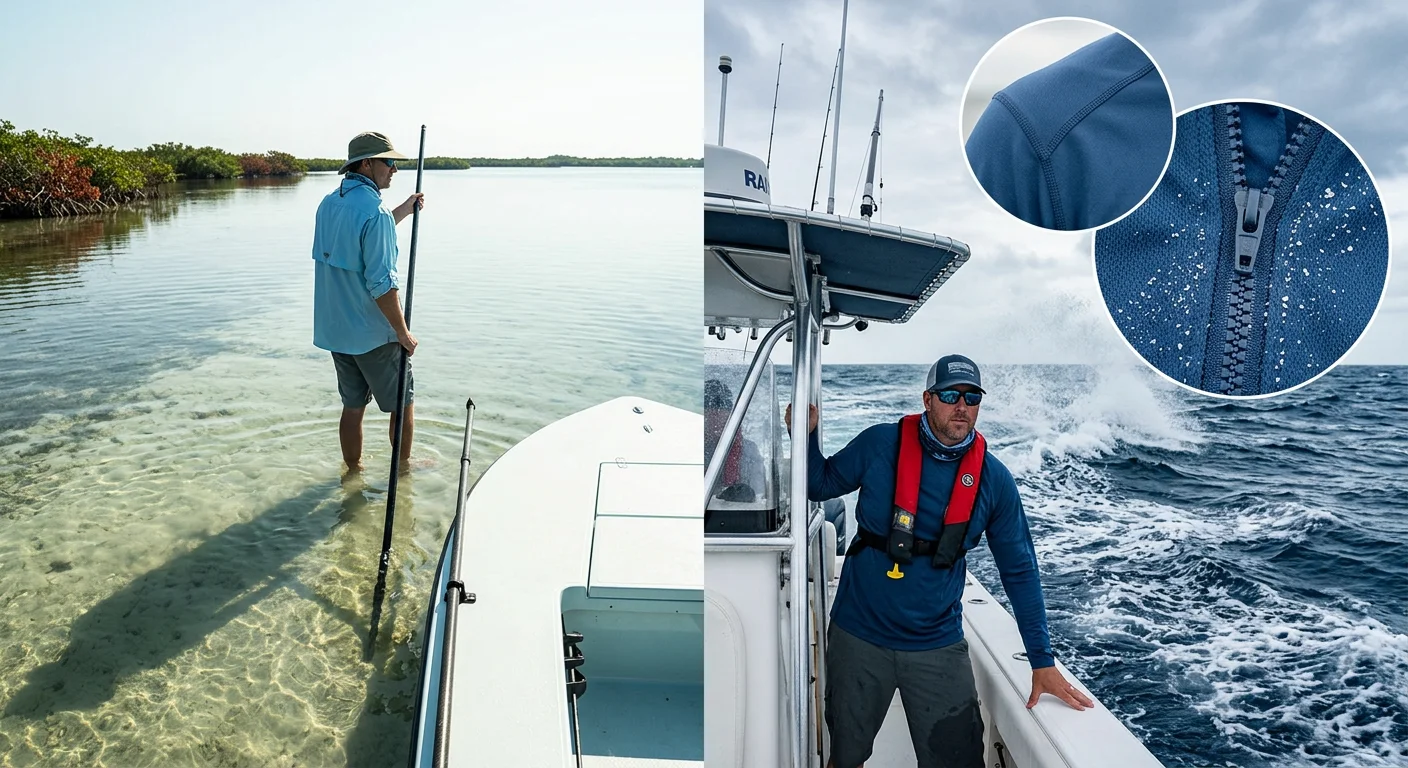
Most gear guides never separate these two scenarios — but they should. The ventilation system that saves you on a dead-calm flats skiff will work against you on a 30-knot offshore run. These aren't the same environment. They don't need the same shirt.
One practical question drives the whole decision before you buy anything — where does most of your air movement come from?
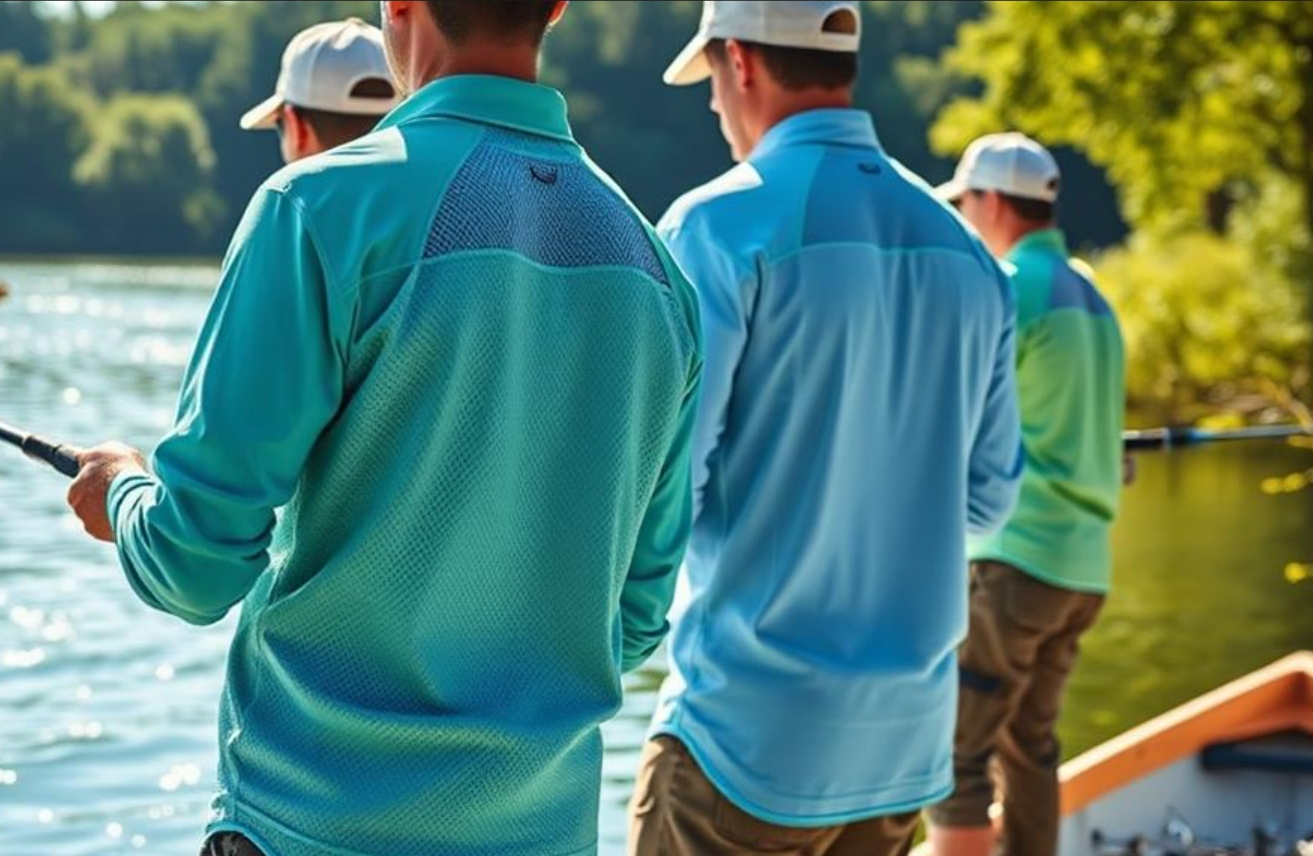
On inshore flats, the answer is often nowhere. You're poling through skinny water in August. Humidity sits at 90%. Wind is under 5 knots. Your body heat has nowhere to go unless the shirt moves it. That's a physics problem. The solution is a specific structural feature: a cape-back vent with mesh lining . The cape creates a chimney effect — rising body heat vents upward through the mesh even in dead-still air. Without it, any shirt turns into a wet compress by hour two.
Offshore, the air problem flips. Wind and spray hit you non-stop. You don't need a chimney. You need a shirt that keeps performing when soaked , moves with your body under a PFD, and doesn't bunch against harness straps during an 8-hour run to the canyon.
Those two demands point to two distinct shirt architectures.
Inshore: Woven Construction with Mechanical Vents
The Columbia PFG Bahama II is the standard reference point here — and for good reason. Its 100% nylon plain-weave construction sits around 120–150 g/m² . Light enough to breathe. Tight enough to block UV at UPF 50 . The full cape-back vent with mesh lining is the core feature. It creates passive airflow in still conditions — the kind a stretch knit can't generate on its own without wind pushing through it.
This architecture fits best for: - Temps 80–100° f , high humidity, wind under 10 knots - Poling, wading, kayak fishing, or flats skiff work - Frequent sun exposure but limited spray
One real limitation worth knowing: the cape vent gets blocked when a PFD sits over your back. Wear a vest all day, and you lose most of that benefit. The shirt still works — just not at its best.
Offshore: Knit Construction Built for Motion and Saturation
Shirts like the HUK Pursuit or Icon X take a different approach. No cape. No discrete vents. Instead, they use dense polyester microfiber knit — 4-way stretch — to wick sweat to the surface and let offshore wind finish the job. The key advantage: they hold UPF 50+ even when soaked through. A wet woven shirt loses measurable UV protection. A well-built knit holds it.
Under a PFD, this construction is clearly better. The fabric compresses without bunching. Shoulder seams don't dig pressure ridges into harness straps. Most models dry in 15–40 minutes in standard offshore wind — so you cycle through wet and dry multiple times in a single day without the shirt dragging you down.
This architecture fits best for:
- Temps 70–95°F, medium-to-high wind, variable cloud cover
- Run-and-gun offshore, trolling, jigging with PFD on all day
- Any trip where you'll get soaked more than once
Heavy Offshore: The Hoodie Tier
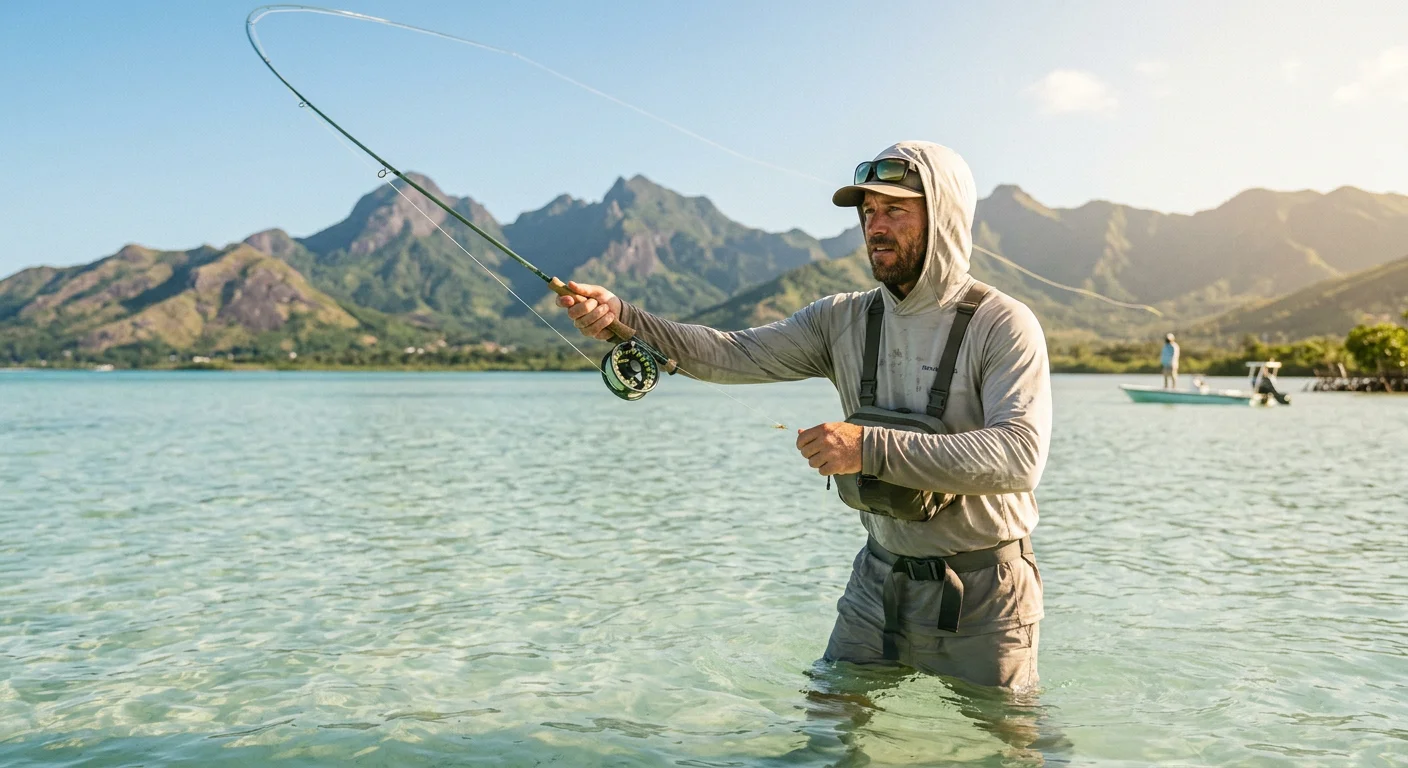
For long canyon runs, overnight trips, or tournament fishing, the math shifts again. Shirts like the AFTCO Samurai or Salt Life Advantek go past basic ventilation and into full-coverage design. Integrated hoods and face gaiters protect your face and neck at 25–40 knots apparent wind — better than any collar setup. Reinforced shoulder zones hold up to constant harness friction across long days. Sublimated polyester knit construction keeps color intact through a full tournament season of salt exposure.
This is the right tool for situations where max coverage and PFD-specific fit matter more than the airflow of a cape-back vent.
The Budget-to-Architecture Map
Price | Architecture | Best Scenario |
|---|---|---|
Under $25 | Basic poly knit, UPF 15–30, no true venting | Casual inshore, no PFD, fair weather use |
$25–$50 | Vented nylon wovens or entry UPF 50 knits | Flats/inshore (woven) or light offshore (knit) |
$50+ | Body-mapped mesh, 4-way stretch, hoods, harness patterning | Serious offshore, tournament use, full-day PFD wear |
The $35–$45 vented woven and the $45–$65 performance knit aren't competing products. They solve different problems. Most serious saltwater anglers end up owning both — the woven for inshore heat, the knit for offshore days. Fishing skews inshore? Go woven with a full cape. Trips involve a PFD and open water? Go knit with documented UPF 50+ wet-retention. Budget forces one choice for both environments? The performance knit covers the wider range of conditions without falling short at either end.
Execute the Saltwater Selection Scorecard for Final Decision
All the gear knowledge from the previous four sections comes down to this one moment. You're standing in the aisle at Bass Pro, or scrolling through a third Amazon page at midnight. You're trying to decide if a shirt is worth your money. Most anglers just gut-check it. They look at the fishing shirts price, skim the reviews, and hope for the best. That's how you end up with a rust-stained zipper and a cotton-blend shirt that smells like low tide by August.
There's a better way. Run the numbers.
The 100-Point Saltwater Scoring System
Five dimensions. Fixed weights. Every shirt goes through the same filter. No exceptions for brand loyalty, color preference, or a convincing product photo.
Dimension | Weight | What a 5/5 Looks Like |
|---|---|---|
Fabric Salt Resistance | 25% | Tag reads 100% polyester or 100% nylon. Zero cotton. "Offshore," "technical," or "sublimated" language present. |
UPF Certification | 25% | UPF 50+ confirmed, test standard named (AATCC 183, AS/NZS 4399), "blocks 98%+ UV" stated. |
Hardware Corrosion Guard | 20% | YKK plastic or coated zippers, resin buttons, polyester thread. No bare metal in salt-contact zones. |
Ventilation & Moisture Wicking | 15% | A stated quick-dry claim, mesh-lined cape back or laser-cut vents, "dries in under 30 minutes." |
Scenario Match | 15% | Features built for your use — inshore stretch and roll-up sleeves, or offshore hood, thumb loops, and tight weave. |
Score each dimension 1–5, then use the weights:
Fabric × 5 (max 25)
UPF × 5 (max 25)
Hardware × 4 (max 20)
Vent/Wick × 3 (max 15)
Scenario × 3 (max 15)
Automatic penalties come off the top before you finalize:
- –2 points for any cotton content in the fiber blend
- –2 points for any metal hardware not described as coated or marine-grade
- Both problems present: –4 points total
How to Run It in Under Five Minutes
Open the product page. Follow these five steps in order. Don't skip ahead to the photos.
Step 1 — Fabric. Go straight to the materials section. Find "100% polyester," "100% nylon," or a synthetic blend with elastane under 10% and zero cotton. Give it a 4 or 5 only when cotton is absent and salt-specific language shows up somewhere in the description. Cotton anywhere in the fiber list — drop it to a 2 and take the –2 penalty.
Step 2 — UPF. Look for the rating number, then the test standard behind it. "UPF 50+" with " AATCC 183" earns a 5. "UPF 50+" alone earns a 4. "Sun protective" with no number earns a 3 at best. No UV claim at all — score it a 1 and move on.
Step 3 — Hardware. Pull up the product images. Zoom in on the zipper pull, the chest pocket closure, the collar buttons. Plastic coil teeth and polymer sliders earn a 5. One coated metal component earns a 4. Multiple metal pieces with no corrosion-resistance language — take the –2 penalty and score a 2.
Step 4 — Ventilation. Scan the features list for "moisture-wicking," "cape back mesh," "underarm eyelets," or a stated dry time. A shirt with a strong wicking claim and a visible vent system earns a 5. "Lightweight" or "breathable" with no specifics earns a 3.
Step 5 — Scenario match. Decide first: are you buying this for inshore flats work or offshore open-water runs? Then check the shirt's design. Look at sleeve cut, collar height, and shoulder construction. Does it match that environment? A tournament-ready offshore shirt built for 30-knot wind is the wrong tool for a flat-calm August wade. Match is a 5. Mismatch is a 2.
What the Final Score Tells You
Score Range | Price Tier | What It Means |
|---|---|---|
25–55/100 | Under $25 | Acceptable for occasional beach or shore trips. Expect UPF 30, some cotton risk, generic hardware. Below 30: not serious saltwater gear. |
65–85/100 | $25–$50 | The working tier for coastal anglers who fish every week. 100% synthetic, UPF 50+, corrosion-safe hardware on most pieces. ≥75 is a reliable daily-use saltwater fishing shirt. |
85–100/100 | $50+ | Pro-grade. Certified UPF 50+ with test documentation, engineered vents, corrosion-proof hardware throughout, scenario-specific construction. Above 90: buy it once and wear it for years. |
Two shirts land within five points of each other? Look at which dimension drove the gap. A shirt that loses points on ventilation but maxes out on fabric and UPF is a stronger offshore buy than one with the opposite profile. Scenario match is the tiebreaker.
The Quick-Reference Checklist
Save this. Pull it up the next time you're comparing mens fishing shirts saltwater options on any platform.
Fabric : 100% poly or nylon? Zero cotton?
UPF : 50+ with named test standard? "98%+ UV blocked" confirmed?
Hardware : Plastic or coated zippers? No bare metal at collar, chest, or hem?
Venting : Mesh cape back, laser-cut vents, or documented quick-dry time?
Scenario : Inshore or offshore features present and matched to your use?
Penalties : Any cotton? Any unverified metal? Subtract the points.
Final score : Does it hit the target range for your budget tier?
Run at least three to five shirts through this before you decide. Ignore brand names and colorways until you have the scores in front of you. The highest score in your saltwater fishing shirts price tier is your shirt. Color is the last choice you make — not the first.
Conclusion
Every offshore trip teaches you the same lesson — the ocean doesn't forgive shortcuts. Saltwater on cheap fabric doesn't either.
You now have the framework serious saltwater anglers spend seasons figuring out the hard way. Here's what it comes down to:
Verify fabric composition before trusting any "fishing shirt" label
Treat UPF certification like a tide chart — the verified numbers are all that count
Never overlook hardware and seams — they give out to salt long before the fabric does
Before your next trip, run any shirt through the five-point Saltwater Selection Scorecard . Pull it up on your phone at Bass Pro Shops or while scrolling Amazon at midnight. It works either way.
A quick dry fishing shirt with legitimate AATCC-certified UPF 50 protection and marine-grade construction isn't a luxury. It's the cost of staying comfortable and protected through a full season of serious saltwater fishing.
The salt will test your gear. Make sure your shirt passes before you leave the dock.