Standing in a tackle shop, you're staring at two jackets that look nearly identical—one tagged at $89, the other at $349. Both claim "waterproof." Both promise to keep you dry on the water. So what's actually different?
Most anglers overpay for features they'll never use, while others cheap out and end up soaked three hours into a trip they can't cut short. The gap between budget fishing rain gear and a true Gore-Tex fishing jacket is measurable in waterproof ratings, seam construction, and how the fabric performs after 50 days on the water versus five.
This breakdown cuts through the spec-sheet confusion with real cost, material, and performance comparisons so you know exactly where your money makes a difference, and where it doesn't.Brands can use these insights when developing custom fishing jackets for different market needs.
Price Tiers: Budget, Mid-Range, and Premium Fishing Jackets
Three price brackets split the fishing jacket market, and each one targets a different angler.A reliable fishing jacket manufacturer helps brands balance materials, performance, and target pricing. Pick the bracket that matches how often you fish, and you won't overpay or end up with gear that can't keep up.
Budget Tier: $40–$100
This range is for casual anglers who fish fewer than 10 days per season. Shoreline outings, occasional camping trips with a rod in tow, or backup rain gear stashed in a boat compartment.
KastKing AquaLite (~$60): 5,000–8,000mm waterproof rating, breathability under 5,000 g/m²/24h
Frogg Toggs Cascades ($99.99): entry-level standard
Frogg Toggs Ultra-Lite2 ($19.98): disposable emergency rain shell
Columbia Pouring Adventure ($69.99): general-purpose outdoor jacket
Expect 1–2 seasons of reliable use before zippers, seam tape, or coatings degrade.
Mid-Range Tier: $100–$250
Industry sources call this the "sweet spot" for 10–30 fishing days per year. Waterproof ratings climb to 10,000–15,000mm, with breathability jumping to 10,000–18,000 g/m²/24h.
Simms Waypoints ($100–$130): 15,000mm, 18,000 g/m²/24h, ~420g
Grundéns Neptune ($175–$220): 20,000mm waterproof rating
AFTCO Fortress ($200–$250): built for "serious anglers"
These jackets last 3–5 seasons under regular use.
Premium Tier: $250–$800+
This is for anglers logging 30+ days per year — guides, tournament competitors, and offshore crews facing sustained storms.
Gill Apex Pro-X (~$900): 20,000+mm, 20,000+ g/m²/24h, ~680g
WindRider Pro All-Weather (~$425)
Whitewater Great Lakes Pro (~$800)
Many premium brands back their gear with 5–10 year performance guarantees or lifetime warranties.
Waterproof Rating Explained: HH Value and Comparison with Fabric Technology
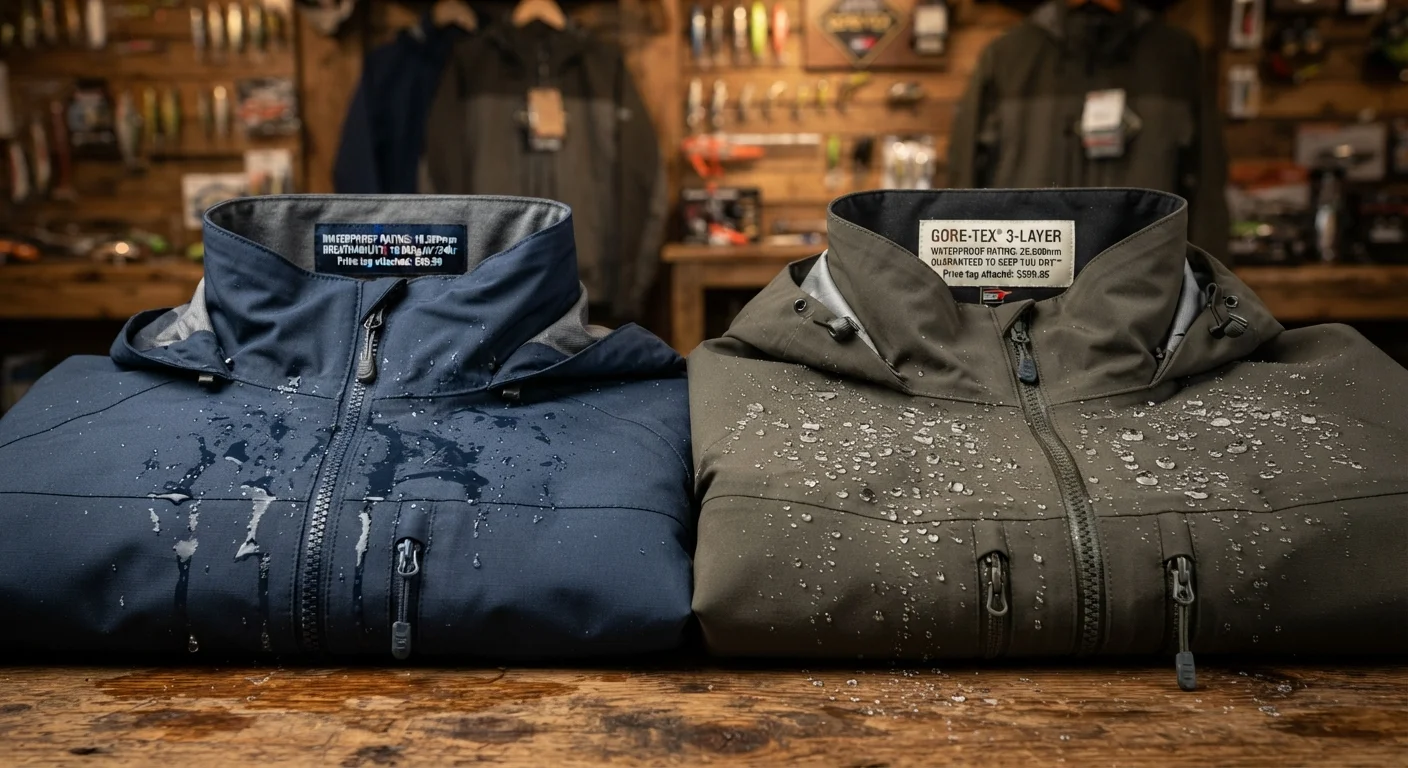
That $89 tag and that $349 tag both say “waterproof.” What matters is the Hydrostatic Head (HH) rating and the fabric technology that holds that number up over time.Understanding custom fishing jacket wholesale price helps buyers evaluate performance against production costs.
HH measures how many millimeters of water a fabric can withstand before leaking. The regulatory bar is lower than most anglers assume. The EU’s DIN EN 343 standard sets Class 2 waterproofing at just 800mm and Class 3 at 1300mm. In the UK, a jacket needs 1500mm to legally claim “waterproof.” Most outdoor brands and testing labs use 1000mm as their baseline threshold for the same claim.
That’s the loophole budget brands exploit. A $60 shell hitting 5,000‑8,000mm technically crushes the legal minimum, five to six times over, while still underperforming on a boat deck in driving rain.
Fabric Technology: Where the Money Goes
2-layer PU coated polyester (budget tier) is a single hydrophilic coating sprayed onto polyester fabric with no membrane, no protective backing. Typical HH sits at 1,500‑3,000mm. The coating absorbs moisture, hydrolyzes under heat and humidity, and turns tacky or flakes off within a few seasons. Breathability is minimal; structural venting provides all the air exchange.
2.5-3 layer laminates (mid-range) sandwich a functional membrane between the outer fabric and a protective liner. HH climbs to 10,000‑20,000mm+, with breathability rated 10,000‑25,000 g/m²/24h. Because the membrane is physically protected, HH stability holds up far longer than single-coating systems.
ePTFE membranes (Gore-Tex tier) use a microporous membrane with pores 0.1‑0.2 micrometers wide, small enough to block rain, large enough to release vapor. Gore-Tex classic fabric tests above 28,000mm. Failure in these jackets rarely comes from the membrane itself; it’s the DWR coating wearing out.
DWR Coating: The Silent Failure Point
DWR doesn’t change the HH ceiling, but it determines whether water beads and rolls off or soaks in (“wet-out”), killing breathability and comfort. Budget jackets often use thin, non-fluorocarbon DWR that drops from a 3‑4 spray rating to 1‑2 after five to ten washes. Premium ePTFE jackets hold 3‑4 spray ratings through a full season and recover with a home dryer cycle.
Breathable Waterproof Fabric:Actual measurement comparison of ventilation performance
Sweat is the variable most anglers ignore until it's too late. A jacket can block every drop of rain and still leave you soaked from the inside out if the breathable waterproof fabric can't move vapor fast enough.
The industry benchmark is MVTR (moisture vapor transmission rate), measured in g/m²/24h. Entry-level shells sit at 5,000–10,000 g/m²/24h — fine for standing still, useless once you start working. Mid-range 2.5-3 layer jackets climb to 10,000–20,000 g/m²/24h, the range most anglers need. Premium fabrics push 20,000–30,000+ g/m²/24h, built for anglers who sweat hard and often.
Lab testing under ISO 11092 uses a second metric: RET. Lower is better. RET under 6 m²·Pa/W means excellent breathability for high-output activity. RET 6-13 covers "comfortable" for moderate exertion. Above 20, you're wearing a sauna suit.
Sweat Output Meets Fabric Math
A seated angler produces 50-100 g/h of sweat. Start casting and walking the bank, and that jumps to 200-400 g/h. Wade fishing, hauling nets, fighting current — that's 500-600 g/h, rivaling a slow jog.
Run the numbers against fabric performance over roughly 1m² of upper-body surface: a 5,000 g/m²/24h shell moves about 208 g/h. That falls
Fishing Jacket Durability
The durability data shows exactly where cheap fishing jackets fall apart.
C6 fluorocarbon DWR coatings start at a spray score of 5, with a contact angle of 120°-140°. After 20 standard wash cycles ( AATCC TM135, with dryer), the score drops to 3. Add 10,000 rubs from Martindale abrasion testing, and water repellency drops another 30%.
Price Tier vs. Real-World Lifespan
Under $30 jackets lose DWR after 10-15 washes. One heavy fishing season, and you'll see visible wear on shoulders and elbows from boat rail friction. Coating flakes, seams leak.
$50-100 jackets carry a 5,000-10,000mm waterproof rating. Skip machine washing and wipe them down instead, and DWR holds for 3-4 years of moderate use.
$150+ jackets use a membrane-based construction like Gore-Tex, so they don't depend on surface DWR for waterproofing. Reapply DWR annually, and you'll get 3-5+ years of heavy use, 30+ fishing days per season.
Warranty Data Confirms the Split
Brands like Frabill, Striker, and Clam Outdoors guarantee their premium lines with 3-5 year or lifetime warranties against seam failure and delamination. Premium jackets fail at under 1-2% annually, and budget gear fails at 5-10% annually. That fivefold difference shows up in your wallet within two seasons.
Real-World Performance: Comparison of warmth retention, wind resistance and all-day comfort
Numbers on a spec sheet mean nothing until wind hits your neck at 8m/s and rain starts running down your collar. That's where budget and premium fishing rain gear split apart in ways lab tests only hint at.
Wind Chill: Where Collar and Hood Design Matter
A high collar sealed at 8–12cm blocks most neck exposure. With a drawcord-and-velcro combo, wind infiltration through the collar gap drops to 20–30% of an open design. In 5–8m/s wind, that translates to a 2–3°C bump in perceived warmth. Budget shells skip this detail almost entirely — thin collars, no cinch, no barrier.
Hoods follow the same pattern. A three-way adjustable hood cuts facial heat loss by 15–25% in 10m/s wind by tightening the fit around your face instead of flapping loose. A 5–7cm rigid brim keeps driving rain off your eyes during storm-level sessions.
Layering Systems: The Comfort Multiplier
Single-layer shells block wind and light rain but add zero insulation. Three-layer systems — wicking base, insulating mid, waterproof breathable membrane shell — hold comfort at -5°C with light activity for 3–4+ hours. Single-layer gear hits noticeable cold in 60–90 minutes under the same conditions.
Premium jackets built with detachable mid-layers let you add or shed insulation in 30–60 seconds via zip-in systems. That's the difference between adjusting on the boat and heading back to shore because you overheated or froze.
The 8-Hour Reality Check
Users of performance jackets with 20,000mm+ waterproof ratings and matching breathability report "dry inside after a full day in rain." Budget gear at 5,000–10,000mm draws different language — "damp," "clammy," "cold against skin" — within 1–2 hours of sustained exposure.
Expensive Fishing Jacket Worth It?Analysis of the Cost-Benefit Critical Point
The key price range of fishing jacket is $150–$300. That's where a high-performance outdoor jacket stops delivering meaningful returns per dollar. Cross into the $600–$1000+ flagship range, and you're paying for marginal gains most anglers will never notice on the water.
Public gear reviews place professional-grade fishing jackets in the $150–$300 range, with flagship options climbing to $300–$500+. Entry-level shells covering basic needs run $100–$150.
Minimum Performance Thresholds
Casual/light use : 3,000mm+ waterproof rating, 5,000+ g/m²/24h breathability — the baseline for spring/summer or light rain days
Safer budget target : 5,000-8,000mm HH with partial seam sealing covers light rain, occasional splash, and daily wind-rain scenarios
Ice/saltwater fishing : Demands high waterproofing, wind resistance, and insulation together. Extended stillness and cold amplify exposure risk fast.
The Real Decision Logic
Premium makes sense when you fish 30+ days annually, sessions run long, you face storms or offshore wind regularly, or you guide or compete where failure costs you the trip.
Budget works fine when you fish casually in mild weather, sessions are short, and you just need to block rain and wind — nothing more.
Winter and ice fishing shift the math. Fleece linings, heated panels, graphene heating elements justify premium pricing because those features exist nowhere in budget tiers.
Bottom line : Under $150, buy "good enough." If you fish frequently in harsh conditions and are approaching $150–$300, premium becomes the rational choice.
Fishing Jacket Buying Guide by Budget:Budget Purchase Suggestions
Match your jacket to your fishing calendar. Below is the exact spec floor for each price bracket, plus what to check before you buy.
Under $80: Entry-Level Fishing Rain Gear
Target HH ≥ 5,000mm and breathability ≥ 5,000 g/m²/24h. Weight runs 500-900g with basic insulation. These jackets work for shoreline sessions, light rain, and short trips.
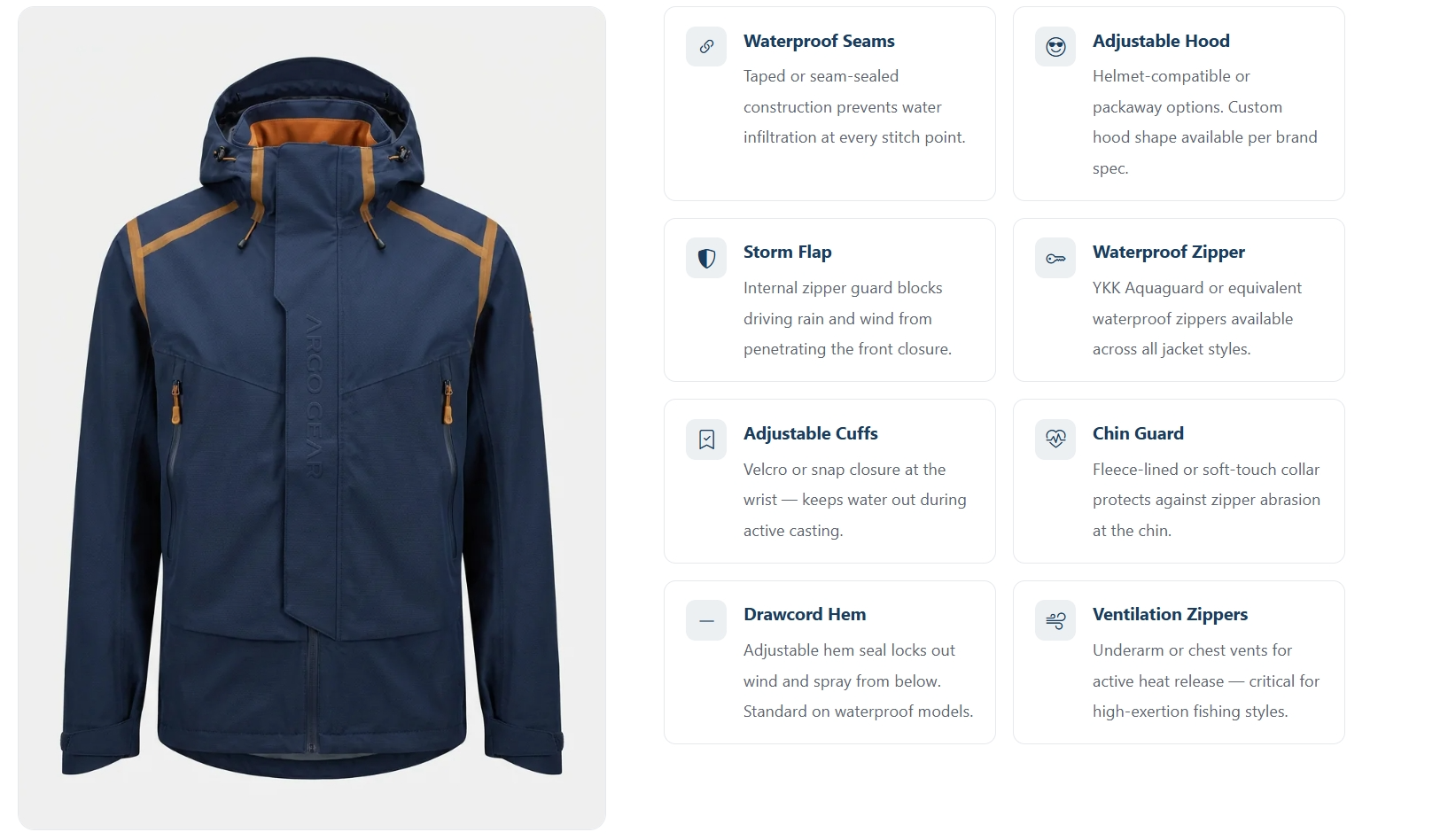
Check for waterproof or DWR labeling on the tag, not just water-resistant. Look for taped seams at shoulders, hood line, and armholes, since full-body sealing isn't realistic at this price. Ensure 2-3 functional pockets for lure boxes and terminal tackle, and an adjustable hood and hem to block wind at the collar.
$100-200: The Working Angler's Range
Push for HH ≥ 8,000-10,000mm and matching breathability. This is where 2.5-layer construction shows up, and full seam taping across zippers, shoulders, and hood becomes non-negotiable.
Check for storm flaps or welded zipper guards, 4 or more pockets, underarm ventilation zips, and a high collar with cinch.
$200-450: High-Performance All-Weather Territory
Aim for HH ≥ 15,000-20,000mm with matching breathability. Look for full-body seam taping, D-ring tool attachments, reinforced elbows for casting motion. This bracket suits 30+ day anglers who need a shell that layers.
$450-800+: Professional/Extreme Conditions
Look for HH ≥ 20,000-30,000mm, welded seams, multi-zone venting, and salt-resistant hardware. These are offshore and guide-grade builds only.
FAQ:Frequent Purchase Decision Q&A
Five questions come up in every gear forum thread. Here's the direct answer to each.
Q: Does more expensive always mean better?
Not automatically. Higher fishing jacket price usually buys higher HH, fully taped seams, and better fabric layering — but the value curve flattens hard around 10,000–15,000mm HH . Beyond that, you're paying for extreme-weather margin.
Q: Is a cheap jacket good enough?
Yes, if it has HH ≥ 5,000–8,000mm and seam sealing at high-exposure points. Waterproof fabric with unsealed seams still leaks — check both, not just one.
Q:Which metric should we look at first?
HH value and seam construction together. Brand name tells you nothing on its own.
Q: What is the best value-for-money range?
$150–250 , 10,000–15,000mm HH, 3-layer or premium 2.5-layer construction. This bracket covers daily rain, wading, and moderate storms without flagship pricing.
Conclusion
Price alone doesn't guarantee performance, but it usually reflects real engineering differences you'll feel on the water. Budget jackets handle light drizzle and short trips fine. For sustained rain or harsh conditions, a Gore-Tex fishing jacket with proper seam sealing and a high waterproof rating is insurance against a ruined day—or ruined gear.
What you really need to ask is what your fishing actually demands. Weekend anglers in mild climates can spend their money elsewhere. Serious offshore or all-weather fishermen should take durability and breathability over saving $50 upfront.
Match your jacket to your conditions. Browse Runfish Apparel 's lineup, compare specs, and invest once in gear that won't quit when the storm rolls in.