The first time I saw a guy reel in a mahi-mahi wearing a fishing shirt that looked like it wanted to rob a bank, I had questions. Mainly, is that thing sun protection, or did he just not want to be recognized at the boat ramp?
After years of getting sunburned in increasingly creative places, and once mistaking a jellyfish sting for "character," I finally understand why so many performance fishing shirts come with a built-in mask. It makes you look like you're either fly fishing or fleeing a crime scene, but that's not the point.
What matters is what that fishing sun mask does for your face, neck, and sanity when you're six hours into a trip with only UPF fabric between you and regret. Brands can develop custom Fishing Shirts with Mask for different fishing conditions.And how to pick one that doesn't feel like breathing through a gym sock.
How the Built-In Face Mask on a Fishing Shirt Works
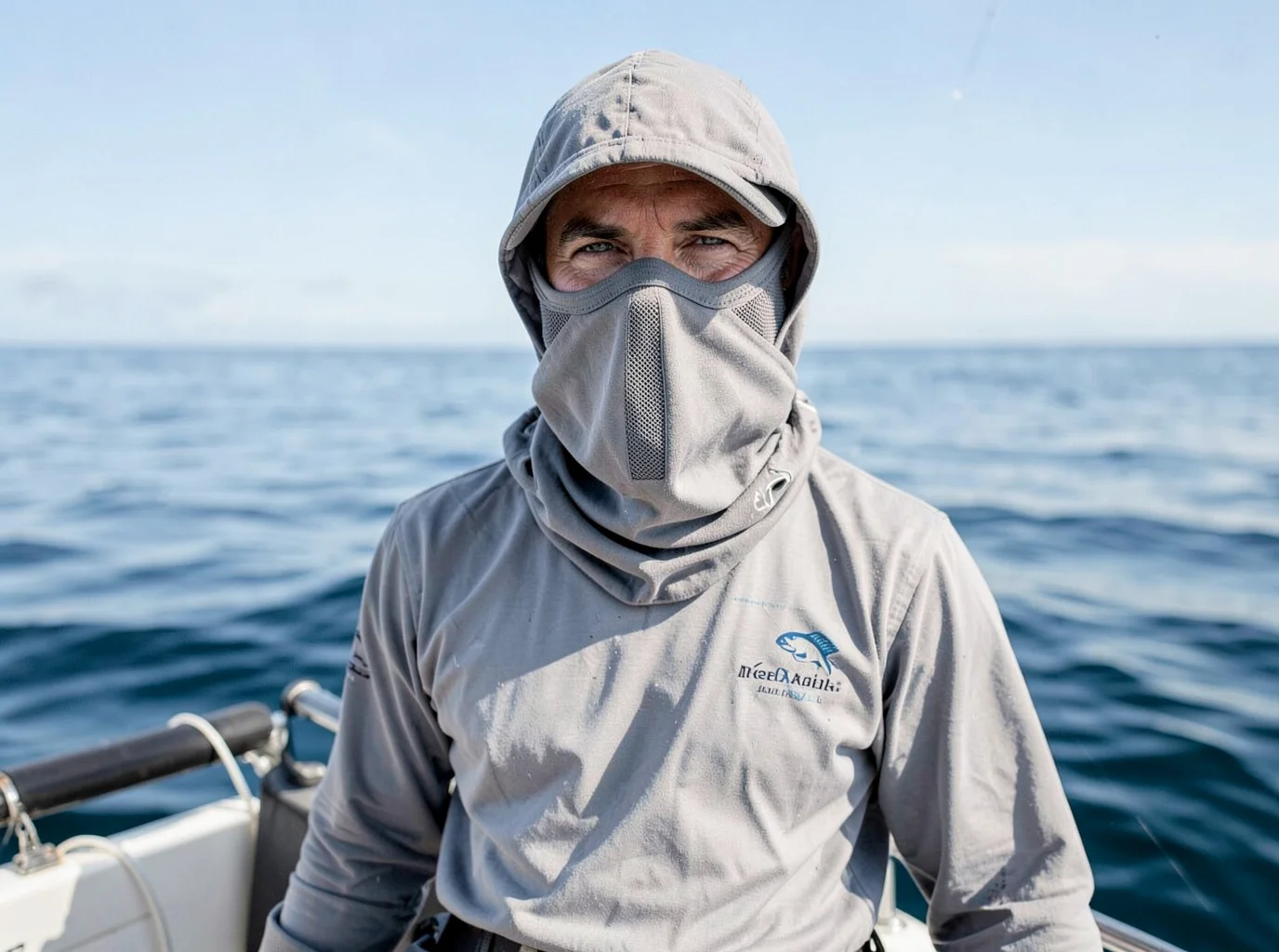
That mask isn't a separate gadget you clip on like a snorkel accessory from 1987. It's an integrated hood-neck gaiter , sewn directly into the shirt's collar or hood. Pull it up over your mouth, nose, cheeks, and neck, and you're ready to fish — or commit light larceny.
The fabric is usually 100% polyester or an 88% polyester / 12% spandex blend. It's lightweight, stretchy, and rated at UPF 50+ (sometimes UPF +40), which means it blocks the vast majority of UV rays trying to turn your face into a leather wallet.
Breathability matters most here. A specialized Fishing Shirts with Mask manufacturer can refine airflow and stretch.A UPF 50+ face sauna is useless if you rip it off after ten minutes gasping like you just ran a marathon in a ski mask. That's why most designs build in:
Mesh mouth panels
Laser-perforated holes
Breathing holes (bonus: less fogging on your sunglasses)
Enlarged mesh breathing panels
Brands like Pelagic (the Defcon hood) and Grundéns (Tough Sun Masked Hoodie) lean hard into this combo — full coverage plus laser-perforated airflow so you're not marinating in your own regret. Muddy Water Outdoors does a 5.0 oz hooded version with breathing holes, and Bob Marlin Gear adds water resistance and stain repellency to their UPF 50+ mesh-paneled mask, which is nice when you inevitably wipe fish guts on your own face.
When you're not using it, the mask usually stows flat into the neck opening, so it's not just dangling there making you look like a superhero who gave up halfway through the costume.An experienced Fishing Shirts with Mask factory can integrate the gaiter cleanly.
The Three Real Problems a Fishing Shirt Mask Solves
Nobody straps fabric to their face for fun. There are exactly three reasons this thing exists, and I’ve suffered through all of them before someone explained the science.
Problem one: your face is a solar panel now. UPF 50+ fabric blocks about 98% of UV radiation — at least 95% of UVA and 98% of UVB. That sounds like a lot of numbers until you realize it’s the difference between “fun day fishing” and looking like a tomato that regrets its choices. Fishing is uniquely brutal because you’re catching direct sun and water-reflected UV, getting hit twice for the price of once. Every fishing-accessory guide treats UPF 50+ as the non-negotiable minimum for face and neck coverage.
Problem two: bugs think your face is a buffet. BUFF’s fishing gaiters call out protection against mosquitoes, ticks, fleas, flies, ants, chiggers, and midges — which is either impressively thorough or deeply alarming, depending on your relationship with nature. Comparable insect-protective fishing shirts pair that bug barrier with UPF 30+ sun coverage, so you get two problems solved in one panel of fabric. If you’ve ever fished a marsh, mangrove, or humid summer bank and come home looking like you lost a fight with a sewing needle, you already know why this matters.
Problem three: wind, spray, and the coverage gap your hat brim ignores. Neck gaiters also block wind and dust. That matters on boat rides, jet skis, and windy surf-casting days when your face feels like it’s being sandblasted. They cover the neck, ears, and lower face — exactly where hat brims stop and sunscreen sweats off first. A cotton bandana can drop to UPF 3–9 the second it gets wet. A technical gaiter holds UPF 50+ even soaked, making it roughly 5–7 times more protective when you actually need it.
UPF Fishing Shirt Mask vs. Ordinary Fishing Shirt, Neck Gaiter, and Sun Hoodie
People who've stood on a boat for eight hours know that not all sun protection clothing fishing gear is created equal. The differences aren't subtle.
An ordinary fishing shirt (the plain long-sleeve kind your uncle's been wearing since 1998) covers about 85% of your body. That's fine until you realize the missing 15% is your head, neck, and hairline — which is where the sun aims first. If it's untreated cotton, it can test at a pathetic UPF 5, the protective equivalent of wearing a wet paper towel.
A fishing neck gaiter rated UPF 50+ blocks roughly 98% of UV across the neck, ears, and lower face — the exact real estate your hat brim ignores. But it's a separate piece, which means more gear, more steps, and more things to lose in the tackle box.
A sun hoodie fishing shirt bumps coverage to about 95%, using lightweight moisture-wicking knit that vents heat instead of trapping it against your skull.Buyers can ask their Fishing Shirts supplier for fabric samples first.
The UPF fishing shirt mask sews shirt, hood, and gaiter into one piece, closing the gaps at your nose, cheeks, ears, and neck that separate pieces always seem to leave open. Fabric specs vary. Some brands use 100% polyester micro-mesh at 160 gsm, claimed 15% lighter than standard shirt fabric; others run 90% polyester/10% spandex. Testing follows AATCC 183 or AS/NZS 4399 standards, depending on the brand.
Sun hoodies cover more skin, but integrated masks are more convenient without sacrificing much coverage.
When Anglers Notice the Biggest Difference: Offshore, Shore, Lake, and Tropical Use
Ask five anglers if they need a face mask and you'll get five different answers. Mostly that's because they're fishing five different bodies of water and haven't compared notes.
Offshore is where the mask earns its keep. You're out there six-plus hours, running 50–80 lb braid with a 60–100 lb fluoro leader for bottom fishing, or 50–80 lb mono for trolling because the stretch keeps hooks pinned at speed. That's a long day with zero shade and double UV exposure: direct sun plus glare bouncing off open water. This is where I stopped being precious about looking ridiculous in my mask.
Shore and inshore trips are shorter, but the sun doesn't care. A typical setup runs 30 lb braid with 18–24 inches of 20 lb fluoro leader — lighter gear, faster sessions, usually a few hours instead of a full charter day. The mask still matters, but it's less "survival gear" and more "why did I forget sunscreen again."
Lake fishing is the mask's easy mode. With 6–10 lb mono or fluoro for bass, walleye, or redfish in calmer water, you're often in shade, near trees, or done before noon. Bugs are the real enemy here, not UV.
Tropical conditions are brutal on everything, not just your face. High tropical sun can cut line lifespan by roughly 40%, and saltwater exposure knocks off another 30%. If UV degrades fishing line that fast, imagine what it's doing to unprotected skin. Tropical trips are non-negotiable mask territory.
Wearing a Fishing Shirt With a Mask: Real-World Difference in Two Common Sessions
There are two kinds of fishing days, and I've ruined my face for science on both of them.
Session one is the hot, high-sun, actively-casting kind of day , where you're moving your arms every thirty seconds and sweating like you owe someone money. For this, the setup that works is a UPF 50+ long-sleeve shirt with quick-dry, moisture-wicking fabric and, if you're lucky, thumbholes so your wrists don't burn in that one specific stripe nobody warns you about. Add a built-in hood/neck gaiter and you've got arms, neck, and face covered without needing to stop reeling to adjust anything. The BASSDASH shirt-with-mask combo does this well — UPF 50+, 4-way stretch, mesh breathing holes, and it's built to cut down on sunglass fog, which matters more than you'd think when you're squinting at a bite.
Session two is the exposed-bank, boat-ride, wind-and-spray situation — dawn patrol, midday chop, the kind of day where the water's throwing UV at you from two directions and the wind won't quit. This is where a separate face mask or gaiter earns its keep. The AFTCO Solido runs UPF 40 stretch polyester, which is solid, though I'll admit I side-eye anything that isn't the full 50+. The Aqua Design balaclava goes UPF 50+, 4-way stretch, breathable, certified fabric — and some masks on the market claim 99.8% UV blocking, which is either extremely precise marketing or someone really wanted to beat the 98% guy next door.
The real difference between the two sessions isn't the shirt — it's what's covered. Without a mask, your UPF 50+ shirt is babysitting your torso, arms, and shoulders while your face just sits there, exposed, like it volunteered for something it didn't fully understand. Add the gaiter, and suddenly your neck, cheeks, nose, chin, and ears are in on the protection too — which is the entire point when sun, wind, and spray decide to gang up on you at once.
Mesh Density, Fabric, and Fit: What Actually Makes a Mask Comfortable
Fabric weight and breathability are locked in a custody battle, and your face is the kid caught in the middle.
Denser weaves filter better but breathe worse. That's physics, not opinion. Fabric guidance splits things into lightweight (20–150 gsm) , medium (150–350 gsm) , and heavyweight (350+ gsm) . For a multi-layer mask, the comfort sweet spot sits around 120–300 gsm total across all layers. Any heavier and you're wearing a doormat on your chin.
Layering reaches a point of diminishing returns. Every extra layer improves filtration a little but hurts breathability more. Good mesh fishing masks stay comfortable because lab testing on breathable fabrics shows differential pressure around 2.5 Pa at low airflow — barely noticeable. Dense cloth masks can spike past 11 mm water gauge , which is the textile equivalent of breathing through a couch cushion.
Fit matters just as much. A gap around your nose or cheeks lets air (and UV) sneak in around the edges, no matter how good the fabric is. The combo that actually works when you're six hours into a trip and just want to breathe: moderate density, minimal layers, snug seal .
Which Fishing Hoodie Mask Design Fits Your Fishing Scenario
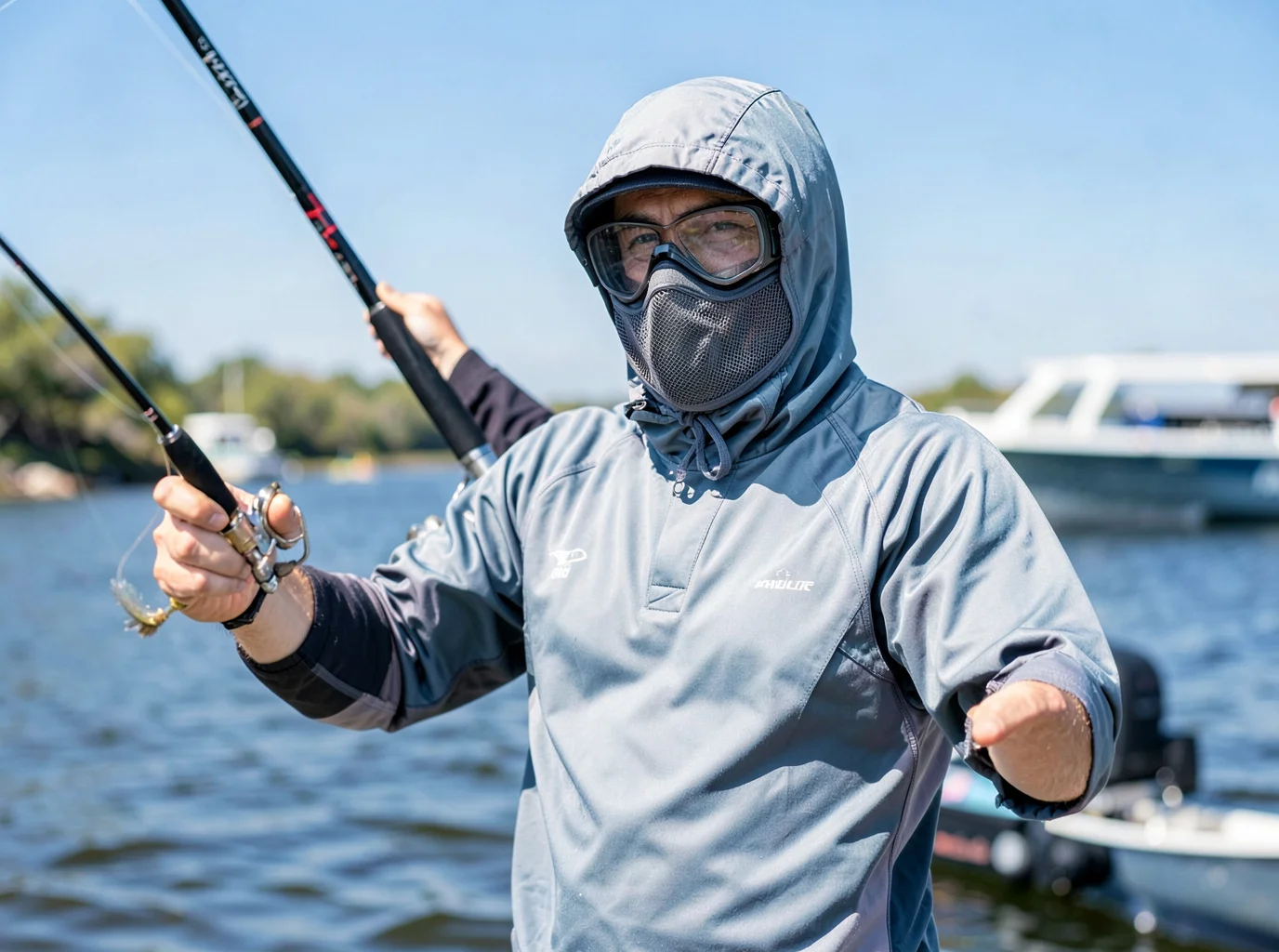
Not every mask is built for the same kind of misery. Match the design to the day, or you'll end up either sweating through your own regret or freezing with your face exposed like a fool who forgot what season it is.
For hot, high-sun offshore or flats fishing, go with a hoodie-plus-mask combo in UPF 50+ quick-dry fabric. The Coolibar Vented Andros has it: UPF 50+ guaranteed for life, a breathable mask, a wire nosepiece you can shape to your face, laser-cut vents, and a ponytail hole for anglers who still have hair to worry about.
For windy boat runs and unpredictable spray, the Bob Marlin Gear hoody adds water resistance and stain repellency on top of UPF 50+. That matters when the ocean decides to join your fishing trip uninvited.
For cold, early-morning sessions, skip the mesh. A gaiter-style mask worn under a hood blocks wind and UV without turning your face into a colander.
For high-movement kayak or casting days, look for 4-way stretch and flat-lock seams. Grundéns pairs this with thumbholes and hood overlap so nothing shifts mid-cast.
What to Check Before Buying a Fishing Shirt With a Mask
I've become the person who reads fabric tags for fun now, and I refuse to suffer alone. So here's a shortlist.
UPF 50+, non-negotiable. It blocks about 98% of UV radiation, which is the difference between "fishing" and "auditioning for a lobster costume."
Polyester/spandex blend (90/10 is common) for stretch that doesn't quit mid-cast.
Mesh mouth panels or air holes in the mask itself — glasses fog is real, and nobody looks cool wiping their sunglasses on a fish.
Quick-dry, moisture-wicking fabric , because sweat inside a mask is its own special betrayal.
Full coverage : arms, torso, neck, ears, lower face. Gaps are where regret lives.
4-way stretch so reeling doesn't feel like a wrestling match with your own shirt.
120–150 gsm for hot climates. Heavier fleece-feel fabric just traps heat, moisture, and bad decisions.
A UPF 50+ shirt with a built-in hood/mask and breathable quick-dry fabric is the benchmark that works. Everything else is negotiable.
Conclusion
The mask is a UPF fishing shirt that blocks 98% of UV rays that would otherwise turn your face into a leather wallet, while keeping bugs and wind chill out of the equation entirely. If you're grinding it out offshore or standing in tropical sun for six hours with nothing but a hat and hope, a proper fishing sun mask is the difference between a great day on the water and a face that feels like a sunburned onion. Match the mesh density and fabric to your actual fishing conditions, not the shirt that looked cool on someone's Instagram.Request a custom wholesale price for Fishing Shirts with Mask based on order volume.