Getting the right custom fishing shirt size shouldn't feel like guesswork. This is true whether you're outfitting a full team, a family, or a crew that spans from a 7-year-old with a rod in hand to a 6'4" tournament angler who needs a 5XL. One wrong size in a bulk order means delays, reprints, and frustration nobody has time for.
This guide gives you a complete size reference — from Youth 4 through Men's 5XL . You'll find chest measurements, body length, and fit recommendations for both kids and adults. That's everything you need to place your fishing shirt custom order right the first time.
Youth Fishing Shirt Sizes (Kids 4–16 & Youth XS–XL)
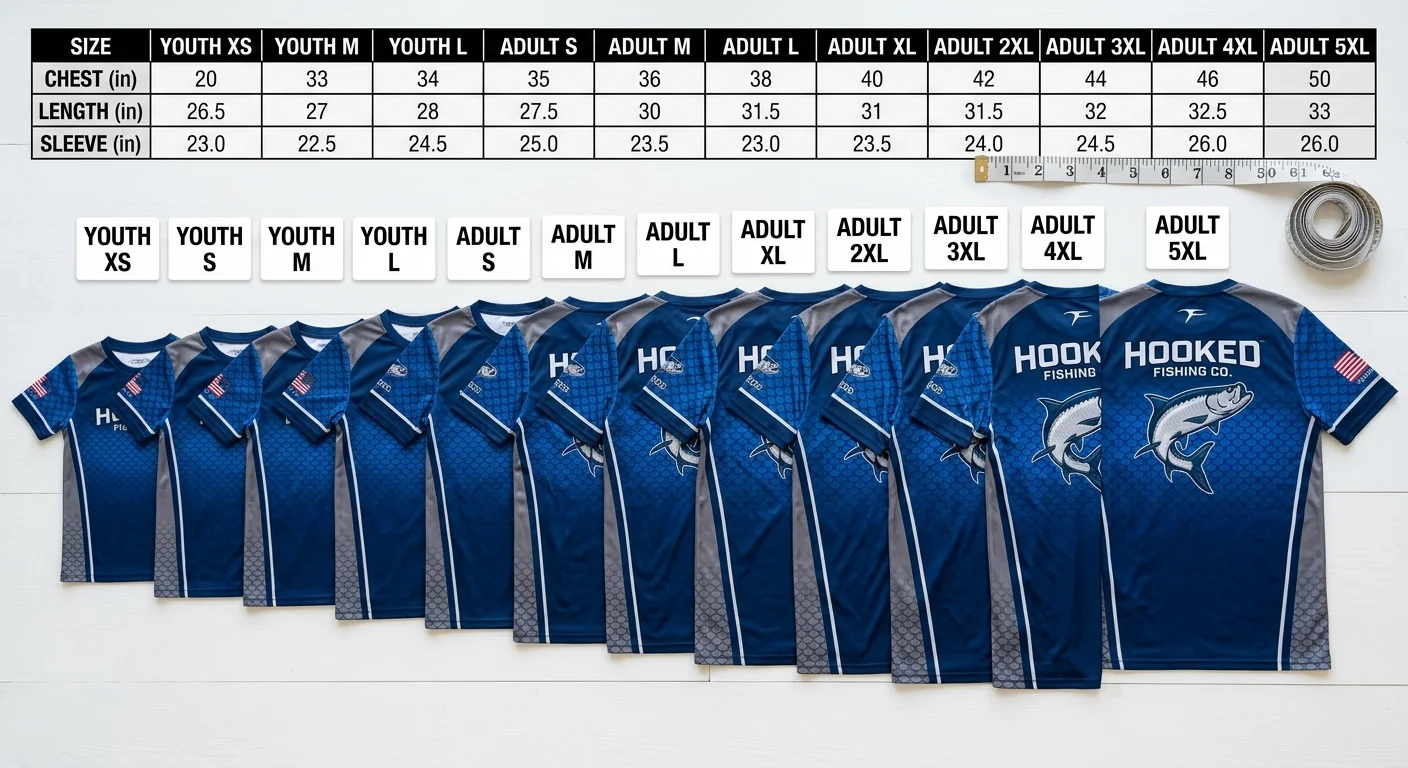
Kids grow fast — and fishing shirt sizing doesn't always keep up. Before you lock in a bulk order for your team or family, here's what you need to know about youth sizing.
Youth fishing shirts split into two groups: Kids 4–7 (the younger set) and Youth 8–16 (older kids and teens). Each group works differently. Chest width, body length, and how sizing labels translate to real-world fit all change between the two groups.
Kids Size Chart: Ages 4–16 (Numeric Sizing)
Age / Size | To-Fit Chest (cm) | ½ Chest Width (cm) | Back Length (cm) |
|---|---|---|---|
4Y | 60–65 | 33.5 | 43 |
6Y | 65–70 | 36 | 45.5 |
8Y | 70–75 | 38.5 | 52.5 |
10Y | 75–80 | 41 | 57.5 |
12Y | 80–85 | 43.5 | 59.5 |
14Y | 85–90 | 46 | 61.5 |
16 | 90–95 | 45.5 | 63 |
Note: To-fit chest includes 10–15cm of ease — standard for performance fishing shirt construction.
Youth XS–XL: Quick Age-to-Size Reference
Youth Size | Age Range | Body Chest (in / cm) | Height Range |
|---|---|---|---|
XS | 4–5 yrs | 20–22 in / 51–56 cm | 39–45 in / 99–114 cm |
S | 6–7 yrs | 24–26 in / 61–66 cm | 45–51 in / 114–130 cm |
M | 8–10 yrs | 28–30 in / 71–76 cm | 51–54 in / 130–137 cm |
L | 10–13 yrs | 31–33 in / 79–84 cm | 54–57 in / 137–145 cm |
XL | 13–15 yrs | 34–38 in / 86–97 cm | 57–60 in / 145–152 cm |
How to Pick the Right Youth Size
Three steps. That's all it takes:
Start with age to find the ballpark size range
Check height to confirm the body length will work
Measure chest and match it against the to-fit chest column — this is your final call
Not sure? Go by chest measurement, not age. Kids with broader shoulders should size up by one.
One Key Difference: Youth Fit vs. Adult Fit
Don't use adult sizing logic here. Youth fishing shirts use a straighter, gender-neutral cut. You get minimal waist tapering, narrower shoulders, and a longer body length relative to chest width. That "long body, narrow shoulder" structure is intentional. It gives kids a full range of motion while casting. The shirt stays down instead of riding up.
Adult performance fishing shirts work differently. Shoulder width and chest girth grow faster between each size step. Youth sizes grow taller faster than they grow wider — and that's how kids' bodies actually develop. The youth cut follows that natural pattern.
Men's Fishing Shirt Sizes (S–5XL): Chest & Length Reference
Adult sizing is where most bulk orders go wrong — and it almost always happens at the extremes. Someone grabs a 2XL based on habit, ignores the actual chest measurement, and ends up with a performance fishing shirt that's too tight across the shoulders. Or it's so boxy it gets in the way of a full casting motion.
Here's the complete men's reference table. Use the garment chest column — not your body measurement — to cross-check fit before you finalize any order.
Men's Size Chart: S–5XL
Size | ½ Chest (cm) | Garment Full Chest (cm) | Back Length (cm) |
|---|---|---|---|
S | 54.0 | 108 | 69.5 |
M | 56.5 | 113 | 72.0 |
L | 59.0 | 118 | 74.0 |
XL | 61.5 | 123 | 77.0 |
2XL | 65.0 | 130 | 81.0 |
3XL | 68.5 | 137 | 85.0 |
4XL | 72.0 | 144 | 88.0 |
5XL | 75.5 | 151 | 89.0 |
How to read this table: Measure your body chest (tape under armpits, fullest part). Add 8–10 cm for a relaxed performance fit, or 5–7 cm for a more athletic cut. Match that number against the Garment Full Chest column.
What to Know About Chest Grading: S Through 5XL
The sizing doesn't scale at an even rate — and that's by design. From S to XL , each step adds 5 cm to the full garment chest. Cross into extended sizes, and the gaps get wider. 2XL through 5XL each jump 7–8 cm per step.
That wider grading at the top end is there for a reason. Broader torso proportions need more room — especially across the shoulders on big and tall fishing shirts . A 4XL isn't just a stretched-out L. The entire pattern structure shifts to match the body shape.
Length Grows With Size — But Not at the Same Rate
Back length grows steadily from S through 3XL, then starts to slow:
S → XL: adds 2.5 cm per size step
XL → 3XL: adds 4 cm per step — the biggest length jump in the range
3XL → 5XL: slows to +1–3 cm per step
The key number to know: a 5XL tournament fishing shirt sits at 89 cm back length. That's enough to cover most tall-plus builds without the shirt riding up mid-cast. Your angler needs more length than that? Flag it during the custom men fishing clothing order. A length extension is buildable.
Big & Tall Fit: 3XL, 4XL, 5XL Specifics
Three things matter most for big and tall fishing shirt sizing at 3XL–5XL:
Shoulder seam placement — on a 5XL, the half-chest hits 75.5 cm. Shoulder seams need to land at the actual shoulder point, not slide down the arm.
Sublimation print sizing — at 3XL–5XL, front chest graphics should run 12–14 inches (30–36 cm) wide to keep visual proportion intact. That covers 43–50% of the shirt's chest width — enough presence without looking stretched.
Moisture-wicking construction — extended sizes cover more body surface area, which means more heat to manage. Make sure your moisture-wicking fishing shirt uses 100% polyester performance weave. A heavier cotton blend won't cut it.
Cross-Brand Size Comparison
Your team mixing this order with gear from other brands? Use this as a quick check:
Size | This Chart — Body Chest (cm) | Savage Gear — Body Chest (cm) | Cutter & Buck — Body Chest (in) |
|---|---|---|---|
M | 105–110 | 99–103 | 39–41" |
XL | 115–120 | 109–113 | 45–48" |
2XL | 120–127 | 114–118 | 49–52" |
4XL | 134–141 | 124–128 | 57–60" |
5XL | 141–148 | 129–134 | 61–64" |
The differences are real. Someone on your team who wears a Savage Gear 2XL may land closer to an XL in this chart. Always recheck the chest measurement. Don't carry size labels straight across brands — the numbers don't match up.
How to Measure for a Custom Fishing Shirt (Adults & Kids)
A wrong measurement costs you time, money, and a reprint. Here's how to get it right — for every person on your list, from a 5-year-old to a 6'4" tournament angler.
The Four Numbers That Matter
Drop everything else. These are the measurements you need to lock in the right custom men fishing shirt size :
Chest — the most important number
Sleeve length
Back/shirt length
Neck circumference (for collared performance styles)
How to Measure Adults
Chest: Stand with arms relaxed at your sides. Wrap a soft tape around the fullest part of your chest — across the shoulder blades, parallel to the floor. Keep it snug, not tight. That's your body chest number.
Now add your ease:
- 8–12 cm for a relaxed, fishing-all-day fit
- 4–6 cm for a fitted, athletic cut
Match the result against the Garment Full Chest column in the size chart. Don't use your raw body measurement.
Sleeve length: Bend your arm slightly, shoulders relaxed. Measure from the center back of your neck, across the shoulder, down to the wrist bone. Follow the arm's natural line. Round up to the nearest 0.5 cm.
Back length: Start at the high shoulder point — where your neck meets your shoulder. Measure straight down to the hem. Keep the tape vertical. For untucked performance fishing shirt styles, the hem should land just below the hip bone. That's about 45–50% of your total height.
How to Measure Kids
Same principles, smaller scale. A parent holding the tape makes this much easier.
Chest: The child stands with arms at their sides. Run the tape at nipple level, around the shoulder blades. For active kids fishing shirt sizing, add 10–14 cm ease over the body measurement. This gives full casting range of motion.
Back length: Measure from the high shoulder point down to just below the hip. A quick benchmark: youth shirt back length should be 40–45% of the child's total height . A 140 cm kid needs 56–63 cm of shirt length.
Size up any time a child falls between two chest measurements.
The "Old Shirt" Method (Fastest for Bulk Orders)
No tape measure on hand? Grab a shirt that already fits well.
Lay it flat on a hard surface. Button it all the way. Smooth out every wrinkle.
½ chest width: Measure straight across the front, 1 inch below the armhole. Then double it for the full garment chest.
Back length: From the collar seam at the shoulder down to the bottom hem.
Sleeve: Center back of neck, over the shoulder, down to the cuff.
Take those garment measurements and match them to the product size chart. No guessing needed. For fishing team shirt bulk orders , this is the fastest way to assign sizes without measuring each person one by one.
Team Orders: Use the Template Person Method
Measuring 20+ people one by one isn't realistic. Try this instead:
Split your group into blocks: adult men, adult women, youth 13–17, kids 7–12, kids under 7
Pick 1–2 people per block whose height and weight sit near the group average
Measure those template people in full — chest, sleeve, back length
Map each template to a size, then build your order around that anchor size
Example distribution for a mixed adult male team (no individual data available):
- 20% S / 40% M / 30% L / 10% XL
After the first sample run, shift the whole block one size up or down based on what most people say.
Measurement Quick Rules
Use a cloth tape — never a rigid ruler
Measure over light clothing, standing tall
Keep the tape horizontal for chest and neck , vertical for lengths
Always round up — between sizes, take the larger one
Record everything in one unit: all cm or all inches, not mixed
Fishing Shirt Fit Guide: Loose, Regular & Athletic Cut
Three cuts. One right answer for your situation.
Most people pick a fishing shirt the same way they pick any shirt — grab the size that's worked before and move on. That approach costs you on the water. The wrong cut on a UPF fishing shirt doesn't just feel uncomfortable. It can reduce sun protection, restrict your casting motion, and trap heat you don't want.
Here's how each cut works:
Loose Fit — Add 2–3 inches of ease over your measured chest. This is the default choice for serious fishing. More room keeps the UPF fabric off your skin. It doesn't stretch tight, so the protective weave stays intact. You also get full shoulder range of motion on every cast. For sublimation tournament jerseys, loose fit has another advantage: the graphic lays flat. A tight pull distorts chest and shoulder prints. This is a bigger problem on larger sizes.
Regular Fit — The middle ground. Less volume than loose, more airflow than athletic. Go up if you fall between two chest sizes. That single rule matters more here than with any other cut.
Athletic Cut — Sits close to your chest measurement. Works best for lean or trained builds. Size up by one if you want any breathing room. For UPF fishing shirts, avoid going tight. A stretched weave loses its protective ability against the skin.
The Practical Decision Rule
Your Priority | Go With |
|---|---|
Sun protection + ventilation + casting freedom | Loose Fit (+2–3 in chest ease) |
Balanced everyday wear | Regular Fit (size up if between sizes) |
Clean, trim appearance | Athletic Cut (confirm no pull at chest or raised arms) |
Measure chest first. Then sleeve length. Neck circumference comes last. That's the order — and chest ease is the number that decides whether the shirt holds up for a full day on the water.
Youth vs. Adult Size Transition: Switching Charts
Chest measurements overlap. The size labels won't tell you that — but they do.
A Youth XL and an Adult S can share the same chest circumference ( 34–38 inches ). Yet the shirts fit in two very different ways. Youth XL runs shorter, boxier, and narrower at the shoulder. Adult S runs longer in the torso, wider at the shoulder seam, and cut for a developed frame. Same chest number. Two completely different garments.
That gap is exactly where bulk orders for mixed-age fishing teams break down.
The Overlap Zone: Where Youth Ends and Adult Begins
Measurement | Youth XL | Adult S | Adult M |
|---|---|---|---|
Chest circumference | 34–38 in | 34–37 in | 38–42 in |
Back length | 25–27 in | 27–29 in | 28–30 in |
Fit structure | Short, boxy | Longer torso | Longer + wider |
The decision rule is simple:
Chest 34–36 in + height ≥ 165 cm + shirt always rides up → go Adult S
Chest 34–36 in + height < 160 cm → Youth XL still works
Chest ≥ 38 in regardless of age → move to Adult M , full stop
For tournament fishing jerseys and club team orders, go with the larger option at the boundary. Casting and movement need room. A shirt that pulls across the back mid-cast is a problem no one wants.
The Transition Ladder for Mixed-Age Team Orders
Size a group that spans youth to adult using this sequence:
Youth L → Youth XL → Adult S → Adult M → Adult L
Never skip Adult S once a player has outgrown Youth XL. That single step is where most ordering mistakes happen on fishing team shirt bulk orders . Jumping straight to Adult M leaves a gap that shows up on game day.
Gather three data points per person: chest circumference, height, and the back length of a shirt they already wear with comfort. Map those to the ladder above. Age is the last thing to check — body measurements tell the real story.
Big & Tall Fishing Shirts (2XL–5XL): Sizing FAQ
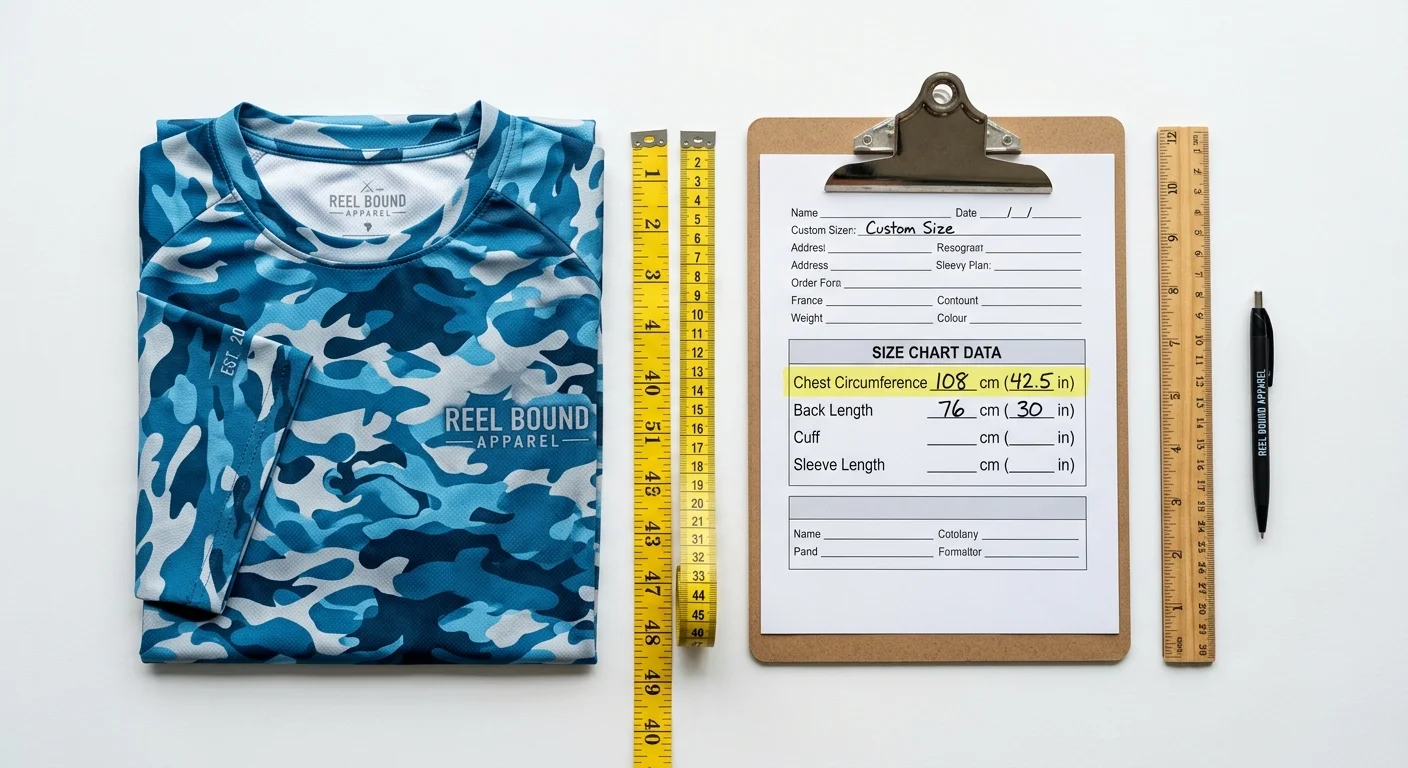
Extended sizes get more pre-order questions than any other range. Here are the answers buyers ask most — with the actual numbers.
What are the chest and length specs for 2XL through 5XL?
Size | Body Chest (cm) | ½ Chest Garment (cm) | Back Length (cm) | Sleeve (cm) | Neck (cm) |
|---|---|---|---|---|---|
2XL | 120–127 | 65.0 | 81 | 89 | 45–46 |
3XL | 127–134 | 68.5 | 85 | 91 | 47–48 |
4XL | 134–141 | 72.0 | 88 | 93 | 49–50 |
5XL | 141–148 | 75.5 | 89 | 95 | 51–52 |
Back length grows 4 cm from 2XL to 3XL, then adds only 1 cm between 4XL and 5XL. That slowdown is normal. It's a proportion decision, not a production error.
Am I between sizes? Which one do I take?
Always go larger. At 2XL–5XL, going too small on a moisture-wicking fishing shirt creates two problems at once. First, your shoulder movement gets restricted. Second, the stretched weave loses UPF protection. The fabric needs 2–4 inches of chest ease to do its job well.
Is there a longer cut available for tall builds?
The standard 5XL back length is 89 cm — enough for most big-and-tall builds. Your angler needs more coverage? Flag it at the custom fishing gear order stage. A length extension is doable.
How do I measure at this size range?
Wrap the tape around the fullest part of your chest , arms relaxed at your sides
Keep it snug, level, and not twisted — a skewed tape gives you a smaller number than your real chest size
Your measurement lands between two sizes? Round up to the nearest 0.5 cm
Comparing to a garment chart? Measure a shirt you already own across the chest and match it to the ½ chest column — not the body chest column
Mixing body measurements with a garment chart causes a full size mismatch. That's the most common ordering mistake in bulk big and tall fishing shirt 4XL 5XL requests.
Does UPF performance hold at 3XL–5XL?
Yes — as long as the ease is right. A tight fit at any size stretches the weave and cuts its protective density. At 3XL–5XL, check that your finished garment still has the target 2–4 inches of ease. The fabric spec alone doesn't guarantee performance. A cut that's too tight works against it.
Sizing Tips for Team & Bulk Custom Fishing Jersey Orders
Bulk orders go wrong at the same spot almost every time. Someone guesses their size instead of measuring it.
"I usually wear a large" is not a measurement. For a fishing team shirt bulk order , that one habit triggers a chain of reprints, delays, and frustration. Here's what works instead.
Build a uniform data collection form. Every person fills in the same fields: name, adult or youth, chest circumference (measured), height, and fit preference (relaxed or athletic). That's it. No guessing, no copying the label off an old shirt.
Chest measurement is the one number that counts. Not height. Not weight. Not "I wore a 2XL last season." Use a cloth tape with arms relaxed. Keep the tape level across the fullest part of the chest. Write down the number in centimeters — then match it to the garment chest column in this size chart.
Split youth and adult into separate groups before you count. A Youth XL and an Adult S can share the same chest number. They come from different patterns, though. Merge them into one column and errors slip in. You won't spot those errors until the box lands on your doorstep.
Keep a 5–10% buffer on your most popular sizes. One or two extra pieces in your core sizes covers last-minute additions and swap requests. No new production run needed.
Save your size distribution after every order. That breakdown — how many S, M, L, XL, and so on — gives you a baseline for next season. Check it against the current size chart before reordering. Sizing specs shift between batches and styles. Last year's L may not match this year's L, so confirm before placing the order.
Your order includes edge sizes like XS or big and tall fishing shirt 4XL 5XL ? Request a sample garment first. Confirm the fit before locking in the full run.
Pre-order checklist: actual chest measurements collected ✓ · one size chart used for all ✓ · youth and adult split ✓ · fit preference noted ✓ · buffer stock added ✓ · edge sizes sample-confirmed ✓
Conclusion
Getting the right fit on a custom fishing shirt isn't guesswork. All it takes is a 60-second measurement and the right size chart.
Outfitting a single angler or a full tournament team from Youth 4 to Men's 5XL? This guide's sizing framework cuts out the back-and-forth that kills bulk orders. Measure once, reference the chart, confirm your cut preference — done.
One thing most buyers miss: stuck between two sizes on a performance fishing shirt ? Size up. Sublimation fabric has zero stretch. A shirt that pulls across the chest on the water is a shirt you'll hate by noon.
Ready to put these measurements to work? Build your custom tournament fishing jersey — youth through big & tall — at runfishapparel.com. Upload your logo, lock in your sizes, and get your team looking sharp before the next tournament drops.
The fish don't wait. Neither should your order.