Your team just locked in a spot at the next BASS Nation Canada tournament. Now comes the part every team captain dreads — getting everyone into matching, professional-looking jerseys before the registration deadline hits.
Sourcing custom bass fishing shirts for a five-person club squad? Or kitting out a full regional delegation? Either way, the gap between a sharp, sponsor-ready uniform and a last-minute disappointment comes down to three things:
Design clarity — know what you want before you talk to suppliers
Supplier reliability — can they deliver on time, every time
MOQ awareness — understand your minimum order quantities before you discuss pricing
This guide covers what BASS Nation Canada teams need to know. You'll get the full picture — from locking in sublimation print specs and UPF-rated fabrics, to minimum order quantities, pricing tiers, and the complete ordering timeline from first mockup to final delivery.
Key Design Elements for BASS Nation Canada Jerseys
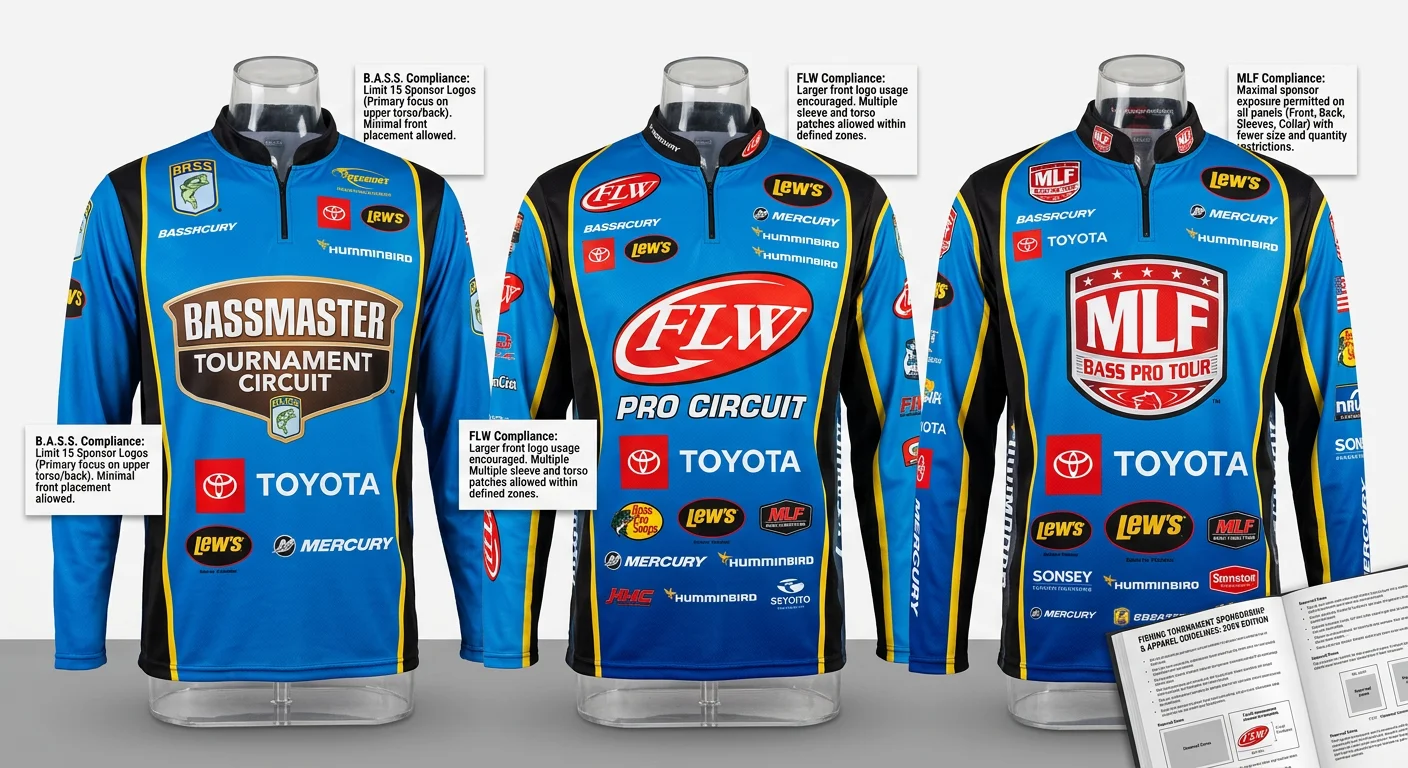
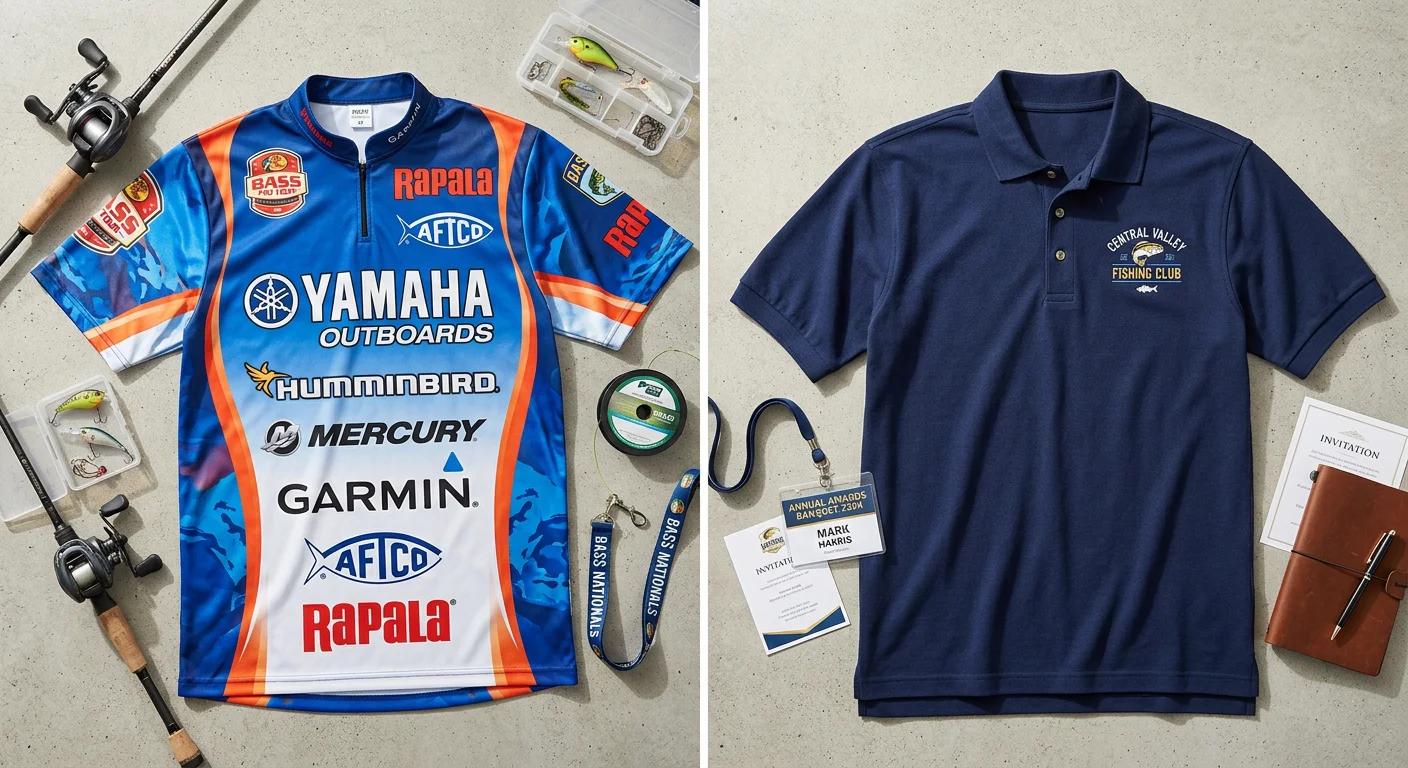
A well-designed tournament jersey does two jobs at once: it identifies your team on the water and puts your sponsors in front of every camera, judge, and spectator. Get the layout wrong, and you lose both visibility and credibility.
Here's how to structure your BASS Nation Canada jersey — zone by zone.
The Front Panel: Three Zones, Three Purposes
Think of your jersey's front as prime real estate split into three floors.
Upper third (collarbone to chest line)
This is your identity zone. Standard B.A.S.S. youth team guidelines apply to BASS Nation Canada too. The layout runs top to bottom:
BASSMASTER / B.A.S.S. official logo at the very top, centered. This is your highest-priority placement. No exceptions.
Athlete name (First + Last) just below, centered, bold sans-serif font, 3–5 cm height. Must be legible from 5–10 meters.
Team or province name one line below that, slightly smaller (2.5–4 cm), centered or left-aligned.
Middle third (chest to stomach)
Your team crest or primary club badge goes here — centered, spanning 30–40% of the jersey width, around 10–15 cm tall. Keep this zone clean. No overlapping elements.
Lower third (stomach to hem)
This is your main sponsor zone. Arrange 2–3 sponsor logos in rows. Primary sponsors can run up to 6–8 cm tall. Secondary sponsors: 3–5 cm. Spacing matters — keep at least 1.5–2 cm of white space between logos to avoid visual clutter.
The Back Panel: Visibility at 20 Meters
Judges, cameras, and spectators look at the back of your jersey a lot — on the weigh-in stage, at the dock, and during tackle setup. This space is too valuable to waste.
Upper back (shoulder to shoulder blade)
- Maple Leaf graphic or "CANADA" wordmark at top center, 5–7 cm letter height
- Athlete's last name centered below, same 5–7 cm height — readable from 15–20 meters
Mid-back (shoulder blade to waist)
- Jersey number centered and visible. Pro sport standards recommend 25–35 cm number height. BASS Nation Canada may not require a number — in that case, use this zone for a large team crest or one anchor sponsor. Stick to one dominant element. Too much here kills readability fast.
Sleeves and Side Panels: Secondary Sponsorship Real Estate
Sleeves get more camera time than most teams expect. Every cast, every fish hold, every arm raise — the sleeve enters the frame.
Left sleeve : Canadian flag + provincial or association logo
Right sleeve : 1–2 secondary sponsor logos, high-contrast background stripe
Keep each sleeve logo within 3–4 cm height and 6–8 cm width. Don't cover more than 30–40% of the sleeve length with print.
For side panels, run a vertical or diagonal color stripe — red, white, and black are strong choices for Canadian national identity — 6–10 cm wide from armpit to hem. This adds visual structure and lifts the overall look from "custom shirt" to professional uniform.
Color and Contrast: The Numbers That Matter
This is where most teams get it wrong.
Your jersey gets photographed under harsh noon sun on open water — one of the toughest visual environments out there. Sponsor logos and athlete names that look sharp in design software can turn unreadable on camera.
Use these contrast standards:
Element | Minimum Contrast Ratio | Recommended for Water/Sunlight |
|---|---|---|
Names & numbers vs. background | ≥ 4.5:1 | ≥ 7:1 |
Large logos (≥ 7mm height) | ≥ 3:1 | ≥ 4.5:1 |
Proven high-contrast combinations for BASS Nation Canada:
- Canadian Red base + white text + black outline — mirrors the NHL 4 Nations Face-Off Canada jersey. White-on-red contrast hits the 4.5–7:1 range with consistency.
- Deep navy base + white text — best for overcast days or evening weigh-ins. White-on-navy often exceeds 7:1 contrast.
One combination to skip : red and green as primary/secondary colors. Around 8% of men have red-green color blindness — that's a real share of your audience, officials, and broadcast viewers.
Typography rule: use bold, block sans-serif fonts with stroke width at least 1/6 of the character height. Add an outline to numbers or names? Keep that outline width under 1/8 of the character height. For example, a 30 cm number gets a maximum 3.5 cm outline.
Before you approve any design , photograph a print mockup in three conditions: indoor white light, outdoor overcast, and direct midday sun. Check legibility from 10–15 meters. Quick test: shrink the design to 3–4 cm wide on your phone screen. Names and numbers still readable? You've hit broadcast-ready visibility.
Sponsor Logo Placement Priority
Not all jersey positions deliver the same exposure. Here's the hierarchy, based on sports sponsorship research:
Front chest (upper + middle) — highest exposure. This zone accounts for 40–60% of total screen time in broadcast and photography, across multiple sports sponsorship studies.
Upper back — solid secondary exposure during weigh-in, award ceremonies, and tackle prep.
Sleeves — moderate exposure during action shots (casting, fish handling).
Side panels — lower priority; best for third-tier sponsors or decorative elements.
Per international event brand exposure standards: keep individual logos at ≤39 cm² (about 6 square inches) per placement. No more than 3–4 sponsors per zone. This isn't just about looks — it's what separates a professional uniform from a billboard.
Fabric and Print Technology: What Makes a Performance Fishing Jersey
A jersey that lasts five seasons versus one that falls apart after one — it comes down to two decisions: the fabric you choose, and how the design gets applied.
Here's what you need to know.
Full Dye Sublimation: Why It's the Only Print Method Worth Considering
Sublimation isn't just a buzzword. It's a different process at a technical level — and for custom bass fishing shirts , it's the clear winner.
Here's what happens during production. Sublimation ink transfers at 190–200°C under 0.3–0.5 MPa pressure for 40–50 seconds . At that temperature, the ink converts from solid to gas. It penetrates the polyester fiber at a molecular level, then solidifies inside the fabric. There's no ink layer sitting on top. The color is the fabric.
What that means in practice:
No cracking, no peeling, no fading — after 50+ wash cycles at 40°C, color retention stays above 90% of original saturation
Full-panel gradient capability — any number of colors, photographic-quality images, large-format team crests, sponsor logos — all printed in one pass, at no extra cost per color
Hand feel stays intact — heat transfer film adds 60–100µm thick PU/PVC layers that stiffen the fabric. Embroidery adds 0.5–1mm of thread bulk. Sublimation leaves the fabric feeling the same as it did off the roll
Sublimation needs ≥65–70% polyester content — 100% polyester works best — to hit full color saturation. Cotton-heavy blends wash out fast and lose durability.
Performance Fabric Specs for Canadian Tournament Conditions
Canadian open-water tournament days are tough. Strong UV, wind, and 6–8 hours on the water — the fabric has to handle all of it. This isn't generic activewear. It's tournament angler uniform territory.
Target fabric weight: 150–160 g/m² knit polyester. That's the right range for Canadian summer conditions.
Drop below 130 g/m² and UV blocking suffers. Go above 180 g/m² and heat builds up fast on calm, high-sun days.
Fiber structure matters. High-performance sublimation fishing jerseys use modified cross-section polyester filaments — Y-shaped or cross-shaped fiber profiles. These profiles increase surface area and pull sweat away from skin through capillary action. Vertical wicking distance should reach ≥10 cm per 30 minutes in standard wick tests.
Recommended construction by panel zone:
Zone | Recommended Structure |
|---|---|
Front & back main panels | Fine bird's-eye mesh or flat sublimation knit |
Underarm / side panels | Open mesh (10–14 holes/inch) for heat venting |
UPF Sun Protection: What the Numbers Mean
A full day on open water hits you with more UV than you'd expect. Water surface reflection stacks on top of direct overhead radiation. Your exposure adds up fast.
The UPF ratings break down like this:
UPF 30+ : blocks ~96.7% of UV — fine for casual fishing
UPF 50+ : blocks ~98% of UV, extends safe skin exposure by up to 50x — the standard for serious tournament anglers
At 150–160 g/m² in a tight-knit, mid-to-dark polyester , your jersey can reach UPF 30–50+ . Light colors with large open mesh can pull that number down to UPF 15–25. So fabric density and color choices in your design aren't just aesthetic — they affect real sun protection.
To hold UPF performance across the full garment:
Keep open-mesh ventilation panels to under 30% of total surface area
Use UV-absorber additives in fiber treatment
Add a stand collar or half-collar at the neck — sunscreen washes off there fastest, so built-in coverage fills the gap
For BASS Nation Canada teams competing in multi-day events , specify UPF 50+ with AATCC 183 or AS/NZS 4399 test certification. That's the professional standard. It's also what serious fishing competition shirts buyers now expect as a baseline.
MOQ Policy and Pricing for Custom Bass Fishing Team Jerseys
The single biggest ordering mistake BASS Nation Canada teams make? Choosing a supplier based on unit price alone — without checking the minimum order quantity first.
Here's the reality: MOQ policies across the custom fishing apparel market vary a lot. Some OEM Tournament Fishing Jerseys suppliers accept as few as 5–8 sets for sublimated team jerseys. Others won't touch your order unless you commit to 50 or even 100 pieces . For a 4-person club squad, that gap is the difference between a smooth kit-out and an expensive headache.
Understanding the MOQ Tiers
The market breaks down into three clear supplier categories:
Small-run suppliers : 5–10 pcs per design — ideal for local club teams and first-time orders
Standard Custom Tournament Fishing Jerseys manufacturers : 20–30 pcs — suits regional delegations or multi-team purchases
Factory-level pricing : 50–100+ pcs — where the real unit cost savings kick in
At runfishapparel.com, the entry point for custom bass fishing shirts is 10 pieces per design per color on first orders. That number works well for smaller teams for one key reason: reorders carry no MOQ . Need a replacement jersey for a late-added teammate? You're not forced into buying ten more.
Working Price Ranges by Jersey Style
These are the working quote ranges for tournament angler uniforms at current standard team-jersey specs. Full sublimation and personalization are included:
Style | Starting Price (per piece) |
|---|---|
Short sleeve jersey | ~$77 |
Long sleeve jersey | ~$86 |
Hooded long sleeve | ~$88 |
Sweatshirt / hoodie | ~$96 |
These prices sit above basic UPF fishing shirts — which run $8–$13 per piece at 100 pcs. The difference comes down to what you're getting. Custom bass fishing shirts for tournament use carry more design complexity, sport-specific construction, and full personalization. That means names, numbers, and sponsor logos spread across multiple zones.
What Moves Your Final Quote
Four variables drive every pricing conversation:
Style — hooded and long-sleeve constructions cost more
Quantity — more units, lower unit cost, every time
Decoration complexity — number of sponsor zones, gradient difficulty, photographic artwork
Personalization — individual names and numbers add per-unit cost
Extended sizing adds a set surcharge: 2XL +$2 / 3XL +$4 / 4XL +$6 / 5XL +$8 per garment. Your team has members in larger sizes? Build that into your total budget from the start.
Volume Discount Tiers: Where the Savings Are
Pricing doesn't drop at a steady rate as quantity goes up — it drops at breakpoints . For fishing team uniforms Canada orders, common discount tiers land at 10, 25, 50, 100, and 250 units . Here's what that looks like in practice:
Quantity | Unit Price Range | Savings vs. MOQ |
|---|---|---|
50 pcs (MOQ) | $18–$24 | — |
100 pcs | $13–$17 | ~28% |
200 pcs | $9–$12 | ~46% |
500 pcs | $7–$9 | ~61% |
The key takeaway: at 8 people, order 10 . That one-tier jump often saves more than the cost of the extra two jerseys.
The Smart Ordering Decision for Small Teams
Most BASS Nation Canada club teams run 3–6 people. The decision comes down to three situations:
Need uniforms now, exact headcount only → find a supplier with a 5–10 piece entry and no-MOQ reorders
Want the lowest unit price → push toward the 25 or 50-piece tier, even if that means holding extra inventory
Expecting roster growth or replacements → order a few pieces above your current headcount. This locks in tier pricing for up to 12 months
One thing worth knowing about reorder pricing: discount rates stay valid for up to one year after your original order. But your reorder must hit at least 10 pieces to qualify. Drop below that, and you reset to the higher 1–9 piece rate. Plan your roster additions with that threshold in mind.
Step-by-Step Ordering Process: From Logo Files to Delivery
Six steps. That's all that stands between your team and tournament-ready jerseys in your hands before race day.
Here's how the process works — from your first email to the final quality check at the door.
Step 1: Submit Your Inquiry With the Right Files
Speed up the whole process by sending these upfront:
Team name and tournament name (e.g., "Vancouver Eagles — 2026 Canada Cup Regional")
Logo files in vector format — .ai, .eps, .svg, or high-res .pdf. Got a .png? It must be at least 300 dpi with a transparent background. Rasterized files need vectorization. That adds $15–$50 per logo in conversion fees.
Pantone or CMYK color values for every sponsor logo — this keeps color deviation within the acceptable ΔE < 2–3 range
Size breakdown — total quantity plus per-size counts (e.g., S×10 / M×15 / L×10 / XL×5)
Target delivery date — your firm must-have-in-hand date before the tournament
Missing any of these on your first contact? Expect delays. Suppliers can't quote or start design work without them.
Step 2: Design Mockup and Revision Rounds
Submit complete files plus a deposit. Most suppliers deliver an initial mockup within 1–3 business days .
Standard policy covers 3–5 free revision rounds . Go beyond that, and you're looking at a $10–$30 per-revision fee . Color and placement adjustments each count as separate rounds. Confirm your Pantone codes up front — don't burn revision rounds on color corrections.
Before signing off on the final art proof, check every line item:
- Name spelling and jersey numbers
- All sponsor logos present and in correct priority order
- Placement zones and dimensions matching what was agreed
Approve that proof and any changes trigger extra fees. Read it closely.
Steps 3–4: Size Collection and Personalization
Have every team member self-measure chest, waist, and height using a soft tape. Add 2–4 cm of ease to the raw measurement for a proper athletic fit. The team captain collects everything in one spreadsheet: name / size / number.
Individual names and numbers are not included in the base price as a rule. Budget an extra $3–$8 per jersey for personalization. Some suppliers do include it for orders over 20–30 pieces — check before you assume.
Steps 5–6: Production, Shipping, and Delivery Check
Full-sublimation fishing tournament shirts with multi-zone sponsor logos and individual personalization take 3–4 weeks to produce after proof approval. Plan for about one week on design finalization, then two to three weeks on the production floor.
Add Canadian domestic shipping on top of that:
Same or neighboring province: 2–5 business days
Cross-country (BC to Ontario): 4–7 business days
Total timeline to plan around: proof approval date + 4 weeks production + 5 days shipping buffer.
Need jerseys faster? Rush orders cut production down to 2–3 weeks at a +20–30% surcharge , or to 1.5–2 weeks at +40–50% . Rush orders require 100% upfront payment and art proof confirmation within 24 hours.
The box arrives — do a 48-hour quality check right away. Count every piece. Verify sizes against your spreadsheet. Compare logo placement and colors against your approved proof. Don't wait. Most suppliers need issues flagged within that window.
How to Choose the Right Custom Fishing Jersey Supplier for Your Canadian Team
The wrong supplier doesn't just cost you money. It costs you credibility on the tournament stage. Late jerseys, misspelled names, sponsor logos that bleed into smears — these are real consequences of a bad choice.
Choosing a custom fishing clothing Canada supplier isn't complicated. It does require the right questions before you commit. Here's what to evaluate.
MOQ: The Number That Decides Everything
Most Canadian club teams need between 20 and 60 jerseys. That's the reality. The problem? Many factories list 500 units on their website but will accept pilot runs of 50–100 pieces if you push for it.
Always verify MOQ at three levels:
- Per design (e.g., 100 pieces per colorway)
- Per style (short sleeve vs. long sleeve — counted as separate minimums?)
- Per size run (minimum 10 pieces per size is common)
Got a small roster? Ask about stock fabric options . These allow lower MOQ because the supplier doesn't commit to custom dye lots. Custom dye lots need 100–300 pieces per color to run at dye-lot efficiency. Stock fabrics skip that requirement.
Lead Time: Get Exact Dates, Not Vague Ranges
Here's a realistic total timeline for sublimation fishing jerseys shipped to Canada:
Stage | Timeline |
|---|---|
Design samples | 10–14 days |
Bulk production | 30–45 days |
Air freight to Canada | 7–15 days |
Customs clearance | 3–7 days |
Total (air) | ~60–75 days |
Sea freight adds another 30–40 days in transit alone. Tournament teams with fixed event dates can't absorb that extra time. The margin is too tight.
Two hard requirements for any supplier you consider:
1. Ask for their OTIF rate (On-Time In-Full) over the last 12 months. Below 95% is a red flag .
2. Get a specific ship date in writing. "Ships mid-August" is not a commitment. "Ships August 15" is.
Samples and Revisions: Don't Skip This Step
Before any bulk order, confirm what's included in the sample process:
How many revision rounds are free? (Industry standard: 2–3 design revisions + 1 fit correction)
Do they produce a pre-production sample in actual bulk fabric — not a substitute material?
Who covers sample shipping costs to Canada?
One smart negotiation move: ask the supplier to credit your sample fee toward the first bulk order . Most quality Tournament Fishing Jerseys manufacturers will agree to this. Also, get approval of a "golden sample" in writing. This becomes the binding quality standard for your entire production run. No golden sample approval, no bulk sign-off.
Fabric and Print: Demand Documented Numbers
Skip vague claims like "sun protective" or "moisture-wicking." Ask for test data instead.
For bass fishing tournament gear in Canadian conditions, check these four specs:
Fabric weight : 140–150 gsm polyester knit for most summer tournaments. Go 150 gsm for cooler early-season provinces.
UPF rating : Require a lab-certified UPF 30–50+ result (AATCC 183 or AS/NZS 4399). A marketing claim doesn't count.
Print resolution : Confirm 300 dpi minimum artwork requirements. This keeps sponsor logos sharp across all sizes.
Color management : Ask whether they use lab dips or color swatches before bulk runs. This step is critical for sponsors with strict Pantone color standards.
Fishing jerseys often carry 10+ sponsor logos . Poor sublimation looks bad. Worse, it damages the relationships those sponsors represent.
The Supplier Comparison You Should Run
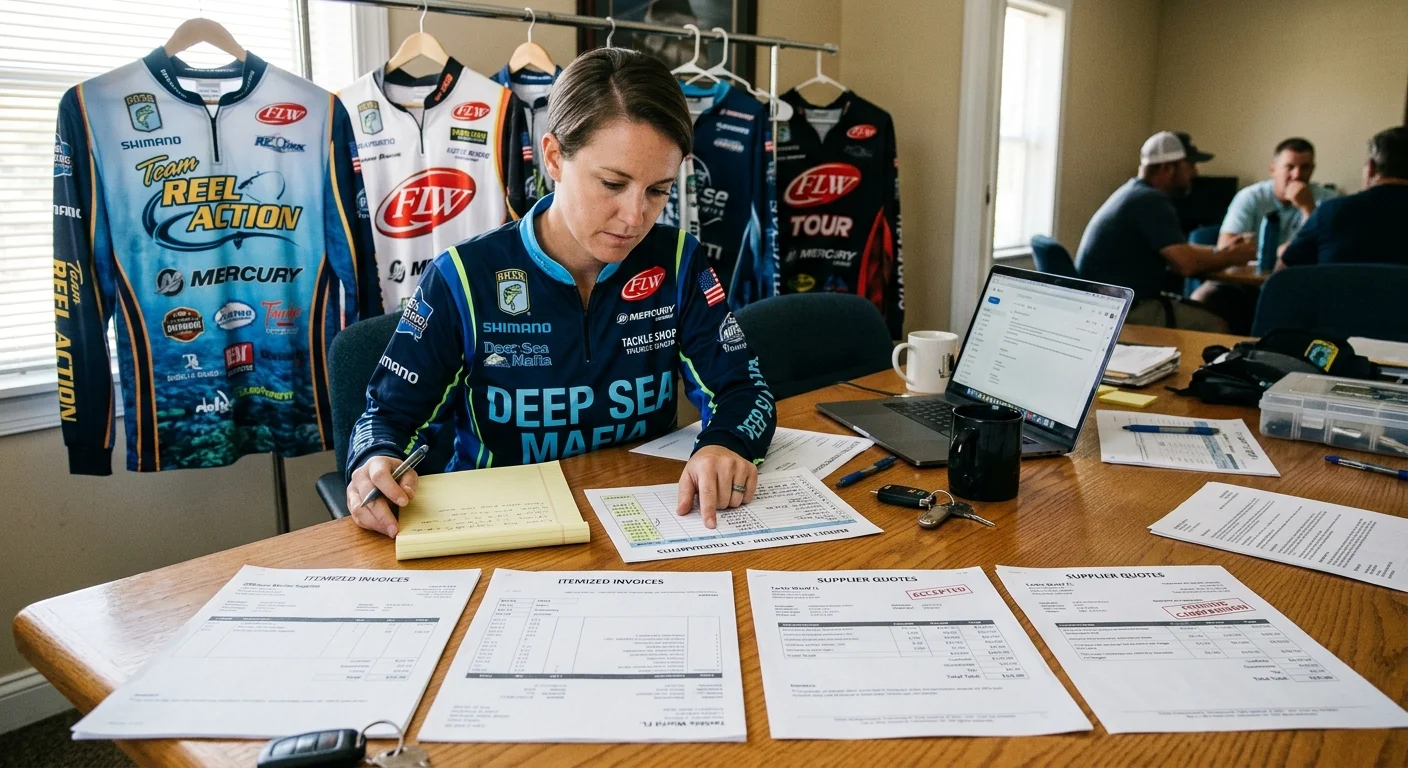
Don't evaluate suppliers one at a time. Shortlist 3–5 options — a mix of Canadian-based and overseas tournament Fishing apparel manufacturers — and send each one an identical brief. Cover team size, size range (Youth–5XL), target GSM, UPF requirement, print method, and sponsor logo count.
Score each response across five dimensions:
- Product capability
- QC standards
- Communication speed
- MOQ flexibility
- Pricing
Set a minimum threshold — say 75 out of 100 . Move to sample stage with suppliers who clear it. Cut the rest.
One last thing worth noting: a supplier who offers free design mockups with real sponsor logo placement — before you commit to bulk — is showing confidence in their process. That kind of confidence tends to be backed by results.
FAQ: Custom Tournament Fishing Jerseys for BASS Nation Canada
Every BASS Nation Canada team captain asks these questions. Most ask them three weeks before the jerseys are due.
How long does the whole process take?
See a "4-week production" quote? That clock doesn't start until you approve the final art proof.
Design work comes first. A straightforward layout — existing team logo, clean background — adds 3–7 days . A complex full-print design with multiple sponsors and custom graphics pushes that phase to 7–10 days .
Add it up: 5 weeks minimum from design kickoff to jerseys in hand — and that's before Canadian shipping.
The safe play for BASS Nation Canada events:
- Absolute minimum : lock your design 5 weeks before your event date
- Recommended : place your deposit and start the design conversation 6–8 weeks out . That buffer handles sponsor logo changes, size corrections, and shipping delays. No panic mode.
How many revisions do I get — and what do they cost?
The standard across the tournament apparel market: 2–3 free revision rounds from first mockup. After that, each extra revision costs $20–$50 , or a design fee of $40–$60/h based on complexity.
Free before you approve the proof:
- Color adjustments — background hue, gradient tweaks, accent color changes
- Logo swaps — bring clean vector files. Raster-to-vector conversion runs $15–$40 per logo
- Name changes — free for up to 10–20 names before batch layout is finalized
Costs money after approval:
- Any name change: $5–$10 per name , or a flat $25–$40 artwork reset fee
- Once jerseys enter the production queue, changes are either off the table — or require a full reprint at full price
Here's a tip teams with active sponsorship rosters use: ask your tournament Fishing Jerseys supplier for BASS Nation Canada Teams to lock the background and team branding early. Keep the sponsor panel flexible until 2–3 weeks before the print date . Most quality vendors will work with you on this.
What sizes are available — and do larger sizes cost more?
Adult sizing runs XS through 5XL . Most suppliers charge nothing extra up to 2XL. From 3XL onward, a size surcharge kicks in — see the pricing section for exact figures.
A few things worth knowing for mixed-roster BASS Nation Canada teams:
Women's cut (tapered waist, shorter length) is available at the same price or a small $2–$5 premium
Youth/junior sizes (YS–YL) are common in Junior BASS Nation programs. They run $5–$10 cheaper than adult pricing — less fabric, lower cost
Performance fishing jerseys come as a semi-athletic fit — relaxed enough for layering, not compression-tight like a cycling kit. Torn between two sizes? Size up. Sublimated polyester gives very little stretch.
Ordering for men, women, and youth on one order? Request a single master size table covering all cuts. Confirm there's no mix-style surcharge as long as the graphic layout stays consistent.
Can I reorder a single jersey later in the season?
Yes — and this is where picking the right Tournament Fishing Jerseys supplier pays off. Look for vendors who advertise no minimum order quantity . Some will outfit a 2-angler team just as readily as a 40-team tournament field.
Reordering with existing artwork and no design changes? Most shops waive the setup fee entirely — you pay unit price plus shipping. Changed your sponsor panel? Add a re-art fee of $20–$50 on top of the jersey cost.
Running a small Canadian BASS Nation club with 3–5 anglers? Here's a solid approach: create one master design, place an initial order of 3–5 jerseys, then use a no-MOQ vendor to add single jerseys as your roster grows. You'll pay a modest $5–$10 premium over bulk rates. That flexibility beats chasing a fractionally lower unit price from a factory-minimum supplier every time.
Get a Free Design Mockup for Your BASS Nation Canada Jersey
Send over your logo files and sponsor list. You'll have a print-ready mockup — front and back — within 24–48 hours. Zero cost.
No watermarks. No commitment. Just a high-resolution proof you can show your team and sponsors before spending a dollar.
Here's what to prepare:
Logo files
- Vector format first: AI, EPS, SVG, or PDF curves
- Fallback: PNG or JPG at minimum 2,000 px on the longest side, 300 dpi
- Label each file with its placement: "front chest," "upper back," "left sleeve"
Sponsor placement list
Build a simple table with four columns: sponsor name, logo file, desired position, and priority tier (P1 main / P2 secondary / P3 minor). That structure cuts out back-and-forth. Your first proof comes back right.
Roster sizing table
Name, size, height, weight, fit preference. One spreadsheet. That's what locks your quantity tier and final price.
Approve the mockup, and a detailed quote hits your inbox within 24 hours. Unit prices, volume tiers, production timeline — all of it, laid out clearly.
One more thing: MOQ starts at one piece. Try the design on a single jersey before ordering for the whole team.
Tournament in 6–8 weeks? Submit your mockup request today. Production runs 3–4 weeks after proof approval. Add shipping and a buffer — and six weeks goes fast.
Conclusion
Your BASS Nation Canada team deserves more than a shirt — it deserves a statement.
The right custom tournament fishing jersey does three things: it unifies your crew on the water, meets official competition dress requirements, and shows sponsors their logo is in good hands. This guide covers everything from sublimation-grade UPF fabrics to logo placement specs. Each detail removes the guesswork between "we need jerseys" and "we're ready to compete."
Here's what most teams learn too late — production slots fill fast before peak tournament season. Waiting costs you rush fees or missed deadlines. Neither is a good option.
Don't let your competition out-dress you.
Get your free design mockup today. Submit your team logo, color scheme, and roster size to runfishapparel.com . Our team turns your vision into a print-ready concept within 48 hours. No commitment required.
Your next podium moment deserves the right uniform.