Your first order with a fishing apparel factory went smoothly: samples approved, production on time, quality solid. Then reorder season hit, and suddenly you're staring at a two-week delay because the quick-dry fabric ran short, or the UPF-rated panels from batch two don't quite match batch one. Sound familiar? Most retail brands get burned here, not on the first PO but on the third or fourth reorder, when demand is unpredictable and fabric suppliers aren't playing nice.
This guide explains what happens behind the factory walls when a reorder comes in: how raw material safety stock is calculated, why modular pre-cut panels can shave days off production lead time, and how minimum order quantity thresholds get set for reorders versus first-time bulk orders. By the end, you'll have a concrete list of questions to ask any fishing apparel factory before you commit to a long-term partnership, so you can spot a fragile supply chain before it costs you a sold-out season.
Quick-Dry Fabric Supply Tightness and Stockout Risk in Fishing Apparel Reorders
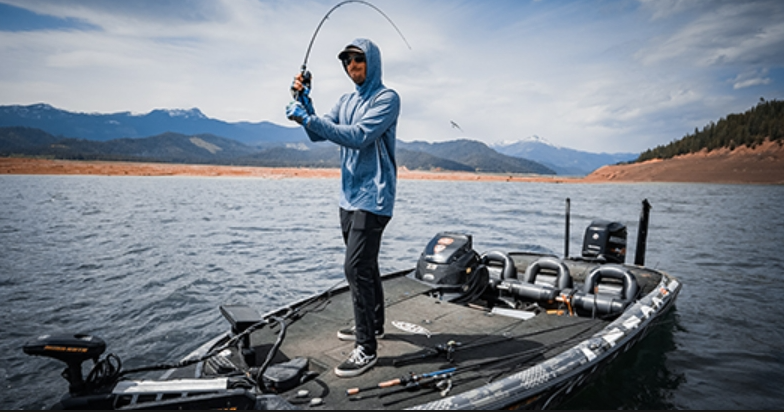
The 130-150 GSM poly/spandex blends that dry in under 20 minutes are the quick-dry fabrics that sell best. When demand spikes, those are the ones factories struggle to keep on hand.
One OEM I've studied keeps 150 GSM wicking jersey and 140 GSM mesh in stock because they're the most common bases. Order those, and stock items ship in 7-10 days. Step outside that range into a custom weave or fiber cross-section of fishing apparel, and you're adding 3-5 days just to source raw material. Production hasn't even started yet. Total turnaround runs 20-32 days from inquiry to doorstep on custom builds, versus 14-20 days when fabric is already sitting on the shelf.
MOQ is the second squeeze point. Garment-level orders on quick-dry fishing apparel typically require fishing apparel 500 pcs MOQ, with fabric-only reorders sitting at 80 meters minimum. A separate benchmark for quick-dry polyester shows 200-300 kg per color with 15-25 day lead times when the factory isn't holding stock. If your factory quotes anything above 500 pcs, or a fabric-only MOQ north of 200 kg, treat that as a red flag for reorder speed.
Quality quick-dry polyester dries in 3-5 minutes; standard polyester takes 15-30 minutes; cotton fishing shirts can run 80-90 minutes. AATCC 195 Grade 4+ wicking is the spec worth asking for in writing.
Building Your Buffer
Ocean freight adds another 25-45 days on top of production. Smart buyers plan 6-10 weeks of coverage for core quick-dry SKUs — one full lead-time cycle plus buffer stock — especially heading into spring/summer fishing season when demand forecasting gets unreliable and specialty textile sourcing volatility hits hardest.
UPF Fabric Certification and Batch-to-Batch Consistency Problems
Your fabric can pass UPF testing on lot one and quietly slide below the labeled rating on lot three, without anyone changing the recipe on paper.
UPF certification varies by standard. AATCC TM 183 is the main U.S. method, labeling fabrics as "good" (UPF 15), "very good" (UPF 30), or "excellent" (UPF 50/50+). AS/NZS 4399 and DIN EN 13758-1 use the same rating tiers but different test conditions. UV STANDARD 801 is the strictest. It tests fabric wet, stretched, abraded, and after laundering, then certifies based on the worst-case result. Reorders are where that matters most. If your factory only tests fabric in dry, unstretched, brand-new condition, you're not seeing the real-world rating your customer will experience on the water.
Why batches drift:
Tighter knit density and cover factor generally hold UPF steady; a looser lot underperforms. Dye lot shade drift changes UV absorption. Finishing chemistry is batch-sensitive, from add-on percentage to cure temp. GSM, stretch %, and shrinkage shift test outcomes because certification methods test wet/stretched states.
Small production shifts near the UPF 15/30/50 thresholds can knock a fabric into a lower labeling category. No one notices until a third-party lab flags it.
What to Lock In With Your Factory
Ask for lot-specific UPF certificates , not a one-time fabric claim. Require the same lab and same standard across every reorder batch. Get GSM, stretch %, dye recipe, and finishing add-on written into your spec sheet as critical-to-quality items, not just "UPF 50+" on a hangtag.
Spring and Summer Fishing-Season Order Spikes and Replenishment Delays
March comes around, and fishing apparel factories get slammed. It’s a predictable seasonal crunch that catches unprepared retail brands every single year.
Fishing lures alone account for 43% of annual purchases in Q2 and Q3. Search demand for core fishing categories climbs from late spring, peaking hard between May and August. One dataset tracking fishing rod interest records a normalized score of 98 in August 2025.
Most brands don’t plan backward from that peak. They wait until sales start climbing, then panic-order.
The math that works:
Spring/summer buying windows open in October–November
March–April is your reorder trigger point to hit May–August sell-through
Manufacturing lead times run 30–45 days for simple styles, 60–90 days for custom or private-label builds
Sea freight takes 18–25 days to the West Coast, 30–40 days to the East Coast, plus 3–7 days for customs clearance
Total landed lead time stacks up to 8–16 weeks depending on complexity and destination
Place your reorder PO 4–6 months before peak season. Entry-level and mid-tier gear needs at least 6–8 weeks of ramp time before shelves need to be stocked.
Miss that window and you’ve turned inventory into a liability. Stock that arrives after the season peak becomes off-price or dead stock, sold at a discount or written off. Brands using local or regional manufacturing can cut lead times from 8–12 weeks down to 2–4 weeks, a real lever if your factory’s overseas timeline keeps pushing your reorder trigger date earlier each year.
Raw Material Safety Stock Formula and Fabric Buffer Inventory Control
Most factories don't guess how much fabric to hold in reserve. They calculate it. And the formula they use changes everything about whether your reorder ships on time or sits in a queue waiting on yarn.
The core math looks like this:
Reorder Point = Expected Demand During Lead Time + Safety Stock
Minimum Stock = (Daily Consumption × Lead Time) + Safety Stock
For safety stock itself, factories pick one of a few models depending on how clean their demand data is:
Demand-only formula: Safety Stock = Z × σ_D × √LT
Lead-time variability formula: Safety Stock = Z × σ_LT × D_avg
Combined formula (used for woven/knit raw materials): SS = Z × √[(LT × σ_D²) + (D_avg² × σ_LT²)]
Simple max/avg method: Safety Stock = (Max Daily Usage × Max Lead Time) − (Avg Daily Usage × Avg Lead Time)
The Z-value sets your service level. Z = 1.28 covers a 90% service level. Z = 1.65 covers 95%. A factory running fishing apparel reorders should push Z higher on quick-dry and UPF fabrics, since those are your critical-to-quality SKUs, and lower on trims or non-visible materials.
Example: a fabric roll averages 100 meters/day demand, 14-day lead time, Z = 1.65. The lead-time buffer alone starts at 1.65 × σ_LT × 100, then adds the 14-day expected demand to set the reorder trigger.
Ask your factory which formula they use, and whether they recalculate quarterly. If they can't answer, they're guessing your buffer, not planning it.
Modular Pre-Cut Panel Pre-Processing for Quick Turnaround
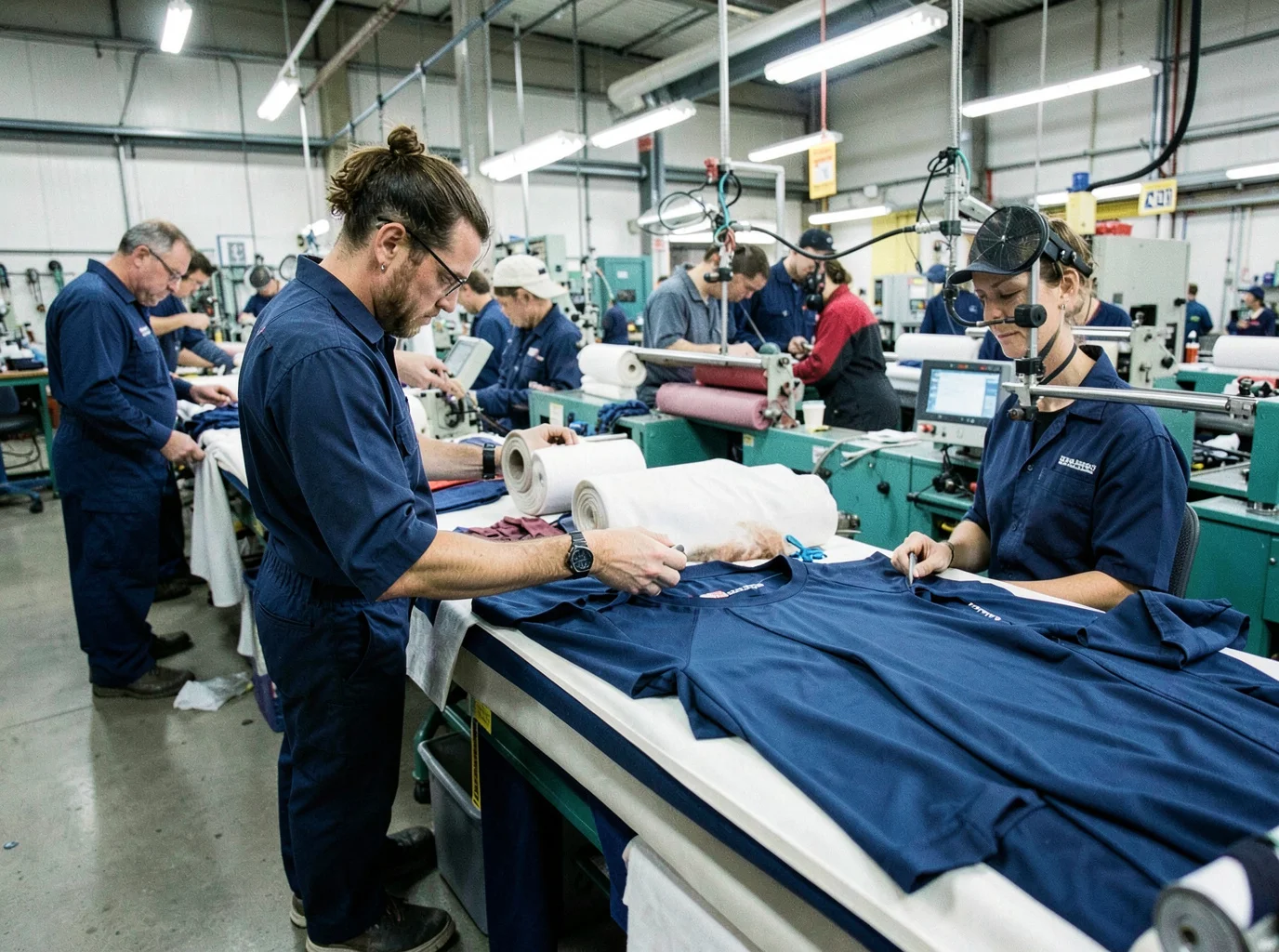
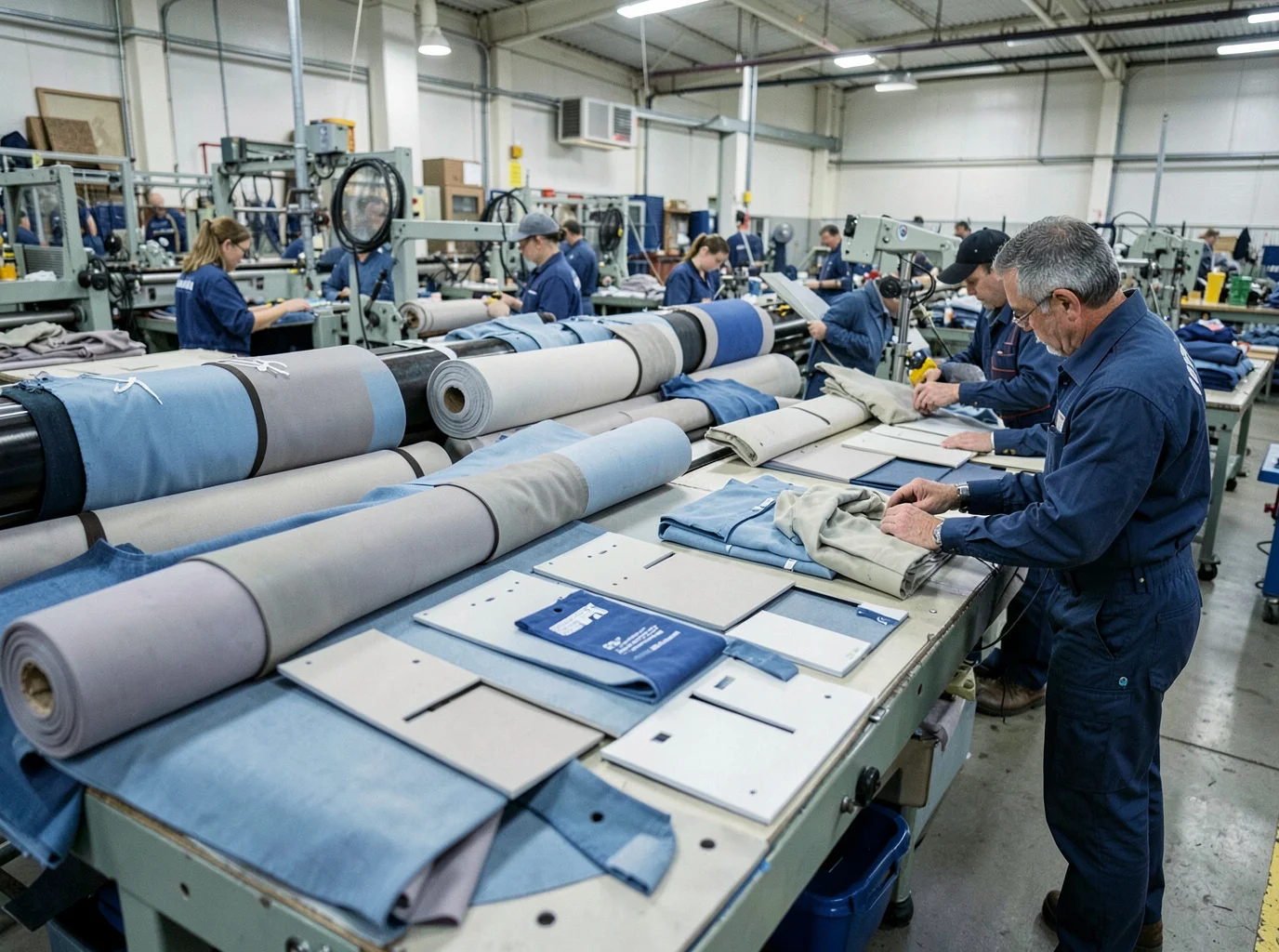
Cutting fabric to shape is the single biggest bottleneck between "reorder confirmed" and "goods on the truck." Factories that handle reorders well solve this before the PO even lands, by pre-cutting standard panels — sleeves, front/back bodies, collar facings — in bulk during slower production windows, then storing them ready for assembly.
Your fishing apparel production lead time shrinks because nesting-optimized cut files for your core styles stay on file, so a reorder skips the marker-making step entirely. Automated cutting systems (CNC or laser cutters) handle size grading and shape precision without a re-setup cycle. Panels are bundled and sequenced by size and color, ready to hit the sewing line the moment fabric arrives. Pre-cut inventory buffers the fabric supply gap discussed earlier — panels are already cut when the roll runs low.
This alone can shrink a bulk order fulfillment cycle from weeks to days for repeat SKUs.
Ask your factory whether they keep nesting files and pre-cut inventory for your core styles, or if every reorder starts from a blank cutting table. That answer tells you whether their quick turnaround manufacturing claim is real or just a sales line.
Reorder Priority Production Scheduling Rules
Not every order on a factory floor gets treated the same, and there's a reason for that. When a machine opens up, a well-run factory doesn't just grab the next job in line. It runs each waiting order through a priority index and dispatches the one that scores highest. That index is built from formal sequencing rules. Knowing which rule your factory uses tells you where your reorder sits in the queue.
The rules that matter most for reorders:
FCFS/FIFO first come, first served. Your urgent reorder waits behind whatever arrived first, even a low-priority job.
EDD (Earliest Due Date) the order with the closest deadline jumps ahead. This is the rule you want if lateness is your biggest fear.
SPT (Shortest Processing Time) quick jobs get pushed through first to reduce work-in-progress. Good for factory throughput, bad if your reorder is a longer run.
Critical Ratio (CR) time remaining divided by work remaining. A CR under 1.0 flags your order as behind schedule and bumps it up.
Slack and Slack per Remaining Operation measures how much cushion a job has left; lowest slack gets served first.
MWKR / LOPR some shops prioritize jobs with the most work remaining to keep long routings moving; others push jobs with the fewest remaining steps to finish more orders faster.
In make-to-order and multi-item inventory setups, production on a current batch can get interrupted if a different item drops below its safety stock trigger. That means your reorder priority isn't fixed. It shifts based on real-time inventory levels across the factory's entire product line, not just your PO.
Ask your factory which rule governs reorder dispatch, and whether reorders default to EDD or CR treatment. If they can't name a rule, they're sequencing by memory.
Small-Order Quick-Reaction SOP for Low-Volume Reorders
A 40-piece reorder shouldn't queue the same way a 5,000-unit bulk PO does. Most factories that handle small reorders well run a lot-for-lot or MOQ-driven reorder rule. The PO triggers the moment stock hits the reorder point: average daily demand × lead time + safety stock.
The SOP sequence is: forecast demand, pick the lot rule, set the reorder point, then validate against MOQ, capacity, cash, and storage. Skip validation and you'll overshoot into inventory you can't move.
Calculating Net Need
Net reorder quantity = on-hand stock + inbound POs − demand during lead time − safety stock. Round up to the fishing apparel supplier's MOQ or nearest case multiple. MOQ can be unit-based, case-based, or value-based. Example: a $10,000 minimum spend at $100/unit effectively means your MOQ is 100 units, even if nobody calls it that.
Low-volume in fishing apparel runs 10 to 5,000 units depending on garment complexity. That is the range where Quick Response Manufacturing (QRM) logic applies — the goal is shrinking Manufacturing Critical-path Time (MCT), the calendar time from order creation to first piece delivered.
Before Releasing the PO
Check three gates: cash, storage, and cartonization waste. Freight runs 5-8% of order value; receiving labor runs $2-4 per carton. If the MOQ forces excess inventory, weigh the extra carrying cost (20-30% annually for mid-market retailers) against the unit-price discount. If holding cost beats the savings, do not take the overshoot.
Track each fishing apparel supplier's MOQ, minimum order value, lead time, unit pricing, and volume discounts in one running sheet. Book production backward from your required in-stock date, not forward from PO placement. For every small-batch run, record configuration, source path, availability window, production-time boundary, release evidence, and reorder condition. That log is what separates a factory with a real quick-reaction SOP from one improvising each time.
Reorder Partnership Verification Questions for a Fishing Apparel Factory
Here's the checklist I'd hand a fishing apparel vendor before signing anything for round two. Don't wing this conversation.
Fit and pricing: Same line, same sewing team as last run? Reorder MOQ is typically 100 pcs/style for custom fishing apparel logo work, sometimes 50 pcs for light customization. Ask if the sample fee credits toward bulk — many factories do this. Get reorder pricing against the original quote and ask exactly what changed: fabric, trims, freight.
Timeline: Sample lead time runs 7–14 days. Bulk production sits at 20–35 days for standard styles, longer for insulated or waterproof builds. Seasonal orders need 8–12 weeks advance booking.
Continuity: Same fabric lot or an approved substitute? Can they match the previous lab dip? Trims, labels, packaging still identical?
Compliance: Confirm ISO 9001, OEKO-TEX, BSCI are current. Request UPF test reports tied to AATCC 183. Ask their final inspection standard. AQL 2.5 is the benchmark.
Ownership: One WhatsApp or email contact for changes and signoff.
Conclusion
Any fishing apparel factory can nail the first order. Order two, three, and ten are where you separate a real long-term manufacturing partner from a one-hit wonder, especially when quick-dry fabric runs tight or your spring fishing season hits harder than forecasted.
The factories that handle fishing apparel production lead time consistently don't lead with the fastest turnaround promise. They can show you their fabric buffer math, their reorder priority rules, and a real answer to "what's your minimum order quantity MOQ reorder ?"
Before you sign anything, pull out that verification checklist and ask the questions. Don't accept vague reassurances. Get numbers, get days, get percentages.
Your reorder strategy should be a system you can predict, month after month, season after season.