You've got three quotes sitting in your inbox, and the price gap between them makes zero sense. One factory quotes $3.20/meter for virgin polyester, another wants $4.80 for rPET fabric fishing shirts using the exact same GSM — and you're stuck explaining to your boss (or your budget) why "eco-friendly" costs 50% more.
That gap isn't random, and it's negotiable more often than custom fishing apparel manufacturers let on.
This guide breaks down the real cost math between recycled and virgin polyester for custom fishing apparel — per-meter pricing, per-garment margins, and where a custom fishing jersey manufacturer actually has room to move on price. You'll also get negotiation scripts to control GRS certification cost increases and a QC checklist so you're not paying premium prices for subpar performance.
Actual Cost Breakdown: Per-Meter and Per-Garment Price Difference Between Recycled and Virgin Polyester (Data Table)
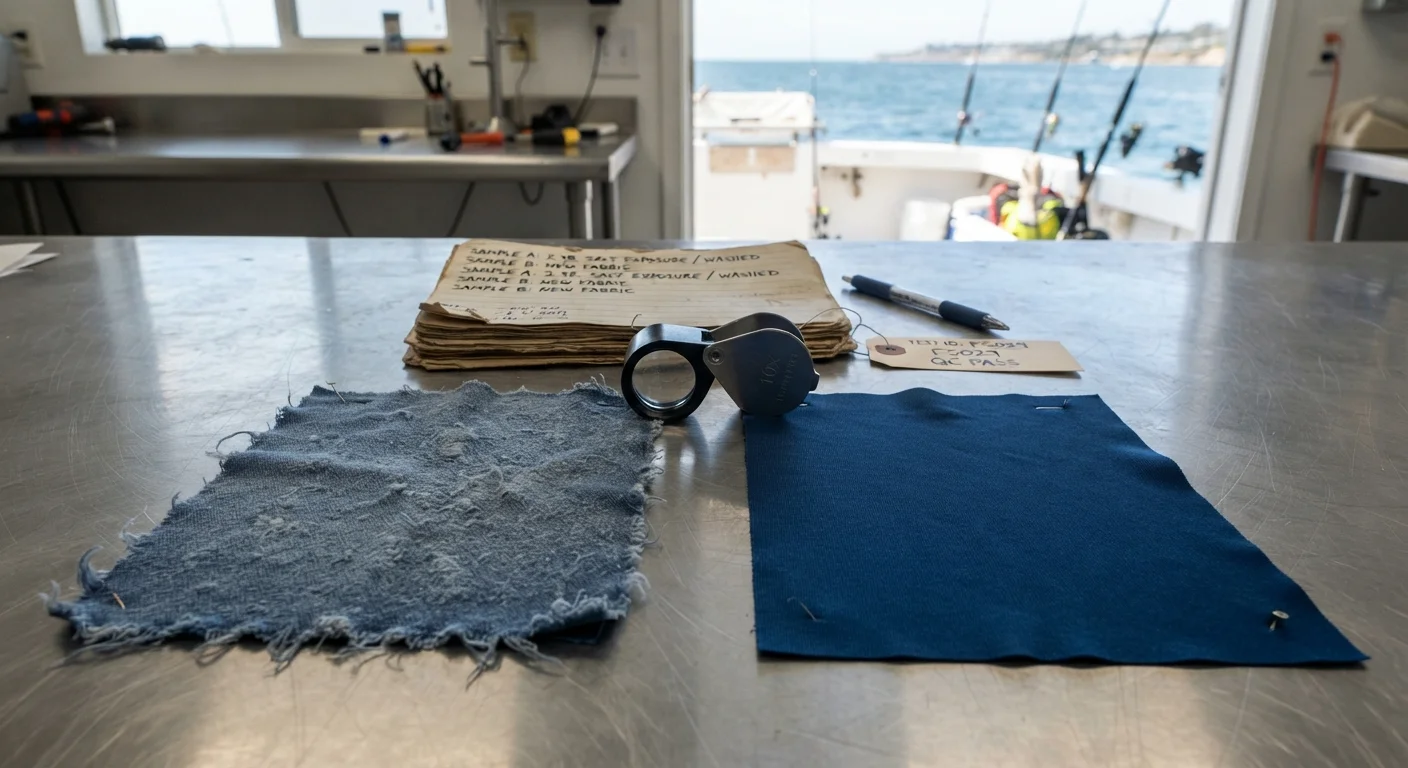
Here's the number you need: rPET fishing shirts cost 5–20% more per meter than virgin polyester. That's the finished-fabric premium range backed by 2025-2026 data, and not the 50% some factories quote. Above 20%, you're paying for a specific certification tier or getting overcharged.
Let's put real numbers on the table.
Raw material pricing (2025 benchmarks):
Cost basis | Virgin polyester | Recycled polyester (rPET) | Difference |
|---|---|---|---|
Global filament average (Q2 2025) | $1.58/kg | $1.83/kg | +13–18% |
Textile pricing benchmark | $0.85–$1.05/kg | $1.10–$1.40/kg | +5–15% |
Finished yarn/fabric premium | Base | +5–20% | — |
US market premium (2024-25) | Base | +30–35% | — |
Notice the spread. Europe saw raw pellets jump +69% in April 2025 (€994/mt vs €1,680/mt), and one Q2 2025 snapshot showed +161% for T2T feedstock. That's raw material volatility, not what you'll see reflected 1:1 at the finished-fabric level.
Per-meter pricing you can quote back to suppliers:
Fabric weight (GSM) | Virgin (USD/m) | rPET estimate | Delta |
|---|---|---|---|
120–150 | $0.60–$0.90 | $0.63–$1.08 | +$0.03–$0.18 |
160–200 | $0.85–$1.25 | $0.89–$1.50 | +$0.04–$0.25 |
220+ | $1.30–$2.00+ | $1.37–$2.40+ | +$0.07–$0.40+ |
Per-garment impact, which is what matters for margin:
T-shirt (0.7–1.0m fabric): +$0.03–$0.25/piece
Hoodie/heavier top (1.8–2.5m fabric): +$0.12–$1.00+/piece
Fishing jacket (higher consumption): +$0.25–$2.00+/piece
Tell eco-conscious clients this: 6–8 recycled bottles make a T-shirt's worth of fiber; 25–30 bottles make a jacket.
Why the gap widens or shrinks:
Recycled input tracks PET bottle scrap prices, not oil
Extra sorting, washing, and decontamination adds cost
GRS certification runs $3,000–8,000/year, which is factory overhead, not fabric cost
When scrap is abundant and oil prices spike, rPET can run 5–15% cheaper
Budgeting rule of thumb: use +5–20% for planning, +13–18% if you need a filament-level benchmark, and treat +30–35% as an outlier, not your negotiating baseline.
Which Option Fits Your Business Model? Recommendations for 3 Buyer Profiles
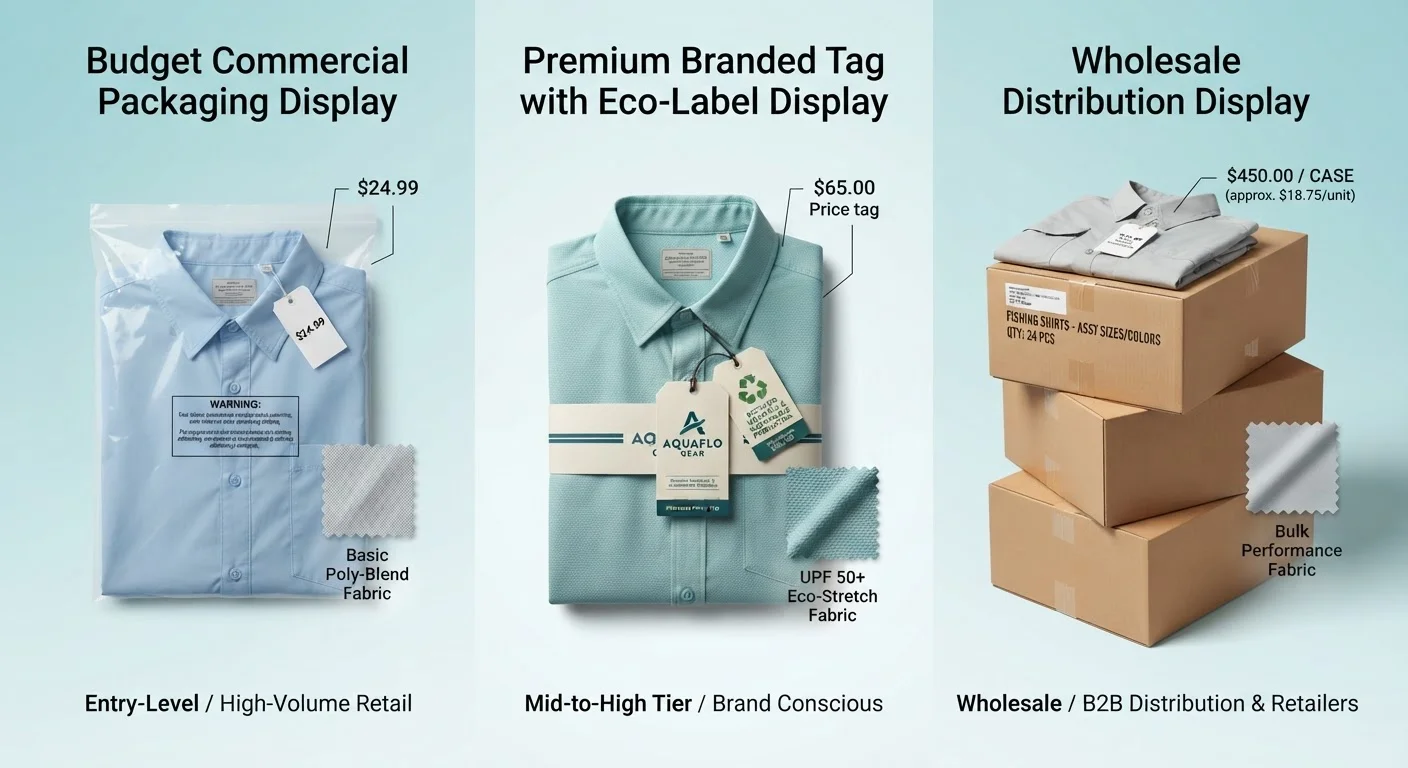
Not every buyer should make the same call here. Your business model decides whether rPET fabric fishing shirts are a smart bet or a margin killer. Here's how the math plays out for three real buyer types.
Profile A: Budget-Sensitive E-commerce Seller
You're selling fishing shirts at $12–18/unit, competing on Amazon or Shopify against five other sellers with nearly identical listings. Your margin ceiling is tight — usually 20–30% after fabric, freight, and platform fees.
Recommendation: Stick with virgin polyester unless a specific client demands eco-certification. At 150 GSM, that +$0.03–$0.18/meter delta on rPET eats directly into a margin you can't afford to lose. Target fishing apparel suppliers with MOQ 300–500 pieces and lead times under 10 days. If a customer insists on "eco-friendly," offer a 50/50 rPET-virgin blend instead of full recycled content — it cuts the cost increase roughly in half while still letting you list "recycled content" on the tag.
Profile B: Brand-Premium Independent Site
You're pricing shirts at $22–30/unit and building a sustainability story into your brand identity. Your customer isn't price-shopping — they're paying for the story.
Recommendation: Go rPET, and get GRS-certified. At this price point, a +$0.25–$1.00/piece premium is invisible next to your margin. Push for a supplier that already runs GRS-certified lines — onboarding cost is lower since certification overhead is already absorbed into their base pricing.
Profile C: Bulk Distributor
You're ordering 5,000+ units per season for resale to regional retailers or team outfitters. Price sensitivity is high, but so is negotiating leverage.
Recommendation: Negotiate tiered virgin/rPET pricing brackets — ask for cost breaks at 1,000 / 5,000 / 10,000 units. At this volume, even a 5% rPET premium is negotiable down toward 2–3% if you commit to a 12-month standing order. Use your volume as the bargaining chip, not the certification.
How to Negotiate with Your Fabric Supplier: Practical Scripts to Control Recycled Polyester Cost Increases
Fishing apparel factories using recycled and virgin polyester won't volunteer a cost breakdown unless you demand one. Start there.
Demand a Line-Item Breakdown, Not a Lump-Sum Quote
When a supplier quotes rPET fabric fishing shirts at a premium above 20%, don't accept the number — ask for the math behind it. Request five separate line items:
Base fibre benchmark (virgin PET index price)
Sustainability premium (rPET sourcing + GRS fees)
Conversion cost (spinning, knitting, dyeing)
Compliance cost (traceability, audits)
Landed cost buffer (freight, duties)
Give them a 5-business-day deadline to respond in writing. Suppliers who can't itemize that fast don't have real cost data — they're marking up because "eco" sells.
Use This Email Script Verbatim
Subject: rPET fabric pricing — cost breakdown needed before we confirm order
Thanks for the quote on [fabric name, GSM, rPET %]. Before we move forward, can you send a full breakdown separating base fibre cost, recycled/certification premium, conversion cost, and freight/duties?
We're benchmarking this against 2025 polyester index data and 8–10 alternate mill quotes for identical spec. Once we have your numbers, we'd like to discuss volume commitments or extended payment terms that could offset part of the premium.
Please reply by [date, 5 business days out].
The email signals you're not naive about pricing and gives the custom recycled polyester fishing apparel factory a face-saving way to lower the number.
Build Real Leverage With Alternate Quotes
Send your tech pack to 8–12 mills. Include at least two that offer both virgin and recycled options. Set a one-week quote deadline. When quotes come back, use the median price as your anchor:
"We have quotes from six mills for this exact spec, ranging $3.40–$4.10/meter. Your quote is $4.80. Help me understand the gap."
Offer Three Packages Instead of One Counteroffer
Instead of haggling over a single number, present three structured options:
Package | Price Increase | Term | Volume Commitment |
|---|---|---|---|
A – Price focus | +3–4% | 12 months | Baseline +10% |
B – Term focus | +5–6% | 24 months | Baseline +20–30% |
C – Index-linked | Base + fixed premium | Quarterly review | 70% contracted / 20% indexed / 10% spot |
Then say: "All three work for us. Which structure helps you manage recycled polyester costs while keeping our unit price competitive?"
Factories respond better to a collaborative negotiation than a flat rejection.
Performance Testing Checklist: What to Verify Before Placing Your Custom Fishing Apparel Order
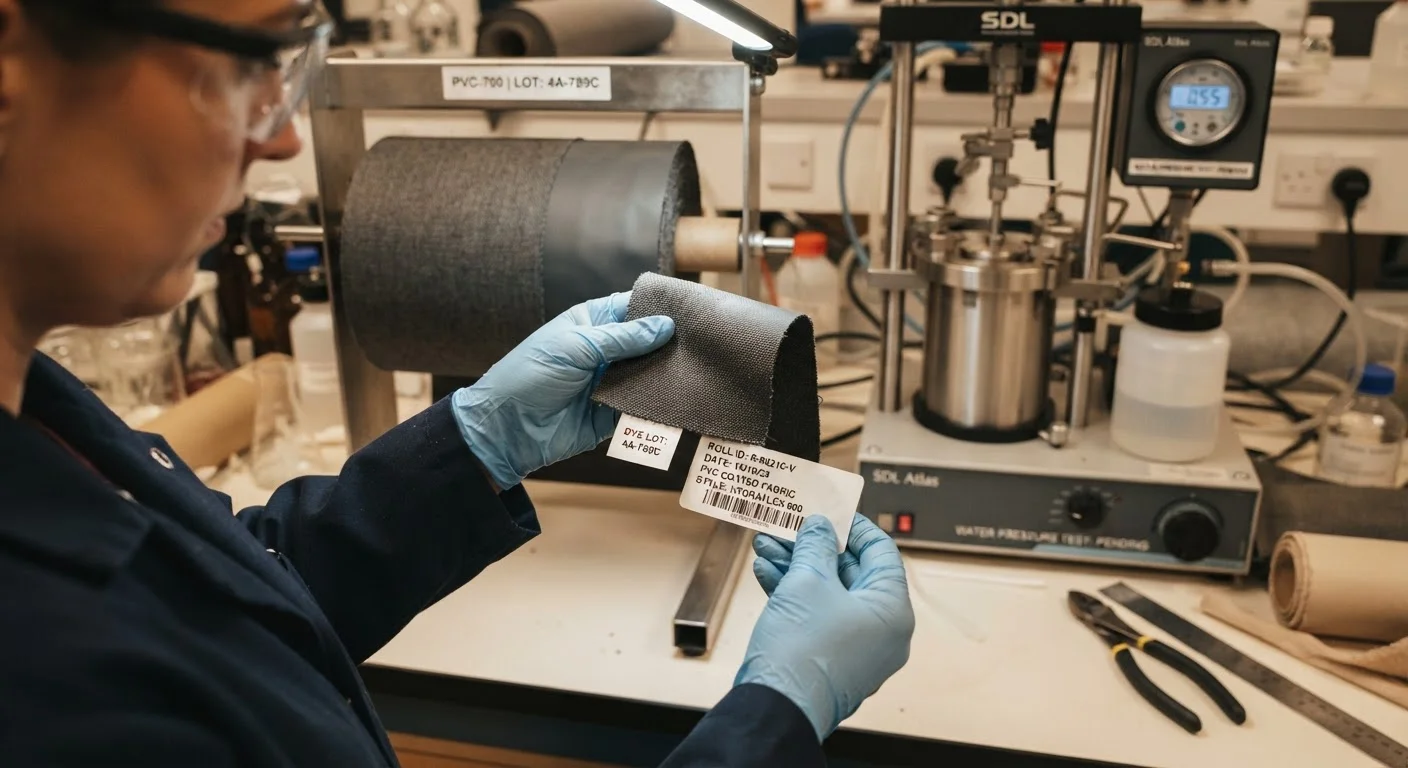
Cheap fabric and expensive fabric look identical under warehouse lighting. The difference shows up 40 washes later, on a boat, in the sun. That's why you test before you commit to bulk.
Here's the checklist that separates suppliers who talk about UPF fishing shirt fabric from custom fishing apparel suppliers who can prove it.
Lab-Backed Specs to Demand Before Sampling
UPF rating : require 50+ with third-party AATCC 183 test reports for your exact fabric, not a generic mill certificate.
GSM verification : weigh a 10cm × 10cm swatch yourself and calculate g/m². Don't trust the tech pack blindly.
Moisture-wicking polyester : ask for vertical wicking ≥50mm in 30 seconds, dry time ≤30–40 minutes. Wet a corner with tap water. If it's still damp after 2 minutes, reject the fabric.
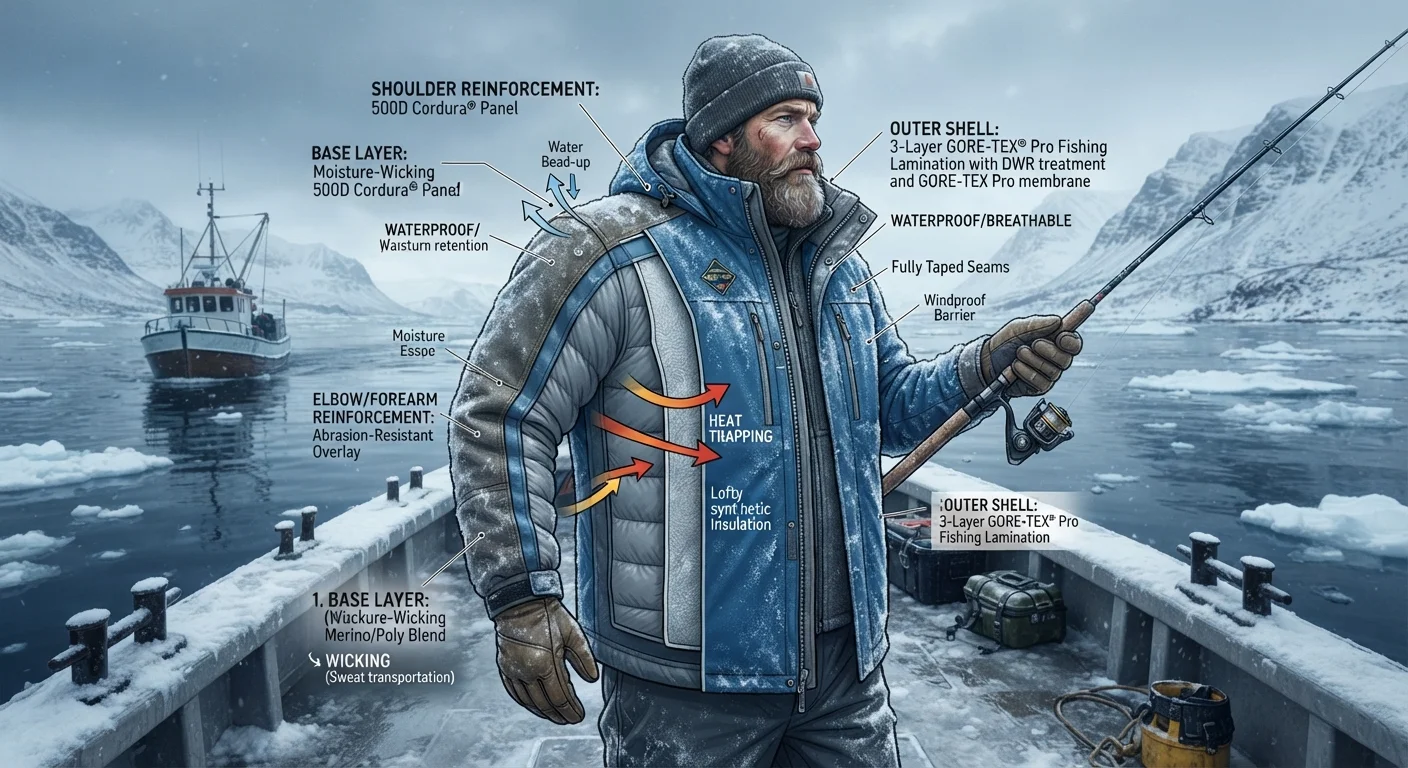
Waterproof/breathable ratings (jackets only): hydrostatic head ≥20,000mm, breathability ≥15,000 g/m²/24h, plus DWR confirmation.
Golden Sample Tests Before You Approve Bulk PO
Saltwater soak + wash cycle : check print fading and logo peeling against your control sample.
UV lightfastness : minimum 20 hours equivalent UV exposure, no visible color shift at shoulders and neck.
Shrinkage : wash 3–5 times, measure body length and chest width. Keep it within 3–5%.
Pilling : 20 key-rubs on the front panel. Heavy pilling at 20 rubs means this fabric won't survive a season against boat rails.
Seam strength : pull test on shoulders and armholes. No cracking, no visible opening.
AQL Standards for Bulk Acceptance
Use ANSI/ASQ Z1.4. For lots of 3,201–10,000 pieces, sample 200 units. Accept if major defects stay ≤10 and minor defects ≤14. Anything higher, reject the lot, regardless of what the invoice says about certification tier.
This checklist works whether you're sourcing from a low-cost mill or a premium eco-friendly fishing apparel supplier. Performance either holds up under testing, or it doesn't. The fabric story on the tag doesn't change that.
MOQ Impact on Pricing: When Small Batches Hurt Recycled Polyester Cost Competitiveness
The rPET premium isn't fixed. It moves based on how much you order. Small MOQs push per-kg or per-unit pricing up 10–30%+ , which can wipe out any cost advantage recycled polyester might have at container scale.
The container vs. trial-order gap is brutal. A full 40HQ container of recycled polyester staple fiber runs roughly 22 tons. That's where "large-lot" pricing kicks in. Need less, say a 300kg trial batch for a capsule collection? You'll pay noticeably more per kilogram. If your capsule line only needs 0.5–1.0 ton, the surcharge alone can erase whatever savings rPET offered on paper.
Volume tiers tell the same story at the garment level. A generic apparel cost curve shows this clearly:
Order Volume | Unit Price |
|---|---|
500 units | $8.00 |
2,000 units | $5.50 |
10,000+ units | $3.75 |
Moving from 500 to 2,000 units cuts price 31% . Jump to 10,000 units, and you're saving 53% . Recycled polyester makes this worse because it often needs 2–3x higher MOQs than standard cotton to hit efficient production runs.
Fabric-stage surcharges stack on top. Order below the typical 800–1,500m/color threshold, and expect a $0.20–0.35/meter penalty . On rPET fabric priced at $2.00–2.50/m, that's an instant +8–17% hike before you even get to cut-and-sew, where sub-300-unit orders add another 20–25% .
If your order sits below 500–1,000 units per style, the "eco-friendly" premium can balloon past 40–50% above virgin polyester because you're paying micro-batch penalties on every production stage.
Conclusion
At a $15-25 price point, virgin polyester still wins on margin, but rPET fabric fishing shirts close the gap to just $0.80-1.50 per garment when you hit 500+ MOQ with GRS-certified fishing apparel suppliers. That's a rounding error compared to the brand equity you gain.
Know which lever to pull. If you're budget-tight, negotiate a 70/30 recycled-virgin blend before accepting a full-price GRS quote. If you're scaling fast, lock in your MOQ tier before your competitor does.
Don't take the next quote at face value. Pull up your fabric supplier's cost breakdown, run it against the negotiation scripts above, and ask for the blend ratio option specifically—most custom fishing jersey manufacturers won't offer it unless you push. That single question could save you 12-18% on your next production run.