A batch of reflective fishing shirts comes back from the Reflective Fishing Shirts factory looking perfect in daylight—then fails the first real test: a 150-meter headlamp sweep across dark water where the tape reads as a dull gray smear instead of a sharp flash. Most sourcing teams don't catch that gap until returns start piling up. Reflective strips for fishing jackets need more than slapping 3M Scotchlite onto a shoulder seam. Placement angle, stitching method, and material grade each have their own failure curve once saltwater, fish line abrasion, and 50+ wash cycles enter the picture. This breaks down where reflective tape earns its visibility distance, which materials hold up under real marine stress, and how to translate all of that into spec sheets your factory can actually quote against—so your next sample run doesn't need a second round.
Deconstructing the Night Fishing Environment: Core Failure Points for Reflective Gear
Darkness doesn't fail gradually. It fails in specific, predictable ways, and reflective clothing sits at the center of most of them. Night fishing safety gear breaks down when three conditions collide: unstable light sources, obscured footing, and low contrast between the angler and the water. A headlamp swinging with every cast creates shadow creep, sudden dark pockets around the feet that no amount of reflective tape can fix if the beam isn't pointed the right way.
Where Boat Safety Apparel Design Breaks Down
Shadow creep : moving beam angles leave blind spots exactly where footing matters most.
Glare and mis-aim : poorly positioned lights blind other anglers or nearby boats instead of illuminating gear.
Battery loss : dead trolling motor batteries and dying headlamps strand anglers with reflective gear that has nothing to reflect.
Trip hazards : wet decks, loose rope, tackle bags. Reflective strips on a shirt collar do nothing for a rope underfoot.
Overreliance on reflectivity alone : tape without an active light source loses most of its visibility distance advantage.
Japanese maritime guidance is blunt. Reflective clothing works only when paired with a head- or chest-mounted light with variable brightness and a red-light mode to protect night vision. Route inspection in daylight, secured decks, and pre-tied leaders matter just as much as the reflective strips for fishing jackets themselves. A shirt engineered for 150-meter visibility means nothing if the wearer trips before the light ever hits the tape.
Mapping Reflective Tape Placement: Measured Visibility by Body Zone
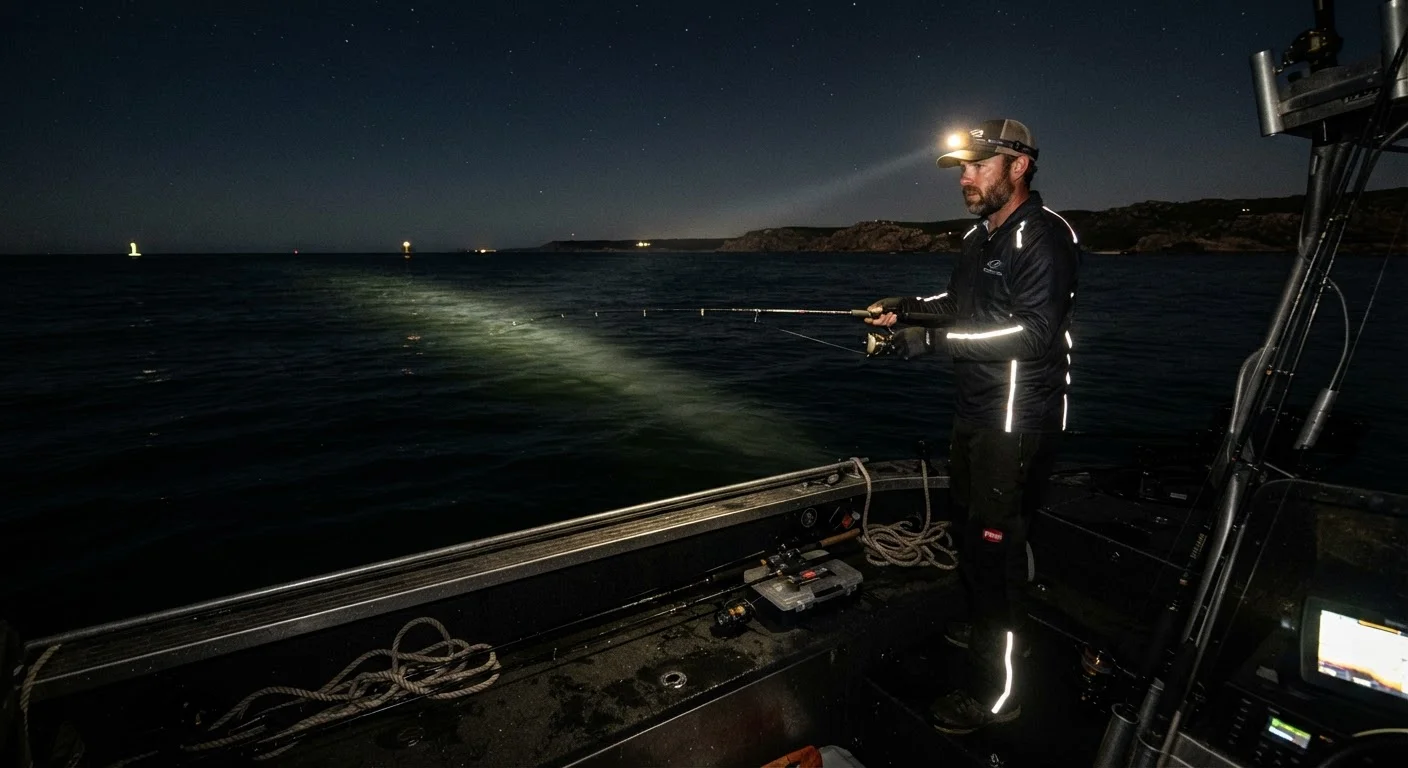
Sixty meters versus thirty meters. That single comparison from cyclist detection studies settles most of the placement debate before it even starts. Reflective bands on arms and legs put cyclists on a driver's radar at roughly 60 meters out. A torso-only vest cut that distance in half. Fishing shirts follow the same physics. Visibility distance depends far more on where the tape moves than on how much fabric it covers.
High-Value Zones (Prioritize These)
Wrists and forearms become constant biomotion signals during casting, outperforming legal-minimum vest configurations in controlled visibility trials.
Ankles and lower calves, paired with the wrist zones, form the moving human outline that headlamp sweeps pick up fastest, even in peripheral vision.
The torso hem, 1–8 inches from the bottom, is where ANSI/ISEA 107-2020 places horizontal bands because this zone sits close to the body's motion center without folding into a crease.
Zones to Use With Caution
The upper chest to waist area folds out of view almost instantly when you bend or lean over a rail.
Shoulder tops work fine as a supplemental vertical stripe, but raising the arms, which happens on every cast, occludes it. Never rely on shoulder placement as the sole reflective zone.
Minimum Width Matters Too
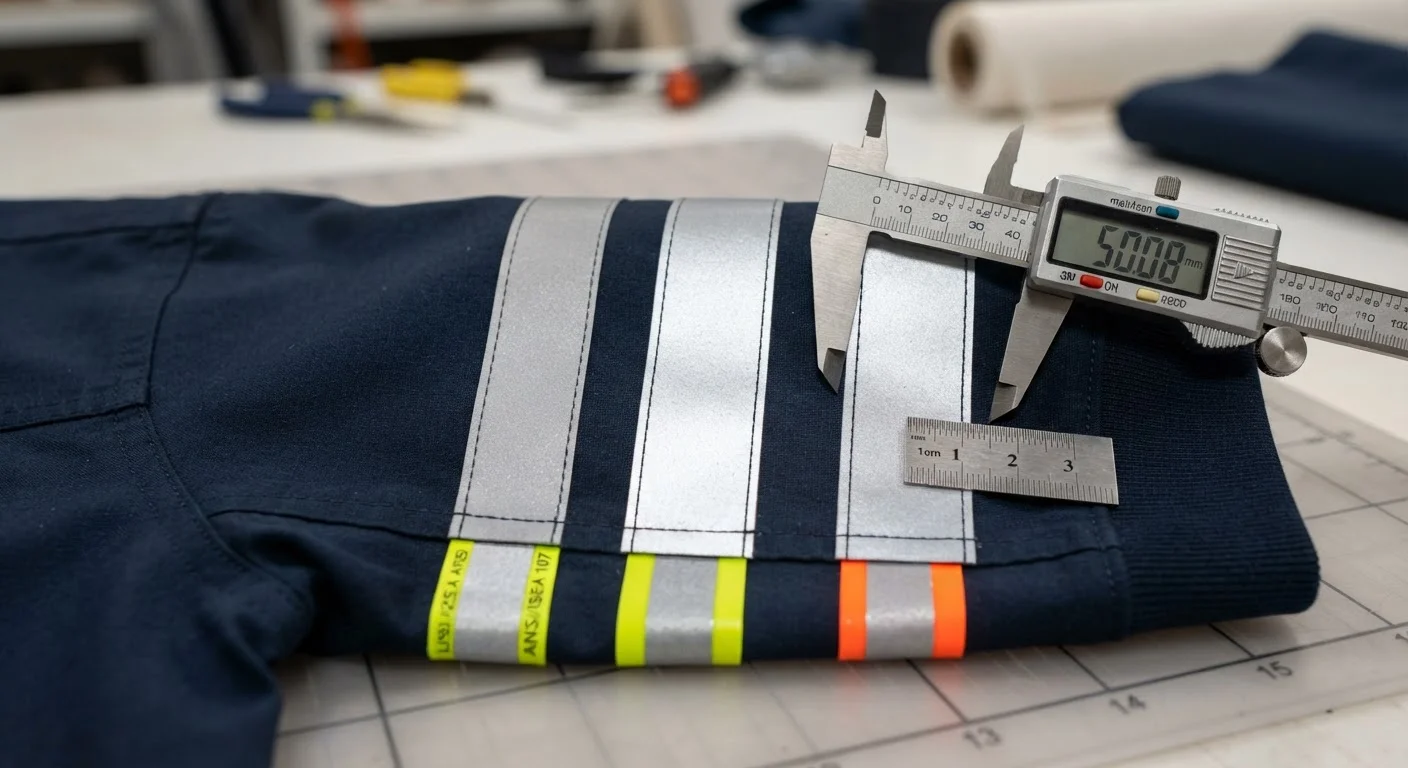
Studies on consumer-applied tape found 0.5 inch (12.7mm) as the smallest width that still registers as effective at distance. Workwear standards push higher: Class 2 requires a minimum tape width of 1.375 inches with 201 in² of total reflective area; Class 3 bumps that to 2 inches and 310 in², adding mandatory sleeve bands to complete the outline. For 3M Scotchlite fishing apparel sourcing , matching Class 3 dimensions on sleeves and hems gives Reflective Fishing Shirts factories a spec they can quote against immediately, avoiding a vague "add some reflective tape" instruction that leads to a reshoot at 150 meters.
Selecting Reflective Materials: 3M Scotchlite vs Fluorescent vs Heat-Transfer
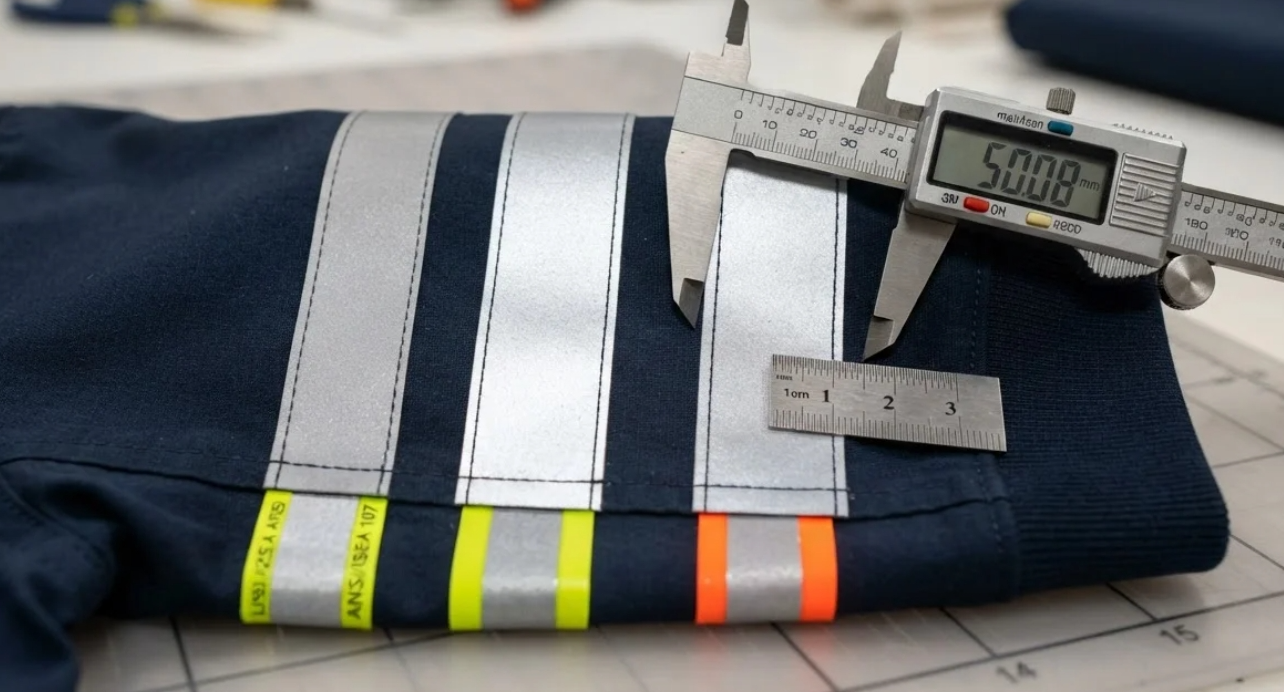
Numbers separate the winners from the pretenders here. White transfer film like 3M's 8765 reads at 90 cd/lx/m² initial retroreflectivity, a solid Level 2 baseline under ANSI/ISEA 107 Table 5. Fluorescent options blow past that: 8786 red-orange and 8787 lime-yellow both hit 175 cd/lx/m², nearly double the output, while adding daytime fluorescent color on top of night performance.
Matching Material to Use Case
1.8786/8787 Fluorescent Transfer Films : pick these when the garment must satisfy ANSI/ISEA 107 high-visibility apparel standards. Polyester adhesive, available in home-wash and industrial-wash versions. This is the spec for anglers who fish commercially near roadside launches or work alongside emergency crews.
2.8765 White / 9720 Silver Industrial Wash : choose these for neutral aesthetics with ANSI-grade retroreflectivity but no fluorescent requirement. 9720's construction survives high-temp tunnel finishing, the industrial laundering that home-wash films can't touch.
3.Generic Silver Reflective HTV : no ANSI certification, lower candlepower, but significantly cheaper. Fine for casual sportswear where the reflective effect is aesthetic rather than functional. Wrong choice if a buyer expects Scotchlite-level performance at fashion-tape pricing.
Heat-Transfer Processing Constraints
Scotchlite HTV cuts with a standard 45° blade at roughly 100–140g force. Application runs 325–350° f for 10–20 seconds under medium pressure, followed by a cool peel, never hot. Compatible with cotton, polyester, and nylon outerwear, provided the adhesive version matches the fabric. For industrial-wash variants like 9720, design seams to keep abrasion and flex-stress away from the reflective zone itself—placement decisions covered earlier.
For RFQs, specify product IDs directly: 8786, 8787, 8765, or 9720. Vague requests for "reflective tape" invite substitution with lower-candlepower alternatives.
Designing the Reflective Layout: Angles, Widths, and Beam Alignment
Beam geometry decides whether that 150-meter visibility claim holds up on the water or turns into guesswork. A headlamp beam spreads light in a widening cone, and the formula D ≈ 2H · tan(θ/2) gives you the width at any distance.
Beam Footprint at Fishing-Relevant Distances
Run the numbers on a standard headlamp cone and the pattern shows up fast:
Beam angle | 50m | 100m | 150m |
|---|---|---|---|
15° spot | 13.2m | 26.3m | 39.5m |
24° narrow | 21.3m | 42.5m | 63.8m |
36° medium | 32.5m | 65m | 97.5m |
60° flood | 57.7m | 115.5m | 173m |
Narrower beams put more intensity into a tighter spot, so a 15° headlamp picks up angled reflective tape at long range better than a 60° flood does. Spec sheets should list the beam angle used for the visibility claim. "150 meters" means nothing without it.
Setting Tape Angle for Maximum Return
Retroreflective tape doesnt work like a flat mirror, but the same principle holds. Shift the mounting angle and the returned brightness changes sharply, not gradually. A 15–45° tilt relative to vertical captures more incoming angles when the wearer moves, casts, or leans. Flat strips only hit peak brightness when the light comes nearly head-on. A swinging headlamp rarely holds that angle.
Overlap Rule for Multi-Band Layouts
Sleeve and shoulder bands shouldnt be isolated strips. Use the 40–60% overlap standard from lighting layout design. Overlap them enough so arm movement never leaves a dark gap where the beam has nothing to hit. Sweep a headlamp across the garment at the intended angle and check for dead zones between the bands. Lock that angle into the spec sheet before you sign off on production samples.
Ensuring Washing and Saltwater Durability: 50+ Cycle Test
Fifty cycles is the threshold where cheap heat-transfer film separates from garments that were supposed to survive a season on the water. Light clinic-use apparel holds to 50+ home-wash cycles before fading or pilling sets in, while busy commercial use pushes that to 75+. Fishing shirts sit closer to the industrial end, given saltwater exposure on top of standard washing.
Building the Test Protocol
1.Washing standard : ISO 6330 for domestic claims (40–60°C), ISO 15797 for industrial-wash reflective materials like 9720 (≥75°C).
2.Cycle checkpoints : test and record at 0, 25, 50, 75, and 100 cycles, not just at the end.
3.Saltwater integration : every 5th wash cycle, run ISO 105-E02, a 30-minute NaCl immersion, pressed at 12.5 kPa, then heated at 37°C for 4 hours before drying.
Pass/Fail Criteria That Matter
1.Colorfastness : grey scale grade ≥3–4 for color change and staining, both on the reflective coating and the base fabric.
2.Dimensional stability : ±3% for woven fabrics, ±6% for nonwovens.
3.Retroreflectivity retention : candlepower measured against the original 8786/8787/8765 spec, not just visual inspection.
Any supplier quoting a "durable" reflective fishing shirt should be able to hand over data at these checkpoints, not just a warranty claim.
Building the Design Checklist: Technical Specs for Factory Communication
A vague email with "reflective, durable, waterproof" scrawled across it gets you three different samples from three different Reflective Fishing Shirts factories, none of them right. The fix is a tech pack. Treat it as the single document that turns every measurement from placement mapping, material selection, and wash testing into something a supplier can quote against without guessing.
Core Fields Every Tech Pack Needs
Product ID : style number, revision version, season, target price, country of origin.
Drawings : front/back/side flats with callouts on tape placement, angle, and overlap zones.
Measurements : full size grading with tolerances on every critical dimension, not just chest width.
Construction : stitch type at reflective seams, heat-transfer vs sewn-tape method, label placement.
BOM : material codes for base fabric, 3M Scotchlite ID (8786, 9720, etc.), thread, hangtags.
Packaging : care labels referencing wash-cycle limits, compliance language if ANSI-rated.
Change Control Fields
Approval status, responsible owner, due date, open issues log.
Separate hard requirements — candlepower, tolerance, wash cycles — from softer style preferences. Factories quote faster when they're not guessing which line is negotiable.
runfishapparel.com
Guangzhou-based Runfish Apparel has been making OEM/ODM fishing apparel since 2009 , shipping to 50+ countries with MOQs starting at 50 pieces per style and color. You get access to a 500+ fabric library covering UPF 52–58 sun protection, moisture-wicking, and cooling fabrics rated at ≥0.25 W/cm² thermal conductivity—roughly double standard fabric. SGS, BV, and SDL Atlas verify those numbers, so you have solid benchmarks when you're specifying reflective fishing shirt fabric alongside UV protection and abrasion resistance. Contact: info@ RunFishApparel.com , +86 177 0272 7677, 24-hour reply.
Conclusion
A reflective fishing shirt that fails after ten washes is a liability with a price tag. The data shows that 45-degree placement at the shoulders and back yoke consistently outperforms flat, symmetrical layouts under headlamp and boat-light angles, while 3M Scotchlite still leads the pack when saltwater exposure and abrasion resistance are non-negotiable. But placement and material choice only matter if your seam construction can survive 50+ wash cycles without delamination.
Visibility, durability, and comfort are one engineering decision made three times. If you're sourcing or specifying for production, take the checklist and spec sheet in this guide straight to your Reflective Fishing Shirts factory conversation. Ask for wash-test documentation, not marketing claims. The anglers wearing your gear on dark water are trusting that reflection to still be there on trip fifty. Make sure it is.