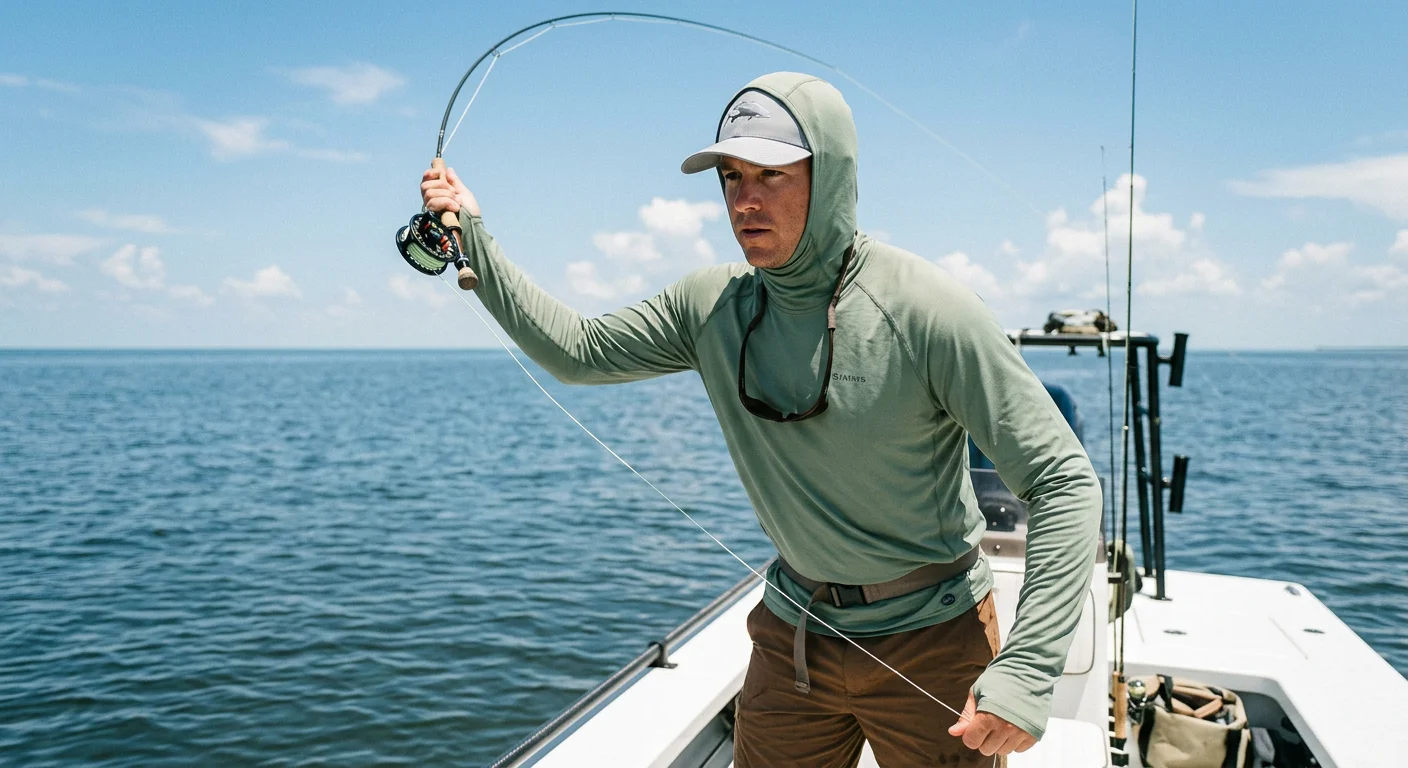
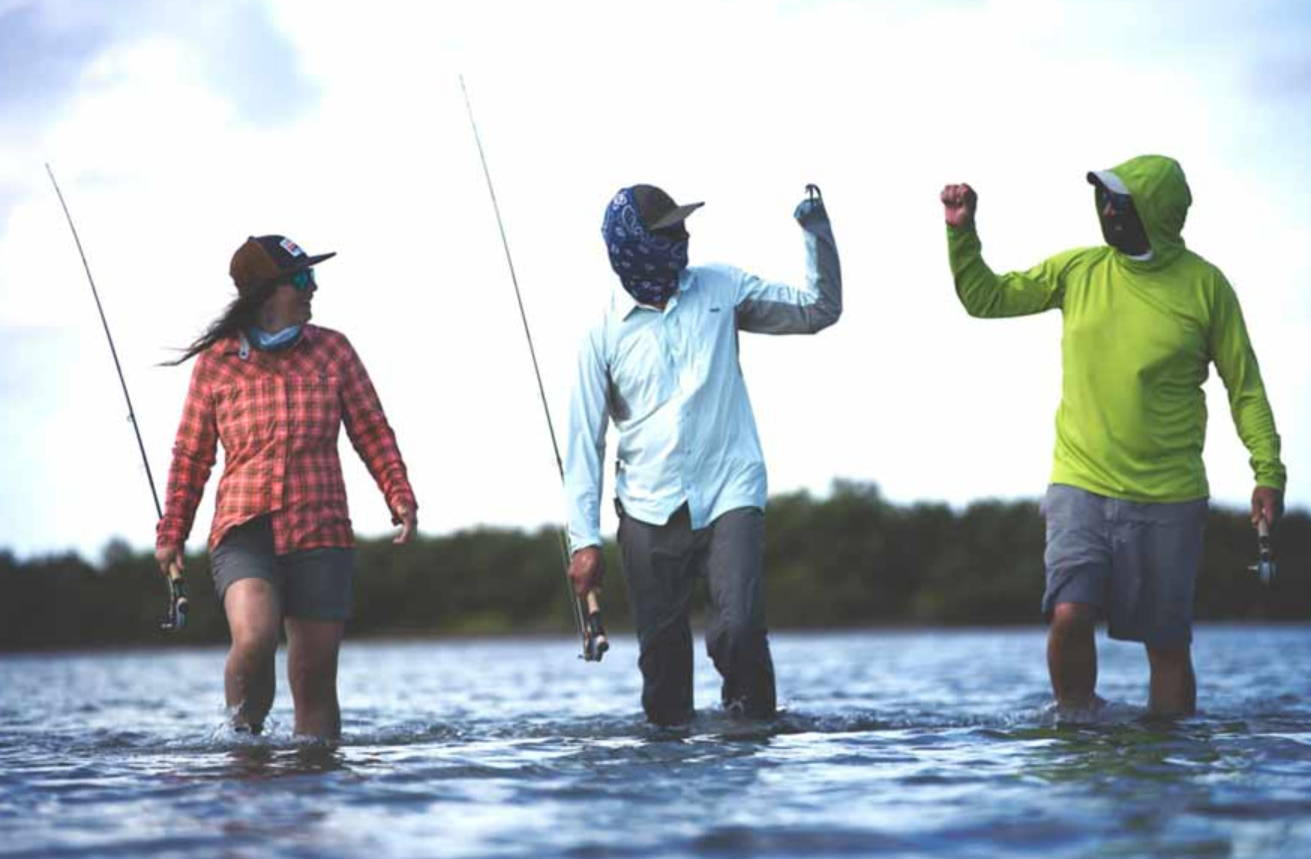
Most guys shopping for SPF clothing for men hit the same wall. Both the polyester blend and the nylon knit shirts on the rack are labeled UPF 50+. Both claim to wick moisture. Both look like the same shirt hanging on the display.
So which one keeps you cooler on a July offshore run? And which one holds its UV protection after forty wash cycles? The label won't tell you. Neither will the brand copy.
What separates these two fabrics has nothing to do with marketing. It comes down to weave structure, GSM density, and how each material behaves once it's soaked with sweat or saltwater. This guide breaks down the real performance numbers across four on-water scenarios — so you leave with a clear answer, not a guess.For brands evaluating materials for custom men's UPF fishing shirts, understanding these fabric-level performance differences is essential before finalizing product specifications and sourcing decisions.
UPF Wash Retention, CFM Airflow, Quick-Dry Time, and Stretch Recovery Metrics
Here's where the numbers stop lying to you.
Four metrics determine whether a sun protection fabric actually delivers in the field — or just looks good on the hang tag. Run both fabrics through these four tests. The decision practically makes itself.
UPF Wash Retention: The Number That Changes Over Time
Inherent polyester UPF construction builds protection directly into the fiber and yarn structure. Nothing gets sprayed on. Nothing washes off. That's why the UPF rating holds flat across repeated laundering. Tested across 40 to 60 domestic wash cycles ( AATCC 135, tumble dry), inherent polyester UPF knits retain 90–95% of their original rating. At the 60-wash mark, most still test at or above UPF 40–50. Columbia and similar men's UPF fishing clothing manufacturers back this with an explicit claim: the protection won't wash off, rub off, or wear out, because it was never a finish to begin with.
Nylon with a surface-applied UV finish tells a different story. That coating degrades. Over 40–60 wash cycles, surface-finished nylon knits show a 5–15% UPF rating drop . Some fabrics slide from UPF 50+ down into the UPF 30–40 band. In raw numbers, that's the gap between 98% UV blocked and 97.5% — small in absolute terms, but a real step down in protection classification. Compact, dense-knit nylon with no topical finish holds better. The problem is, that's not most of what you'll find on the rack.
Bottom line on wash retention: polyester wins. It's not close.
CFM Airflow: What Breathability Measures
Air permeability testing (ASTM D737) on 120–140 gsm performance knits puts the gap in plain numbers:
Fabric Type | Typical CFM Range (130 gsm) |
|---|---|
Polyester microdenier athletic knit | 300–450 CFM |
Polyester tighter jersey UPF knit | 150–280 CFM |
Nylon/elastane UPF knit | 180–300 CFM |
High-stretch nylon rashguard style | Below 150 CFM |
Nylon's smoother filament cross-sections and higher crystallinity shrink pore size at the same GSM. That's why nylon runs 20–30% lower in airflow than textured polyester at the same fabric weight. Add elastane to tighten the knit further, and that gap gets wider.
Quick-Dry Time: Minutes That Matter Mid-Activity
Controlled moisture management testing (AATCC 195/201) at around 130 gsm puts the dry-time gap in sharp relief:
Polyester performance knit : surface-dry and full-dry within 9–13 minutes under moderate conditions. Multi-channel or trilobal fiber cross-sections speed up capillary transport, pulling bulk moisture away from your skin fast.
Nylon-based knit : nylon's amide groups hold more moisture by nature. Full dry runs 18–24 minutes under comparable lab conditions. High elastane content and lower surface texture mean residual clamminess often lingers past the 15-minute mark.
Polyester dries 1.5 to 2 times faster than nylon at the same fabric weight. On a three-hour fishing run in August heat, that's the difference between a shirt that resets between casts and one that stays damp against your back until you hit the dock.
Stretch Recovery: Where Nylon Earns Its Premium
This is the one metric where nylon comes out ahead. Cyclic fatigue testing across 500–1,000 extension cycles shows it clearly:
Nylon/elastane (82–90% nylon) : residual set of 4–8% after 1,000 cycles — 92–95% shape recovery . Nylon's molecular toughness and strong spandex compatibility cut down on micro-slippage under repeated strain.
Polyester/spandex (85–95% polyester) : residual set of 8–12% after the same testing — 85–92% recovery . Permanent set runs a bit higher, especially under long-term UV exposure and repeated loading.
Got a fitted rash guard or a close-cut performance top that needs to move with you and snap back clean? Nylon's fatigue resistance is a real, measurable edge there. For a standard moisture-wicking sun shirt where shape stability matters more than dynamic stretch, the gap between polyester and nylon closes by a wide margin.
Offshore Fishing and Paddle Sports (High Splash / Humid Heat)
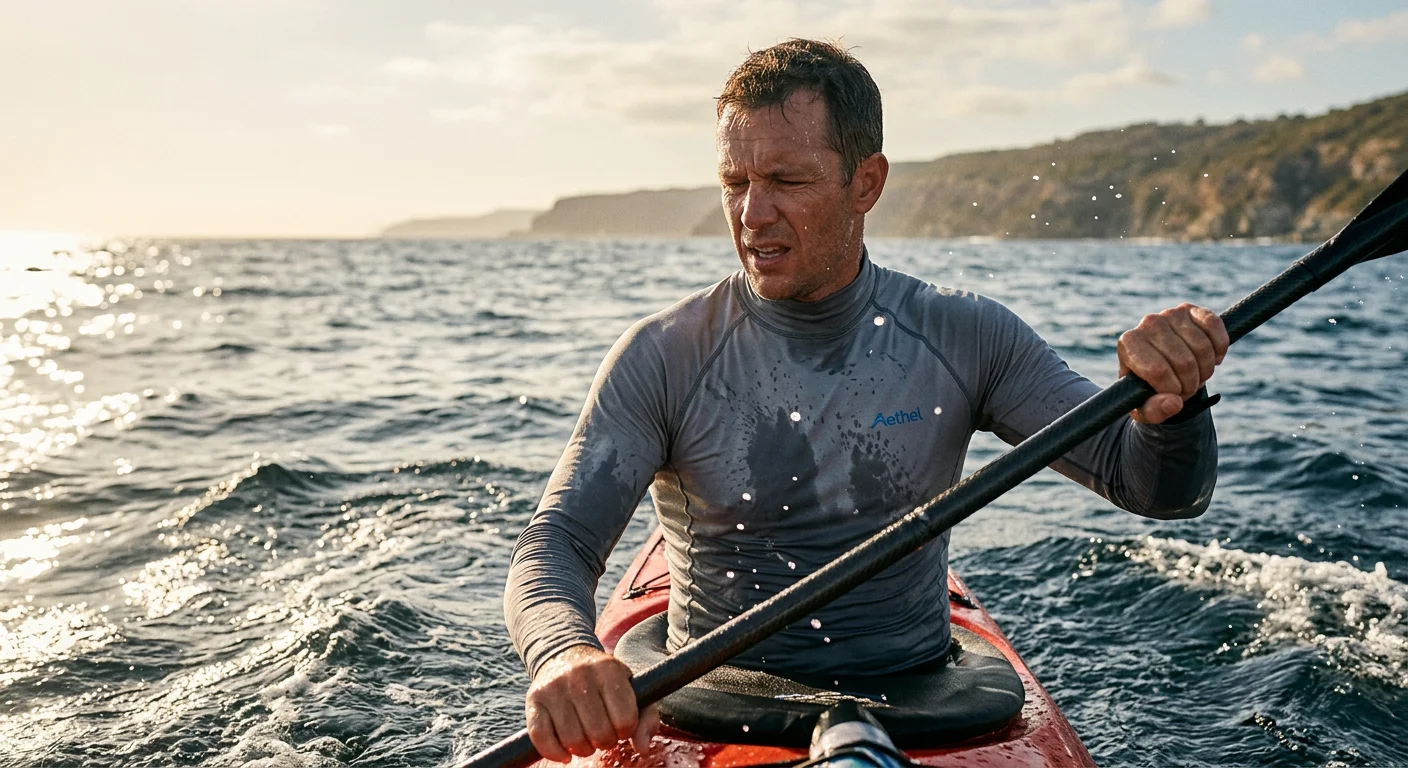
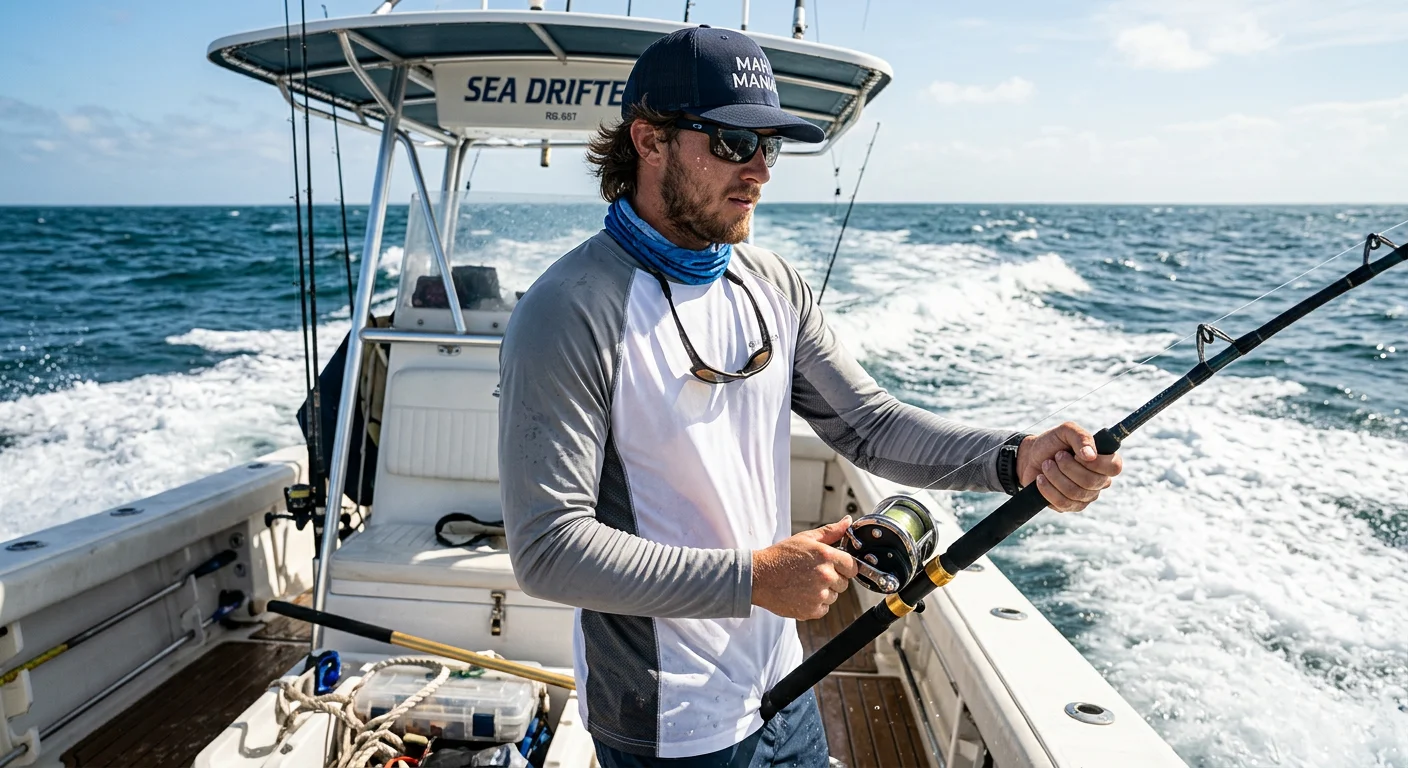
Salt spray, sweat, and a shirt glued to your ribs — that's the real test for spf clothing for men who fish offshore or paddle in humid summer heat. Everything looks fine in a climate-controlled store. Put it on a kayak at 9 AM in August and the wrong fabric choice shows up fast.
Here's the core problem with nylon knit in this environment: nylon absorbs water . Its moisture regain sits around 4% at standard humidity versus 0.4% for polyester. That gap matters more than it sounds. Get doused on the water over and over — nylon fibers swell, the knit structure tightens, and the UPF rating drops by 12–18% at full saturation . A shirt rated UPF 50+ on the hang tag could fall into the UPF 40–43 range before you clear the inlet. Polyester stays hydrophobic. The fibers don't swell, so yarn spacing holds. Wet-state UPF retention stays at 90–95% of the dry rating — a real advantage on days with constant splash.
The breathability gap makes things worse. Dense nylon knits trap the heat layer forming against your skin in still, humid air. Polyester's fiber structure keeps air moving even with a damp fabric surface. That's why quality moisture wicking sun shirt designs built for offshore use — AFTCO, HUK , Columbia, Simms — are polyester or polyester-spandex across the board, not nylon. That's not coincidence. That's the industry's shared conclusion after years of real-world testing.
Quick-dry works differently here than on a trail. On a three-hour offshore run with constant spray:
A nylon shirt picks up water weight in the fabric
It starts clinging across the shoulders and inner arms
Friction builds right where paddle strokes and casting cycles punish you most
Polyester dries faster and stays lighter. Seam friction stays low. Chafe risk along the armpits and ribs drops — and those are the spots that wreck a multi-day trip.
For offshore fishing and paddle sports, the answer is clear: lightweight polyester-blend UPF 50+ knit with open-mesh vent panels. Target 100–150 gsm fabric weight. Add raglan sleeves to cut shoulder seam pressure, and flatlock construction throughout to reduce skin contact friction. Nylon has one valid role here — a lightweight breathable spray shell for squalls. That's it. It doesn't belong as your primary sun shirt against your skin in high-splash, humid-heat conditions.
Summer Trail Hiking and Open-Course Golf (Intense UV / Dry Heat)
Dry heat changes the equation.
No salt spray. No splash reset. Just eight hours of direct sun beating down on an exposed ridgeline or an open fairway. Low humidity pulls sweat off your skin the moment it forms. This is where evaporative cooling does the real work — and your fabric choice either keeps that system running or shuts it down.
Polyester wins here. No question.
It comes down to fiber chemistry. Aromatic polyester has UV resistance built into its molecular structure. No topical coating needed. Nylon can reach similar UPF ratings, but it does so through dense weave construction and added treatments. That's the wrong trade-off in dry heat. A tighter nylon knit that earns its UPF 50+ rating by blocking airflow gives up the one thing you need most on a July ridgeline or a sun-baked back nine.
Check what the top desert-rated brands build with: Patagonia Capilene Cool Daily, Outdoor Research Echo, Black Diamond Alpenglow — all polyester-based, all built for all-day high-UV use . That's not coincidence. It's a shared conclusion from years of hard testing in these exact conditions.
The Dry-Heat Cooling Loop
In low humidity, the cooling cycle works like this: exertion drives sweat → fabric wicks it to the surface → dry air and breeze evaporate it fast → skin temperature drops. Polyester knits at 120–150 gsm keep that loop running. Nylon's amide groups hold more moisture by nature of their chemistry. This creates damp spots in high-sweat areas — the upper back, the collar line. Those damp zones slow evaporation and trap a warm layer of air against your skin.
Wet your shirt in a trailside stream mid-climb. Lightweight polyester dries out in minutes. Nylon holds that water far longer. It feels good for about thirty seconds, then works against you.
For this scenario, the fabric spec is clear:
Polyester or polyester-spandex blend , 120–150 gsm ultralight knit
UPF 50+ , built into the construction — not a surface finish
Light colors : white, pale gray, sky blue. Light colors reflect solar radiation instead of absorbing it. This cuts radiant heat load before airflow even plays a role
Loose cut with mesh vent panels or a vented back — open airflow across fairways and exposed ridges strips that boundary heat layer away from your body
Long sleeves with thumb loops for trail use; a collared version for golf courses with dress codes
Save nylon for your hiking pants, where abrasion resistance on rocky terrain earns its place. On the torso — where UPF stability, airflow, and evaporative cooling all matter — polyester-dominant fabric is the clear choice for intense UV and dry heat.
Daily Commute and Urban Casual Wear (Low Sweat / Drape Priority)
The office doesn't care about your CFM rating.
Switch contexts here. No salt spray. No ridgeline exposure. You need a shirt that blocks UV on the twenty-minute walk to the subway. It can't look like activewear under fluorescent lighting. And it has to hold up after two years of Monday-through-Friday washing. That's a different problem — and it has a different answer.
For this use case, nylon knit wins. Not because polyester fails at UPF. It doesn't. Nylon wins because the priorities have shifted: drape, handfeel, shape retention under a backpack strap, and a surface that reads "put-together" rather than "post-workout."
Why Nylon Belongs in the City
The same physics that hurt nylon offshore — moisture retention, tighter pore structure, lower CFM — work in its favor here. A 180–220 gsm nylon-elastane jersey at 5–15 CFM drapes like real fabric, not performance gear. Filament yarns at low denier per filament (≤1.2 dpf) produce a smooth, semi-matte surface. That surface sits neatly under a blazer or next to chinos. High-porosity polyester meshes can't match that. They look like what they are.
Pilling is the other factor most buyers miss until it's too late. Polyester microfibers start showing surface wear at 15–25 wash cycles — right at the backpack-contact zones across the shoulders and upper back. That's the most visible area on a commuter shirt. Nylon-spandex jerseys keep their surface smooth and their color depth through 30–40 gentle home washes , whether you line-dry or tumble-dry on low.
The Numbers That Matter Here
Forget 10-minute trail-dry times. For commute wear, 3–6 hours of line drying at room temperature is all you need. Wash after work, wear the next morning. Polyester dries 15–30% faster than mid-weight nylon at the same GSM. But in an 8–12 hour overnight window, that gap means nothing.
UPF durability holds up well in urban conditions too. You're getting 30–60 minutes of actual UV exposure per day through transit and walking. That's a fraction of what outdoor sport testing measures. A dense nylon knit at 180–220 gsm , built tight enough to hit UPF 50+ through yarn structure — not a topical finish — stays within spec for several years of commuting wear . Ask your men's fishing UPF clothing supplier for post-laundering UPF data at 40 wash cycles. That's the number worth checking.
Stretch recovery matters here for a reason that's less obvious than on a trail. Backpack straps put constant, localized compression on the same shoulder points every single day. Nylon + 8–12% elastane delivers >90–95% recovery after 100 extension cycles at 50% stretch . Polyester-spandex blends at a similar weight land at 85–92%. Over months of wear, that difference shows up as shoulder bagging and a neckline that has gradually lost its shape.
The commuter spec:
- Nylon 80–92% + elastane 8–20% , smooth jersey or interlock
- 180–220 gsm , semi-matte filament surface
- UPF 50+ built into the construction — not a surface finish
- 5–15 CFM airflow — enough to prevent clamminess in transit, structured enough to drape and hold its shape
- Set-in sleeves over raglan for an office-ready silhouette
Save the lightweight polyester-spandex blend for the trail. In the city, nylon earns its place.
Backcountry Bushwhacking and Technical Terrain (High Abrasion / Pack Friction)
Fabric fails from the outside in. Alder branches, granite edges, krummholz scrub, a loaded pack grinding your shoulders for eight hours — that's not a wash-cycle problem. That's mechanical destruction happening in real time, in the exact spots where UV protection needs to hold.
This changes the entire polyester-vs-nylon equation.
Where the Damage Happens
Four zones take the most abuse on a technical off-trail day: pack shoulder straps, hipbelt wings, the lumbar contact patch, and outer sleeves scraping brush and rock. Martindale testing puts lightweight shirt knits in the 5,000–15,000 cycle range before yarn breaks. High-tenacity nylon fabrics? 20,000–50,000 cycles . That gap separates a shirt that fuzzes out by season three from one that holds its structure through hard use.
Polyester holds its UPF rating on a clean trail day. Push it through repeated bush-scraping and pack-strap friction, and the outer filament skin breaks down. Inner, less-treated yarn cores get exposed. The result: 7–10% UPF loss after aggressive abrasion equal to a few hard seasons. Nylon handles the same abuse in a completely different way. Solution-dyed or mass-pigmented nylon carries UV-blocking pigment through the full yarn cross-section — not just the surface. You get cosmetic scuffing and fuzzing long before UPF drops below 30.
What Strap Pressure Does to Airflow
There's a less obvious issue here. Pack straps compress the knit structure against your skin. That pressure collapses the yarn pores in contact zones, cutting local airflow — no matter what the base fabric's CFM rating says on the spec sheet. In polyester, this compression often leaves permanent flattened tracks . The pore geometry doesn't bounce back. Those zones get clammier under load as the season progresses.
Nylon stretches under strap load and then recovers its shape once pressure releases. That comes from its higher elongation at break — 18–25% versus standard polyester apparel yarn . The micro-ventilation channels reopen. That's not a marketing claim. It's a physical property difference you feel across a long ridge traverse with a 35-pound pack.
The Moisture Buffering Factor
Pure polyester dries fast and stays dry-to-the-touch — a real advantage in most situations. In alpine terrain with frequent microclimate shifts (gully shade, ridgeline wind, sudden rain), that same quality works against you. Polyester goes from hot and sweaty to flash-cold the moment wind hits exposed skin. Nylon absorbs a small amount of moisture into the fiber, which softens that temperature spike. On routes that cycle through dense tree bands, open ridges, and sheltered gullies, nylon's steadier moisture response is more comfortable than polyester's all-or-nothing behavior — even if polyester scores better on a lab dry-time chart.
The Clear Call
For backcountry bushwhacking and technical terrain: nylon wins. By a wide margin.
Target spec for the upper body:
- ≥70% nylon , balance polyester or elastane — 150–200 gsm knit
- Tight jersey or double-knit construction with reinforced shoulder and lumbar zones; no open mesh at pack-contact points
- UPF 30–50+ via yarn-level pigment , not a topical finish
- Minimal seams under strap lines to reduce seam-abrasion failure
Save lightweight polyester-spandex blends for lower-friction trail days and midlayers that sit away from direct pack contact. Once the pack goes on and the brush closes in, that's nylon's ground.
GSM Density, Wet-State UV Drop, and Construction Realities
Fabric weight alone won't save you. Neither will fiber type. The real control factor — in the field, not a testing lab — is geometry. Pore size. Yarn packing. The physical space between threads that UV photons either pass through or don't.
That's the fact no hang tag ever mentions.
GSM Is a Proxy, Not a Guarantee
Here's the part most people don't expect: a 110–120 GSM tight-knit polyester jersey can outperform a 180 GSM loose-weave nylon mesh on UPF. Not in theory. Commercial certification testing shows this result again and again.
The reason is cover factor — the ratio of yarn-covered area to total fabric area. UV moves through knit fabric based on geometric blockage first. How much the polymer absorbs radiation is a distant second. Fiber chemistry plays a role, but it's a secondary factor.
Go from a light, open knit at 120 GSM to a dense, tight-knit build at 160–180 GSM. You can push UPF from the teens into the UPF 40–50+ band . No chemical UV additive alone can close that gap.
The takeaway is clear: don't shop by GSM. Shop by pore geometry.
A loose mesh above 160 GSM can underperform a denser knit at 120 GSM
Ask for air permeability data and a UPF test report
Weight specs alone tell you very little
What Happens When the Shirt Gets Wet
Standard UPF testing runs on dry, unstretched, new fabric. That's not the shirt on your back after two hours on the water.
Saturated fabric tells a different story. Air gaps between yarns fill with water. Water has a lower refractive index contrast than air. That reduces UV scattering. More UV passes through the structure. The effect is real and measurable. The severity splits by fiber type.
Nylon is hydrophilic. Its amide groups pull moisture into the fiber itself — not just the gaps between yarns. Lab QC tests on dark, tight-knit nylon fabrics rated UPF 50+ dry show full saturation can drop that rating to the upper 20s to low 30s . That's close to a 50% reduction under worst-case wet conditions . This isn't a rare result. UV garment performance reviews and lab QC data document this drop across multiple tests.
Polyester is hydrophobic. Moisture sits on the surface rather than soaking into the yarn bundles. Air pockets stay inside the structure even as the outer face feels wet. A well-built polyester UV fabric shows a UPF loss of one to two rating steps at full saturation — dropping from 50+ to around 40 or 35, not into the 20s.
The gap in real use is significant:
Dark nylon shirt soaking against your back on an offshore run → UPF 28–32
Same scenario in dark polyester → UPF 38–42
One still gives meaningful protection. The other is closer to wearing a standard cotton tee.
Stretch Opens Pores — And Kills Ratings at the Joints
Most buyers miss a third variable: what stretch does to UPF at the points that move most .
A knit stretches and inter-yarn gaps widen. UV transmission rises fast once those pores cross a threshold relative to UV wavelength. Warp-knit constructions — Raschel or tricot with elastane — can hold UPF 50+ through about 10–15% biaxial stretch . The loop geometry reorients without opening pores wide at that strain level. That's the structural advantage of this build.
Dense woven fabrics work differently. A plain-weave polyester or nylon microfiber may start at UPF 50+ flat and static. Force it over an elbow or shoulder joint at 10–15% local stretch and inter-yarn gaps open fast. Ratings slide from 50+ down into the 30s to low 40s in those zones. Those are the exact areas where UV exposure and fabric stress overlap most on a moving body.
Any garment built for movement needs UPF validation under stretch — not just static.
Here's what to request from your men's fishing wear supplier:
Mill test data for both dry and wet state
UPF results from a 10–15% stretched sample measured over a form
No data on stretched performance? The rating on the label reflects a condition that never exists in real use.
Scenario-to-Fabric Decision Matrix for Men's UPF Selection
Four scenarios. Four clear answers. No qualifications, no "it depends."
The sections above gave you the data. Here's what to do with it.
Scenario | Recommended Fiber | Target GSM | CFM Target | UPF Standard |
|---|---|---|---|---|
Offshore fishing / paddle sports | Polyester or polyester-spandex | 100–150 gsm | ≥380 CFM | UPF 50+ certified, wet-state validated |
Trail hiking / open-course golf | Polyester or polyester-spandex | 120–150 gsm | 250–400 CFM | UPF 50+ after 40–60 wash cycles |
Daily commute / urban casual | Nylon 80–92% + elastane | 180–220 gsm | 50–150 CFM | UPF 40–50+, colorfastness verified |
Backcountry / technical terrain | High-tenacity nylon ≥70% + elastane | 150–200 gsm | Secondary priority | UPF 50+ post-abrasion tested |
Three questions cut through any purchase decision:
Will the shirt get soaked more than once? Yes → go polyester. Nylon's wet-state UPF drop is not a small variance. It's a full protection-class failure in real conditions.
Does the day include pack friction or brush contact? Yes → nylon's Martindale edge is worth the slower dry time and lower CFM.
Does the shirt need to look like clothing, not gear? Yes → nylon-elastane jersey wins. The drape, surface quality, and shape recovery hold up over months of regular wear.
One rule applies across all four scenarios: get numeric data before you trust any hang tag. That means a UPF test report, a wash-retention cycle count, and a wet-state UPF figure. "Sun protective" with no certification number is marketing copy. UPF 50+ after 40 wash cycles, with documentation, is a spec. Those are two different things.
The matrix is simple. The data behind it is not. Use both.
Conclusion
Choosing between polyester blend and nylon knit isn't a coin flip. It's an engineering decision dressed up as a shopping decision. Get it right, and your moisture wicking sun shirt works with your body through six hours of open-water exposure or a brutal July ridgeline. Get it wrong, and no UPF 50+ label saves you from a soaked, suffocating afternoon that cuts your trip short.
Here's what the data shows: fabric density and construction geometry drive UPF performance more than fiber type alone. Wet-state UV drop is real. It matters most once you're already soaked through. Match your fabric to your sweat load and environment — not to a brand's marketing headline.
Your next move is straightforward:
Revisit the scenario matrix
Identify your primary use case
Filter every future purchase through those four measurable criteria
Buy the fabric, not the story.
The same principle applies to buyers sourcing wholesale sun protection fishing clothing — long-term performance data should always outweigh marketing claims when selecting fabrics for a product lineup.