Scroll far enough down any fishing hashtag and you'll notice the same thing — some accounts just hit different . The cast looks better, the light is unreal, the caption makes you laugh and reach for your credit card. That's not luck. That's influence.
The fishing social media world in 2026 is bigger and more focused than ever. So whether you're a brand searching for the right fishing lifestyle Instagram partner, an angler looking for someone worth following, or a creator taking notes on how the best do it — this list is for you.
These eight creators cover bass, saltwater, fly fishing, and one completely unhinged noodling obsession.Brands working with a fishing apparel manufacturer can also use influencer partnerships to showcase real-world product performance. They're the ones moving the needle right now. Some are polished. Some are chaotic. All of them are worth your attention.
1. Brodie Moss (@brodiemoss) — The Cinematic Spearfishing Adventurer
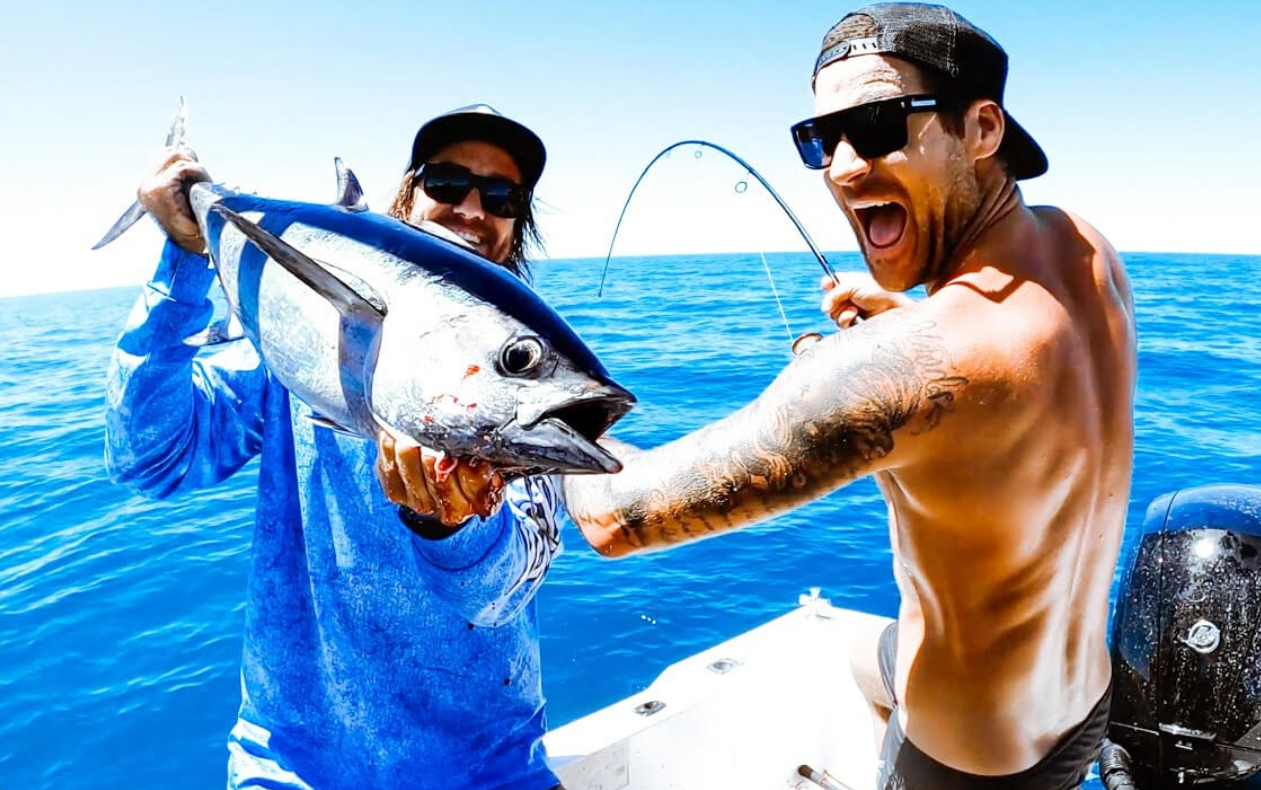
Brodie Moss didn't build a fishing channel. He built an underwater film studio that also catches fish — and 18 million people across platforms decided that was what they needed in their lives.
He's based in Exmouth on Western Australia's Coral Coast. This 36-year-old spearfishing obsessive has been using Ningaloo Reef as his backdrop for stunning ocean cinema since 2014. His YouTube channel, YBS Youngbloods , sits at 8.62 million subscribers . His TikTok has racked up 174.1 million lifetime likes . His Instagram (@brodiemoss) holds around 2 million followers .Many outdoor brands partner with a fishing apparel factory after seeing this level of audience engagement. Strong posts clear 100k likes with a 5% engagement rate — a number most creators would kill for.
What makes him different from every other guy pointing a camera at the ocean:
The content was labeled " Liquid Cinema " from day one — not a vlog, not a tutorial, an experience
Episodes run 15–30 minutes, mixing offshore spearfishing dives, drone passes over reef drop-offs, beach survival camps, and some pretty alarming close-range wildlife encounters
He once took a months-long break caused by a puffer fish incident. He never explained what happened. The internet was devastated and full of questions.
For fishing brands and outdoor apparel marketers , the product placement here is almost too obvious. Every episode shows someone standing on a boat under a UV index of 10+ in the Western Australian summer sun. They get soaked over and over, then dry off next to a fire. That is a UPF fishing shirt's entire origin story .
Performance fishing apparel, quick-dry boardshorts, polarized sunglasses, neck gaiters — these aren't forced integrations. They're load-bearing parts of his content. Logos show up at the helm, on the dive platform, during catch-and-cook segments, and in overhead drone shots. You get multiple recurring brand moments per episode — not a single awkward mention.
His estimated net worth runs anywhere from $850k to over $6M AUD . He built that across brand deals, merch, and AdSense over a decade of steady output. For anyone looking at long-term ambassador programs, that signals a creator with real commercial infrastructure — not just a lucky viral moment.
Brodie Moss is the benchmark for cinematic saltwater fishing content with a global English-speaking audience. Everything else gets measured against him.
2. Andrew Flair (@fishing_with_flair) — The Relatable Bass Fishing Creator
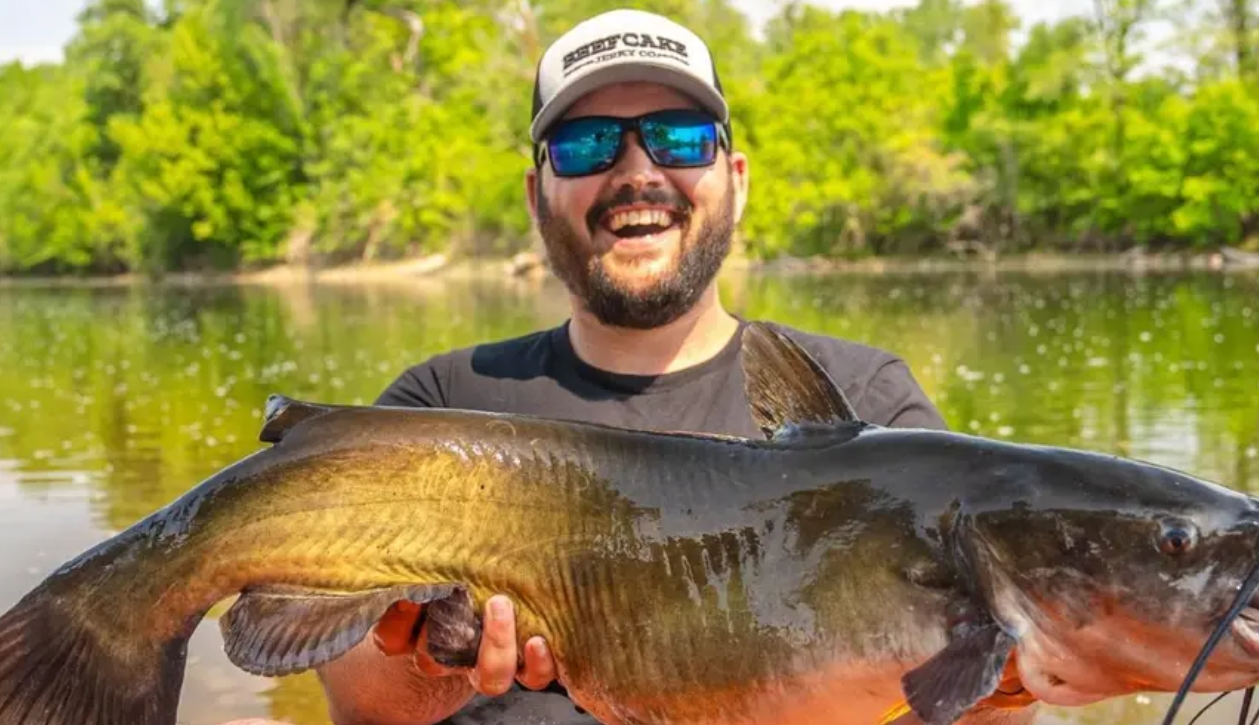
Andrew Flair is the guy who makes you believe you could catch a bass with a bent paperclip and a dream. Next thing you know, you're six videos deep at 1 a.m., wondering why you don't own a boat yet.
His numbers are solid without being outrageous. He has around 733K Instagram followers (@fishing_with_flair) and a YouTube channel in the 500K–1M subscriber range . Not Brodie Moss ocean-cinema territory. That's by design. That's the whole point.
His content breaks down into three types:
Challenge videos — "$20 budget, one lure, packed pond. GO." These aren't flex content. They're permission slips for normal people to go fishing with whatever is in their garage.
How-to and technique — seasonal patterns, rig setups, and gear walkthroughs that explain things clearly without talking down to you
Vlog life — farm chores, hunting trips, friends being chaotic on boats, and the occasional snack content that somehow works
He's also a co-founder of Googan Squad . It started as a fishing creator collective and became a real tackle brand — soft plastics, hard baits, rods, apparel — now stocked in major U.S. retail chains. Scaling a brand like this often requires a dependable fishing apparel supplier.Product launches tie directly to YouTube challenge videos. Instagram handles close-up reel shots of colorways and catches. It's a clean loop, and it converts.
For fishing apparel brands , this integration model runs on pure utility storytelling. Shirts and hoodies show up mid-vlog during a cold-front bank session — not in a standalone fashion post. Nobody's posing. They're just cold and fishing, and the jacket is doing its job. That's the entire pitch — and it hits harder than any glossy campaign.
3. Hannah Barron (@hannahbarron96) — The Viral Noodling Queen of the South
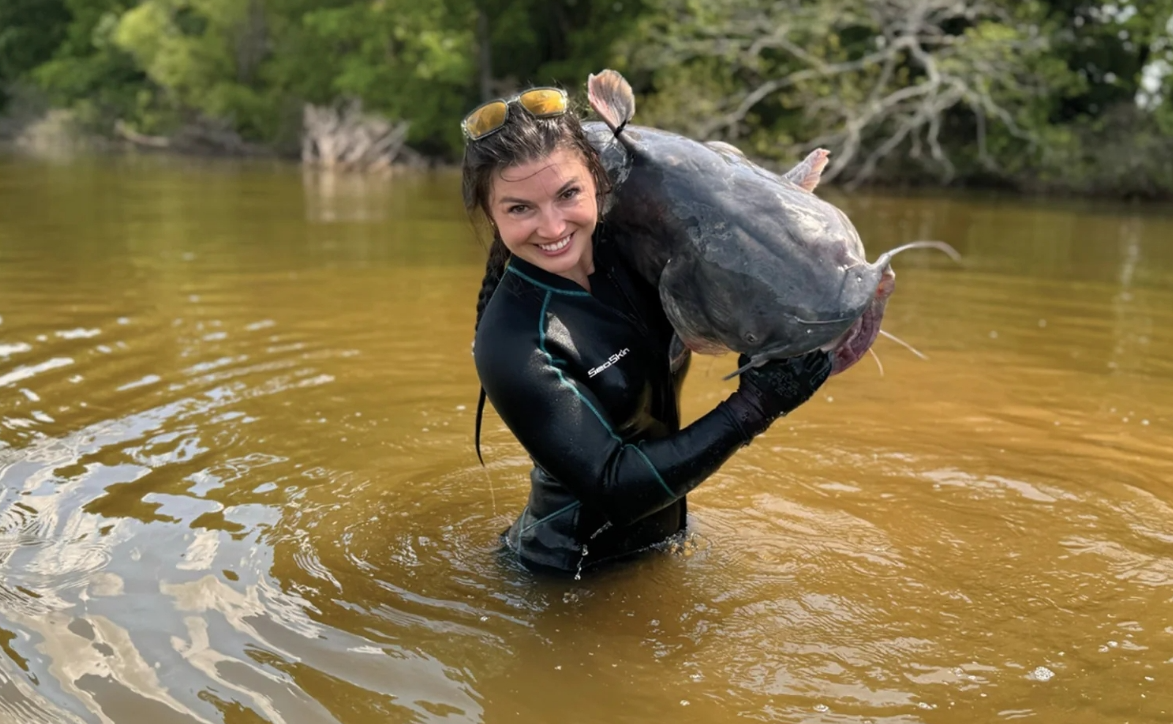
Hannah Barron shoves her bare arm into a dark underwater hole. She pulls out a catfish the size of a golden retriever. And she makes it look like no big deal. That's the whole thing. That's why 1.12 million people follow her .
Her niche is noodling — hand-catching catfish — and it's as chaotic as it sounds. The content formula is dead simple: submerge arm, find an enormous fish by feel, refuse to let go, and come out screaming. Her engagement rate sits at 3.85% , well above the typical outdoor creator average of 1–3%. These aren't passive followers. They watch every second, ask technique questions in the comments, and stay locked in on whether she beats a 40-pound catfish.
What her content looks like:
- Close-up shots of arms vanishing into riverbank holes (alarming, effective)
- Size-contrast catches — fish that match or exceed her torso length
- Raw adrenaline reaction shots that drive replays and shares
She's also a bowhunter, a bowfisher, and a deer hunter. The #GetBit catchphrase and "The Catfish Girl" identity tie it all to the American South — Alabama rivers, camo, summer humidity, and zero hesitation.
For fishing apparel brands , the product-use case here is concrete. Noodling means full-body submersion, scraping against rocky holes, brutal sun exposure, and wrestling large fish with your hands. Performance fishing shirts, quick-dry women's apparel, and UV-protective gear aren't accessories in this content — they're survival equipment. Many brands develop these products through custom fishing apparel OEM/ODM services.Her audience leans toward women in the South who hunt and fish. That's a segment most technical outdoor apparel brands still ignore.
Her estimated net worth runs USD 1–5 million across brand deals, AdSense, and appearances. She averages 41,800 likes per post. Her content niche is wild and nearly impossible to copy. Nobody else is doing this at her scale.
4. Darcizzle Offshore (@darcizzleoffshore) — Florida's Saltwater Visual Powerhouse
Florida's offshore waters are a UV index nightmare wrapped in a postcard. Darcizzle has been filming herself out there for years — and thriving.
She has 350,000–400,000 YouTube subscribers . Single videos pull 50,000–250,000 views , and the hot ones crack 500k. She owns a clear lane: Florida offshore saltwater fishing content that looks stunning and stays useful at the same time. The PO Box is in Lantana, FL. Her content covers the Florida Keys, the Bahamas, and whatever tropical reef she can point a camera at that week.
What the content looks like:
40–50% open-water offshore trips — live bait, fast boats, full-sun exposure for 6–8 hours straight
20–30% reef and wreck fishing — dawn, noon, dusk, all of it
20–30% catch processing and sashimi moments — Mahi-Mahi on a boat deck with blue water all around makes for beautiful, watchable content
The target fish reads like a Gulf Coast menu: Mahi-Mahi, tuna, Kingfish, snapper, grouper, Bonito. Every one of these catches happens under a UV index of 8–11 . That's the "very high to extreme" range. Sunscreen alone doesn't cut it out there. A UPF 50+ fishing shirt is load-bearing gear , not a style decision.Serious retailers often compare UPF fishing shirts wholesale price before expanding their collections.
For fishing apparel brands , the camera setup does most of the work for you. She shoots from fixed deck positions and handheld close-range angles. Her upper body fills 30–40% of the frame during most key moments — the cast, the fight, the net, the hold-up-the-fish victory pose. In a standard 10–15 minute video, you can spot fishing apparel for 6–10 minutes straight. Put your logo on the chest or sleeve, and you get dozens of distinct shots per video. That adds up to 3–6 minutes of brand face time.
Bright colors — coral, turquoise, tropical fish prints — photograph well against white boat hulls and blue Caribbean water. That's not styling advice. That's just physics.
Reach her at [email protected] . For an influencer at her level, the direct contact is a plus. Fishing brands targeting the women's performance fishing apparel segment will find her one of the cleaner access points in the saltwater space. It's a niche that's real, underserved, and already paying attention.
5. Scott Martin (@scottmartinchallenge) — The Pro Tournament Bass Authority
Scott Martin won the 2011 Forrest Wood Cup. He still fishes every week like that title is on the line.
He runs ~369K Instagram followers (@scottmartinchallenge) and 650K+ YouTube subscribers — not viral-video numbers, but the right numbers. His audience is hardcore North American bass anglers aged 25–44 . These are people who drop $2,000–$4,000 on a forward-facing sonar without a second thought. That's not a casual crowd. That's a buying crowd.
What his content covers:
Tournament recaps — full race-day breakdowns with hard specifics: water temp 68–70°F, chatterbait on 4–6 ft grass edges, 16lb fluorocarbon, 7'2" MH fast action. No vague fishing advice. Serious anglers pause the video and take notes.
Gear walkthroughs — 15–25 rods on deck, three sonar units running at once, forward-facing sonar locked at 18–20° down-angle with a 60–80 ft range. Think of it as a floating tackle store.
Behind-the-scenes life — cross-country trailer hauls, 4 a.m. boat launches, weigh-in line banter. This is the raw, unglamorous side of professional tournament fishing.
For fishing apparel brands , the numbers are clear. His jersey is on camera 70–90% of every video . A sponsor logo on the sleeve or back panel shows up across 150–250 Instagram posts per year and 80–120 YouTube uploads. That's steady, low-effort exposure to the audience that buys UPF 50+ performance fishing shirts and trusts gear picks from pros — not influencers.It's also why brands work directly with a trusted performance fishing clothing factory.
Pro tournament anglers convert gear endorsements at 30–50% higher rates than recreational fishing creators. Scott Martin makes that case every time he steps on camera in your logo.
6. April Vokey (@aprilvokey) — The Fly Fishing Voice for Conservation
April Vokey has been wading into freezing British Columbia rivers chasing wild steelhead since before most fishing influencers knew what a hashtag was. She founded Fly Gal Ventures in 2007 . That's close to two decades of guiding, teaching, filming, and fighting for the rivers she fishes. That's not a content strategy. That's a life.
Her Instagram sits at 120K–130K followers — modest by mass-market standards, enormous by fly fishing ones. She isn't chasing the algorithm. Her audience includes technical fly anglers, conservation-minded outdoor women, and people who stop a video mid-play to write down water temperature data. Her podcast, Anchored , pulls thousands of plays per episode in a niche where most content tops out at 1–3K. That's what high-authority, low-noise influence looks like in practice.
What her content is:
Close-up fish detail shots paired with wide river valley landscapes — wild fish in wild habitat, not a grip-and-grin trophy wall
Long-form captions covering migration timing, spawning sensitivity, and catch-handling technique ( shorten the fight, reduce air exposure, support the belly — she means it )
Direct criticism of dam projects, hatchery replacement programs, and habitat destruction — not hashtag activism, real positions with real arguments
She describes her own role as "fighting to protect wild fish." That's her word choice, not a PR team's.
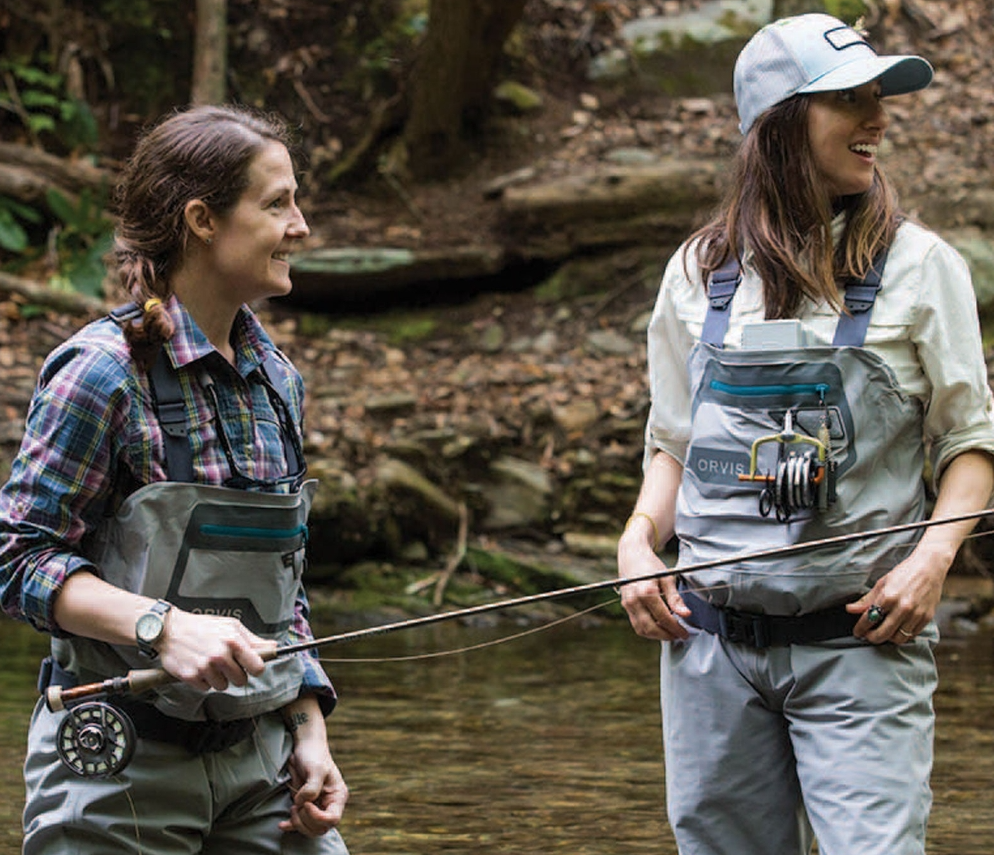
For fishing apparel and outdoor gear brands , the product integration is straightforward. Cold-water wading calls for waders, insulating mid-layers, waterproof shells, and UPF quick-dry tops — all showing up across her guided sessions without feeling forced. Plus, her conservation narrative builds a direct bridge to brands using recycled nylon, PFC-free DWR treatments, or repair programs . The gear choice becomes part of the environmental argument, not a separate sponsored mention.
Her audience also leans toward women in technical fly fishing — a segment long ignored by apparel brands still defaulting to "shrink it and pink it" sizing logic. For a brand ready to engage with female-specific fit, warmth retention, and long-day comfort on cold rivers, she's one of the few voices that reaches that buyer.
120K followers who trust her outperform 1M followers who scroll past. In high-ticket fly fishing gear — waders running $300–$800 — that trust is what drives conversions.
7. Luiza Nelson (@fishingwithluiza) — The Lifestyle-First Travel Fishing Creator
Luiza Nelson fills a category that had no name before she came along. Brazilian-born, saltwater-obsessed, and sun-drenched year-round — she's just as comfortable fighting a billfish as she is stretched out on a white sand beach in a coral bikini. She co-hosts Livin' the Dream with Captain Jimmy Nelson with her husband, Captain Jimmy. The title is one of the most accurate in outdoor television history.
Her platform sits in the ~322K range . That number sounds modest at first. But her audience isn't casual scrollers. These are people who price out Caribbean fishing trips and go ahead and book them.
What her content looks like:
40–50% offshore fishing — billfish, tuna, shark, the stuff that bends heavy rods
20–30% tropical travel vlogs — Florida, the Gulf, Caribbean coastlines, and the occasional island you've never heard of but want to visit the moment you see it
15–20% diving and spearfishing — scuba, freediving, underwater footage that doubles as screensavers
10–15% beach lifestyle — the part everyone keeps watching without admitting it
For fishing apparel brands , the integration opportunity here is unusually clean. Every session puts gear through real stress — cast mechanics, hard bends, jumping overboard, climbing back up a swim ladder. That's performance swimwear and quick-dry layers tested in open water, not a studio. High-saturation tropical colorways shoot beautifully against deep blue water and white hull paint. Her estimated net worth sits around $3 million USD , built across YouTube AdSense, brand partnerships, and merchandise. That's the commercial foundation of a serious long-term partner, not a one-campaign personality.
The "lifestyle-first" label isn't soft positioning. It's a calculated content structure. It pulls fashion-sensitive viewers in within the first 15 seconds. Then it holds the hardcore fishing audience through a full 20-minute offshore fight. Both audiences stay. Both audiences buy things.
8. Brandon Palaniuk (@brandonpalaniuk) — The Technical Elite Bass Tournament Pro
Five Bassmaster Elite Series wins. One Angler of the Year title. A 2010 B.A.S.S. Nation national championship. At some point, the résumé stops being impressive and starts being almost rude.
Brandon Palaniuk doesn't fish for content. He fishes to win — and the content follows on its own, because serious bass anglers want to watch that. At Santee Cooper Lakes, he posted a two-day total of 59 lb-0 oz , including a 29 lb-15 oz single-day bag that put him in first place. Those aren't lifestyle numbers. Those are proof .
What his audience cares about:
Boat electronics and sonar setup for locating fish fast
Precise rigging details — not "use a jig," but which jig, which line weight, why
Tournament decisions when conditions shift mid-day
Gear performance under full competition pressure
For fishing apparel and performance rainwear brands , the fit here is clear and direct. His followers are tournament anglers who buy on function. They want UPF 50+ technical shirts and rain protection that hold up across a full competition day — not branding, not aesthetics. A Palaniuk endorsement reaches that audience right where they make buying decisions.
How to Choose the Right Fishing Influencer for Your Brand Campaign
Picking the wrong fishing influencer is like buying the wrong lure — it looks great in the package, costs real money, and nothing bites.
The eight creators in this list represent different audiences, different water types, and different buyer psychology. That variety is the point. Not every one of them fits your brand campaign. Try to partner with all eight at once, and you've already made a strategic error. Here's how to figure out which ones move the needle for your product.
Step 1: Define Your Angler Segment Before You Look at Anyone's Follower Count
Before you open a single Instagram profile, answer one question: who buys your product, and where do they fish?
This is not a philosophical exercise. It's a segmentation filter. It cuts about 70% of your candidate list right away.
Saltwater / offshore buyers — Look for boat-based creators geo-tagged in coastal states. Check for heavy usage of #offshorefishing and #saltwaterfishing, plus species like snapper, grouper, and pelagics. Darcizzle and Luiza Nelson sit in this lane.
Freshwater bass buyers — Tournament anglers, regional lake content, hashtags like #bassfishing and #largemouthbass. Here's a number worth saving: a regional bass angler with 12,000 engaged local followers can outperform a national 200K account for a region-focused brand. Andrew Flair and Brandon Palaniuk anchor this segment.
Fly fishing buyers — River wading, trout and salmon species, fly-tying tutorials, educational platform focus. April Vokey is almost the entire case study here.
Fishing lifestyle buyers — Fishing plus travel plus family or boat life. These creators fold in apparel, accessories, and outdoor lifestyle content without it feeling forced. Clothing brands get the widest visual real estate here.
Pull the last 30–50 posts from any candidate. Tag each one by water type and content style. You want at least 60–70% of posts matching your target segment. Anything below that means you're paying for an audience that isn't yours.
Do a feed audit too. Count how many posts show a full-body or upper-body shot on the water. For apparel brands, you want more than 40% of posts with visible clothing in real fishing scenarios. No real-water presence means no real placement opportunity — no matter what their media kit claims.
Step 2: Match the Creator to Your Funnel Stage — Awareness, Authority, or Conversion
This is where most fishing brand campaigns fall apart. Brands treat all influencers like they do the same job. They don't.
Top of funnel — Brand awareness
These are your high-reach creators. Look for combined follower counts of 100K–1M+ across YouTube, Instagram, and TikTok. Check for an Instagram engagement rate of at least 2–4% and TikTok engagement of 5–10% . Those numbers confirm people are watching. The job here is impressions — short clips under 60 seconds showing your apparel in real fishing situations. You're measuring reach, branded search volume, and follower growth. Not sales. Not yet.
Mid-funnel — Technical authority
Think tournament anglers and respected educators. Follower counts often sit at 20K–200K , but the audiences are focused. These viewers pause videos to write down gear specs. More than 50% of content should be tutorials, gear reviews, or tournament reports. A pro saying your UPF shirt holds up through a full competition day hits differently than any lifestyle post. Track saves, shares, and comments that signal purchase intent — "What shirt is that?" beats a thousand heart emojis.
Bottom of funnel — Visual conversion
Look for creators with sharp action shots and a strong on-camera presence. Feeds where more than 50% of posts are hero shots — fish in hand, boat backgrounds, scenic water. These creators work well with YouTube description links, Instagram Stories swipe-ups, and TikTok bio links. Track everything with UTM codes and creator-specific discount codes. Target a ROAS of 2–4x minimum before you scale spend.
The Quick-Sanity Checklist
Before you sign anything, run every candidate through these six filters:
Does ≥60–70% of their content match your target water type and style?
Is their engagement rate ≥3–6% on Instagram or ≥8–12% on TikTok, with comments showing real fishing interest?
Do ≥40% of posts show clear apparel visibility in real on-water scenarios?
Can you place them clearly as an awareness , authority , or conversion creator for your funnel — not a vague "all of the above"?
Is their content field-based, with fewer than 30–40% staged promo shots ?
Does their audience demographic and regional spread match your actual buyer profile?
A candidate who clears all six is worth a call. Two or more failures, and no follower count fixes that math.
Conclusion
The fishing influencer world is wilder, more diverse, and more interesting than most people expect. Brodie Moss free-dives into crystal-clear Australian waters. Hannah Barron wrestles catfish out of muddy Southern riverbanks with her bare hands. That's not a metaphor. That's just Tuesday.
This roundup proves one thing: fishing lifestyle Instagram isn't a single thing. It's eight very different things. Your brand belongs in the specific corner where your people already live.
So here's your next move — stop scrolling without purpose and start matching with intention. For brands, pick the creator whose audience feels like your customer. For fans, hit follow on whoever made you want to cancel your weekend plans and go find a body of water.
Building your own fishing identity from the ground up? Start with gear that looks as good as it performs. Brands launching new collections can also source through experienced fishing apparel wholesalers for faster market entry.The right fit matters — whether you're on a tournament boat or just wading into something beautiful.