So you paid thirty bucks for a "technical" fishing shirt that looks suspiciously like the shirt you already own, and now you're wondering what they're made of — and whether that fabric tag justifies the markup. Most of them boil down to the same handful of synthetic fibers: polyester fishing shirt blends, nylon, and the stretchy spandex mixes that let you cast all day without feeling restricted.Brands can develop a custom fishing shirt around the right fabric performance. Each one dries at a different speed, blocks sun differently, and holds up (or falls apart) depending on whether you're grinding it out on a hot saltwater flat or wading a shaded creek. We break down what's in each fabric, how it performs when you're sweating and getting splashed, and which one deserves a spot in your tackle bag, no marketing fluff required.
100% Polyester: The Fastest-Drying Mainstay for Sun-Exposed Fishing
If your fishing shirt dries fast and doesn't feel like a wet sponge stuck to your back, it's probably 100% polyester. This workhorse fabric is made of cheap synthetic fibers that shed water and block UV rays.
Polyester dominates the sun-shirt category for three reasons. It's lightweight. Most performance fishing shirts land between 85–120 GSM for breathable summer versions, though heavier 150–200 GSM builds appear in more durable, premium lines. In ounces, you're looking at 3.9 to 6.5 oz polyester fabric, with 4.1 oz marketed as the "barely feel it" lightweight tier. UPF 50+ is the default claim on almost every serious polyester sun shirt, meaning the fabric blocks roughly 98% of UV radiation. That's why these shirts cost more than a cotton tee from the clearance rack.A specialized Polyester fishing shirt factory can adjust GSM and fiber blends for different climates.
The Drying Speed Matters
Premium polyester fishing shirts dry in under 15 minutes after a wave soaks you or you wipe sweat off your face with your sleeve. Cheaper synthetic fabric fishing apparel takes 30–45 minutes, still faster than cotton but noticeably slower.
Real Products Using This Fabric
You'll see 100% polyester in:
Angler Armour long-sleeve shirts (UPF 50+)
AVID Core AVIDry 50+ UPF, stain release included
Bassdash short-sleeve button-downs, lightweight and skin-friendly
GOT Sports kids' fishing hoodies, tested to AATCC 183-2014
A UPF 50+ tag with no testing standard listed is a guess. One backed by AATCC 183 or AS/NZS 4399 is an actual measurement. When comparing a cotton vs polyester fishing shirt, that certification is your tiebreaker. Cotton offers no verifiable UV protection.
Nylon: The Smoother, More Abrasion-Resistant Choice for Rough Fishing Conditions
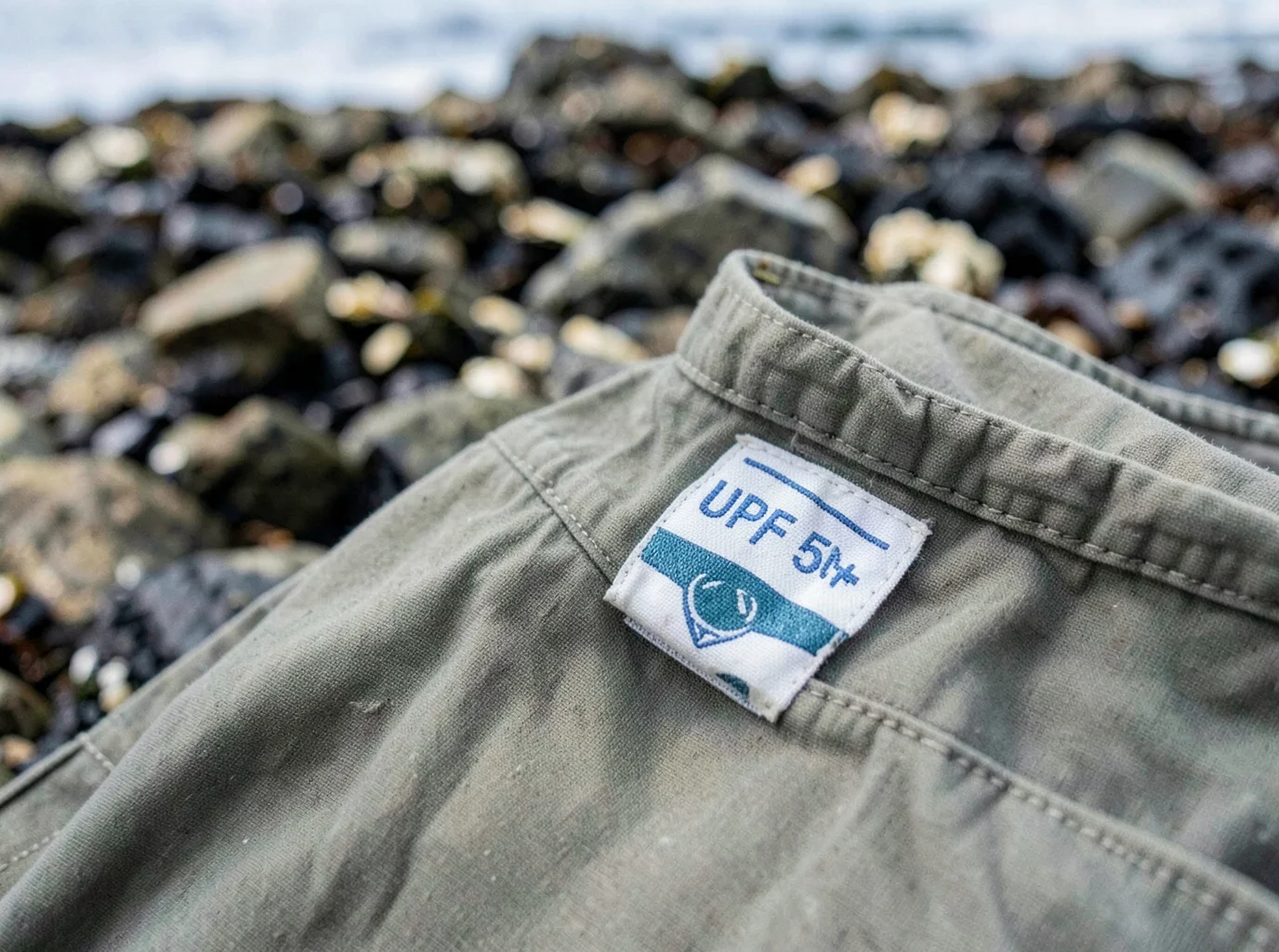
Polyester gets the marketing spotlight. But when your fishing trip involves scraping against oyster beds, dragging your sleeve across a boat rail, or climbing over rocks to reach that one honey hole, you want nylon. A nylon fishing shirt trades a bit of drying speed for serious toughness.
Why Nylon Wins on Abrasion
In independent fabric testing, nylon monofilament fiber survives 2,000–3,000 Taber cycles before failing, compared to 1,500–2,000 cycles for polyester and 800–1,200 for polypropylene. That gap matters when your shirt sleeve is rubbing against a piling or a barnacle-covered rock all day. Nylon fiber also stretches up to 30% before breaking, which is why nylon fishing shirts feel less restrictive when you're reaching, casting, or hauling in a fish that's fighting near structure.
Saltwater and Structure Performance
Nylon is naturally saltwater resistant and doesn't rot or break down from micro-organism exposure the way some cheaper synthetics do. That's a real advantage for anglers fishing reefs, weed beds, stump fields, or piers, environments where your shirt is getting snagged, brushed, or soaked repeatedly.
The Trade-Off
Nylon absorbs slightly more water than polyester, so it dries a bit slower. If your priority is a UPF fishing shirt fabric that also survives rough handling, nylon earns its price tag.Bulk Nylon Fishing Shirt production works well for abrasion-focused fishing collections. If you're mostly casting from a clean boat deck in open water, polyester still dries faster.
Polyester/Spandex and Nylon/Spandex: The Stretch Blends Used for Active Casting
A shirt that's 100% anything is rare once you start reading labels. Most "performance" fishing shirts sneak in a little spandex, and product pages rarely explain what that blend actually is.
Polyester/spandex blends run 88–92% polyester and 8–12% spandex , with 90/10 as the industry-standard mix for general sportswear. Need more compression or a tighter fit for reaching over the gunwale? The Stretch Blends fishing t-shirts Manufacturers push that to 85/15 or even 80/20. Weight lands around 140–280 GSM , though a lightweight fishing shirt stays closer to the 160 GSM end. A 95/5 polyester-spandex fabric gives you a gentle 12–20% stretch, just enough to swing a rod without feeling like a straightjacket.
Nylon/spandex blends skew heavier on the spandex side, 80–90% nylon and 10–20% spandex . The 80/20 mix is the go-to for swimwear and activewear that needs real recovery. Nylon-spandex knits are tested against ASTM D2594 for stretch recovery at both 50% and 100% extension, so the fabric snaps back instead of sagging by trip three.
Which one wins for casting? Polyester/spandex holds color better and dries faster. Nylon/spandex feels smoother and resists abrasion, better if you're bracing against a boat rail all day.
Bamboo Fiber and Cotton Blends: Softer Casual Options With Slower Wet-Dry Performance
Bamboo/cotton blends are the comfy sweatpants of the fishing shirt world. Most blends run 70/30 bamboo/cotton, with 66/28/6 bamboo/cotton/spandex showing up when brands add stretch.
Bamboo viscose feels smoother, silkier, cooler against skin than cotton. Cotton feels drier and holds its shape better. That's the tradeoff.
Bamboo viscose holds 12–13% moisture regain versus cotton's 8.5%. More absorbent, sure. But absorbing water and drying fast aren't the same skill. One buyer test showed 70/30 bamboo/cotton fleece surface-drying in 6 minutes versus cotton's 12, a decent improvement. But heavier 180–220 GSM tees still take 2–3 hours to fully dry, and 240–280 GSM sweatshirts stretch to 4–5 hours. That's a lunch break, not a quick-dry claim.
One academic study found higher bamboo content did improve sweat evaporation off skin, which explains the "feels drier" reports even when total dry time lags.
Great for casual polos, summer lounging, sensitive skin. A reliable Bamboo Fiber and Cotton Blends Fishing Shirt vendor can offer softer fabric options for casual lines.Skip it for all-day saltwater grinding — that's polyester's job.
UPF, Quick-Dry, Breathability, and Anti-Odor Features Come From More Than the Fiber Name
Two shirts made of identical polyester can have wildly different UPF ratings. The fiber name is the starting point. Construction determines the real performance.
UPF Depends on Weave Construction
UPF climbs with tighter weave, higher cover factor, higher GSM, and lower porosity. Loosen any of those and UPF drops, even if the fiber stays the same. A UPF 30 fabric lets through about 1/30 of UV (roughly 3%). UPF 50 lets through about 1/50 (closer to 2%). That gap is real, and it comes from construction.
For fabrics with similar tightness, UPF generally rises from plain weave to twill to satin. In knits, interlock double-jersey beats rib and single jersey. The gaps between threads matter too: effective UVB blocking needs interstices under roughly 0.1mm, UVA blocking under 0.05mm, and high-protection woven fabrics often need 200+ threads per square inch. Heavier, thicker fabric usually protects better, but breathability takes the hit.
Quick-Dry and Anti-Odor Are Finish Problems
Quick-dry performance comes from moisture-management finishes layered onto a fast-drying base fiber. Polyester is naturally quick-drying and wicking, but the finish accelerates evaporation further.
Anti-odor works the same way. It depends on moisture control and an antimicrobial or odor-neutralizing treatment. One textile odor technology claims to absorb moisture 20 times faster than older quat silane treatments. Good treatments don’t clog fabric pores either, so a breathable fishing shirt material stays breathable even after the antimicrobial finish goes on.
What to Ask Before Buying
Skip the vague “UPF 50+” sticker. Ask for test data, cover factor, GSM, weave type, wicking finish chemistry, and the anti-odor mechanism. The best combo fabric is usually a dense polyester or poly-blend knit with UV-stabilizing construction and a real moisture-control treatment. That’s the shirt worth your money.
Match the Fishing Shirt Material to the Fishing Environment
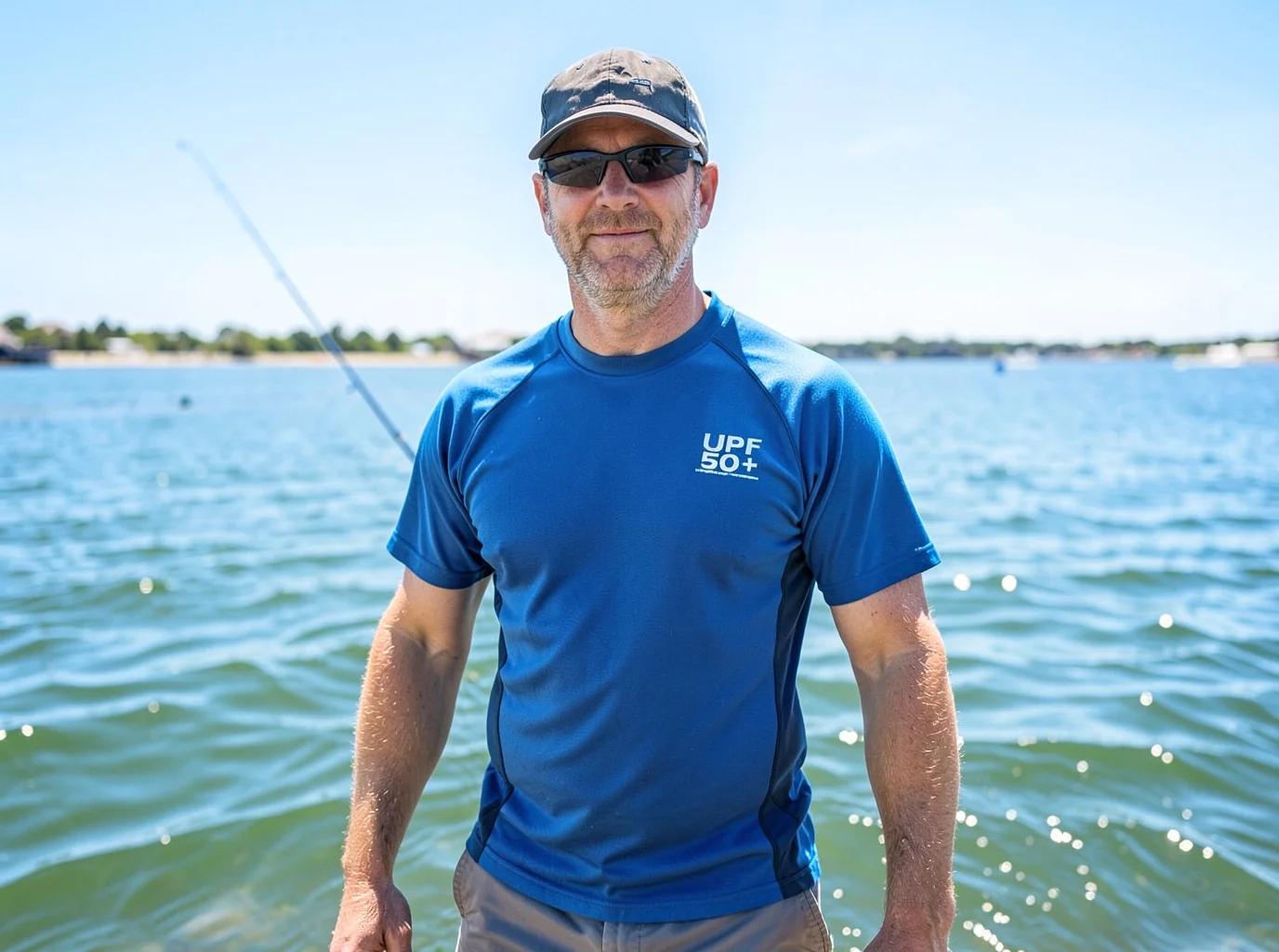
Fabric choice comes down to physics matching your fishing spot. Stand on a blazing saltwater flat in the wrong shirt and you'll cook. Wear the wrong thing wading a cold river and you'll shiver your way back to the truck.
Environment | Best Fabric | Why |
|---|---|---|
Hot sun, tropical flats, saltwater | Polyester or nylon, UPF 30-50+ | Lightweight, dries fast, holds UV protection even when soaked |
Humid heat, long casting sessions | Lightweight polyester blend with mesh vents, loose fit | Airflow prevents overheating; one industry test clocked polyester drying in 40 seconds versus cotton's 8 minutes |
Cold, windy conditions | Merino wool or synthetic base layer | Merino naturally blocks UV and insulates; synthetics work as tight base layers under a shell |
Bright sun, all-day exposure | Tightly woven polyester or nylon (recycled versions included) | REI notes these consistently rate UPF 30-50+ while staying breathable wet |
Casting, paddling, reaching over the gunwale | Polyester/spandex or nylon/elastane blends | Real examples: 90/10 poly-elastane, 74/19/7 poly-Tencel-spandex, 48/49/3 bamboo-poly-spandex |
Insect-heavy zones | Long-sleeve polyester/nylon, UPF 50+ | Combines coverage, sun protection, and quick-dry in one shirt. Columbia-style builds are the go-to |
Casual, low-intensity fishing | Bamboo blends | Softer, cooler feel, but slower drying; skip for wet, all-day trips |
Cotton doesn't make this table. It absorbs water, dries slow, and gives you zero reliable UPF. Save it for the couch.
Fishing Shirt Fabric Quick-Reference Table for Purchase Comparisons
Print this out. Tape it inside your tackle box lid. Next time you're staring at a rack of shirts with confusing spec sheets, this is your cheat sheet.
Fabric | Blend Ratio | GSM / Weight | UPF | Dry Time | Best For |
|---|---|---|---|---|---|
100% Polyester | Baseline | 130–150 gsm (4–4.2 oz) | UPF 30-50+ | 30–45 min | Budget all-arounder |
Polyester/Spandex | 90/10, 92/8, 84/16 | 140–180 gsm | UPF 50+ | Under 15 min (premium) | Casting, stretch, fit |
Nylon/Spandex | 91/9, 80/20 | 140–180 gsm | UPF 50+ | 30+ min | Abrasion, boat rails, structure |
Polyester/Nylon | Varies | 150–200 gsm | UPF 50+ | 20–30 min | Balanced durability + dry speed |
Buying rule: 90/10 or 92/8 poly-spandex covers most trips. Nylon-spandex earns its keep near oysters and rocks. Skip anything under UPF 30 or missing AATCC 183 testing.
Identify What Your Existing Fishing T-Shirt Is Made Of Before Replacing It
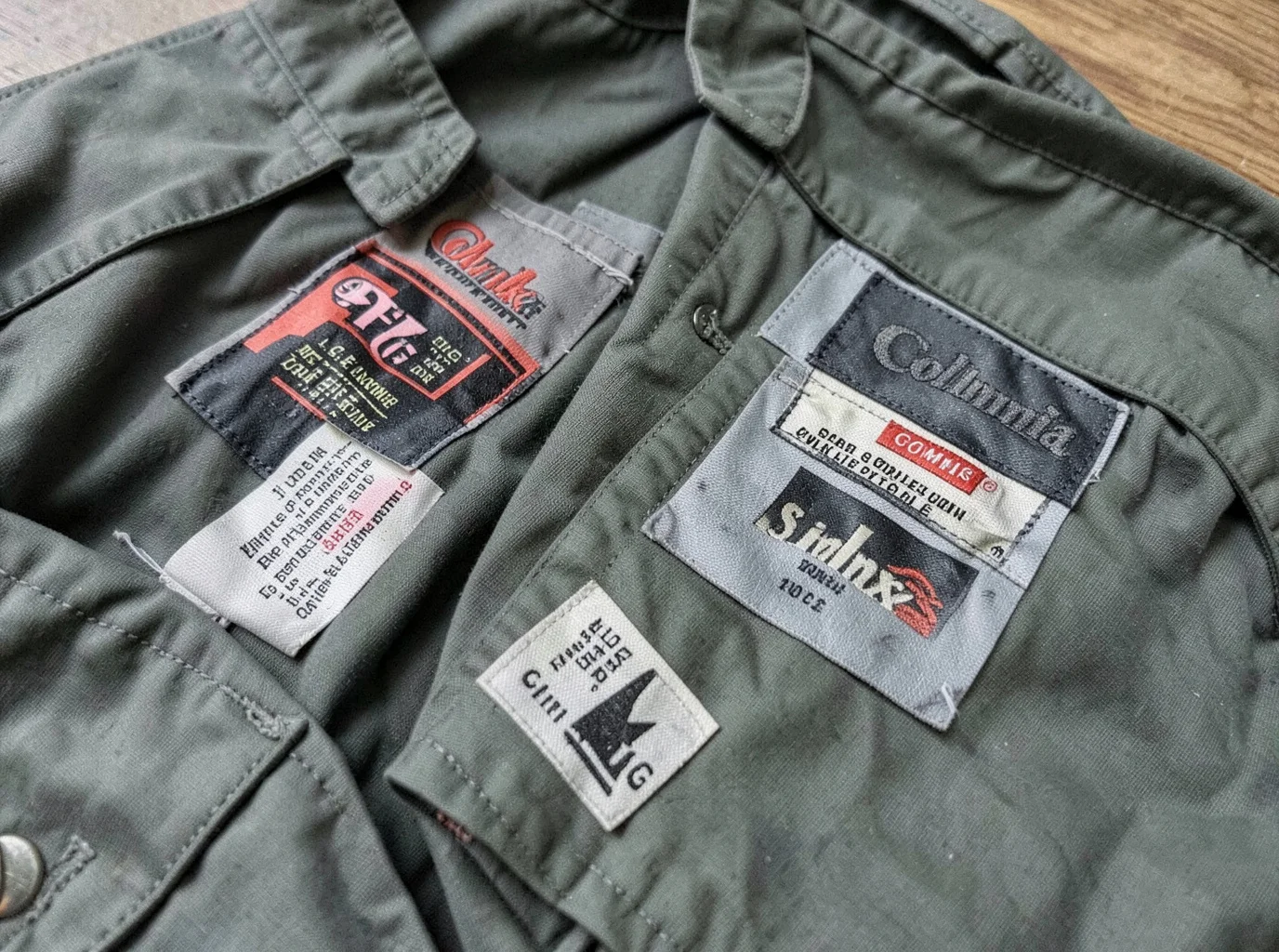
Flip the collar over. In five seconds, that care label gives you 80% of the fabric information. Most fishing shirts are labeled 100% polyester, 60/40 cotton-polyester, or a polyester/spandex blend, and a common budget fishing tee runs 5 oz, 60% cotton / 40% polyester.
Label gone? Faded to nothing? Grab tweezers and try a hidden-swatch burn test on an inside seam scrap:
Cotton burns steady yellow-orange, smells like burning paper, leaves soft gray ash, never melts.
Polyester shrinks from the flame, melts into a hard dark bead, smells sweet-chemical, often puffs black smoke.
Blends show both, bead plus ash.
That 50/50 cotton-poly combo also caps moisture regain near 4.45%, compared to cotton's 8.5%+, which explains why your quick-dry shirt might not be drying quick at all.
Conclusion
Fabric names on a tag tell you enough to stop guessing. A 100% polyester fishing shirt dries fastest and blocks the sun hardest, perfect for baking on a boat deck. Nylon shrugs off rocks and hooks better if you're wading through brush. Spandex blends move with you when you're casting all day. Cotton or bamboo blends feel nice on the couch but turn into a soggy dead weight the second you sweat or get splashed.
So go check your closet and flip that tag over. If it says "cotton" and you're fishing under a brutal sun, you've been overpaying for underperformance. Swap it for a proper polyester or nylon UPF fishing shirt built for your actual conditions. Request a custom wholesale price for UPF fishing shirts when sourcing larger quantities.Use the comparison table, match fabric to water, and stop buying shirts based on vibes.