Your cotton tee felt light in the tackle shop. Two hours into a summer trip, it's soaked through, clinging to your back, and somehow making the heat worse instead of better. Meanwhile, the angler next to you in a Columbia PFG or Simms shirt looks... fine. Dry, even. That's fabric science, and once you understand it, you'll never buy a fishing shirt the same way again.
We're breaking down how moisture wicking fabric pulls sweat off your skin at the fiber level, why UPF 50+ sun protection works better in thin polyester than thick cotton, and where nylon and blends still beat pure polyester depending on your trip. You'll walk away knowing what to check on a hangtag before you buy, and which "quick-dry" shirts are cutting corners.
Cotton Gets Heavy and Nylon Can Feel Hot During Long Fishing Sessions
Cotton can soak up 24 to 27 times its own weight in water. That’s basic textile chemistry. Cotton fibers are hydrophilic—they actively pull moisture into their structure instead of pushing it away. Moisture regain sits around 8–12% under normal conditions, but once you’re sweating hard on a boat deck, that number climbs fast. Because drying time scales directly with how much water a fabric holds, wet cotton stays wet, heavy, clingy, and uncomfortable.
Nylon improves on this but doesn’t solve it. Moisture regain for nylon runs 4–8% , with some fishing-apparel guides citing 4–4.5% water absorption — compare that to polyester’s 0.4–0.8% . That gap matters. Even “cool-touch” nylon variants, tested in textile research, showed better wicking than standard nylon but worse drying performance and lower moisture permeability . So nylon can trap heat during long, sweaty sessions even when it feels okay at first.
Most fishing-apparel guides agree on practical benchmarks. Keep cotton content under 10% for boat or offshore wear. Above 15–20% , cotton behaves like a sponge once wet. And polyester dries 4–5× faster than nylon in side-by-side testing.
Polyester Moves Sweat Without Holding Much Water
Here's the number that explains everything: 0.2–0.4% . That's polyester's moisture regain — how much water the fiber itself soaks up under standard test conditions (roughly 65% relative humidity, 20–21°C, per ASTM D1909 and ISO 6741 benchmarks). Cotton sits at 8.5% under the same conditions. Wool climbs to 13–16% . Even a 50/50 cotton-poly blend lands around 4.45% , and nylon hovers near 4% . Polyester is in a category by itself.
The reason comes down to chemistry, not marketing copy. Polyester is hydrophobic — its molecular structure repels water instead of absorbing it into the fiber core. Sweat hits the surface and stays on the surface. It doesn't sink into the yarn, swell the fibers, or add weight the way cotton does. That's why a soaked polyester fishing shirt still feels lighter than a damp cotton one.
But low moisture regain isn't the whole story. Sweat can still pool between your skin and the fabric if the garment's construction is weak — loose knit, poor surface finish, no engineered wicking channels. This is where quality separates from marketing hype. True performance fishing wear pairs that 0.4% regain with wicking knit structures or surface-finished yarns that pull sweat outward and spread it for faster evaporation.
If you're sourcing or comparing shirts, ask the brand directly: is this a modified, hollow, or cross-section engineered polyester? That's the difference between a shirt that dries fast and one that just claims to.
Polyester Gives Lightweight UPF Protection When the Garment Is Engineered Correctly
A UPF rating printed on a hangtag doesn’t happen by accident. Polyester’s fiber structure already blocks UV better than most materials in its weight class, but hitting UPF 30–50+ while staying quick-drying and breathable requires deliberate engineering of the garment, not just the raw fiber.
Weave tightness and cover factor matter most. A denser weave leaves fewer gaps for UV rays to slip through. This is the single biggest adjustment upf fishing shirts manufacturers make. Color and dye system come next. Darker shades absorb more UV energy than light ones. Dope-dyed or solution-dyed polyester locks pigment inside the fiber itself, which holds up better through wash cycles than a surface coating. UV additives like benzotriazoles, HALS, or inorganic pigments such as titanium dioxide and carbon black boost protection without adding meaningful weight to the fabric.
UPF 15–24 blocks roughly 93–96% of UV. UPF 40–50 blocks 97.5–98%. UPF 50+ blocks at least 98%. The gap between “protective” and “highly protective” comes down to construction choices, not fiber type alone.
Not all polyester performs the same. Published testing on polyester athletic shirts found UPF values ranging from 19 to 49 — a wide spread within the same fiber family. Fit, weave density, and finishing all shift that number.
When shopping, skip vague claims like “UV protective.” Look for a certified UPF number, ideally 40+ or 50+, fabric construction details (woven vs. knit, GSM, thread count), dye method (dope-dyed or solution-dyed signals durability), and whether the protection comes from the fiber or a wash-off finish.
The same polyester blend shirts can range from decent to excellent for sun protection — the spec sheet tells the real story, not the fiber name on the label.
Quick-Dry Polyester Works After Rain, Spray, and Accidental Immersion
A sudden downpour or a slip off the dock tests fishing apparel in ways sweat never does. This is where quick dry fishing apparel earns its name.
Industry drying-time benchmarks break into three tiers. Premium quick-dry polyester reaches dry-to-touch in 15–30 minutes . Standard quick-dry sportswear needs 30–60 minutes . Fully dry indoors, factoring humidity and fabric thickness, takes 2–4 hours . Outdoors, with sun and airflow, lighter garments can dry in about an hour or less .
Compare that to cotton's 2–4 hour saturated-garment turnaround — roughly double polyester's timeline under similar conditions.
Wetting speed matters too. AATCC 79 testing measures how fast water spreads across a fabric surface after contact. Strong quick-dry fabrics hit under 5 seconds. Cotton often runs 45+ seconds or more. That's the difference between rain beading off and rain soaking in.
For accidental immersion, textile labs use a different metric than fiber regain alone: water retention after a soak-and-drain cycle. One standard test immerses fabric for 20 minutes , drains it for 25 seconds , then measures retained moisture. Top-performing polyester loses 90% of absorbed water within 60 minutes at room temperature — some premium fabrics hit that mark in just 30 minutes .
When sourcing or buying, ask Polyester Fishing Shirts suppliers for these specs directly:
Moisture regain: 0.2–0.4%
Dry-to-touch time: 15–30 minutes
AATCC 79 wetting time: under 5 seconds
Immersion-drain retention data, not just fiber composition percentages
Lightweight knits and open weaves recover faster than dense, heavy weaves — because dry time tracks retained water mass, not just fiber type.
Polyester Handles Repeated Washing, UV Exposure, and Fishing Abrasion
That shirt sitting in your closet after forty wash cycles? It should still be doing its job. UPF 50+ sun protection means nothing if it disappears after a season of laundry, and this is where polyester separates itself from fabrics that fade fast.
Inherent or solution-dyed polyester UPF knits retain 90–95% of original UPF after 40–60 domestic wash cycles. Some performance polyester fishing shirts suppliers push that further, specifying UPF 50+ stability after 40 home launderings, referencing ASTM D6603 and ASTM D6544 for UV labeling accuracy. One polyester fabric study even reported UPF 126.61 after 10 standard washing cycles, proof that treated polyester textiles can hold, or gain, UV stability under repeated laundering.
Abrasion tells a different story. Polyester typically handles 10,000–12,000 rub cycles, while nylon reaches 15,000–20,000 in comparable fishing apparel guides. That's why many performance shirts blend 85–92% polyester, 5–10% nylon, and 3–5% spandex. The polyester gives you UV retention, the nylon the toughness.
Spec-sheet checklist for buyers:
Look for solution-dyed or dope-dyed polyester, where protection is built into the fiber rather than sprayed on.
Check for AATCC 183 (UPF after laundering) and ISO 12947 (Martindale abrasion) test references.
Expect 7–10% UPF loss after heavy bush-scraping or pack-strap friction. That's normal wear, not fabric failure.
Polyester Doesn't Automatically Mean Odor-Free
Plain polyester holds smell worse than cotton. A 2020 laundering study found odor compounds bond more strongly to polyester fibers, and repeated wear builds up that odor over time. Washing doesn't reset it. The same research found no significant difference in extracted odorants between 5 and 10 wash cycles — once odor gets embedded, it sticks around.
A separate 2007 wear-trial across nine fabrics backs this up. Polyester scored high in odor intensity, while cotton and wool landed mid-low. Fabric structure matters too: lightweight single jersey polyester smelled less than heavier interlock or 1×1 rib weaves.
What helps:
Wool-polyester blends : 20% wool / 80% polyester cut odor intensity substantially versus 100% polyester
Antimicrobial finishes or β-cyclodextrin treatments , shown to improve odor binding
Asking fishing shirts suppliers for wear-trial data
Polyester's hydrophobic surface traps sweat in the skin-fabric microclimate, feeding bacterial growth. That's the real odor driver.
Polyester vs Cotton vs Nylon vs Polyester-Cotton Blend
Numbers only tell half the story. Put all four fabrics side by side, and the real trade-offs become obvious fast.
Fabric | Moisture Wicking | Sun Protection | Abrasion Resistance | Price | Hand Feel |
|---|---|---|---|---|---|
100% Cotton | Poor — absorbs, holds water | Weak unless heavily treated | Medium | Higher | Excellent, soft |
100% Polyester | Excellent — fast dry, low regain | Strong when engineered (dope-dyed, dense weave) | High | Low-medium | Slightly stiffer, less "soft" |
Nylon | Good, but traps some heat | Moderate | Superior — highest abrasion rating | Medium-high | Smooth, technical |
Poly-Cotton Blend (60/40, 65/35) | Moderate — better than cotton alone | Moderate | Medium-high | Medium | Balanced, comfortable |
Cotton wins on softness and breathability, nothing beats it against bare skin in mild weather. But it loses every performance category that matters on the water. Nylon takes durability, its abrasion resistance beats polyester outright, which is why boat decks, tackle bags, and technical outerwear lean nylon-heavy. Polyester dominates moisture management and sun protection when the weave and dye are done right, and it costs less to produce, which explains why budget performance lines and promotional fishing shirts default to it.
In fire-behavior testing, polyester-cotton blends released more total heat than the sum of their individual fibers, while nylon-cotton blends released less. Not a daily concern for anglers, but it shows blends don't just average their parent fibers, they can behave unpredictably.
For fishing shirts, poly-cotton blends land in the middle. They dry faster than pure cotton, breathe better than pure polyester, and carry a decent price. That's the compromise fabric — good enough, rarely optimal.
Match Fishing Shirt Material to the Fishing Environment
No single fabric wins every trip. The right call depends on where your line hits the water.
Tropical sun, flats, offshore heat: go with 100% polyester or 92–95% polyester / 5–8% spandex, targeting UPF 50+. Weight matters here — 120–150 gsm suits inshore and summer sessions, while 150–180 gsm handles offshore glare better. Look for wicking specs that hit water spread time under 3 seconds and full dry time under 20 minutes.
Saltwater and offshore runs: polyester or poly/spandex again, but check for salt-spray durability data. Color shift ΔE ≤1.0 after 48 hours and strength loss under 10% are the benchmarks worth asking Polyester Fishing Shirts factories about.
Boat decks and abrasion-heavy days: nylon or a nylon-blend takes over. Polyester still wins on drying speed, but nylon shrugs off gear scrapes and deck friction better.
Cold, windy, low-sun trips: switch to merino wool or a layered synthetic-plus-windproof-shell setup. Merino runs UPF 25–50, built for cold more than heat.
Budget everyday tee: 100% polyester with a mesh back panel works fine. An 88% polyester / 12% elastane build with a polyester mesh vent is a common real-world spec.
Simple rule: sun and salt mean polyester with UPF 50+. Heavy abrasion means nylon-blend. Cold means merino.
Verify Whether a Polyester Fishing Shirt Is Truly High Performance
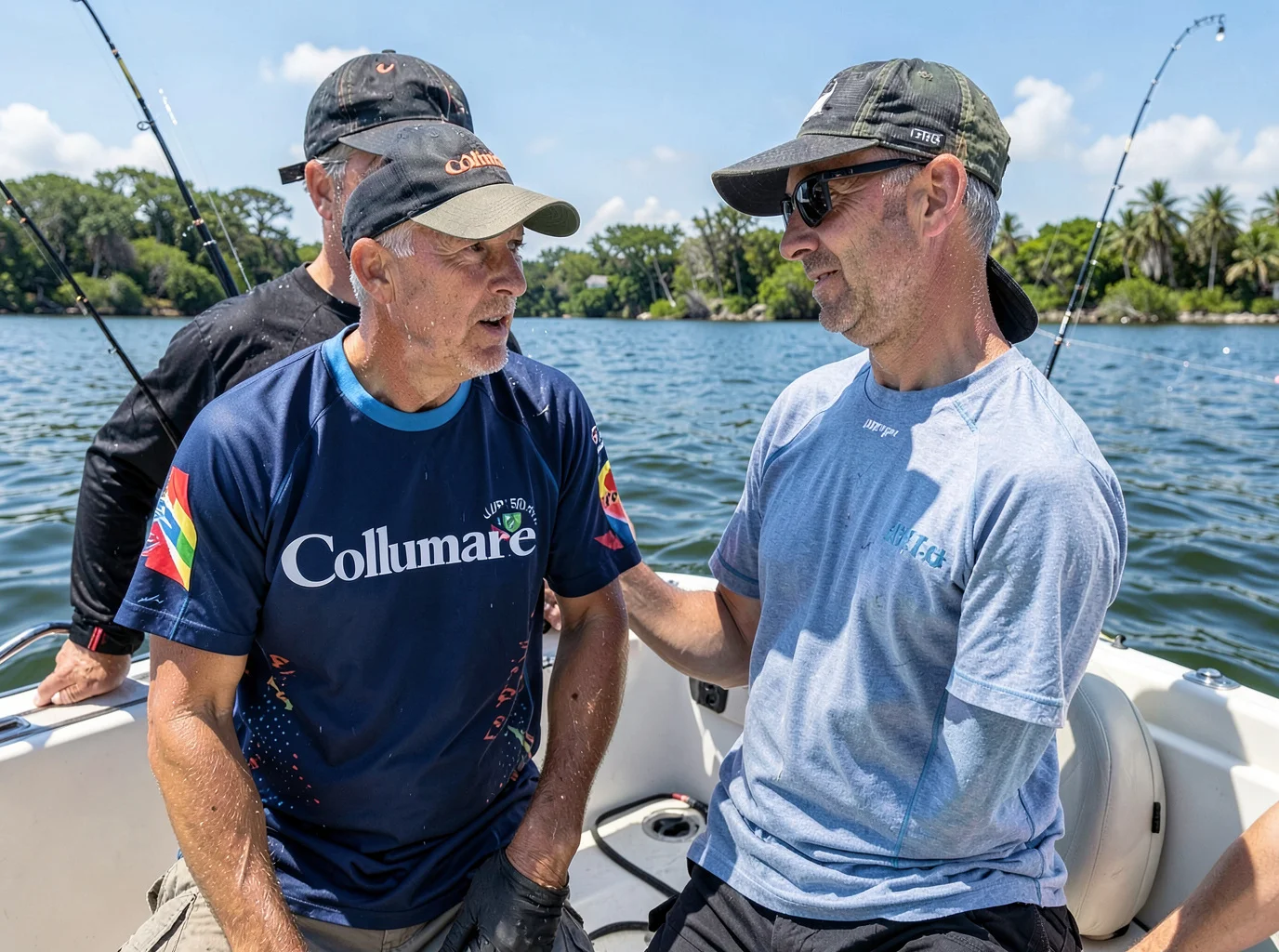
Not every "performance" tag on the rack earns the name. Here's how to tell real engineering from marketing filler before you pay.
Check these five things:
UPF claim with a named test. UPF 50+ backed by AATCC 183 or AS/NZS 4399 is the premium threshold. If there's no lab method listed, treat the number with skepticism.
Wicking data, not adjectives. Look for water spread time under 3 seconds, wicking diameter of 30mm+ in 30 seconds, or full dry time under 20 minutes. Some brands claim 3× cotton's wicking rate — that's a real benchmark, not a slogan.
Breathability rating. MVTR of 10,000+ g/m²/24h beats the standard 5,000 baseline.
Wash-cycle retention. UPF 50+ should hold after 20 washes. Antimicrobial claims need AATCC 100 or ISO 20743 backing, targeting 90%+ effectiveness after 20 washes.
Fabric construction specifics. 93% polyester / 7% elastane at 140–170 GSM, or 2.3-ounce ripstop with mesh venting, are real specs worth trusting.
Real market examples: HUK 's Mossy Oak Pursuit (100% polyester, UPF 50+, antimicrobial), AFTCO's Samurai Hoodie (92/8 poly-spandex, UPF 50), and AVIDry's River Shine (100% polyester, UPF 50+, stain release) all publish testable claims.
Red flag: "quick dry" or "cooling" with zero lab reference behind it.
Conclusion
Polyester didn't become the fishing shirt standard by accident. It pulls sweat away from your skin instead of soaking it up like cotton, delivers UPF 50+ sun protection without adding bulk, and dries fast enough to handle rain, spray, and the occasional dunk without leaving you clammy for hours.
But not every "quick-dry" tag on a shelf tells the full story. Before you buy, flip the shirt over. Check the fabric weight, confirm the polyester percentage, and look for an actual UPF certification instead of a vague "sun protective" claim.
Match the material to your water. Use lightweight polyester for tropical heat and a tighter poly-blend for abrasion-heavy days on the boat.