You've probably already Googled " Custom Fishing Apparel Manufacturer " and landed on a dozen factory homepages that all say the same three words — "quality," "fast," "professional" — without telling you a single thing you need to know before sending that first inquiry email. I've spent years on the production floor, running fabric tests and chasing sublimation print approvals. Most brand founders don't fail because they picked the wrong factory. They fail because nobody explained what questions to ask before signing anything.
This guide breaks down how custom fishing apparel manufacturing works, from OEM vs. ODM decisions to realistic UPF fabric testing standards, so you walk into your first factory conversation already sounding like you've done this before.
OEM vs. ODM: Which Custom Manufacturing Model Fits Your Fishing Brand?
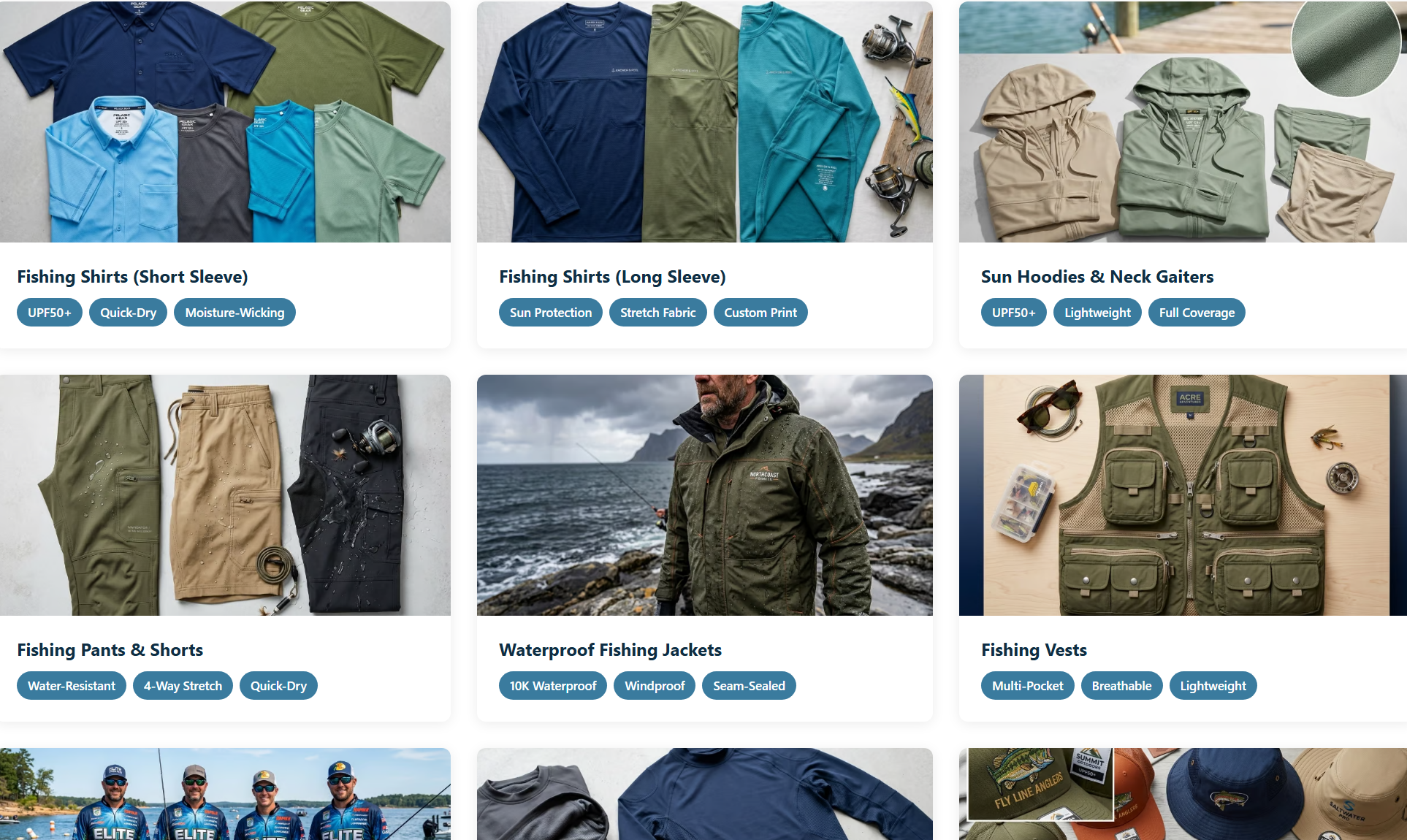
Every custom fishing apparel factory conversation eventually circles back to two letters: OEM or ODM. Pick wrong, and you either burn cash on tooling you didn't need, or you end up selling the same jersey pattern as five competitors with a different logo slapped on it.
The real trade-off is IP ownership and uniqueness versus speed, minimum order quantity, and how much cash you need upfront.
OEM Fishing Clothing — Full Control, Higher Bar
With OEM, you own the pattern. The factory becomes a production resource, nothing more — they can't resell your cut, your sleeve venting layout, or your UPF fabric spec to another brand if the contract is written properly.
MOQ: 300–1,000 pieces per color and design
Lead time: 8–12 weeks including pattern development and fit testing
Best fit: you can commit to 1,000+ units per SKU and want proprietary features like a signature raglan cut or a specific vent mesh placement that competitors can't copy off a catalog
ODM Fishing Apparel — Faster, Cheaper, Shared Design
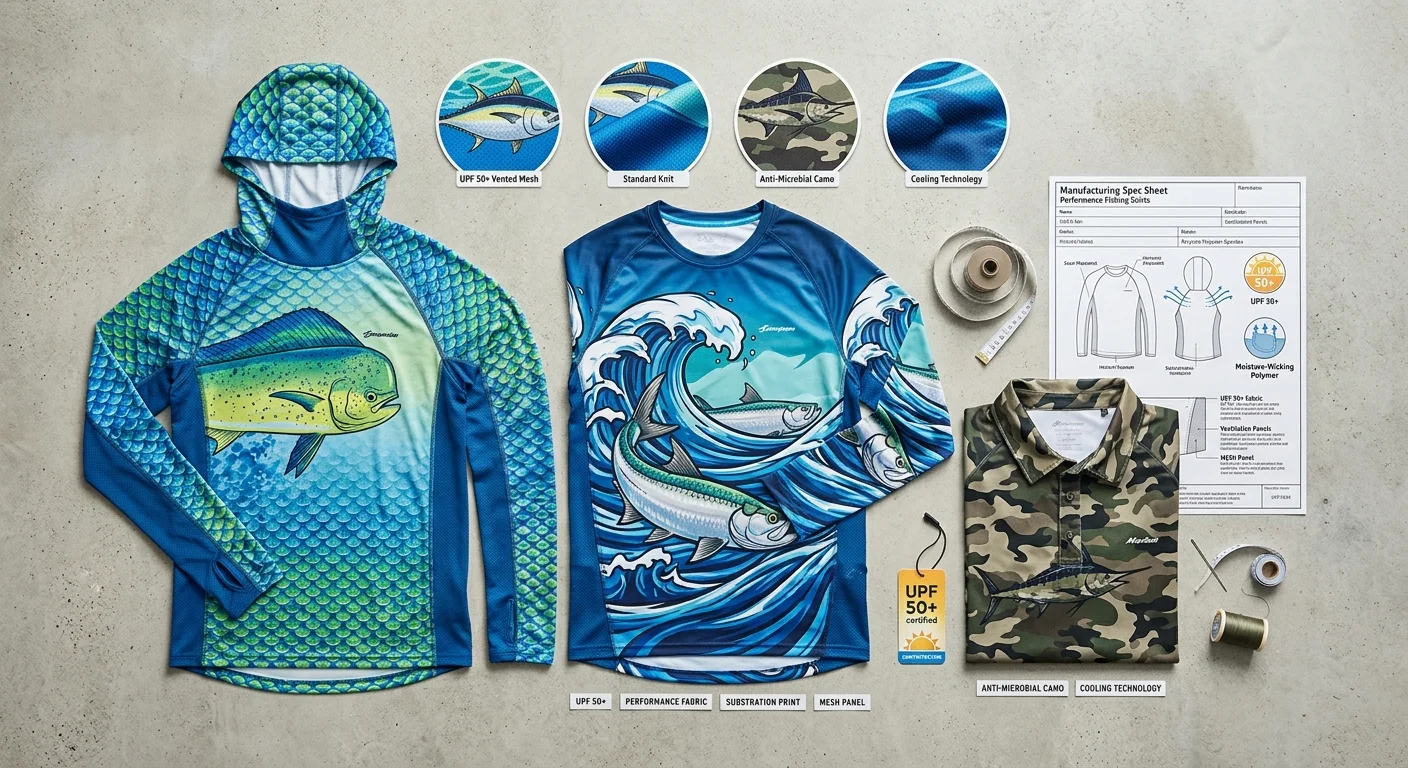
ODM means you pick from a factory's pre-engineered fishing shirt library — raglan sleeves, vented backs, UPF-rated fabric already tested — then customize the print, colors, and logo placement.
MOQ: 50–300 pieces per design. Some fishing jersey manufacturer partners go as low as 100–300.
Lead time: 6–12 weeks
R&D savings: up to roughly 30% lower design cost versus a fully custom OEM fishing apparel pattern
The rule I give new brands : if your forecast confidence is under 70-80%, stay ODM. Run 50-300 piece batches, see what sells, then commission an OEM pattern once a design proves itself over multiple seasons. That's how most sun-shirt brands scale — ODM to validate, OEM to differentiate once volume justifies the tooling investment.
The Custom Fishing Apparel Production Process: From Design to Delivery
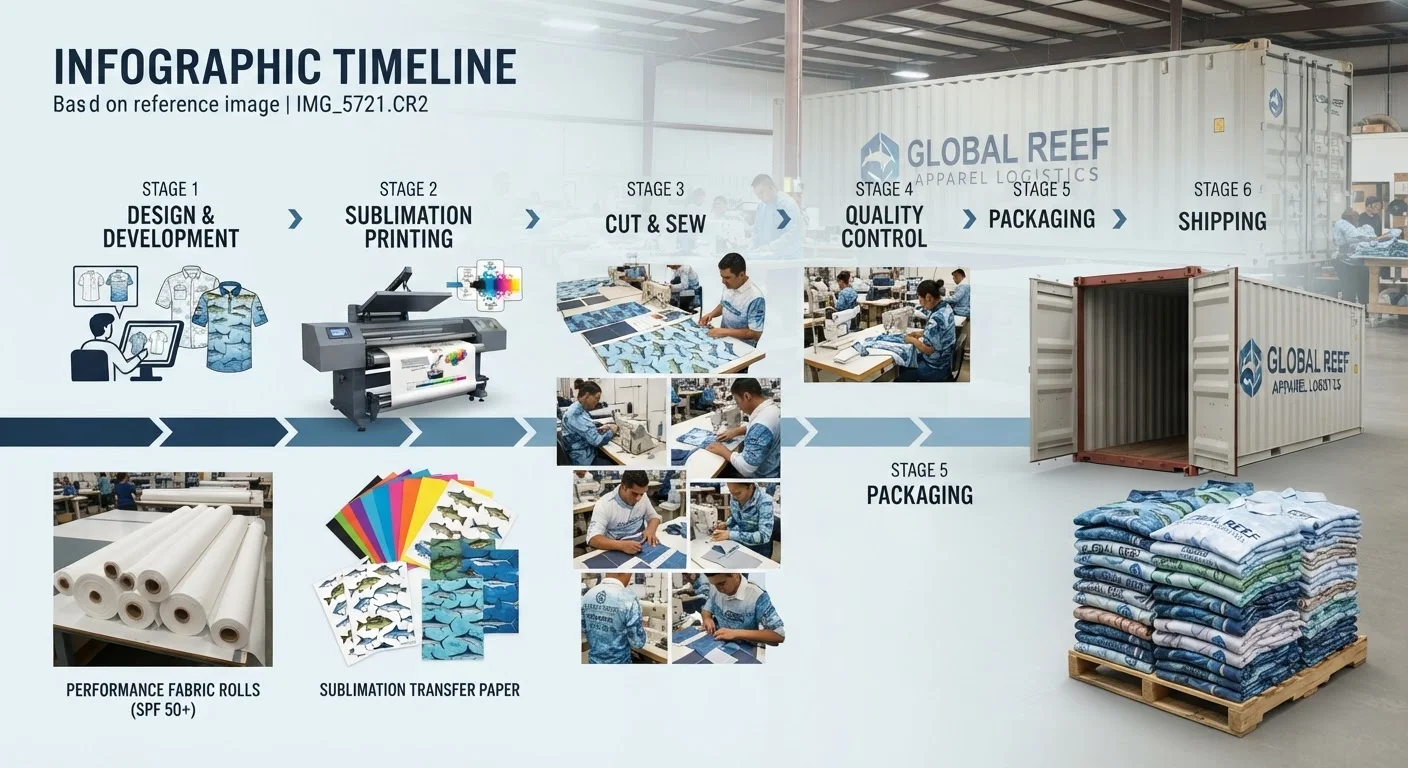
Seven stages stand between your Pinterest mood board and a container of finished shirts sitting in your warehouse. Skip understanding any one of them, and you'll be the brand emailing "what's happening with my order?" at week 6 with no answer.
Stage 1 — Inquiry & Quote (Day 1-2): Send quantity, target FOB price, and performance specs (UPF rating, DWR, anti-odor). A real factory replies within 24 hours with a written scope and line-item quote.
Stage 2 — Tech Pack & Design (Day 3-6): Pattern, graded sizing, print placement, colorways. Build 3 digital mockups per SKU before locking anything.
Stage 3 — Fabric Selection (Day 1-3, overlapping): Better factories run UPF spectrophotometry, DWR spray tests, tensile strength, and colorfastness checks.
Stage 4 — Sampling (Day 7-17): Sewing takes 7-10 days once fabric arrives. You get a production-ready sample plus detail photos for remote fit checks.
Stage 5 — Approval (Day 17-24): Fit check, Pantone color lock, seam construction confirmed (flatlock vs. overlock matters for anti-chafe performance). Lock size ratio and 30/70 payment terms here.
Stage 6 — Bulk Production (Day 24-50): Cutting, sublimation printing, sewing, and embroidery, with WIP photos compared to the golden sample.
Stage 7 — QC & Shipping (Day 50-55+): AQL 2.5 inspection, re-verified UPF and DWR ratings, then DDP shipping.
MOQ/price reality check:
Order Type | MOQ | Price/pc | Lead Time |
|---|---|---|---|
POD | 1 pc | $28-45 | 3-5 days |
Stock fabric + print | 30-50 | $14-19 | 7-10 days |
ODM sublimation | 50-100 | $11-15 | 10-14 days |
Small OEM | 200-300 | $10-18 | 18-25 days |
Large overseas | 500-5,000+ | $6-9 | 30-45 days |
First orders run 5-8 weeks brief-to-ship. Repeat orders skip sampling and take 3-4 weeks , often at half the original MOQ.
How Long Does Custom Fishing Apparel Manufacturing Take? (Timeline Breakdown)
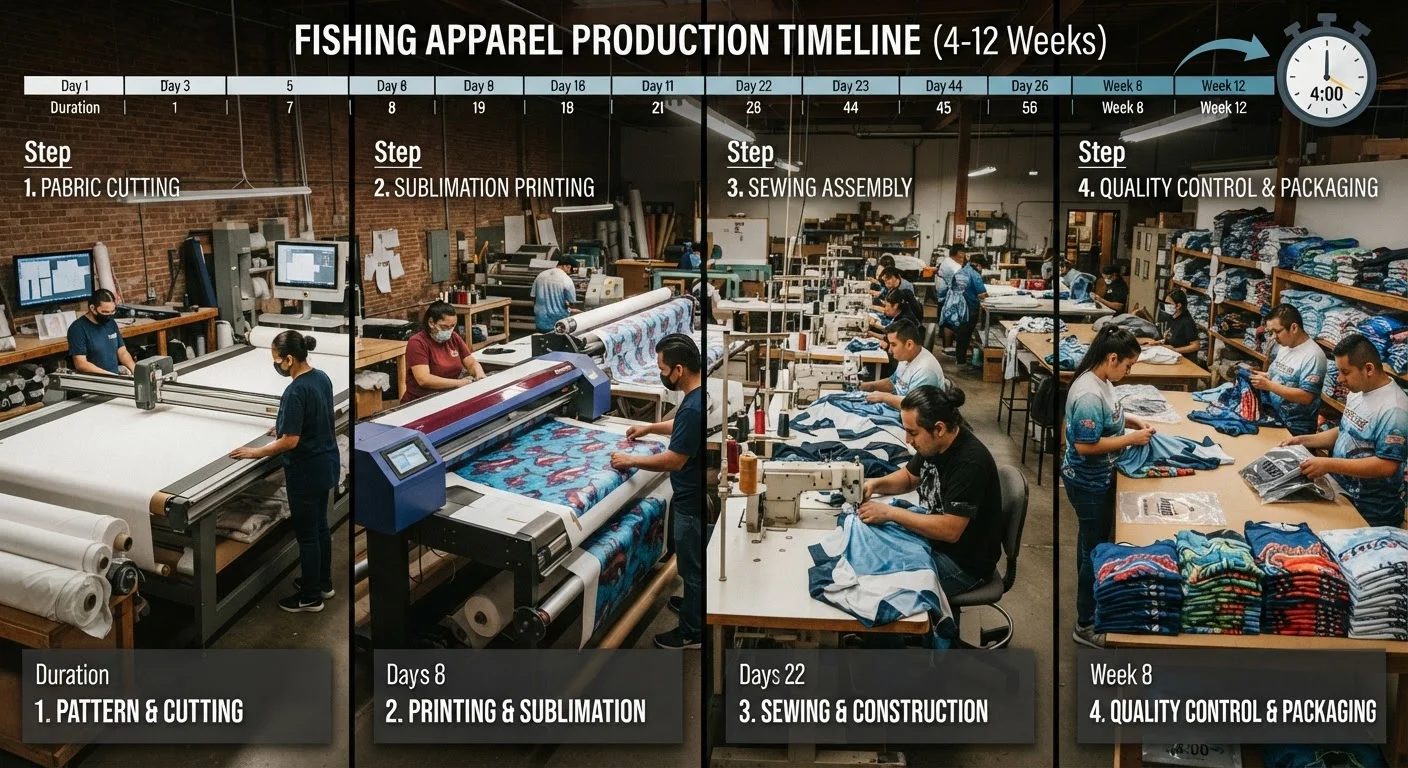
Ask five factories "how long will this take" and you'll get five different answers. None of them wrong, all of them dependent on variables nobody mentions upfront. The range across the fishing apparel supply chain runs 4–12 weeks, and here's what moves that number.
Fabric type swings your timeline by 2–4 weeks. Stock UPF fishing fabric sitting in a factory's warehouse gets you moving fast. Custom-developed fabric — a specific knit blend, proprietary anti-odor treatment — means waiting on fabric mills, and that adds real weeks before cutting starts.
Seasonality matters more than most brands realize. Tournament season runs roughly February through May, when every fishing apparel supply chain gets backed up. Expect 7–14 extra days on bulk production during those peak months.
Design stability is the hidden lever. A proven pattern with locked colorways runs fast. New designs with multiple sample revisions can stretch pre-production by 2–6 weeks. Every "can we try a different Pantone" email costs you days.
Three real scenarios I've walked brands through:
100 pcs, new tournament shirt, stock fabric: ~5–7 weeks total
300 pcs, repeat design, same factory: ~3–4 weeks
2,000+ pcs, custom fishing clothing fabric, sportswear factory: ~12–20 weeks (3–5 months)
Zoom out and factor in brand setup, fabric booking, and shipping buffers. Full launch timelines land at 90–120 days.
Minimum Order Quantities (MOQ) and Cost Benchmarks for Fishing Apparel
The MOQ for fishing apparel isn't one number—it changes with what you're asking a factory to make. Simple sublimated fishing shirts and sun hoodies usually have a 50-piece minimum per style, per color . Tournament jerseys with multi-panel cuts and full custom branding jump to 100–300 pieces . Technical outerwear like jackets, bibs, and high-end waders sits at 300–500 pieces , because fabric mills won't cut smaller rolls for laminates and taped seams.
Real supplier benchmarks worth knowing:
Runfish Apparel: 50 pcs per style/color
Rise Sportswear: 10 pcs per design (zero MOQ on reorders)
FishingApparelFactory.com: 100 pcs, mixed sizes S–5XL in one color
Healong: 30–50 pcs for long-sleeve fishing wear
If your patterns and prints already exist, repeat orders can drop to 30–40 pcs —factories aren't re-tooling anything.
Where Cost Lands
Budget planning gets real once you match MOQ tier to unit price:
Test launch (50 pcs): $14–19/shirt on stock fabric, or $11–15 if you go full sublimation ODM
Growth run (100–300 pcs): $10–18 domestic, $8–13 mid-size overseas
Scaling (500+ pcs): $6–9 per shirt at large overseas factories
Fishing vests run heavier—expect $12–25 FOB at 500–1,000 pieces, depending on mesh panels and pocket count. Outerwear jackets usually cost 2–3x what a shirt does. Know your tier before you email anyone a quote request.
5 Key Checks to Evaluate a Custom Fishing Clothing Manufacturer
A factory's website can say anything. You can verify these five specific things before you wire a single dollar.
1) Performance specs, in writing. Ask for waterproof ratings of at least 5,000mm for light rain, 10,000mm+ for real conditions. Breathability should sit above 5,000 g/m²/24hr. Fabric weight matters too. 70D or 100D nylon holds up against hooks and rocks better than lighter blends. Fully taped seams, YKK-equivalent zippers, and third-party tested UPF 30+ or UPF 50+ paperwork are not optional for any manufacturer claiming sun protection.
2) Physical samples, not renders. Order one sample per style and colorway. Test it yourself. Spray it, stretch the seams, check if the measurements match what's on the spec sheet, not just "size M."
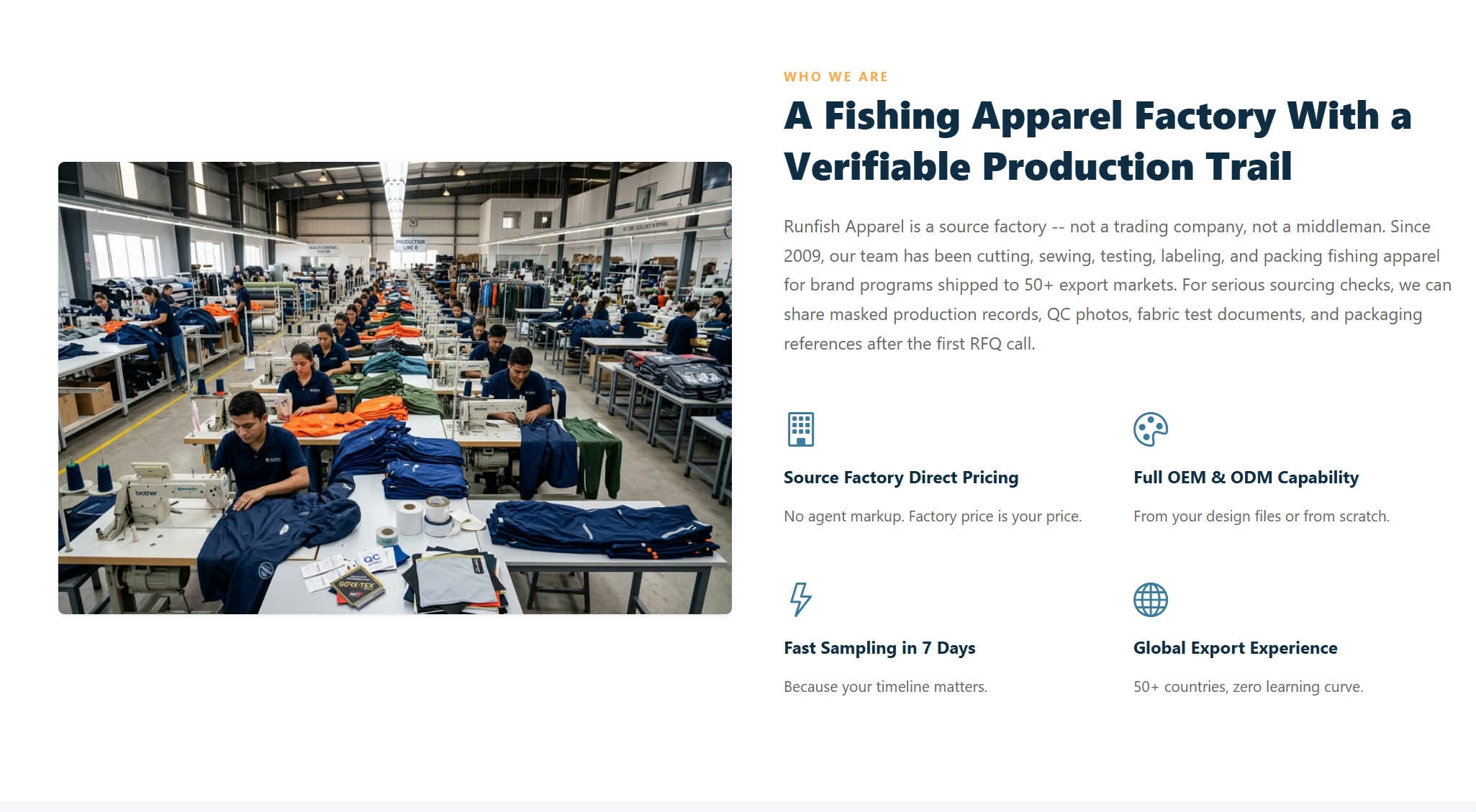
3) Documented QC checkpoints. Ask if they run inline inspections during the sew, not just a final check before boxing. Fabric inspection, stitching evaluation, and trim testing should have paper trails.
4) Real certifications. Business license, export history, ISO 9001. For outdoor gear, bluesign® or OEKO-TEX signals they're not cutting corners on chemical treatments.
5) Commercial terms that don't smell off. Clear MOQ, honest lead times, no demand for 100% upfront before you've approved a sample. If they won't show past work, walk.
Performance Fabrics and Features: What Makes Fishing Apparel Special
Cotton and polyester are chemically different animals, and that difference is exactly why a fishing shirt can't just be a printed t-shirt with a logo on it. When someone messages a factory asking for a custom fishing shirt,what they're really asking for — whether they know it or not — is a specific blend engineered for sun, sweat, and salt.
The Fabric Blend That Actually Works
Most performance fishing shirts run on a standard formula:
Polyester (85–92%) — hydrophobic, holds UV treatments longer than nylon, dries 3–4x faster than cotton
Nylon (5–10%) — adds abrasion resistance for rocky shorelines and boat decks
Spandex/Elastane (3–5%) — gives 4-way stretch for casting without the fabric fighting you
Cotton loses most of its UV protection the moment it gets wet — its UPF can drop below 10. Polyester/nylon blends do the opposite: they hold their UPF rating wet or dry, blocking up to 98% UV at UPF 50+.
UV Protection Has to Survive the Wash, Not Just the Label
Serious fishing brands specify UPF 30 minimum, UPF 50+ for anything premium. The Skin Cancer Foundation's data — cited across the industry — shows UPF 50+ shirts cut sunburn risk roughly 90% versus regular cotton over prolonged exposure. A real UPF 50+ fishing shirt manufacturer builds UV blocking into the yarn during extrusion. A competitor printing on generic fabric sprays it on as a surface coating. Topical finishes can drop roughly five wash cycles in. Yarn-level treatment doesn't wash out.
Wicking, Cooling, and Ventilation
Capillary-structured polyester with micro-channel cross-sections pushes sweat outward instead of absorbing it, spreading moisture across a wider surface for faster evaporation. Some advanced blends absorb up to 3x their weight in moisture within 30 seconds. Lab comparisons show synthetic fishing shirts cutting sweat dry time by roughly 60% versus cotton tees, with wicking speeds 40–60% faster than basic athletic shirts.
Ventilation is engineered, not accidental — mesh panels, laser-cut vents, and perforated underarms placed along heat-heavy zones. Vented designs can deliver 30–50% better airflow and up to 40% less heat buildup than non-vented outdoor shirts, translating to measurable cooling: roughly 4° f lower skin temperature than a cotton shirt in direct sun.
Water Resistance, Durability, and Odor Control
For shirts, hydrophobic fibers plus DWR treatments shed spray and light rain while staying breathable. Outerwear — jackets, bibs — steps up to 10,000–28,000mm waterproof membranes with breathability above 15,000 g/m²/day, so anglers don't end up soaked from the inside during active casting.
Durability matters more in saltwater than most brands expect going in. Heavy-use garments built on 500D–1000D fabrics are rated for 500+ days of hard field use, which is why some manufacturers back them with lifetime warranties. Rust-resistant hardware and rinse-friendly fabrics handle repeated saltwater exposure without corroding zippers or snaps.
Anti-odor treatment is the feature nobody asks about until they've done a three-day multi-day trip with limited laundering access. Silver-ion and antimicrobial finishes claim up to 99% reduction in odor-causing bacteria — a real spec worth confirming, not just a marketing line, since multi-day wearability is a top complaint in fishing apparel reviews.
Cut and construction round it out: articulated sleeves, shoulder gussets, and looser upper-body patterning keep casting motion unrestricted, while chest pockets, tool loops, and hidden plier pockets get built into non-stretch zones so they don't interfere with the fabric's 4-way stretch.
Sourcing, Packaging, and Logistics for Fishing Apparel
Ninety percent of fishing apparel still ships out of Guangdong and Fujian (Dongguan, Xiamen, Shishi) because those clusters pack fabric mills, printing, trims, and sewing into a five-mile radius. That proximity turns a 12-week timeline into an 8-week one.
Vetting a factory before you commit:
- Business longevity: 5+ years operating, not just registered
- On-time delivery rate: ≥98%
- Response time to your messages: ≤3 hours
- Reorder rate from existing clients: ≥25%
- Documented subcontracting policy and signed NDAs — check for IP litigation history before handing over a tech pack
You can find these factories on Alibaba and Global Sources for transparent MOQs (vet trader vs. real factory), at trade shows like ISPO Munich or Canton Fair, or through sourcing agents who charge 5–8% commission to manage QC on the ground in Shenzhen or Ho Chi Minh City.
Put packaging specs in your PO — polybags with SKU/barcode/logo, 20–40 pieces per carton, PO number and country of origin printed on every box. Misaligned packaging causes more reshipment delays than bad stitching does.
Standard payment terms run 30% deposit, 70% on shipment. Run third-party inspection (SGS, QIMA) before that balance clears.
Conclusion
Launching a fishing apparel brand comes down to finding a manufacturer that fits your fabric, MOQ, and timeline. Samples take 7-15 days, bulk production runs 30-45 days, and MOQs start around 100-300 pieces depending on whether you go OEM or ODM.
You also know the five checkpoints that separate a legitimate sun protection fishing shirt manufacturer from a factory that'll waste your budget. UPF50+ lab reports, sublimation printing capability, and sample revision policies aren't nice-to-haves — they're deal-breakers.
Pull together 2-3 factory quotes using the exact questions from this guide, compare their answers side-by-side, and you'll spot the pros in about five minutes flat. That's how brands get built — by asking better questions than everyone else.