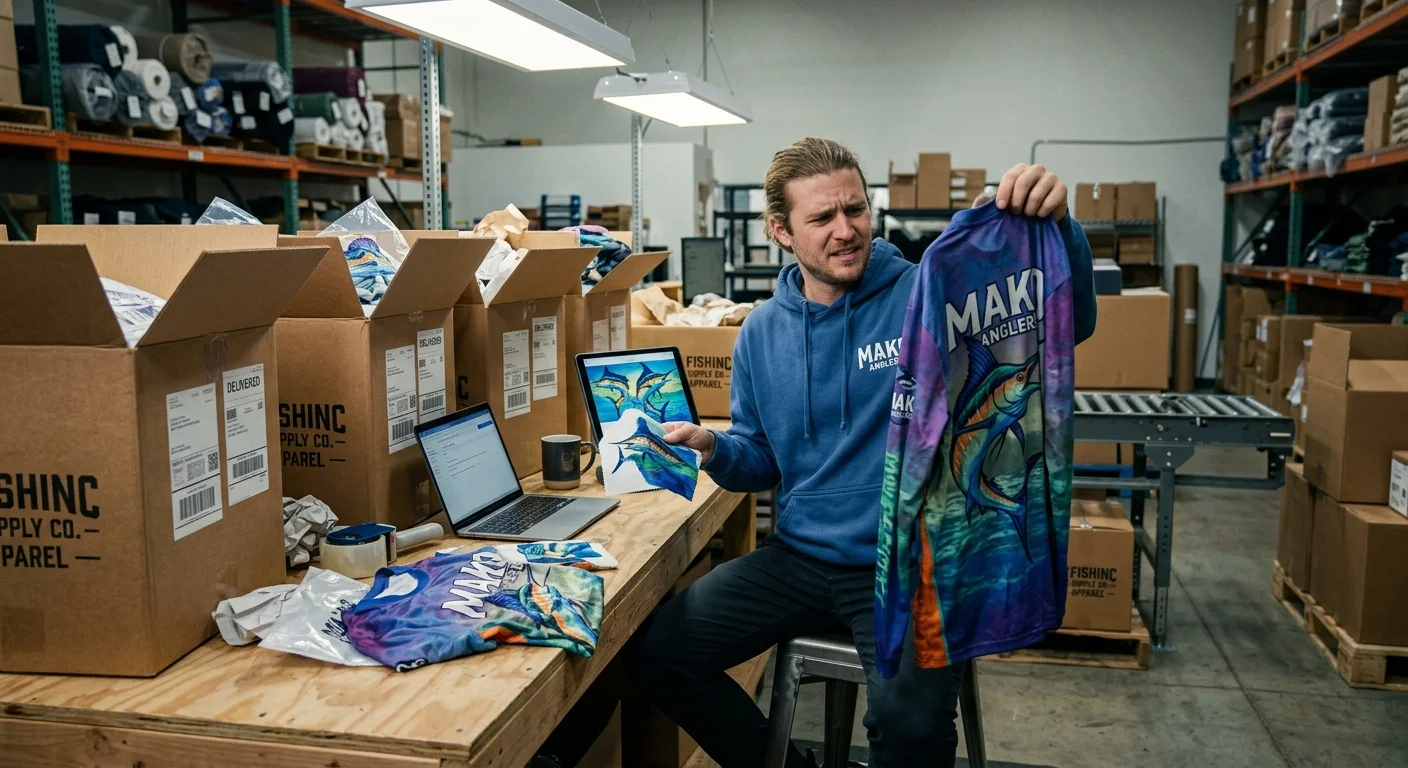
Your fishing apparel is dialed in—performance fabrics tested, fit perfected, colors that pop. Then the samples arrive with a flimsy printed label already peeling, a hangtag that feels like an afterthought, and a poly bag too thin to survive the warehouse, let alone customs. Suddenly your "premium" brand looks anything but.
Packaging isn't the last step in production. It's the first impression your buyer, and eventually your customer, will ever have. This guide walks you through customizing fishing apparel packaging the right way, from choosing woven labels vs printed labels to specifying poly bag thickness and export carton standards that clear customs without a hitch.
Whether you're building a private label fishing clothing line or vetting your next OEM partner, you'll leave knowing exactly what to ask for—and what to avoid.
The Packaging Workflow for Fishing Apparel
Seven steps stand between a finished garment and an export-ready carton. Skip one, and you'll feel it in customs delays, in damaged stock, in a buyer who never reorders.
Everything starts with the tech pack. This master document needs a dedicated packaging section covering polybag specs, label placement, carton packing method, and shipping mark format. No packaging section in the tech pack means no consistency on the fishing apparel factory floor.
Your Bill of Materials needs to list packaging items per unit, alongside the fabric and trims. For a typical fishing hoodie, that means:
1 polybag (30×40cm, 40–50 microns)
1 backboard (250–350 gsm)
1–2 tissue sheets
2–3 labels (neck, care, size)
1 hangtag (300–400 gsm)
1 barcode sticker
The physical workflow follows a fixed sequence: thread trimming, quality inspection, stain removal, pressing, trim attachment, then hang tagging, folding, poly bagging, cartoning, taping, and bar-coding. Each stage has an owner, a standard time, and a checkpoint. In sportswear production, folding and bagging alone runs 0.5–1.5 minutes per piece.
Miss the workflow order, and you will be reworking finished goods.
Custom Fishing Apparel Labels: Woven vs Printed vs Care Labels
Woven for brand, printed for care instructions. Everything else is detail.
Woven labels survive 50+ commercial wash cycles at temps up to 75°C without fading—the color lives in the yarn, not on a surface coating. They score a 10/10 on wash resistance and shrug off ironing and tumble drying. Printed labels max out around 20–30 wash cycles before ink degradation shows, earning roughly a 7/10. That gap matters when you're outfitting offshore guides or charter crews doing industrial-frequency laundry.
The Real Cost Difference
Woven | Printed | |
|---|---|---|
Unit cost | $0.15–$0.45 | $0.08–$0.20 |
Setup fee | ~$150 | ~$50 |
MOQ | 500–1,000 pcs | 100–250 pcs |
Lead time | 2–3 weeks | 5–10 days |
Printed labels run 30–50% cheaper. If you're testing a tournament capsule collection at low volume, printed wins on flexibility. If you're committing to 500+ units per style for an established fishing line, woven pays off in brand perception.
What Each Label Can Say
Woven labels handle 8–12 thread colors max—fine for a bold logo or "XL," useless for fine print. Printed labels do unlimited CMYK, gradients, hazard icons, QR codes. That's why UPF-rated sun shirts need printed labels for the care details that protect the rating and antimicrobial finish—there's just too much text for thread to carry.
The Standard Label Deck
Woven main label (inside back neck/hem): brand logo, sub-line like "Offshore Series," survives sweat, sunscreen, saltwater
Printed care label (side seam): fabric %, wash instructions, country of origin, coating notes (DWR, antimicrobial)
For 500 units with one of each: woven totals $250 ($150 setup + $0.20/unit), printed totals $100 ($50 setup + $0.10/unit). That's $0.70 per shirt for full branding plus compliance—the standard build for a serious merchandise line.
Quick rule: heavy-wash, guide-grade, 500+ units → woven brand label. Small runs, multilingual care copy, fast turnaround → printed. Most fishing apparel brands need both.
Custom Clothing Hangtags: Materials, Sizes, and Attachment Options
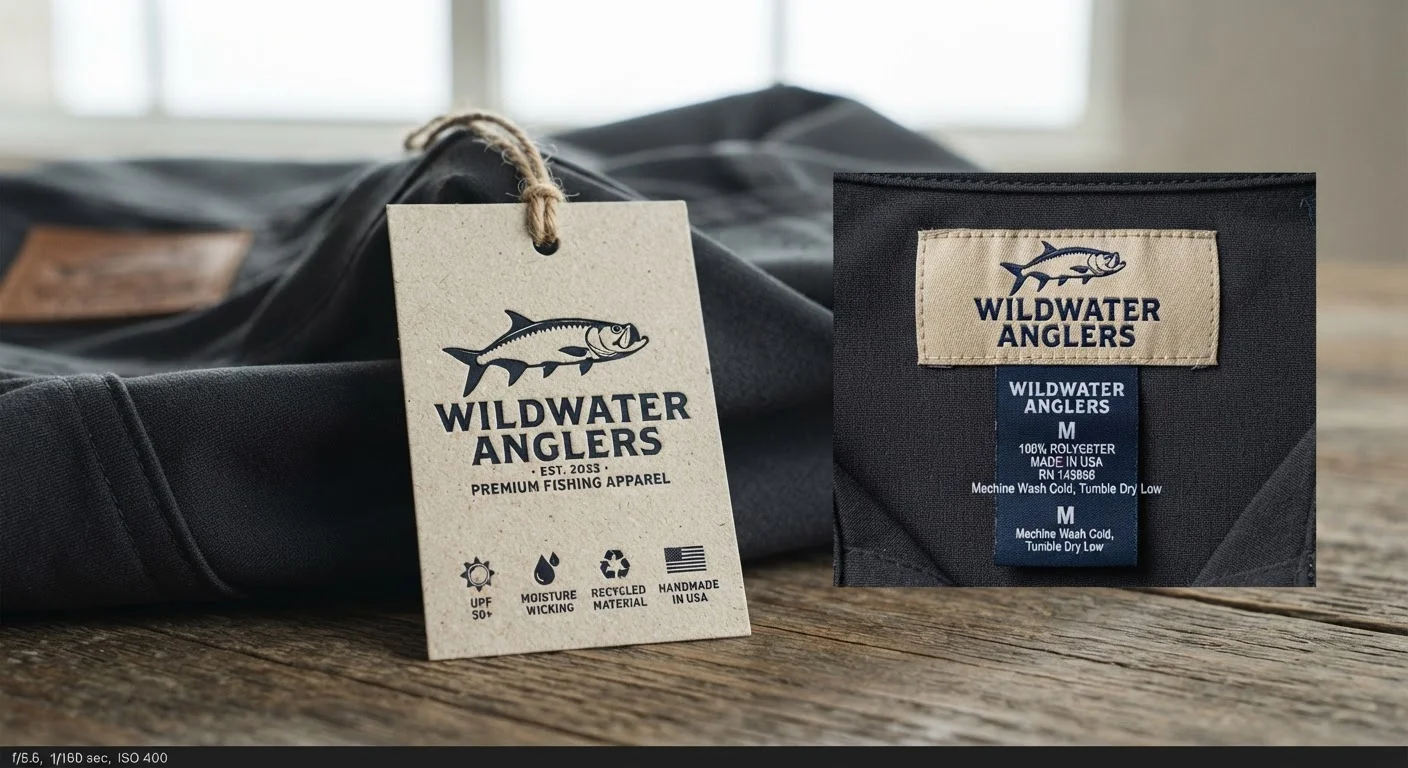
A hangtag is the handshake before the sale. Customers touch it before they touch your fabric. Get the stock wrong—too thin, too flimsy—and that handshake feels limp.
Material: Match the Tag to the Fish Story You're Telling
Paper and cardstock dominate for good reason. They're cost-effective, print cleanly, and take foil and emboss well. Standard weight runs 300–350 gsm (14–16 pt). Budget tags dip to 250–300 gsm. Luxury or oversized tags climb to 400–450 gsm, sometimes double-layered for heft.
But fishing apparel isn't office wear. It gets rained on, tossed in tackle bags, handled with wet hands. That's why plenty of brands skip paper entirely:
PVC/TPU (plastic): waterproof, durable, built for outdoor and sportswear racks
Kraft/recycled paper: rustic texture, FSC-certified options, signals eco-positioning—though the color range shrinks
Metal (zinc alloy, brass, stainless steel): premium heft, often paired with denim-style or heritage lines
Leather and plant-based leather (cactus, cork): tactile, brand-differentiating, pricier
Sizing That Doesn't Look Like an Afterthought
Standard retail runs 2" × 3.5" (50-55mm × 90mm)—business-card proportions. Need more copy or imagery? Bump to 16 pt stock for rigidity. Thin paper sags under extra ink and folds.
Attachment: The Detail Buyers Notice, Even Subconsciously
Cotton or polyester cords (waxed or plain): standard, affordable
Metal chains: denim and heritage aesthetics
Safety pins with punched holes or eyelets: fast, functional
Plastic kimble fasteners: mass-production speed
Coatings and die-cutting (embossing, foil, custom shapes) need at least 300 gsm to hold their shape. Anything thinner, and your "premium" edge just crumples.
Custom Poly Bags for Clothing: Materials, Thickness, and Safety Requirements
Six microns doesn't sound like much. It's the thickness of a standard dry-cleaner garment bag—thinner than a human hair—and it proves that "thin" and "wrong" aren't the same thing. Poly bag specs live and die on the details. Get them wrong and you'll pay at customs, in warehouse damage, or during a compliance audit you didn't see coming.
Pick Your Material by What the Bag Needs to Survive
LDPE dominates apparel packaging. It's flexible, cheap, and fine for folded garments. HDPE steps in when you need higher tensile strength in a thinner film; recycled HDPE can run up to 100% pre-consumer or post-consumer content and still outperform virgin LDPE on strength. LLDPE adds tear resistance at thin gauges. CPE gives you that soft, frosted, premium feel, often specified as 100% recycled and GRS certified.
If your brand leans eco, cornstarch and PLA blends work well. EcoPackables' D41 film, for example, runs 20–100 μm, prints on both sides, and carries EN 13432 or "OK compost" certification. Cassava-cornstarch blends go further, with TUV and ABA certification for home compost in 180 days and industrial compost in 90.
Thickness: Match Gauge to What's Inside
Lightweight garments (t-shirts, light layers, up to 10 lb): 1–2 mil / 25–50 μm
Medium-weight (10–50 lb): 2–3 mil / 50–75 μm
Heavy or sharp-edged items (50 lb+): 3–4+ mil / 75–100+ μm
Most brands mandate a minimum 25 μm gauge for inner bags. Thinner film tears into small pieces, which creates its own safety problem.
Safety Requirements Aren't Optional
Bags with openings large enough to pose a suffocation risk need a printed warning in a specified minimum font size, placed where it can't be missed. Drawstring closures are off-limits for children's wear. On the chemical side, expect REACH (EU) and CPSIA (US) compliance for restricted substances, plus non-toxic, textile-safe resins. Use virgin LDPE when purity and clarity matter. If you're marketing an eco position, back it with GRS certification for recycled content or EN 13432 for compostables. Skip the certification, and "sustainable" is just a word on your hangtag.
Export Carton Packaging for Apparel: Board Grade, Dimensions, and Shipping Marks
A carton is the last line of defense between your fishing apparel and a 12-hour truck ride, a humid container, and a forklift operator who's seen better days. Skimp here, and everything upstream—the woven labels, the hangtags, the poly bags—arrives crushed or soggy.
Board Grade: Don't Go Below the Floor
Board grade 4, C-flute, single wall is the minimum acceptable spec for apparel export cartons. Anything softer invites crushing. For better stacking strength and humidity resistance, most experienced exporters upgrade to 5-ply double-wall or 7-ply triple-wall corrugated board. Flutes should run vertical—that's what carries the weight when cartons stack five or six high in a container.
Dimensions: Stay Inside the Band
Industry benchmarks put carton length between 200–850 mm, width 200–570 mm, height 160–450 mm, with gross weight capped around 2.5–17 kg. Common apparel sizes: 60×40×50 cm or 50×40×30 cm. Some buyers tighten this further, capping cartons at 600×400 mm and 15 kg gross weight. Always use outside dimensions for freight calculations, not internal fit. The CBM formula is simple: length × width × height in meters, or centimeter dimensions divided by 1,000,000.
Shipping Marks: What Customs and Warehouses Expect to See
Every carton needs buyer/consignee code, PO number, SKU description, carton number (like 12/50), quantity, gross and net weight in kg, dimensions in L×W×H, country of origin ("MADE IN CHINA"), and destination port. Marks should appear on at least two opposite sides, with buyer code text at least 30 mm high for visibility from 5 meters away. Side marks typically run 200×150 mm; end marks, 100×100 mm. Get the numbers wrong, and customs holds your shipment—not your buyer's problem, yours.
Fishing Apparel OEM/ODM Factory with Full Packaging Capabilities — Runfish Apparel
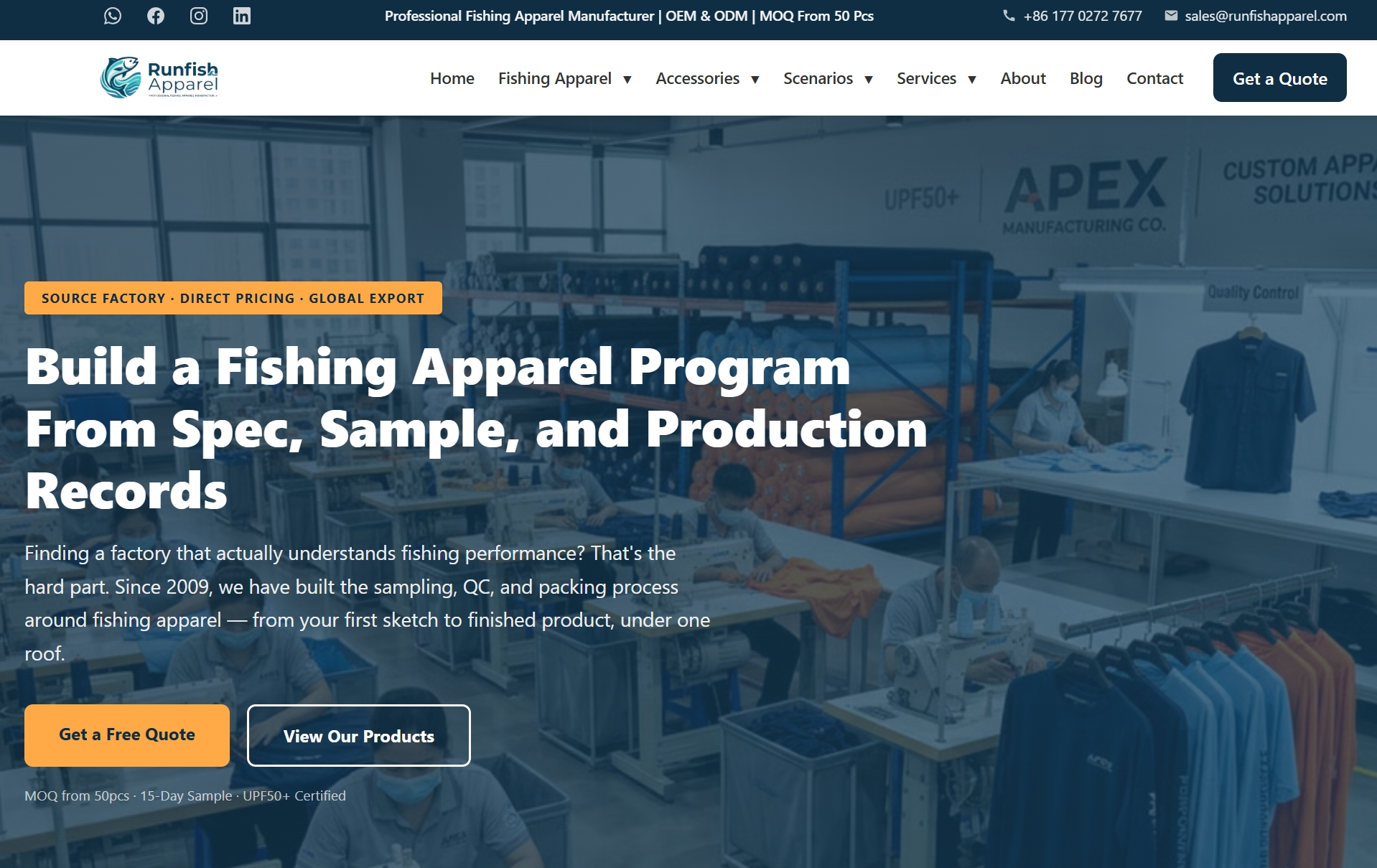
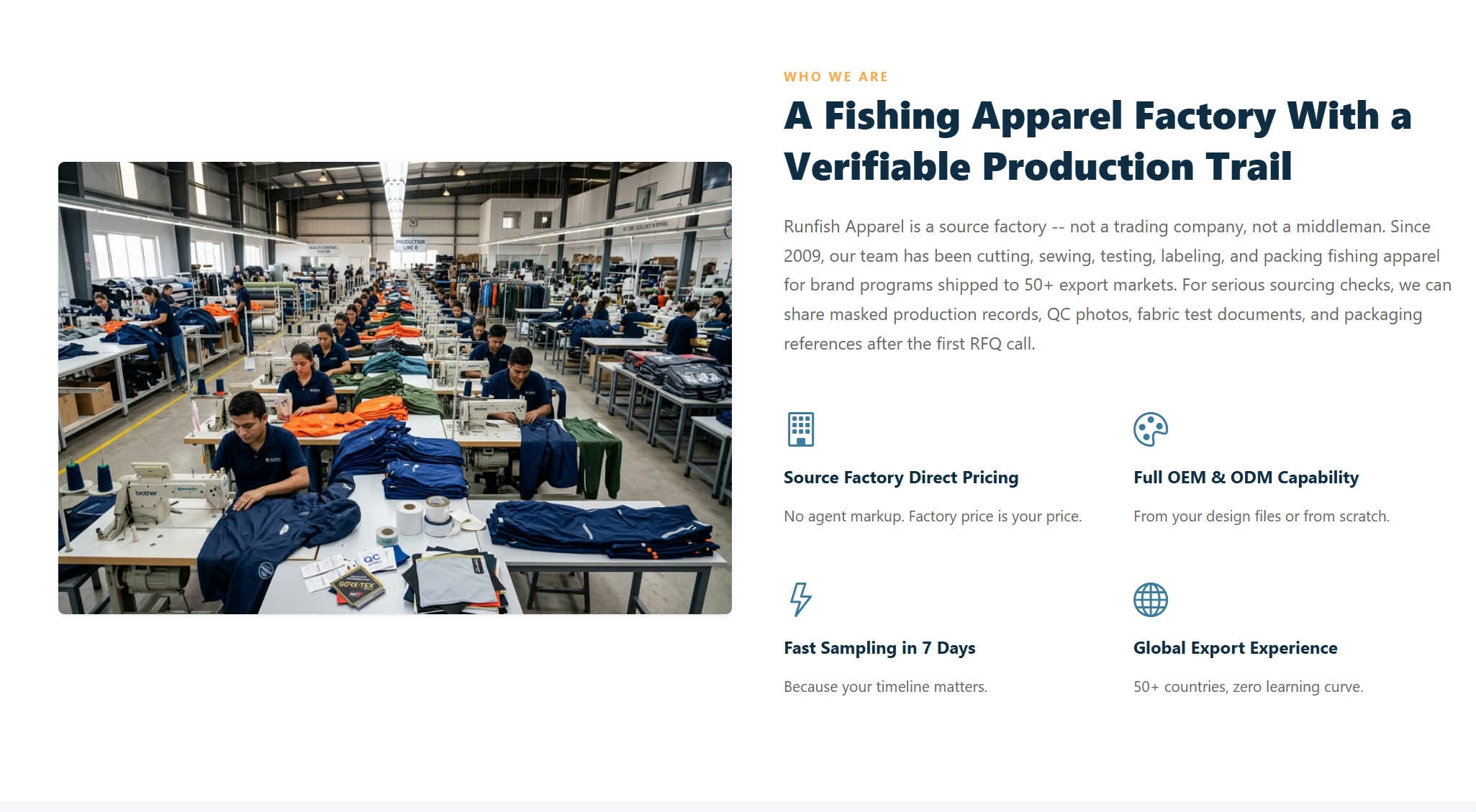
Runfish Apparel can make, package, and get your fishing apparel through customs in 30 days. It has been doing that since 2009, running an 18,000 sqm facility with 12 production lines dedicated entirely to fishing apparel. It makes UPF50+ sun shirts, DWR-treated rain shells, fly fishing shirts, waders, and technical bottoms, from raw fiber to warehouse door.
The real advantage of in-house production shows up in packaging. Runfish doesn't outsource labeling or export packing to a third party who’s never seen your tech pack. The same team cutting your fabric coordinates your polybag specs, your carton marking, your shipping documents. Fabric sourcing, sampling, cutting, sewing, printing, QC, labeling, packing—all under one roof, one accountable process.
For brands with a finished tech pack (OEM): submit your design, get a production-ready sample in 7 days, bulk delivery in 20–30 days. MOQ starts at 100 pieces for fly-fishing styles.
For brands still shaping the concept (ODM): work from Runfish’s fishing pattern library or start from scratch. Sampling runs 5–14 days depending on the path, MOQ as low as 50 pieces.
The industry norm is 500+ piece MOQs and weeks longer to sample. That’s why 200+ fishing brand programs across 50+ countries have run their packaging and production through Runfish.
Independent Hangtag and Label Suppliers for Fishing Apparel
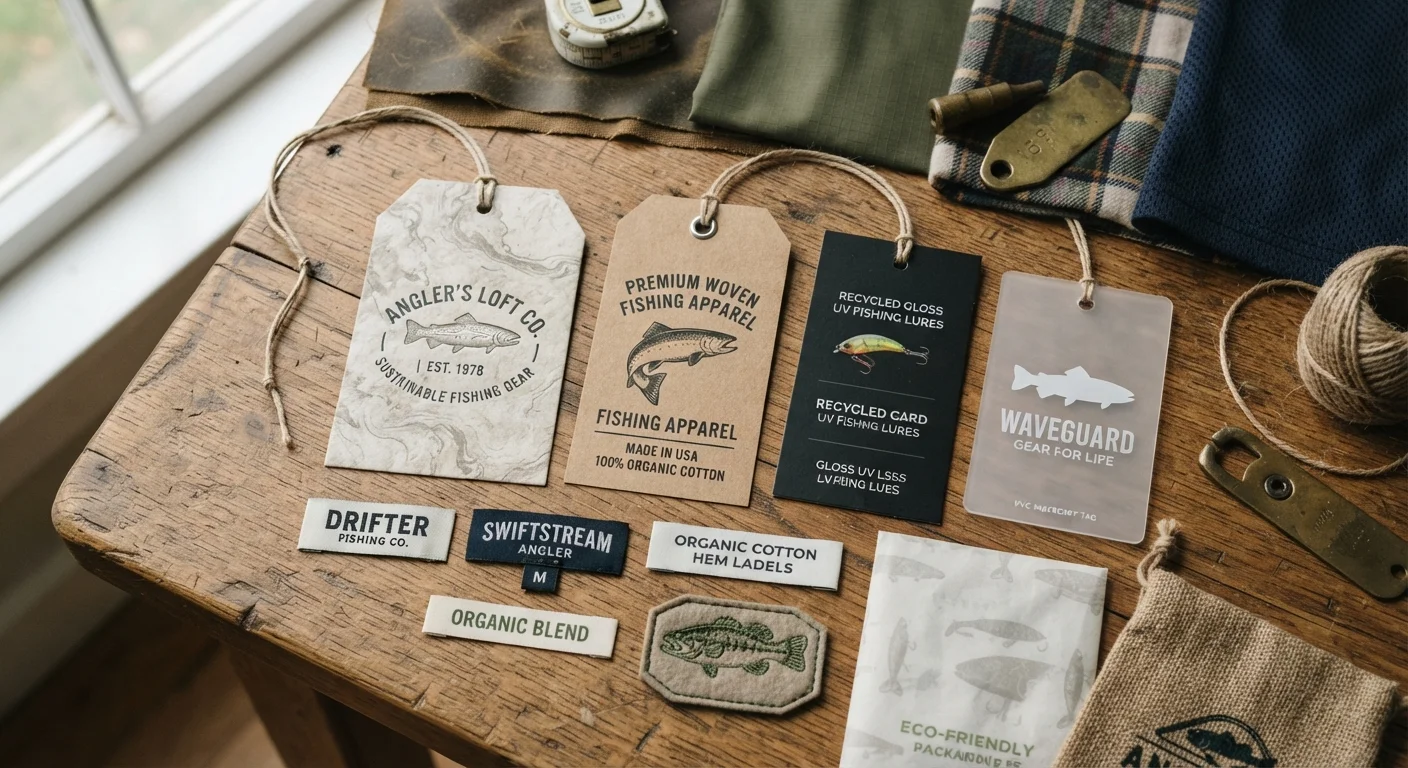
Not every brand builds packaging through their garment factory. Plenty go straight to independent tag and label shops—especially for small runs, eco lines, or premium finishes a customize fishing apparel factory doesn't stock in-house.
US-based, small-to-medium MOQ:
Hangtags.com – full-service printer with outdoor-brand chops (Body Glove, LL Bean). Handles hangtags, woven labels, flexible packaging.
CBF Labels – apparel-only focus, phone/email support for custom brand tags.
BestLabels™ (Miami) – cardboard hangtags at low prices, built to work with minimum quantities. Good for a first fishing capsule.
St. Louis Tag – running since 1959, specializes in short-run production. Fits seasonal drops.
Lee Label, Cruz Label – indie-friendly, non-toxic label options favored by small apparel brands.
Global / higher-volume or premium positioning:
MTW Label Factory (Dongguan, China) – hangtags, woven labels, rubber patches, heat transfers under one roof. MOQ negotiable.
DG Shanglian Textile – eco-focused hangtag manufacturer of fishing apparel, works well if sustainability is your brand story.
Weavabel – luxury hangtag supplier for premium wading jackets and high-end fly-fishing lines.
Materials matter here too: Tyvek, PVC, and other synthetics work best for weatherproof, outdoor-grade tags. Worth requesting those if your gear gets wet or lives on a boat.
Poly Bag and Export Carton Suppliers for Fishing Apparel Brands
Some customize fishing apparel suppliers make packaging. Others make apparel export packaging—and that distinction matters when your fishing shirts and waders are heading to Europe or North America.
Apparel-focused packaging manufacturers:
Poly Creations (Pvt) Ltd — Sri Lanka, est. 2013. Now supplies 100+ fishing apparel manufacturers exporting to Europe and America. If your polybags need to survive the same journey as your garments, this is the kind of track record to look for.
Mono Group / Mono Packaging Industry — operating since 1989, 100% export-oriented for both cartons and poly bags. One group, two packaging needs solved.
Mono Bag Mills Ltd — founded 2012 in Gazipur; 4,000 tons/year capacity (~12 million pieces), with 30% clean-room production . Relevant if your fishing apparel line touts a premium, dust-free finish.
Alfa Polyplast — Mumbai, since 1985. Long-running custom plastic fishing bag manufacturing for export.
Polynova — serving Canada and the US since 1981. Custom printed plastic bags and films, useful if North American replenishment speed matters more than rock-bottom cost.
Polybags — supplies liners, pallet covers, and polyethylene sheeting for carton and shipment protection.
What to Filter For Before You Sign
Export experience specific to apparel, not general plastics
Custom printing for SKU, barcode, size, and compliance marks
Volume capacity that scales for seasonal fishing-apparel demand
Clean-room production if your line markets itself as premium
Geographic fit —South Asia for cost efficiency, North America for speed
For direct outreach: Fisher Bag Company Inc. takes calls at +1-206-575-4888 or [email protected] for stock poly bags. Poly Creations and Mono Group both carry proven export-apparel customer bases worth referencing in your first email.
Conclusion
Packaging is never just packaging. Every woven label, every poly bag thickness, every carton dimension either builds trust with your customers or quietly chips away at it.
You now know the difference between a hangtag that looks premium and one that looks like an afterthought. You know why export cartons need more than "sturdy" as a spec. And you know that custom garment packaging isn't a final checkbox—it's part of your product story from day one.
The brands that win in fishing apparel aren't necessarily the ones with the biggest budgets. They're the ones who treat packaging like a competitive advantage, not a compliance headache.
So don't leave this to guesswork—or to a factory that treats packaging as an afterthought too. Talk to an OEM fishing apparel manufacturer who's already solved these problems, so you don't have to solve them the hard way.