Your monthly order just jumped from 500 units to 5,000, and your customizable fishing clothing fabric supplier is suddenly pushing "custom production" like it's the obvious upgrade. Meanwhile, the sourcing agent you talked to last week swore stock fabric would save you 40% with zero downside. One of them is selling you something. But which one?
Most guides on stock vs. custom fabrics give you textbook definitions when what you actually need is a number. What's the real cost gap at your specific MOQ? Where's the exact point where fabric lead time and quality control tradeoffs stop being worth the savings?
This breakdown skips the theory and gets straight to the data: real pricing ranges, batch consistency benchmarks, and the inflection point where switching from stock to custom fabric actually pays off. By the end, you'll have a decision framework you can apply to your next PO, not just more things to think about.
The Stock vs. Custom Fabric Decision: When Your Brand Scales from 500 to 5,000 Units

The math changes the moment you cross 500 units per style. Below that line, stock fabric wins almost every time. Above it, the economics flip, and the data backs this up across multiple sourcing categories.
Stock fabric supports 50 to 300 units per style because the material already exists on the shelf. Custom fishing clothing fabric MOQs start around 500 to 1,000 units and need 5,000 units or more to hit full mill-pricing efficiency. Alibaba's own B2B framework confirms that custom fishing apparel manufacturing requires 10 times the volume of a stock-based order to make sense.
This isn't unique to apparel. A hats procurement benchmark found the exact break-even at 576 units (48 dozen), the point where custom fishing clothing production costs less than decorating stock blanks. The sweet spot for economies of scale lands at 500 to 600 units across categories.
Cut-and-sew garment data shows costs drop from €22–26 per unit at 75 pieces to €17–20 at 300 pieces (22% savings), to €15–18 at 500 (30% savings), to €13–16 at 1,000 (38% savings). The biggest drop happens between 75 and 300 units. After 500, marginal savings flatten, meaning custom fabric's per-meter mill pricing starts outweighing stock's convenience markup right around that same 500 to 1,000 unit window.
Lead time is the tradeoff you're buying. Stock fabric moves design to bulk in 3 to 4 weeks. Custom fabric needs 6 to 8 weeks or more, sometimes stretching to 45 to 120 days once sampling and dye development are factored in.
Under 300 units, stay stock. Between 300 and 500, test with a hybrid approach: stock base fabric with custom dye or print. Once you're consistently ordering 500 to 5,000 units annually, custom fabric stops being a luxury and becomes the financially smarter move.
Cost Comparison: Stock Fabric Pricing vs. Custom Fabric Pricing (with Real Data Ranges)
Stock fabric runs 50-80% cheaper per meter or kg than its custom-dyed or custom-woven fishing clothing equivalent. This pattern shows up across cotton, polyester, and wool-blend categories when you compare actual mill quotes side by side.
Fabric isn't one price point—it's ten different markets. Here are the numbers by fiber type.
Cotton:
- Stock lot, 160-200 gsm: $2.50-$5.00/kg
- Custom Pima cotton: $8-$12/yard
- Custom organic cotton: $12-$15/yard
Convert that stock price to a yard equivalent and you get roughly $0.50-$1.25/yard versus $8-$15/yard custom. That's a 70-90% gap for basic cotton alone.
Polyester and blends:
- Stock polyester knits: $1.80-$4.00/kg
- Custom functional/technical knits: $3-$6/yard (roughly $12-$24/kg equivalent)
- China stock lot polyester (by meter): $0.65-$1.20/meter
- Custom sportswear-grade polyester: $2-$4/meter
Same story, 60-80% difference.
Linen and wool blends:
- Stock: $7.00-$15.00/kg
- Custom suiting-grade linen/wool: $10-$25/yard
Stock wins by 60-85% here too.
Regional Pricing: India vs. China
Comparing textile sourcing across regions shows the same gap. In India, stock lots run ₹15-175/meter, while custom mill fabrics for branded shirting or suiting quote ₹200-400/meter. Stock sits 50-80% below custom. In China, standard stock lot woven or polyester runs $0.50-$1.20/meter. Custom export-grade apparel fabric runs $1.50-$3.00/meter for basics and $4-$8/meter for high-end. Low-end stock is 30-70% cheaper than basic fishing apparel custom, though premium stock ($7.59-$8.32/meter) can land close to top-tier custom pricing.
The Working Numbers to Budget With
Use these ranges when pricing out a PO. Stock fabric runs $0.50-$1.50/meter for everyday cotton, polyester, and blends. Custom fabric runs $2-$5/meter for the same fiber categories, direct from mill.
That gap is your savings ceiling—assuming you're fine with fixed colors, no reorder guarantee, and whatever quantity happens to be sitting on the shelf.
Quality Breakdown: Batch Consistency, Color Variance, and Inspection Standards
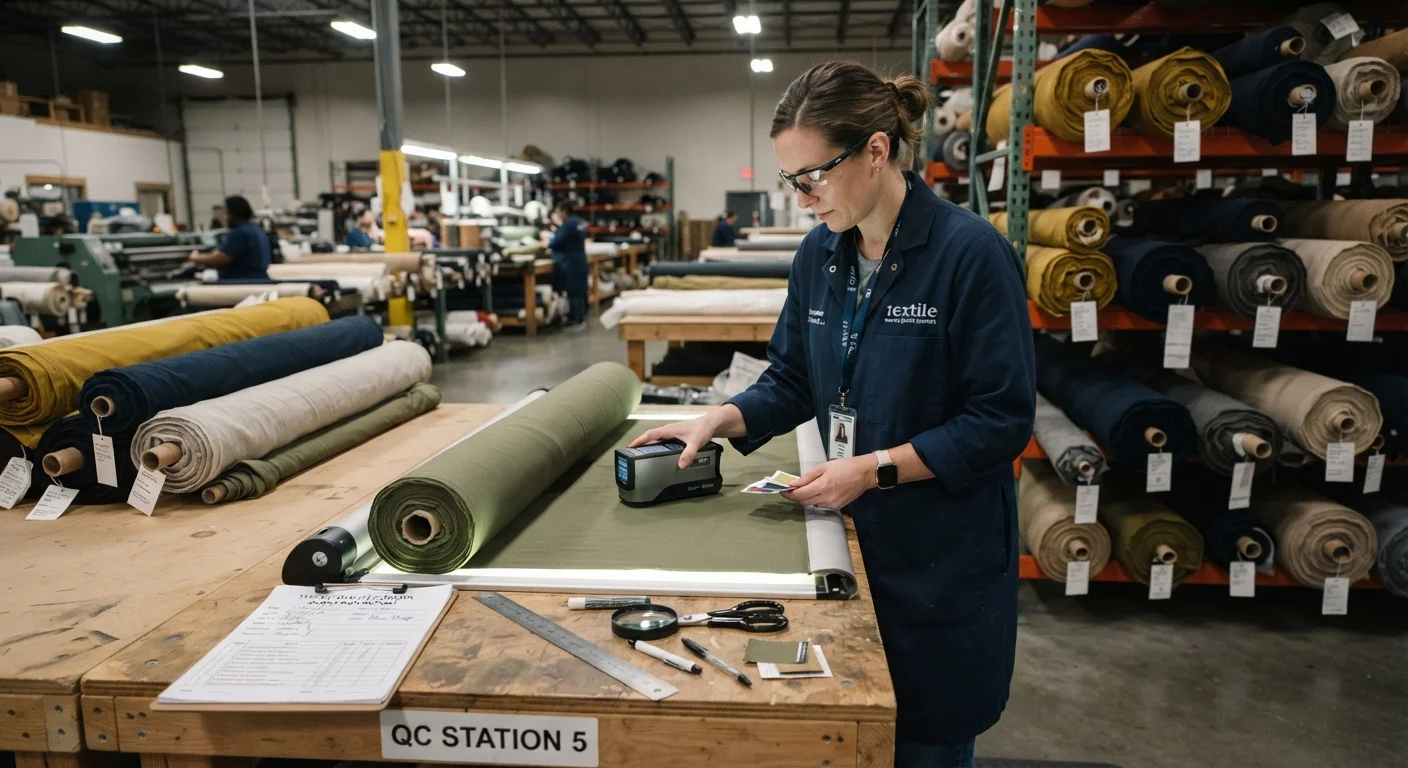
Price gets you in the door. Quality control determines whether you're still doing business with that supplier six months from now. Custom fabric mills run tighter batch controls because they're producing for one client, on one recipe, with no shortcuts. Stock fabric fishing apparel suppliers run blended lots for dozens of buyers, which is where inconsistency creeps in.
Batch Consistency: What the Numbers Show
Serious mills track a metric called Batch Conformity Rate (BCR) — the percentage of batches that meet spec on the first run. Mature custom operations hit 98-99% BCR. Early-stage or lower-tier stock suppliers often sit at 95-97%, and that 2-3% gap translates into rejected yardage on your end.
Fabric weight (GSM), width, and shrinkage rate are the three physical properties tested per batch. Custom mills document these against a locked spec sheet. Stock suppliers test against a general range, which is why two "identical" stock lots can vary by 5-8% in weight or shrinkage between shipments.
Color Variance: The ΔE Number You Should Ask For
Fabric color matching is measured using ΔE (Delta E) — the total color difference calculated from L a b* color space against a reference standard. This is the single most useful number for evaluating whether a supplier's "color matching" claim is real.
Custom-dyed fabric at ΔE ≤1.0-1.5 vs. master standard is the industry benchmark for apparel. Stock-dyed lots often run ΔE 2.0-3.0+ between production runs, since stock dyeing isn't controlled per client.
Ask any supplier for their ΔE tolerance in writing. If they can't produce a number, they're not doing instrumental color matching — they're eyeballing it.
Inspection Standards: What Should Be Tested Per Batch
A real fabric quality control process checks dimensional tolerance (width variance, typically ±1-2% for custom, wider for stock), physical testing (tensile strength, colorfastness to wash and rub, pilling resistance), and visual grading using 4-point or 10-point inspection systems sampled per roll, not per lot.
Custom production tests every batch against these standards before release. Stock inventory is spot-checked at intake, not re-verified at the point of sale. The batch you're buying today may not match the sample that sold you on it.
Performance Metrics: Does Custom Fabric Actually Outperform Stock Fabric?
Custom fishing clothing fabric only outperforms stock fabric when you can prove it with lab data. Otherwise, you're paying a premium for a marketing claim.
Abrasion resistance is where the difference shows up. Martindale testing (EN ISO 12947) rates most stock fabric at 10,000-25,000 rubs, general domestic grade. Custom weaves can hit 30,000+ Martindale for commercial use, or 50,000-100,000 Wyzenbeek double-rubs for performance upholstery. That's a real 3x durability jump, but only if your spec sheet demands it.
Colorfastness works the same way. Custom programs can use solution-dyed fibers, embedding color into the polymer instead of dyeing the surface. That means better UV fade resistance and better chemical resistance than standard piece-dyed stock. Ask for AATCC Test Method 8 crocking results. No data, no proof.
Shrinkage control favors custom too, if the mill runs AATCC TM135 testing on every batch. Tight tolerances (under 3% warp/weft) mean predictable fit across washes. Stock fabric shrinkage varies lot to lot since it's not tested per client.
Fabric utilization is the metric nobody talks about. Custom width and GSM can be optimized for your marker layout, pushing utilization from 90% to 94%. On a program where fabric is 50% of garment cost, that's a 2% total cost reduction, on top of any performance gain.
Reorder consistency is custom's quiet win. Stock fabric can get discontinued or shift shade between runs. Custom programs, if maintained, deliver repeatable GSM, shade, and handfeel season after season.
Custom fabric wins on paper only when backed by Martindale numbers, TM135 shrinkage reports, and mill certificates. Without those, you're just buying a story.
Decision Tree: Stock Fabric vs. Custom Fabric
Run four yes/no questions, and you'll land on the right answer in under two minutes. No spreadsheet required.
Question 1: Is your confirmed volume per color ≥500-1,000 meters, and repeatable across seasons?
No → Stock fabric. Lower MOQ, lower risk, done.
Yes → Move to Question 2.
Question 2: Is your launch window under 12 weeks from fabric brief to delivery?
Yes → Stock fabric. You get 2-4 week fabric lead time and 3-4 week total turnaround in fast setups. Custom can't compete on speed here.
No → Move to Question 3.
Question 3: Do you have performance or brand-identity requirements that stock genuinely can't meet — exact Pantone match, unusual GSM, a weave built for chemical or abrasion exposure?
No → Stay with stock, even at higher volume. Simpler and cheaper wins.
Yes → Custom fabric is the right call, but budget for 6-10+ weeks fabric lead time and 16-24+ weeks total.
Question 4: Is this a long-term core style with multi-season reorders expected?
No → Stay stock. Don't lock capital into a niche spec you'll drop next season.
Yes → Custom fabric is worth the investment.
Quick-Reference Scenarios
First launch, tight budget, uncertain demand → Stock. Faster sampling (5-7 days vs. custom's 10-15), lower testing cost.
Seasonal capsule with a fixed date under 10 weeks → Stock. Pre-book early to dodge out-of-stock delays, which can add 2-6 weeks and turn a "fast" project into a 16-24 week crawl.
Core hoodie or tee where hand feel and drape define the brand → Start stock to validate demand, migrate to custom once volume and specs stabilize.
Workwear failing durability tests on catalog fabric → Custom, no debate. Engineer the GSM and finish for the exposure profile.
Procurement Checklist: How to Verify Supplier Claims and Avoid Hidden Cost Traps
A supplier's "custom" claim is worth nothing without paperwork to back it up. Pull these documents before you sign anything.
Verify identity first. Match the legal name, registration number, and address on the contract against the official company registry. Also confirm the bank beneficiary name matches the registered entity on the pro forma invoice — mismatches usually mean a fake intermediary.
Check financial health. Request 2-3 years of audited financials and run a credit check. If the auditors flag repeated losses or include a "going concern" note, expect mid-contract price hikes or quality shortcuts.
Validate capacity. Don't just take their word. Ask for a machinery list, nominal capacity, and 3 months of recent production data. For orders over $50,000, require a third-party audit or a live video walk-through. If they refuse a shop floor tour, expect subcontracting.
Verify certifications at the source. Don't accept PDFs. Check ISO 9001 or similar cert numbers directly in the issuing body's database, and confirm the scope covers your exact product and site.
Pull references. Get 3 buyers in regulated markets — US, EU, Japan. Ask for their OTIF delivery rate (target ≥95%) and PPM defect rate.
Watch the pricing. Quotes 10-15% below market median without explanation almost always mean downgraded materials or a bait-and-switch later.
Hidden Cost Traps to Nail Down Before PO Sign-Off
Incoterms : local charges and terminal handling fees often aren't included
MOQ price breaks : get the full tier, not just your quantity
Surcharges : fumigation, ISPM-15 pallets, documentation fees, demurrage
Price adjusters : raw material index clauses and FX bands, with a locked notice period for increases
Conclusion
There's no universal "better" between stock and custom fabric. The right choice depends on your order volume, timeline, and margin structure right now. If you're moving under 3,000 units a month, stock fabric's flexibility beats custom's MOQ and 6-8 week lead times. Cross that threshold, and the math flips. Custom fishing clothing pricing starts paying for itself through tighter quality control and brand differentiation stock can't offer.
The real risk is choosing blind. Suppliers exaggerate "custom" capabilities, and hidden costs (color-matching fees, minimum dye lot charges, rejected batch reshoots) can erase any savings you thought you'd locked in.
Pull your last three purchase orders, run them against the cost breakpoints above, and demand your supplier show batch-level inspection data before you sign anything.